Can You Convert a Residential Flat to Commercial Use?
Quick Answer
Converting a residential flat into a commercial space is as much about regulatory compliance as it is about securing the right approvals. For apartment owners, the process extends beyond GHMC permissions to housing society consent, zoning norms, and the building’s sanctioned use. Understanding these requirements upfront can help you assess whether a conversion is legally and practically feasible.
Many apartment owners in Hyderabad wonder whether their flat could generate better returns if it were used as a clinic, professional office, or another commercial space instead of a residence. In many cases, the answer is yes,but converting a residential flat to commercial use is not as simple as changing how the property is used. The process involves legal approvals, local regulations, and, for flats in gated communities, permissions that often begin with the residents’ association rather than the municipal authorities.
The Short Answer: Yes, But It’s Not Just a Municipal Approval
It’s actually legally possible to convert a residential flat for some commercial purpose, but it requires clearing two major obstacles before it’s done, and the two obstacles are entirely different from each other. Mostly, the guidance in this aspect entirely relies on GHMC approval, the change in use of the land, building plan compliance, fire safety clearance, as if that makes the whole story. For an independent house on its own plot, that framing is close to complete. For a flat sitting inside a larger residential tower, it’s missing the obstacle that usually matters more in practice: your housing society’s consent.
Book Now with Just ₹5 Lakhs
1980 sq. ft. from ₹1.99 Cr + GST
2220 sq. ft. from ₹2.15 Cr + GST
A single unit owner inside an apartment complex doesn’t operate independently of the building around them. The society’s bylaws, the building’s original sanctioned plan, and its Occupancy Certificate all govern what that unit can legally be used for, and changing that isn’t something one flat owner can simply apply to change on their own, regardless of what GHMC’s process ultimately allows.
Step One: Getting Your Housing Society’s NOC
Before any municipal application makes sense, most housing societies and RWAs need to sign off, and this is the step that trips up more flat owners than any government form does.
Housing society and RWA bylaws commonly restrict unit usage to residential purposes only, a provision written into the society’s registered documents specifically to protect the character of the building and the comfort of other residents. Even if it’s a quiet and low-profile business, it is illegal to run your operations from your apartment if you have not obtained a No Objection Certificate (NOC) from the society in question first.
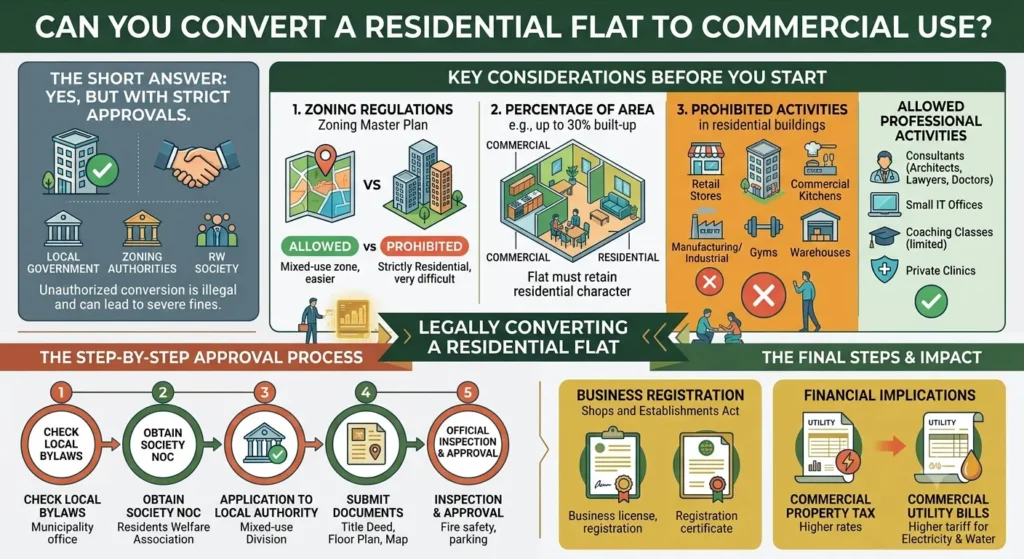
To obtain this NOC, you need to share your business project plan with the Managing Committee or General Body and explain the specifics of the business, its potential impact, operating hours, and possible modifications to the premises. Generally speaking, societies tend to be more supportive of low-impact businesses than of those involving regular customer traffic, deliveries, and long working hours as they influence the use of commonly shared facilities like parking space, lift, and other shared spaces.A society that says no here effectively ends the conversion process before it starts, regardless of how compliant your unit might be from a zoning perspective.
Change of Land Use and Why It’s Different for a Flat vs an Independent House
Change of Land Use, commonly abbreviated CLU, is the zoning mechanism that governs whether a specific plot or building’s designated use under the local master plan can shift from residential to commercial. It’s a genuinely different process depending on what kind of property you own.
For an independent house on its own plot, CLU is relatively direct: the plot’s classification itself is what needs to change, and the owner applies for that change as the sole party with a stake in the outcome.
For a flat inside an existing apartment tower, the picture is considerably more tangled. The building as a whole was constructed and sanctioned under a specific approved plan, tied to an Occupancy Certificate that reflects its residential classification. A single flat cannot simply be re-designated commercially in isolation from the building it sits inside; doing so would put that unit’s use out of step with the building’s own sanctioned plan and OC, creating exactly the kind of unauthorised deviation that municipal authorities have become increasingly focused on identifying.(Source)
In practice, this means genuine commercial conversion for an apartment unit is really only straightforward when the building itself sits on a GHMC-notified commercial road, one of the specific roads the corporation has formally declared eligible for such conversion, and even then, the process runs through a self-declaration and impact fee mechanism at the building or unit level, not a unilateral change a flat owner can force through on a purely residential street. Owners in this position should approach a CLU application understanding it’s fundamentally different from converting a standalone plot, both in complexity and in the range of outcomes actually available to them.
What You Can Do Without Full Conversion: Low-Footfall Professional Use
Not every use of a flat for income or professional purposes actually requires the full commercial conversion process described above, and it’s worth knowing where that line typically sits.
Low-footfall professional activities, a consultancy practised largely by appointment, a small private clinic with limited daily patients, tutoring a handful of students at a time, are often permitted with nothing more than your society’s NOC, without triggering the need for full CLU or a building-use change through GHMC. The concept behind this is simple and straightforward: these ventures do not result in substantial shifts in vehicular movement patterns, occupancy levels, or noise levels that would disturb the neighbours or affect the building’s community footprint.
However, it should be noted that there are no absolute exemptions here. The concept of genuinely low-traffic activity varies from one local association to another based on their policies and regulations as well as how certain things are viewed from a municipal perspective. Running a few students through a tutoring agency is perceived in a very different light by the social committee than running back-to-back classes with several dozens of students every day. Therefore, before jumping into the conclusion that your particular initiative can be classified as a low-impact one, it would be a good idea to discuss its specifics with the committee members.(Source)
GHMC Approvals, Documents, and the Step-by-Step Process
For conversions that do require full commercial approval, typically buildings on GHMC-notified commercial roads or independent houses seeking a genuine use change, the municipal process runs through a defined sequence.
Owners begin by confirming their property sits on one of GHMC’s notified commercial roads, since conversion eligibility is generally tied to this designation rather than being available citywide. The application itself is filed online through GHMC’s dedicated change-of-use portal, where owners submit a self-declaration along with supporting documents: proof of ownership such as the sale deed or title documents, layout plans showing the proposed use, your housing society’s NOC where applicable, identity proof, and GST registration details if the space will generate taxable rental or business income.
GHMC’s building permission process more broadly targets a 21-working-day turnaround once an application is complete, though timelines extend when the corporation needs to consult other agencies, such as fire services, for additional clearance, which is common for genuine commercial conversions. Recent technology upgrades to the platform, including AI-assisted plan scrutiny, have generally shortened processing time compared to the older manual review process.
Fire safety clearance is a distinct requirement for most commercial use cases, particularly anything involving regular visitor footfall, and is assessed separately from the core building-use change application. Owners should budget for this as a genuinely separate step in the timeline, not an automatic byproduct of GHMC approval.
Do’s
- Obtain your housing society’s NOC before applying for approvals.
- Verify whether your property qualifies for commercial use under GHMC rules.
- Check if your business requires Change of Land Use (CLU).
- Complete all municipal and safety approvals before commencing operations.
- Budget for higher taxes, utility charges, and compliance costs.
Don’ts
- Starting commercial operations without required permissions.
- Assuming every residential flat can be converted.
- Ignoring the building’s sanctioned plan or Occupancy Certificate.
- Relying solely on verbal approvals or informal permissions.
- Overlooking the long-term costs of commercial classification.
What This Actually Costs: Fees, Taxes, and GST on Rental Income
Conversion costs run beyond a single approval fee, and it’s worth budgeting for the ongoing shift in classification, not just the upfront paperwork.
The municipal side typically involves an impact fee, calculated based on the property’s location and size, plus a compounding fee where the space has already been used commercially before formal approval was secured, a genuinely common scenario GHMC has periodically offered amnesty-style windows to regularise. Once converted, the property shifts to commercial property tax rates, which run meaningfully higher than residential rates, along with a corresponding shift to commercial utility tariffs for electricity and water, an ongoing cost increase worth factoring into your return calculations, not just the one-time conversion expense.
On the tax side, if you’re renting out the converted space, GST registration becomes mandatory once your aggregate annual turnover from taxable supplies, including this rental income, crosses ₹20 lakh, a threshold that applies regardless of whether the underlying property is technically classified residential or commercial.
Separately, TDS obligations apply to whoever is paying you rent: under Section 194-I, a tenant who is a company or business must deduct 10 percent TDS once annual rent crosses ₹6 lakh, a threshold raised from the earlier ₹2.4 lakh figure effective April 2025, while individual or HUF tenants not subject to a tax audit fall under the separate Section 194-IB, deducting at 2 percent once monthly rent exceeds ₹50,000. These TDS rules apply based on the rent amount and tenant type, not on whether your property carries a residential or commercial classification on paper.
For a fuller picture of financing considerations if you’re specifically looking to acquire a commercially-zoned property rather than convert an existing home, our guide on non-residential property loans is worth a look, and our explainer on GST considerations when purchasing a flat covers related ground for anyone weighing a fresh purchase against conversion.
Why This Matters More Now: The March 2026 Supreme Court Directive
Improper use of residential property for business has become a matter of great concern in the country with fallout from decisions very recently emitted from the Supreme court, and therefore, it is crucial to understand the background of this issue in case you are under the impression you could rely on slow actions of state authorities when carrying out some commercial activity in your residential property.
On the 25th of March, 2026, the Supreme court issued an order in Loganathan vs State of Tamil Nadu to municipal bodies of different localities and so, the high court required them to find out if there are any residential properties being used for commercial purposes by means of violating the by-laws of building and land use.
In the judgement, the judge was mentioning that there are serious violations of the regulations, since some cases showed that residential colonies have transformed into commercial zones due to unethical actions of their owners. Local authorities were given a deadline until the 15th of May, 2026 to deliver relevant statements proving their investigations, and soon after that began monitoring of residential buildings and cooperatives taking action to define wrongful use of local businesses.
For those owning flats in Hyderabad and thinking of starting a business from their place, the situation is crystal clear: there are serious challenges that one will face and trying to overlook the fact that actions regarding approval will need to take place later on is too dangerous nowadays.
Municipal bodies are now under direct Supreme Court pressure to identify exactly this kind of unauthorised use, and the consequences, fines, legal notices, and in serious cases the sealing of the premises, apply regardless of how established or well-intentioned the business itself is. Getting your society’s NOC and, where required, GHMC’s approval before you begin operating is no longer simply the cautious approach. It’s the approach far less likely to attract regulatory attention in an environment where authorities are actively looking.
If you’re evaluating a property’s zoning status more broadly, whether for a conversion or a fresh purchase, our guide to GHMC’s Master Plan roads and how Hyderabad is being future-proofed offers useful context on how commercial road designations get decided in the first place, and our guide to GHMC property tax explains what a shift to commercial classification actually does to your ongoing tax bill.
Key Takeaways
- Converting a residential flat to commercial use requires compliance with both housing society rules and municipal regulations.
- A housing society’s No Objection Certificate (NOC) is often the first and most important approval for apartment owners.
- Some low-footfall professional activities may be permitted without full commercial conversion, subject to society bylaws and local regulations.
- Full commercial conversion may require Change of Land Use (CLU), GHMC approval, and fire safety clearance, depending on the property’s location and intended use.
- Operating a business without the necessary approvals can lead to legal notices, penalties, or enforcement action.