Indexation Benefit On Sale Of Property: Act Now Before It’s Too Late!
Quick Answer
The indexation benefit on the sale of property changed significantly after Budget 2024. While resident individuals and Hindu Undivided Families (HUFs) selling certain properties acquired before July 23, 2024 may qualify for grandfathering relief, NRIs generally cannot opt for this benefit. For most NRIs, long-term capital gains on qualifying property sales are taxed at 12.5% without indexation, making it essential to understand your tax liability, available exemptions, and TDS obligations before completing the transaction.
Selling a property has never been just about finding the right buyer. It is equally about understanding how much of the sale proceeds you will actually keep after taxes.
That question has become far more important since Budget 2024, which reshaped the taxation of long-term capital gains on real estate. While headlines focused on the removal of indexation, the real story is more nuanced. The new rules created different outcomes for different categories of taxpayers.
If you are a resident selling a property purchased before a specified date, the law may still allow a favourable tax calculation under certain conditions. However, if you are an NRI, the position is different. The choices available to resident taxpayers are generally not available to non-residents, which means your tax liability could be considerably different even if two people sell similar properties at the same price.
This distinction is often overlooked in online articles, yet it can influence financial decisions involving several lakhs of rupees.
In this guide, we’ll explain what changed after Budget 2024, how the new rules affect NRIs selling property in India, how long-term capital gains are now calculated, the exemptions that may still be available, and the practical steps you should take before completing the sale.
What Changed for Property Sellers After Budget 2024
For many years, property owners who held a real estate asset for the prescribed long-term holding period benefited from indexation.
Indexation adjusted the purchase price of the property using the Cost Inflation Index (CII) published by the Income Tax Department. Since inflation increases the cost of assets over time, indexation ensured that tax was levied on the real economic gain rather than the entire difference between the purchase and sale prices.
For example, imagine someone purchased a property twenty years ago for ₹40 lakh. Due to inflation, that original investment would be worth much more in today’s terms. Under the previous system, the indexed acquisition cost could substantially reduce taxable capital gains, resulting in a lower tax liability.
The Budget 2024 shift
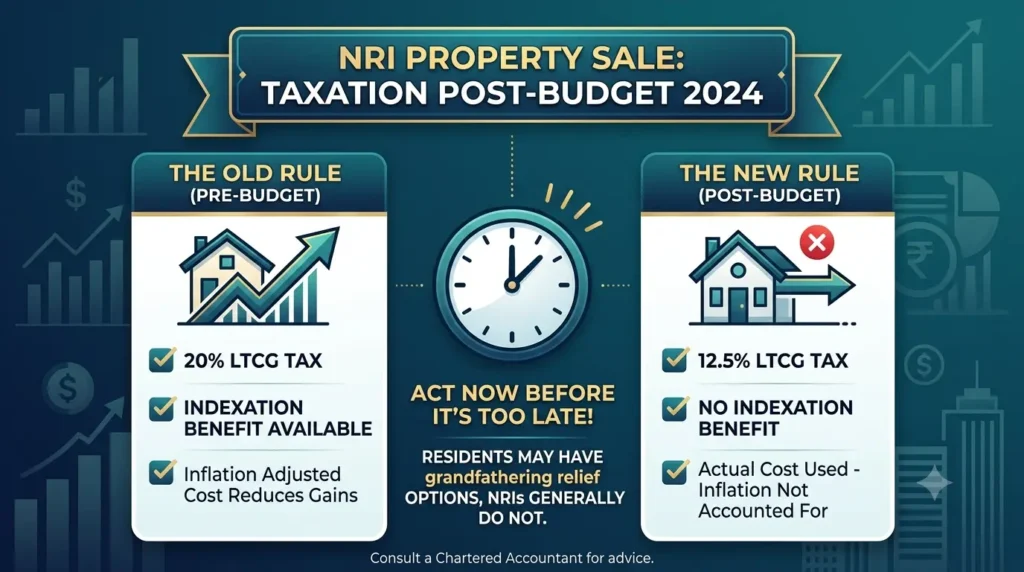
The Union Budget presented on 23 July 2024 proposed significant changes to the taxation of long-term capital gains on immovable property. One of the biggest changes was the replacement of the earlier taxation framework with a 12.5% long-term capital gains tax without indexation for applicable transfers.
At first glance, the lower tax rate appeared beneficial. However, removing indexation meant that taxpayers could no longer increase their acquisition cost to account for inflation.
For recently purchased properties, the lower tax rate may offset the loss of indexation. For properties purchased many years ago, especially during periods of high inflation, the absence of indexation could increase the taxable gain substantially.
This is why the announcement immediately triggered concerns among homeowners, tax professionals, and the real estate industry.
Why the Government revised the proposal
Following extensive feedback from industry stakeholders and taxpayers, Parliament introduced an important amendment while passing the Finance Bill in August 2024.
The amendment recognised that owners of older properties could face a disproportionately higher tax burden if indexation disappeared entirely. As a result, a grandfathering mechanism was introduced for eligible resident taxpayers who had acquired property before the specified cut-off date.
However, this relief was not extended equally to every category of taxpayer.
That distinction is where many NRI property owners need to pay close attention.
The Grandfathering Amendment: Why Residents Got a Choice and NRIs Didn’t
Much of the public discussion around Budget 2024 focused on one question:
“Has indexation been removed completely?”
The answer is not entirely.
After the Finance Bill was amended in Parliament, certain resident individuals and Hindu Undivided Families (HUFs)selling residential or commercial property acquired before 23 July 2024 were given an important choice.
Subject to the conditions prescribed under the amended law, eligible resident taxpayers may calculate their long-term capital gains tax under either:
- the earlier framework involving 20% tax with indexation, or
- the revised 12.5% tax without indexation,
with the more favourable outcome applying where the statutory conditions are satisfied.
The objective was straightforward. Someone who had owned property for twenty or thirty years should not automatically face a higher tax burden merely because the indexation benefit had been withdrawn.
Why this matters for NRIs
This is where the position changes.
For Non-Resident Indians (NRIs), the grandfathering relief available to eligible resident individuals does not generally extend in the same manner. As a result, most qualifying property sales by NRIs are governed by the revised 12.5% long-term capital gains regime without indexation, subject to the applicable provisions of the Income-tax Act and any relevant exemptions.
In practical terms, this means two people selling identical apartments purchased in the same year could face different tax outcomes simply because one is a resident taxpayer and the other is an NRI.
Why understanding this distinction is important:
Many NRIs continue to rely on older online guides or advice based on the pre-Budget 2024 rules. Others assume that the grandfathering relief announced after the Budget automatically applies to them.
Both assumptions can lead to incorrect tax estimates.
Before listing your property for sale, it is advisable to answer a few key questions:
- What is your residential status under the Income-tax Act for the relevant financial year?
- Does your transaction qualify as a long-term capital asset?
- Which exemptions under Sections 54, 54EC, or 54F may still be available?
- How much TDS is likely to be deducted by the buyer?
- Do you need to obtain a lower deduction certificate before the transaction?
Getting these answers early can help avoid cash flow issues, unexpected tax demands, and delays in completing the sale.
How LTCG Is Now Calculated for NRIs Selling Property
For an NRI, understanding the capital gains calculation is no longer about choosing the most tax-efficient method. Under the post-Budget 2024 regime, the calculation itself has become simpler, but the scope for reducing tax through indexation has narrowed considerably.
If you sell a long-term capital asset, such as land, a residential house, or a commercial property, on or after 23 July 2024, the gain is generally taxed at 12.5% without indexation. The cost of acquisition is taken at its actual value instead of being adjusted for inflation using the Cost Inflation Index (CII). The grandfathering option allowing eligible resident individuals and HUFs to compare the old and new tax methods does not generally extend to NRIs.
Step 1: Determine whether the gain is long-term
The first step is to identify whether your property qualifies as a long-term capital asset.
For land, buildings, and residential apartments, a holding period of more than 24 months generally qualifies the property as a long-term capital asset. If it is held for 24 months or less, the gain is treated as short-term and taxed according to the applicable income tax provisions rather than the concessional long-term capital gains regime.
Step 2: Calculate the capital gain
Under the new framework, the calculation follows a straightforward formula:
| Particulars | Amount |
|---|---|
| Sale consideration | XXX |
| Less: Cost of acquisition | XXX |
| Less: Cost of improvement (if eligible) | XXX |
| Less: Expenses incurred wholly and exclusively for the transfer (brokerage, legal expenses, etc.) | XXX |
| Long-Term Capital Gain | XXX |
Unlike the previous regime, there is no indexed cost of acquisition for most NRI property transactions completed after 23 July 2024.
Cost of improvement still matters
Although indexation has been removed, legitimate capital improvements remain deductible.
For example, if you carried out structural renovations, added a floor, or incurred expenditure that permanently enhanced the property’s value, these costs may generally be deducted while computing capital gains, provided they are properly documented.
Routine repairs and maintenance expenses, however, are not treated as capital improvements.
Maintaining invoices, contractor agreements, payment records, and municipal approvals can therefore become valuable during tax computation.
Don’t forget transfer expenses
Many sellers overlook expenses directly connected with the sale.
Subject to eligibility under the Income-tax Act, deductions may generally include:
- Brokerage paid to a real estate consultant
- Legal documentation charges
- Certain transfer-related professional fees
- Other expenses incurred exclusively for completing the sale
Keeping proper records of these expenses can reduce taxable gains without relying on indexation.
A Worked Example: What an NRI Actually Pays Under the New Rule
Numbers often explain tax rules better than legal language.
Consider the following example.
Scenario:
Rahul is an NRI living in the United States.
He purchased an apartment in Hyderabad in 2014 for ₹80 lakh.
After holding it for over ten years, he sold it in 2026 for ₹2 crore.
He has also spent:
- ₹10 lakh on eligible structural improvements
- ₹5 lakh towards brokerage and legal expenses
Step-by-step calculation:
| Particulars | Amount |
|---|---|
| Sale consideration | ₹2,00,00,000 |
| Cost of acquisition | ₹80,00,000 |
| Cost of improvement | ₹10,00,000 |
| Transfer expenses | ₹5,00,000 |
| Long-Term Capital Gain | ₹1,05,00,000 |
Tax calculation: ₹1,05,00,000 × 12.5% = ₹13,12,500
In addition, the applicable surcharge, if any, and 4% Health and Education Cess would apply in accordance with the Income-tax Act.
Why this example matters:
Under the previous tax regime, Rahul would have been able to increase his acquisition cost using indexation, potentially reducing his taxable gain substantially after a decade of inflation.
Today, that inflation adjustment is generally unavailable to an NRI.
This illustrates why maintaining complete documentation of acquisition costs, improvements, and sale-related expenses has become even more important. Every legitimate deduction now has a more direct impact on the final tax payable.
Practical Tip: Before finalising a sale agreement, prepare a detailed capital gains computation with your chartered accountant. It helps you estimate tax liability, evaluate exemptions under Sections 54, 54EC or 54F where applicable, and avoid unexpected cash flow issues after TDS is deducted.
One of the biggest misconceptions in property transactions is that TDS is always 1%.
That is true only when the seller is a resident and the transaction falls under Section 194-IA.
When the seller is an NRI, an entirely different provision applies.
Section 195 governs NRI property sales
The buyer is required to deduct tax under Section 195 of the Income-tax Act before making payment to an NRI seller.
This often surprises buyers because the TDS deduction can be significantly higher than what they expect in a normal property transaction.
TDS Obligations When an NRI Sells Property
Many NRIs assume that once TDS has been deducted, their tax obligations are complete.
That is not always correct.
TDS is only a mechanism for collecting tax in advance.
Your final tax liability will depend on several factors, including:
- Nature of the capital gain
- Eligible deductions
- Applicable exemptions
- Surcharge and cess
- Relief available under Double Taxation Avoidance Agreements (DTAAs), where relevant
If excess tax has been deducted, the balance can generally be claimed as a refund while filing the income tax return.
Conversely, if the TDS deducted is lower than the final tax liability, the remaining amount must be paid before filing the return.
Can an NRI reduce the TDS deduction?
Yes, in appropriate cases.
If the expected tax liability is substantially lower than the standard TDS deduction, an NRI may apply to the Income Tax Department for a Lower or Nil Deduction Certificate before the transaction is completed.
Once issued, the buyer deducts tax according to the certificate instead of applying the normal deduction mechanism.
For high-value property transactions, obtaining this certificate can significantly improve cash flow because a large portion of the sale proceeds is not unnecessarily locked up until the tax return is processed.
Documents buyers usually request
Before releasing payment, buyers commonly ask the seller to provide:
- PAN
- Passport and NRI status documents
- Property ownership records
- Sale agreement
- Capital gains computation, where relevant
- Lower deduction certificate, if obtained
Having these documents ready before negotiations begin can prevent delays during registration and payment.
Example: Tax an NRI Actually Pays Under the New Rule
Tax law becomes much easier to understand when you see the numbers.
Consider this example.
An NRI purchased a residential apartment in Hyderabad in June 2015 for ₹80 lakh and sold it in September 2026 for ₹2 crore.
Under the current tax framework:
| Particulars | Amount |
|---|---|
| Sale Price | ₹2,00,00,000 |
| Purchase Price | ₹80,00,000 |
| Long-Term Capital Gain | ₹1,20,00,000 |
| LTCG Tax @ 12.5% (without indexation) | ₹15,00,000* |
Notice what is missing.
There is no inflation adjustment to increase the property’s purchase cost. Under the earlier system, the indexed acquisition cost would have been significantly higher, reducing taxable gains. Today, NRIs cannot use that benefit.
This example also assumes that no exemption under Sections 54 or 54F has been claimed. If you reinvest the gains according to the prescribed conditions, your actual tax liability may reduce substantially.
The takeaway is simple.
Do not estimate your tax using older online calculators or articles written before the Budget 2024 changes. Many still assume indexation is available for everyone, which can produce inaccurate figures for NRIs.
Exemptions Worth Exploring: Sections 54 and 54F
Although indexation is no longer available for NRIs, that does not mean every property sale automatically results in the highest possible tax bill.
The Income Tax Act still provides legitimate exemptions if the proceeds are reinvested according to specified conditions.
The two provisions most commonly considered are Section 54 and Section 54F.
Section 54
Section 54 generally applies when an individual or HUF sells a long-term residential house.
The exemption can be claimed by investing the capital gains in another eligible residential house within the prescribed timelines under the Act.
Section 54F
Section 54F applies when the asset sold is not a residential house but another long-term capital asset.
Instead of investing only the capital gain, this section generally requires reinvestment of the net sale consideration while satisfying additional eligibility conditions.
Choosing the right exemption
The appropriate exemption depends on several factors, including:
- Type of property sold
- Residential status
- Existing property ownership
- Amount proposed for reinvestment
- Timing of purchase or construction
- Compliance with Capital Gains Account Scheme requirements, where applicable
Because these provisions involve multiple conditions, NRIs should avoid making assumptions based solely on online summaries.
A reinvestment made outside the prescribed timelines or in an ineligible property can result in the exemption being denied, leading to an unexpected tax demand later.
Instead of viewing Sections 54 and 54F as tax-saving shortcuts, think of them as carefully regulated relief provisions that reward compliant reinvestment.
Readers planning another real estate investment may also find ASBL’s article on 2025: A Golden Year for NRI Real Estate in Hyderabad useful for understanding current investment opportunities.
Why Working With a Chartered Accountant Matters Here
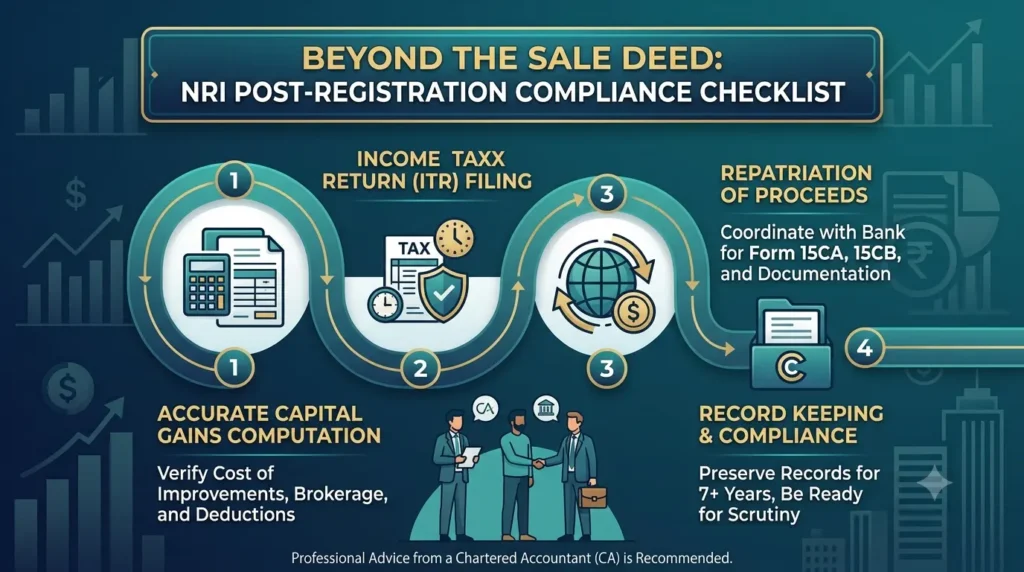
Selling a property in India as an NRI involves much more than calculating capital gains. A single transaction often triggers multiple compliance requirements involving the Income Tax Department, the buyer, authorised banks, and sometimes even the Reserve Bank of India (RBI). A Chartered Accountant (CA) helps ensure that these obligations are handled correctly, reducing the risk of avoidable taxes, delayed refunds, or compliance issues.
Many NRIs assume that since the property has appreciated over the years, the tax calculation will be straightforward. However, after the changes introduced through Budget 2024 and the subsequent Finance Act amendment, the calculations have become more nuanced, especially because NRIs are not eligible for the grandfathering relief available to resident taxpayers.
A Chartered Accountant helps with accurate capital gains computation.
Capital gains tax is rarely calculated using only the purchase and sale prices. A CA evaluates several additional factors before arriving at the final taxable amount, including:
- Purchase-related expenses supported by records
- Eligible cost of improvements made over the years
- Brokerage and transfer expenses incurred during the sale
- Applicable exemptions under Sections 54 or 54F
- Correct classification of the asset as short-term or long-term
An accurate computation reduces the possibility of future notices or reassessment from the Income Tax Department.
Assistance with Lower TDS Certificate applications
One of the biggest financial challenges for NRIs is the amount of TDS deducted by the buyer.
If the expected tax liability is substantially lower than the standard deduction, a Chartered Accountant can prepare and submit an application for a Lower Deduction Certificate under the Income Tax Act.
When approved, this certificate authorises the buyer to deduct tax at a reduced rate, preventing unnecessary blockage of funds and reducing the need to wait for refunds after filing the income tax return.
Guidance on exemption planning
Sections 54 and 54F can significantly reduce the tax payable on a property sale, but only if every condition is satisfied.
A CA can help determine:
- Whether you qualify for the exemption
- The amount that must be reinvested
- Applicable investment timelines
- Documentation required to support the claim
- Whether the Capital Gains Account Scheme should be used if reinvestment cannot be completed immediately
Proper planning before the sale is generally more effective than trying to correct mistakes after registration.
Support with repatriation and banking documentation
Many NRIs eventually wish to transfer the sale proceeds abroad.
Banks typically require supporting documents before permitting repatriation, including:
- Form 15CA
- Form 15CB issued by a Chartered Accountant
- Tax payment proof
- Sale deed
- PAN details
- Foreign inward remittance records, where applicable
Preparing these documents in advance can make the remittance process considerably smoother.
Compliance does not end on registration day
Completing the sale deed is only one stage of the transaction.
Most NRIs must also ensure:
- Correct TDS has been deducted.
- Tax returns are filed within the applicable due date.
- Refund claims, if any, are submitted accurately.
- Supporting documents are preserved for future scrutiny.
Considering the financial value of most real estate transactions, professional advice is usually a small cost compared to the potential consequences of an incorrect tax filing.
Key Takeaways
- Budget 2024 replaced the earlier 20% tax with indexation for many property transactions with a 12.5% LTCG rate without indexation, subject to the applicable rules.
- Resident taxpayers may qualify for grandfathering relief in specific situations, but NRIs are generally not eligible for this option.
- Since indexation is no longer available to most NRIs, proper tax planning before signing the sale agreement has become even more important.
- Sections 54, 54EC and 54F may still help reduce capital gains tax if eligibility conditions are met.
- Buyers must deduct TDS when purchasing property from an NRI, making compliance an important part of every transaction.