Partition Deed Meaning: How to Legally Divide Family Property
Quick Answer
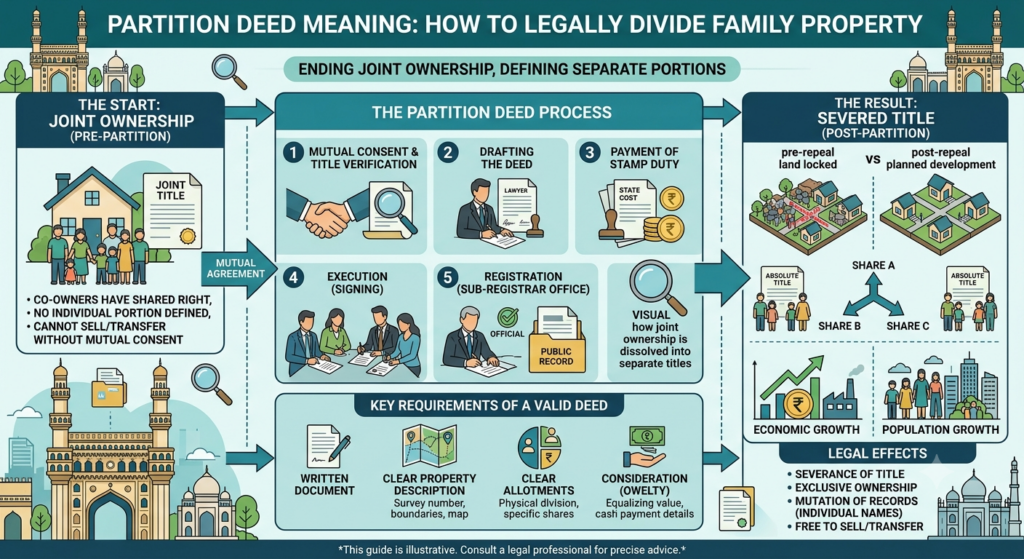
A partition deed is a legal document that divides jointly owned property into individual shares. Registering it gives each co-owner a clear title, making future sale, mortgage, or transfer legally straightforward.
In the event that a house in Secunderabad comes into the possession of three siblings, and they require a clean title in order to sell or mortgage their respective ownerships, an agreement made verbally will not be enough. The Banks, potential buyers, and the sub registrar will need paper work to proceed.
A partition deed is the legal document that converts joint ownership into defined, individual shares.In Telangana, the process can be confusing, as it requires the correct stamp duty amounts, appropriate documentation, and the registration done on the right portal. This guide explains in detail what is meant by a partition deed, its cost in 2026, and how to choose between a mutual deed and a court partition suit.
What Is a Partition Deed, and Why Families Need One
A partition deed is a legal document that specifies the ownership division in a joint estate among its co-owners. Generally, the co-owners can be family members who received the land or building together as inheritance or contributed money together for the joint title.
Be Among the First to Own a Legacy
Without a partition deed, everyone remains on the same title. That creates friction when one person wants to sell, another wants to hold, and a third needs a home loan against their portion. There is no bank willing to finance an undivided share without knowing who gets what piece of property.
You need a partition deed when you have to divide an inherited property as a prerequisite to selling, mortgaging, or developing it, or when you have a verbal family agreement in need of a written record that can be accepted by a registration office.
The document has to identify every co-owners, describe the property, and indicate the exact shares. “Equal shares” is only applicable if the property is divided equally.
Oral Partition vs. Registered Partition Deed: Why Registration Matters
Families often divide property informally first. That is an oral partition. Indian law recognises oral partitions in some circumstances, especially among Hindu coparceners, but proving one years later is difficult.
An oral partition has no sub-registrar entry. If a sibling later denies the arrangement, you rely on witnesses and old correspondence. Courts may accept strong evidence, but the process is uncertain.
A registered partition deed creates a public record visible on an encumbrance certificate search. It is what home loan officers in Hyderabad expect when you pledge a divided share.
Buyer scenario 1
Two brothers inherited a 300 sq. yard plot in Uppal and agreed orally in 2018 that each would take half. One brother built on his share and later applied for a home loan. During the verification process, the bank found that both brothers were still listed as joint owners because no registered partition deed had been executed.
As a result, the loan was put on hold until the property was legally partitioned. What seemed like a simple family arrangement ultimately led to months of delays and additional legal expenses—an outcome that could have been avoided by registering the partition deed at the outset.
The Legal Framework in Telangana
In Telangana, the division of property involves both personal law (heirship and coparcenary rights)cases and the registration law (the process through which the state handles the records of the division).
If registered co-owners agree, they use a partition deed executed at the IGRS Telangana sub-registrar; the Dharani portal has been replaced by the Bhu Bharati system for agriculture plots in Telangana. Rural partitions may need both a registered deed and updated Bhu Bharati records. Urban property follows the standard IGRS path.(Source)
If agreement fails, any co-owner can file a partition suit. The court orders division or a sale and split of proceeds. Disputes over exclusion or denial are where adverse possession and title protection (https://asbl.in/blog/understanding-adverse-possession-law-protect-your-property-in-telangana/) concerns surface.
Partition Deed Stamp Duty and Registration Fees in Telangana (2026)
In the case of family partition deeds in Telangana, the stamp duty is charged at a low rate of 0.5% of the market value of the property not exceeding ₹1,00,000; also, a fixed registration fee of ₹2,000 applies in this case. Partition deeds are taxed lower than standard sale deeds, which is why families formalise splits through partition rather than a sale among relatives.
Worked example:
Let us assume that the value of a jointly owned house in Hyderabad is ₹80 lakh.
- Total stamp duty paid = 0.5% of ₹80,00,000 = ₹40,000
- Registration fee = ₹2,000
- Total government cost: ₹42,000 (plus advocate drafting charges and document charges)
On a ₹2.4 crore property, 0.5% calculates to ₹1,20,000, but the cap applies: stamp duty ₹1,00,000, registration ₹2,000, total ₹1,02,000.
After partition, selling a divided share attracts fresh stamp duty. Heirs reinvesting proceeds may need the Section 54F income tax guide (https://asbl.in/blog/understanding-section-54f-income-tax-act-save-on-capital-gains/) for capital gains relief on a new residential purchase.
Mutual Agreement vs. Partition Suit: Choosing the Right Path
| Factor | Mutual partition deed | Partition suit |
|---|---|---|
| Speed | Weeks, if all parties cooperate | Months to years |
| Cost | Stamp duty, registration, drafting | Court fees, advocate fees, possible commissioner costs |
| Requirement | All co-owners must agree and sign | One co-owner can file without others’ consent |
| Outcome | Deed reflecting agreed shares | Court decree dividing or ordering sale |
| Best when | Family alignment exists | Disputes, missing parties, or bad-faith refusal |
A partition suit vs partition deed decision comes down to whether everyone will sign. If one sibling blocks registration, others file in civil court. The court orders physical division where possible, or a sale and split where splitting is impractical (a single flat, for example).
Buyer scenario 2
Four siblings jointly inherited a row house in Abids. While two wanted to sell the property, one wished to continue living there, and another, who was living abroad, did not sign the necessary documents. After a year of unsuccessful discussions, the two siblings filed a partition suit. The court eventually ordered the property to be sold and the proceeds divided among all four owners. What could have been resolved through a mutually agreed partition deed instead turned into a legal dispute that took more than two years to settle and involved significant legal expenses.
Documents Required for a Partition Deed
1. Original title deed showing joint ownership
2. Encumbrance Certificate (13 to 30 years for bank-linked partitions)
3. Identity proof (Aadhaar, PAN) for all co-owners
4. Property tax receipts and mutation entries
5. Drafted partition deed on correct stamp paper, stating each share
6. Two witnesses at registration
Lost originals? See the guide to certified copies of lost property documents (https://asbl.in/blog/how-to-obtain-certified-copies-of-lost-property-documents-in-telangana/). Match names across title, Aadhaar, and deed; spelling mismatches delay registration.
Do’s
- Register the partition deed to create a clear legal title.
- Verify ownership records before dividing the property.
- Obtain signatures from all co-owners for a mutual partition.
- Update mutation and land records after registration.
- Preserve the registered deed for future transactions.
Don’ts
- Rely solely on verbal family arrangements.
- Overlook pending encumbrances or title disputes.
- Exclude any legal co-owner from the partition process.
- Delay updating government records after registration.
- Assume every dispute can be resolved without court intervention.
Step-by-Step: Registering a Partition Deed in Telangana
1. Agree terms in writing among all co-owners.
2. Engage an advocate to draft the deed in the correct partition deed format telangana.
3. Pay stamp duty (0.5% capped at ₹1 lakh) and ₹2,000 registration via IGRS.
4. Book a slot on IGRS Telangana; appear with all parties, witnesses, and originals.
5. Collect the registered deed and apply for mutation. Update Bhu Bharati for rural land.
Buyers selling a divided share to buy a new flat should run TGRERA verification (https://asbl.in/blog/ts-rera-guide-for-beginners-how-to-verify-projects-stay-safe/) and check the builder’s track record (https://asbl.in/blog/how-to-verify-a-builders-rera-track-record-in-hyderabad/) before booking.
What Happens After Registration
Once registered, each co-owner holds a defined, independently transferable share.
· Mutation: Update revenue or municipal records to match the deed.
· Fresh EC: Pull a new encumbrance certificate showing the partition.
· Sale for future: Attracts separate stamp duty on the transfer.
Deeds can be challenged on grounds of fraud, coercion, or exclusion of an heir. Full disclosure and witnesses reduce that risk.
Key Takeaways
- A partition deed is a legal document that is used by family members to split property evenly among them.
- In Telangana, family partition documents attract a stamp duty of 0.5% of the market value of the property, subject to a maximum ceiling of ₹1,00,000, with a registration fee of ₹2,000.
- Oral partitions can hold some legal weight but are hard to prove; a registered deed is what banks and buyers accept.
- Should there be a disagreement among co-owners, then the only way out would be to approach the civil court for a partition suit which is, however, a slow and expensive process.
- Rural land records are now being maintained by the Bhu Bharati process, while urban property registration continues through IGRS Telangana.