Property Registration in Hyderabad: What Changed in 2026
Quick Answer
Property registration in Hyderabad changed significantly in 2026 with mandatory online slot booking, Aadhaar-linked biometric verification for all parties, and revised guidance values in many high-growth areas. The process is now more digital, structured, and fraud-resistant, but buyers must prepare their documents, payment challans, and appointments in advance. This guide explains the new registration workflow, updated costs, document requirements, and what these changes mean for resident and NRI buyers.
What if the biggest hurdle in registering your property isn’t the paperwork, but not knowing what has changed? Property registration in Hyderabad has seen several important updates in recent years, making the process different from what many buyers and sellers remember.
From online appointments and biometric verification to revised registration charges and documentation requirements, the rules in 2026 are designed to make registrations more efficient. This guide explains the key changes and what they mean for anyone planning to register a property in Hyderabad.
Surprisingly, the queues haven’t vanished, but almost everything that happens before you are finally able to reach the counter has changed. Slot booking for your property registration is no longer an optional choice. Biometric checks for individuals aren’t just occasional anymore. And the factors deciding your pay have changed enough to catch you off guard anytime soon.
This blog will walk you through what has changed in 2026, why it’s taken into consideration by some buyers than others, and what is all that you need to know before you make up your mind to visit SRO.
Be Among the First to Own a Legacy
Property Registration in Telangana: A quick Recap of the Basics
Property registration is the lawful act of keeping a record of sale with the state government, making the transfer of payments part of the public record and giving the buyer an enforceable legal title. In Telangana, this ecosystem is run entirely through IGRS Telangana portal.
The portal has effectively been split into two lanes over the past few years. Non-agricultural, urban property — flats, plots, commercial units, essentially anything a typical homebuyer in Hyderabad deals with — is handled through IGRS Telangana. Agricultural land records, on the other hand, moved off the older Dharani system in 2025 and now sit under a newer platform called Bhu Bharati.
Bhu Bharati is the Telangana Government’s official digital platform for managing agricultural land records and related revenue services. Introduced to replace the Dharani portal, it allows citizens to access services such as Record of Rights (RoR), mutation applications, land record corrections, Encumbrance Certificate (EC) searches, and registration-related services through a single online portal.
The platform aims to improve transparency, simplify land administration, and provide easier access to updated land records. If you’re buying an apartment or a residential plot within city limits, IGRS is the only portal you need to worry about.(Source)
Whichever category you fall into, the underlying charges haven’t changed in structure: buyers still pay stamp duty, a registration fee, and transfer duty, calculated on whichever is higher — the property’s declared sale value or its government-notified guidance value. What has changed is the process wrapped around that payment, and that’s where 2026 genuinely looks different.
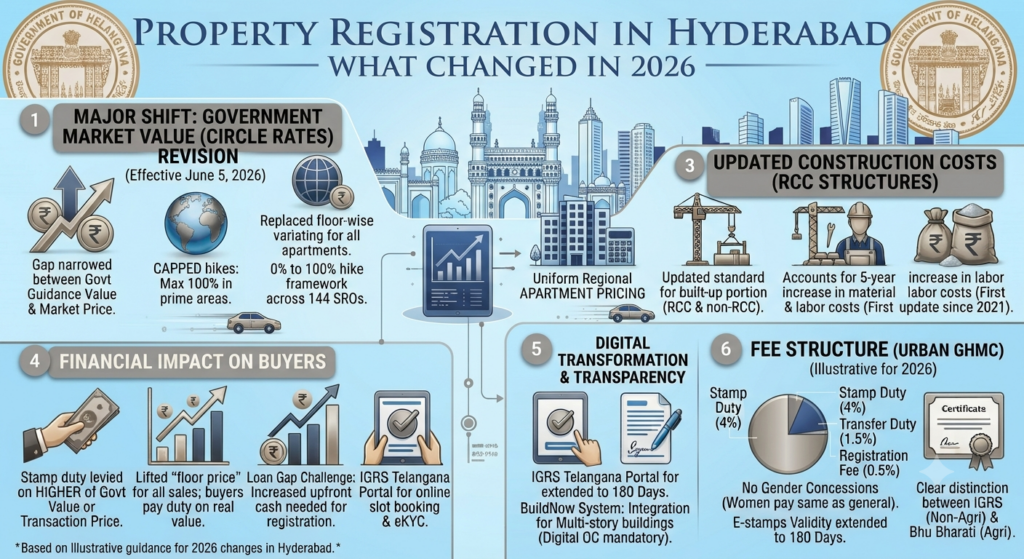
What’s New in 2026: Mandatory Slot Booking, Biometric Verification, and Updated Guidance Values
There are three distinct changes that have been rolled out this year concerning registration that directly address a problem within the state.
Mandatory online slot booking. Walking into a Sub-Registrar Office without a prior appointment is no longer a workable strategy. Every SRO now operates on a fixed number of daily slots — commonly cited at around 48 per day — booked through the IGRS portal at least 24 hours in advance. These changes were introduced in order to get rid of the time-consuming registration day in Hyderabad when everyone would have to wait for hours due to the chaos that surrounded it. Many buyers who do not opt for changes and go to registration on their own face a lot of waiting time and are sometimes turned away.
Mandatory biometric verification. This is arguably the most consequential change. From January 2026, every party involved in a registration — buyer, seller, and both witnesses — must undergo Aadhaar-linked biometric verification at the SRO, with fingerprints and photographs checked against Aadhaar records in real time. The intent is squarely fraud prevention: impersonation and identity fraud in property transactions have been a persistent concern, and biometric authentication closes a gap that document verification alone couldn’t. The practical implication is that everyone’s Aadhaar needs to be correctly linked to an active mobile number well before registration day, because a failed OTP or a biometric mismatch at the counter can derail an otherwise ready transaction.
Updated guidance values. Guidance values — the government’s own benchmark for what a property is worth for stamp duty purposes — saw a substantial revision that has reshaped costs in several high-demand micro-markets. Localities along and around the Outer Ring Road, including Gachibowli, Tellapur, and Kokapet, saw increases in the 30–50% range.
Since stamp duty is calculated on whichever is higher between guidance value and actual sale price, a jump of this size can meaningfully change the government charges on a transaction that looked affordable a year or two ago. Buyers evaluating a purchase in these corridors should check current guidance values before finalising a price, not after.
Step-by-Step: Registering Your Property on the IGRS Telangana Portal in 2026
The mechanics, once you know the sequence, are fairly linear.
- Check the guidance value. Use the Market Value Search tool on the IGRS portal to confirm the government-assessed rate for your property’s location before agreeing on a final price.
- Complete Public Data Entry (PDE). Log in and enter the property details, party information, and transaction value. This generates a draft document number that anchors everything that follows.
- Calculate and pay stamp duty. Use the portal’s Duty Fee Calculator to work out stamp duty, registration fee, and transfer duty, then generate and pay the e-Challan online.
- Book your SRO slot. Select your jurisdictional Sub-Registrar Office — use the “Know Your SRO” tool if you’re unsure which one covers your property — and pick an available date and time. Keep your booking confirmation number handy.
- Visit the SRO in person. This step has no digital shortcut. Buyer, seller, and two independent witnesses (adults with no financial stake in the transaction) must appear together with original documents for biometric verification and signing.
- Download the registered deed. For most 2026 registrations, a digitally signed copy becomes available on the portal within 2–3 hours of completion. A physical copy typically follows by post within 7–10 working days.
Documents must be registered within four months of execution, so it’s worth timing your slot booking with that deadline in mind rather than letting it slip.
Documents You Need for Property Registration in Hyderabad
The main reason for delays in booking the appointment is to not make the required documents in time. Among the documents you have to obtain are:
- The executed sale deed
- Identity proof for all parties, with Aadhaar mandatory for biometric verification
- The Permanent Account Number card (PAN card)
- Passport sized photographs of the seller, the buyer, and witnesses
- The Encumbrance Certificate
- Proof of stamp duty and fee payment (the e-Challan generated during PDE)
- A RERA registration certificate, where the property is part of a new-launch project
If your purchase involves a home loan, it’s also worth understanding how stamp duty and registration charges factor into your overall budget separately from the loan amount, since most lenders don’t cover these government charges as part of disbursement.
Do’s
- Check the current guidance value before finalizing the deal.
- Complete Public Data Entry (PDE) accurately on the IGRS portal.
- Pay stamp duty and registration charges through the official e-Challan system.
- Book your SRO appointment in advance.
- Ensure all parties have Aadhaar linked to an active mobile number.
- Carry original documents and identity proofs on registration day.
Don’ts
- Don’t walk into an SRO without a booked slot.
- Avoid just relying on old guidance values while budgeting.
- Don’t keep waiting until registration day to test OTP and biometric verification.
- Avoid ignoring the four-month registration deadline after execution.
- Don’t assume a home loan covers stamp duty and registration charges.
- Avoid proceeding without obtaining an Encumbrance Certificate (EC).
Understanding the Encumbrance Certificate and Why You Need One
An Encumbrance Certificate (EC) is essentially a property’s financial and legal biography. It records every registered transaction, loan, and mortgage against a property over a chosen period, and its core purpose is to confirm that what you’re buying is free of hidden claims — no unpaid loan still attached to the title, no ongoing legal dispute quietly sitting in the background.
In Telangana, the EC is searchable and downloadable directly through IGRS Telangana for records dating back to January 1, 1983, when the state’s digitisation of property records began. A certified EC costs ₹200 for a period of up to 30 years and ₹500 for anything longer, plus a small service fee depending on how you apply. Banks routinely insist on a clean EC before sanctioning a home loan, and buyers should treat it the same way — as a non-negotiable check, not a formality to rush through. It’s worth noting that an EC won’t surface pending court cases; a separate title search through a property lawyer remains the safer way to rule those out entirely.
What These Changes Mean for NRI Buyers
For NRIs, the 2026 changes land differently — and, in one specific way, more awkwardly. Mandatory biometric verification assumes physical presence at an Indian SRO, which is precisely the part of the process an NRI buyer often can’t accommodate on short notice.
The workaround remains a registered Power of Attorney (POA). An NRI can authorise a trusted representative in India to execute and complete the registration on their behalf, provided the POA is drafted specifically for that purpose, notarised in the NRI’s country of residence, and then either apostilled (for Hague Convention countries, which include the US, UK, UAE, Canada, and most of Europe) or attested by the Indian consulate where apostille doesn’t apply.
Crucially, the POA itself must then be registered at an Indian Sub-Registrar Office before it can be used — an unregistered POA carries no legal weight for a Telangana property transaction. Once registered, it’s the POA holder, not the NRI buyer, who completes the biometric verification step at the SRO.
NRIs should also be prepared for a few additional layers beyond the standard document list: a valid OCI card or passport, a FEMA compliance declaration confirming the property being purchased isn’t agricultural land (which NRIs generally cannot buy), and proof that the purchase payment was routed through an NRO or NRE bank account, as required under FEMA regulations. None of this is new to 2026, but the added weight now placed on in-person biometric verification makes getting the POA chain right, well in advance, more important than ever.
For NRIs and resident buyers alike investing in an apartment specifically, it also helps to understand what UDS (Undivided Share of Land) means for your ownership, since your registered share of the underlying land is a detail that carries forward into every future transaction involving the property, including resale.
How the 2026 Changes Compare to the Old Process
For anyone who last went through this a few years ago, the shift is easiest to see side by side.
Getting an SRO appointment. Earlier, buyers largely walked in and queued, sometimes for hours, with slot allocation handled informally at the office. Now, a slot must be booked online at least a day in advance, with a capped number of appointments per SRO per day.
Identity verification. Verification previously leaned more heavily on document checks — Aadhaar and PAN copies matched manually against the file. It’s now anchored in live biometric authentication for every party present, checked directly against Aadhaar records.
Guidance values. Rates that had stayed relatively static in several corridors for a few years saw a sharp, double-digit percentage revision, particularly around the Outer Ring Road growth belt, meaningfully changing the stamp duty math for buyers in those areas.
Land records for agricultural property. The Dharani portal, which many buyers were still using out of habit, has been succeeded by Bhu Bharati, splitting the ecosystem more cleanly between agricultural and non-agricultural transactions.
Turnaround on certified copies. Where collecting a certified copy of a registered deed once meant a separate trip or a multi-day wait, most recent registrations now generate a digitally signed copy within 2–3 hours, downloadable directly from the portal.
Taken together, these changes trade a bit of upfront friction — more preparation, a mandatory appointment, a physical visit that can’t be skipped — for a process that’s considerably harder to manipulate through impersonation or under-the-table shortcuts. For buyers willing to prepare properly, that’s a reasonable exchange. For those going in unprepared, it’s precisely where delays now happen.
Once your registration is complete, it’s worth understanding how this fits into the larger ownership picture, particularly if you’re buying into an apartment complex or gated community — the conveyance deed and its role in housing societies explains the next major legal milestone most flat owners will encounter after registration, when common areas and land ownership formally transfer to the resident association.
Key Takeaways
- Online slot booking is now mandatory before visiting the Sub-Registrar Office.
- Biometric verification is compulsory for buyers, sellers, and witnesses.
- Guidance values increased substantially in several ORR corridor localities.
- IGRS Telangana handles urban property registration, while Bhu Bharati manages agricultural land records.
- Digitally signed registered deeds are typically available within a few hours after registration.
- NRIs may need a properly registered Power of Attorney to complete the process remotely.