RK vs BHK: Layout, Cost, and Which One You Should Actually Buy
Quick Answer
A 1 RK combines living and sleeping space with a kitchen, while a 1 BHK provides a separate bedroom and hall. A 1 RK is generally 25–40% cheaper, but a 1 BHK offers better privacy, rental demand and resale potential. The right choice depends on your budget, space requirements and long-term plans.
If you are questioning the difference between RK and BHK prior to sealing a rental agreement and making an advance booking payment, you are definitely asking at the right place and time.
Most buyers and renters make this decision based on price alone and that’s fine until they move in. The difference in layout between an RK and a BHK is not just about square footage. It impacts your sleep, your cooking, what your guests feel when they come to visit, and what your choices are when you finally want to sell or upgrade.
Read on to find out what each configuration means, what the numbers in Hyderabad look like and which applies to your situation.
Main points
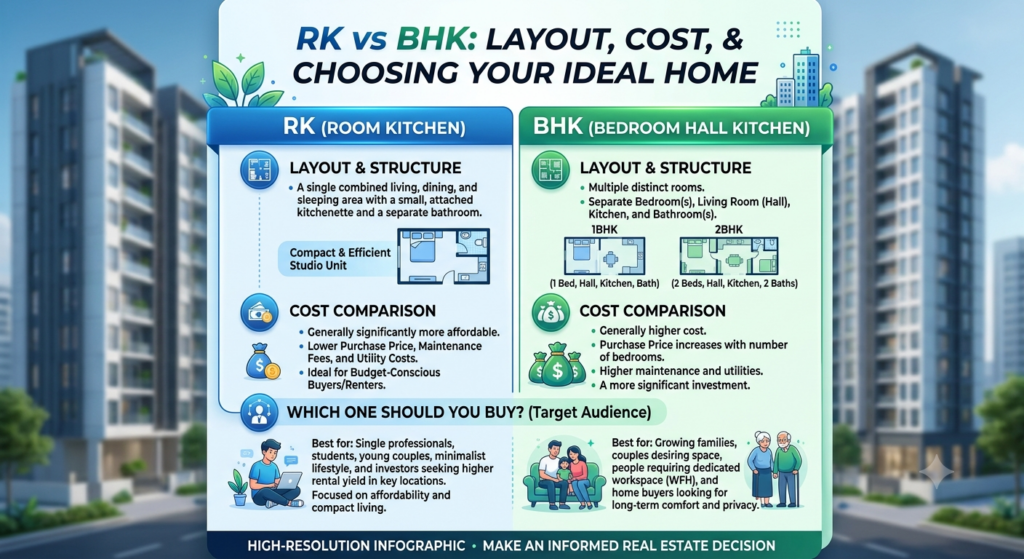
- RK is for Room + Kitchen: a living + sleeping space combined with a kitchen. BHK means Bedroom, Hall, Kitchen. Means a separate bedroom, separate hall and separate kitchen.
- A 1 RK generally costs 25-40% less than a 1 BHK in the same locality and corridor
- 1 BHK provides better resale liquidity, thus attracting a bigger pool of potential buyers, including small families and not only singles and investors
- 1 BHK commands higher absolute rent and stronger tenant demand for rental income in Hyderabad’s IT corridors 1 RK yields are similar but limited tenant pool
- TGRERA-registered gated communities in Hyderabad hardly have 1 RK units; most of the 1 RK stock is in old, unorganised housing, an important difference before you invest.
1.So what do RK and BHK mean?
BHK stands for Bedroom, Hall, Kitchen. So whichever flat is indicated in BHK form, e.g. 1BHK or 2BHK or 3BHK then at least 3 rooms- a bedroom, hall (living room or drawing room) and a kitchen will be there. So, whatever is in front of BHK is the bedroom of the house. 2 BHK indicates 2 Bedrooms, 1 Hall and 1 Kitchen.
The full form of RK in a flat stands for Room + Kitchen A 1 RK flat is the single room that acts as a living room and bedroom with the kitchen attached, in an alcove or sectioned off by a partition wall. There is no room as such. The room used as a bedroom serves as a working place, a sleeping place, a relaxing place as well.
Whereas in 1BHK one can close the bedroom door, keep a guest in the drawing room, it would seem like living in 2 different places.
In a 1 RK, your bed, sofa and kitchen counter are all in the same line of sight.
Be Among the First to Own a Legacy
2.So what do RK and BHK mean?
A typical 1 RK flat in Hyderabad is a rectangular or a square room of 200-350 sq. ft. carpet area. The kitchen is usually set along one wall, either open to the main room or separated from it by a low counter or sliding partition. There is one bathroom attached and no entry foyer, you open the front door and walk straight into the main room.
A typical 1 BHK has a dedicated entrance hall or living room of 100-180 sq. ft., a separate bedroom of 120-180 sq. ft., a kitchen of 60-90 sq. ft. and one or more bathrooms. Carpet area is generally between 400 sq. ft. and 650 sq. ft. depending on the project and the city.
• The first thing to go in a 1 RK is storage space. One room: your wardrobe, bed, sofa and dining area are all fighting for the same square footage.
• It’s a functional separation of rest and activity. Sleep in the bedroom, work or entertain guests in the hall, in a 1 BHK.
The separate room in the 1 BHK is a material quality-of-life advantage, not just a luxury, for couples or those working from home.(Source)
3.Difference in Physical Planning: 1 RK vs 1 BHK Layout
Builders quote super built up area in their brochures but the area you live in is carpet area.
The difference matters when comparing prices across configurations.
Carpet area is the usable floor space within the walls, the area on which you can actually place furniture. This is the number that matters.
Built-up area includes carpet area plus the thickness of the walls.It is usually 10-15% more than the carpet area.
Super built-up area is built-up area plus your share of common spaces (lobby, lift shafts, stairwells and amenity areas). This is what the builders say. Carpet area is usually 20-35% lesser than this.
Typical Hyderabad configurations approximate area comparison (as of 2026):
| Configuration | Carpet Area | Super Built-Up Area | Typical Price Range |
|---|---|---|---|
| 1 RK | 200-350 sq. ft. | 280-480 sq. ft. | Rs. 15-28 lakh |
| 1 BHK | 400-650 sq. ft. | 550-880 sq. ft. | Rs. 28-55 lakh |
| 2 BHK | 750-1,100 sq. ft. | 1,000-1,500 sq. ft. | Rs. 55 lakh – 1.1 crore |
Always ask for carpet area from the builder. For instance two 1 BHK flats on the same corridor worth 40 lakh, but with different loading factor by 5-10% can give very different amount of living space.
4.Cost comparison, purchase, maintenance and registration
The difference in the cost of a 1RK vs a 1BHK in the same location generally comes out to be 25-40% on account of carpet area and non-availability of a hall in RK. In a practical scenario in Hyderabad in the mid segment corridors (Uppal, Pocharam, Miyapur, Kompally) comparing a 1RK of 20 lakh and a 1BHK of
32 lakh in the same project gives you a Rs. 12 lakh difference, which translates to approximately Rs.8,000-9,000 saved in EMI per month on a 20 year loan at the prevailing interest rate.
The registration and stamp duty in Telangana is a percentage of the property value, hence a less expensive 1 RK is less costly in absolute terms.
Stamp duty in Telangana is currently 4% of market value, plus a 0.5% transfer duty. On a Rs. 20 lakh property, that works out to approximately Rs. 90,000 in total registration costs versus Rs. 1.44 lakh on a Rs. 32 lakh property.
Maintenance charges in gated communities are often calculated per sq. ft. of super built-up area. A 1 RK owner in a gated community pays meaningfully lower monthly maintenance than a 1 BHK owner, often Rs. 800-1,500 per month less depending on the amenity basket of the project.
Total cost of ownership in 5 years(purchase+interest+maintenance+registration):
| Payment Type | 1 RK (Rs. 20 lakh) | 1 BHK (Rs. 32 lakh) |
|---|---|---|
| Down payment (20%) | Rs. 4 lakh | Rs. 6.4 lakh |
| Loan amount | Rs. 16 lakh | Rs. 25.6 lakh |
| Monthly EMI (8.75%, 20 yr) | ~Rs. 14,100 | ~Rs. 22,600 |
| EMI over 5 years | ~Rs. 8.46 lakh | ~Rs. 13.56 lakh |
| Maintenance (5 yr, est.) | ~Rs. 90,000 | ~Rs. 1.5 lakh |
| Registration | ~Rs. 90,000 | ~Rs. 1.44 lakh |
| Approx. 5-yr outflow | ~Rs. 14.3 lakh | ~Rs. 22.9 lakh |
The 1 RK costs approximately Rs. 8.6 lakh less over five years. The size trade-off is more a matter of whether it’s worth it to you and what your intentions are for the place.(Source)
5.Rental Yield and Resale Value of RK vs BHK in Tier-1 Cities
For investors, the question is not which configuration is cheaper to buy. When it comes to return, resale, and also salesability, it performs best.
Rental income: In all IT corridor markets of Hyderabad like Madhapur, Kondapur, Gachibowli, HITEC City and Uppal, a 1 BHK of a good location fetches anything between R12,000-22,000 a month as rent depending on furnishings and location. Comparably, a 1 RK in the same location rents between R7,000-12,000. On gross yield basis both would fetch close to 3-4.5% annually, but the gross rental value in terms of absolute amount is higher for a 1 BHK. The kind of people a 1 BHK attracts is also a lot more, compared to a 1 RK which is mainly students or bachelors.
Vacancy risk: In the premium gated community market in Hyderabad, a 1RK takes a long time to re-let, as there are hardly any TGRERA registered projects that are being built with 1RK configuration.
The available 1 RK stock is largely in older, unorganised buildings where tenant quality and lease stability tend to be lower.
Resale value: 1 BHK outperforms 1 RK at resale consistently. A 1 BHK market has small families, upgrade investors and young couples; a much broader market than 1RK which is mainly for bachelors and yield investors. With a 5-7 year holding period, 1BHk unit in TGRERA registered project, within a demand corridor like Uppal or Kondapur appreciates according to market trends and is sold with no considerable negotiation pressures. Whereas 1 RK apartments will linger longer and sell with a more severe price correction.
An investor who bought 1 RK unit in older apartment near Ameerpet at Rs.
18 lakh found at resale that the buyer pool was almost entirely limited to other investors; end-users did not want the configuration. The final sale took 8 months to get over the deal and closed at a 6% discount from the asking price. A 1 BHK purchased in the same corridor at Rs. 30 lakh sold in six weeks at listing price three years later.
6.Who Is a 1 RK Ideal For?
Here is how a 1 RK can make sense in three scenarios:
Single people/students moving into a city for the first time: If you have moved for the first time for work/education and are looking for cheap/low-commitment property to start with, a rented 1 RK fits your bill. Your requirement is location/commute, not space, and if a property located near a metro/IT campus would solve the problem at lowest costs.
Single-income property buyers with low capital: if you have a capital of Rs. 15-22 lakh and would like to own property and at least have rental yield from the property, the best solution for you is a 1 RK located at the corridor of the market and would be giving you 3-4% of rental yield. Find these corridors near universities, hospitals or mid-segment IT centers with demand from single people.
Property buyers with plan of upgrading in 3-5 years: the 1 RK does not have to be a permanent solution. It would be like a temporary stepping-stone property. If you plan to make equity, clear off a small loan amount in a few years and then buy a 1 BHK or 2 BHK, the mathematics is workable. It requires clear thinking over the exit timeline and assessing its exit liquidity on its corridor.
When a 1 RK does not make sense: coupled people with plans of having kids within 2-3 years, working from home professionals requiring separate work and resting space and hosts, who might want to host guests overnight frequently.
7.Who Should Opt for a 1 BHK or Larger?
A 1 BHK is the more versatile configuration. It is the minimum viable unit for most life situations beyond early-stage single living.
Newly-wed couple: Two people in a 1 RK realize quickly that living & sleeping in the same room leads to disputes, and a bedroom door is a simple fix. Hall is the common space for the couple in a 1 BHK. Bedroom is exclusively for the couple. This simple separation can alter a couple’s day-to-day lives to an extent most notice within a month.
Young professional working from home: Since 2020, more and more IT professionals in Hyderabad work from home at least some of the days of the week. A 1 BHK gives space to work from the hall, maintaining a healthy separation from your sleeping space.
A 1 RK cannot offer this.
Investors with a 5-plus year horizon: If your holding period is long enough, the wider buyer and tenant pool of a 1 BHK justifies the higher entry cost. You pay more upfront but sell faster and at a better price when you exit.
Three people can live comfortably in a 1 BHK with one child below the age of 6, and compromise to fit more or older children. A 2 BHK is suitable for a family that is growing and will outgrow a 1 BHK at its breaking point.
Those looking for affordable property in entry-level segment in the eastern part of the Hyderabad are finding some flats in Hyderabad for Rs.67 lakhs at ASBL Springs in Pocharam offer a starting point in a TGRERA-registered community, a different category from 1 RK stock but relevant for buyers on the lower end of the 1 BHK budget range.
8.Modern Variants: Studio Apartments, 1.5 BHK, and Junior BHK
Contemporary variations-studio, 1.5 BHK and junior BHK
A few hybrid versions now exist between 1 RK and a standard 1 BHK.
Studio apartment: An open-plan unit with no interior walls to differentiate a bedroom from a hall and kitchen. Unlike a 1 RK that may have at least a partial screen for the kitchen, a studio is completely open. Increasingly being seen in higher-end Hyderabad projects that target single young IT professionals and that appeal to a minimalist/contemporary living style. Carpet areas typically range from 300-450 sq ft.
1 RK studio: A version of the 1 RK that uses open planning principles, like a studio apartment, along with higher quality specifications. It bridges the gap in price between a standard 1 RK and a 1 BHK and is becoming a key part of compact luxury and co-living.
1.5 BHK: A variant of a 1 BHK that includes a second, smaller room (about 80-120 sq ft) which could be used as a study, pooja room, or nursery. It offers more functionality without the price hike of a full 2 BHK. Common in projects for upgrade buyers who need a bit more space within budget.
Junior BHK: A variant of a 1 BHK where the bedroom is sized under 100 sq ft and the developer has sacrificed bedroom space to ensure the hall and kitchen are larger. Price wise they are close to a 1 BHK, but their internal proportions differ significantly. Carefully check bedroom dimensions against your bed and furniture.
For an understanding of what impacts the day-to-day practicality of each layout, have a look at the practical guide to a 3 BHK floor plan which explains what makes a floor plan liveable versus good in a brochure.
9.Vastu and Ventilation Tips for Small-Format Homes
A 1 RK or 1 BHK flat presents unique vastu and natural ventilation issues compared to larger apartments, and these issues need to be addressed.
Vastu and 1 RK and 1 BHK flats: In a small apartment, the critical vastu parameters are main entrance direction, kitchen location, and sleeping area orientation. In the case of a 1 RK, since the sleeping area and the living area are in the same room, the main vastu considerations would be the direction of the main door and bed location within the room. East-facing and North-East facing main doors are best. In a 1 BHK flat, ideally the kitchen should be located in the south-east quadrant, and the master bedroom in the south-west. Vastu, therefore, must be confirmed at site, not assumed based on the brochure.
Natural ventilation in small apartments: For adequate natural cross ventilation, the unit needs openings on at least two sides. A common problem in older 1 RK flats is a window on only one side, forcing the occupant to rely more on the air-conditioner for air flow. When selecting a 1 RK or compact 1 BHK flat, make sure the unit has windows on at least two sides.
In a 1RK on the second floor of an apartment in Ameerpet, a couple who had rented the space, discovered after moving in that even though the entrance to their flat was east-facing, since the bedroom had a window only on one side, there was absolutely no cross-ventilation.The flat ran hot by 10 AM from March onwards and required the AC to run for 8-10 hours daily. A slightly more expensive 1 BHK two streets away with windows on two sides ran comfortable without AC until mid-April. The monthly electricity cost difference more than offset the rent gap.
Key Takeaways
- 1 RK = Room + Kitchen; 1 BHK = Bedroom + Hall + Kitchen.
- A 1 RK is generally 25–40% cheaper.
- 1 BHK offers better privacy and space separation.
- 1 BHK has a broader rental and resale market.
- Carpet area is more important than brochure area.
- 1 RK can suit singles, students and budget-focused investors.
- Ventilation and future space requirements matter before choosing.