Structural Audits and Concrete Building Lifespan: What Every Homebuyer Should Know
When it comes to buying an apartment, most potential homebuyers will usually focus the majority of their time and effort looking at features that are visible about that property.
The floor plan.
The kitchen finish.
The clubhouse.
The unit’s balcony view is one area of consideration.
However, many potential purchasers could fail to consider some unseen features as well, such as the state of the concrete contained in the walls, strength of the beams/columns that support the structure, and health of the steel reinforcing the concrete behind the various layers of plaster and drywall.
To the extent that these hidden components will help to determine whether or not their investment will remain worth something (always maintaining value) at least for several decades, it stands to reason that purchasers would want to know this information when purchasing a property.
This is why the structural audit (building assessment) is such a valuable tool for prospective buyers considering an older apartment purchase, for residents in an aging community who have an interest in improving the quality of their environment through their resident welfare association, and/or for families who are purchasing a property with the intent of being able to pass it down to future generations.
This guide contains information regarding the following: what structural audits evaluate; average lifespan of concrete apartment buildings in India; indicators that warrant immediate concern; and why advances in technology related to the construction industry are a critical factor influencing the longevity of buildings.
Be Among the First to Own a Legacy
1.What is a Structural Audit? Why Do You Need One?
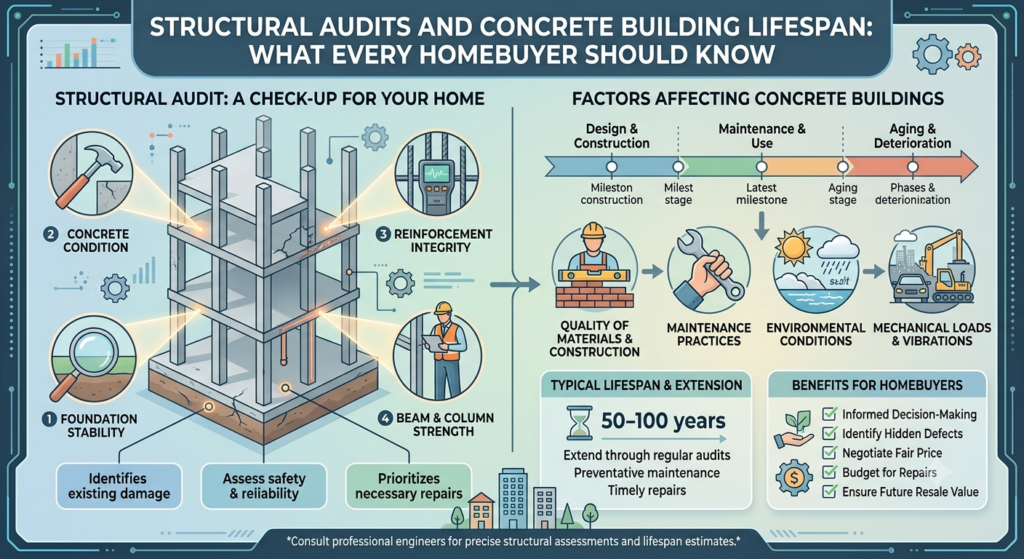
A structural audit is somewhat like a full health exam for a structure or (shocker) building. Just like a medical doctor will examine you for medical conditions that are not visible, a certified professional structural engineer will review the buildings’ structural components to help define whether they are still performing their function safely.
A structural audit does not look at the overall condition of a building or look at every small crack that appears on a wall but will evaluate whether or not, due to its condition, the building can carry its intended loading without an unsafe condition resulting.
A structural audit on residential construction projects usually involves the following:
- Columns
- Beams
- Slabs
- Foundations (where accessible)
- Staircases
- Balconies
- Retaining walls
- Terrace structures
In addition to examining a building’s structural condition, engineers will also evaluate important factors that may lessen the long-term durability of a structure, such as:
- Water infiltration
- Concrete quality
- Corrosion of reinforcing steel
- Structural movement
- Signs of excessive loading
- Previous repair work
Structural audits may also involve the use of special non-destructive testing procedures to measure concrete compressive strength without damaging the structure.(Source)
2.Why is a Structural Audit Necessary?
Without conducting an audit on a structure, it is impossible to determine if a building has become structurally unsound.
Constructed buildings do not suddenly become unsafe as a result of a singular occurrence.
Instead, it takes time for a structure to deteriorate over time before it becomes dangerous for use.
Sometimes if a small/insignificant problem is left unattended to for an extended period of time, it may develop into a much larger issue or require a lot more money to repair at a later date.
Using a structural audit enables the owners of every building with their common group to make plans for maintaining; this is much better than responding to an emergency situation after an accident.
For potential purchasers of apartments, audits will give information about the present condition of the apartment(s) rather than just what appears to be in good condition.
3.What is the Longevity of Concrete Apartment Buildings in India?
A typical question from prospective buyers of resale apartments is, “How long should I expect the concrete apartment building in India to be standing?”
There is no one answer because buildings age differently.
There are three major factors that contribute to the life span of a structure.
- Design quality
- Construction quality
- Lifetime of a building
Buildings that are both designed well and properly maintained can be expected to have a useful life of anywhere from sixty to eighty years. If high-quality materials are used, effective waterproofing is applied, and timely repairs and/or replacements are completed, then the building may also remain functional for longer than that.
Conversely, poorly constructed buildings, water entry issues, no or little maintenance, and low-quality construction can all lead to rapid deterioration of the building.
In some instances, serious building failures may appear as soon as twenty-five to thirty years after construction.
The following three factors can have an impact on building lifespan:
Several factors affect the RCC building lifespan years more than age alone.
Construction Quality
In terms of construction; a well-constructed building will last much longer than one incorrectly constructed. A well-constructed building will be able to have a longer service life if it was constructed with structural integrity through use of good design principles, proper mix of concrete (concrete mix), appropriate curing of concrete, and through strict control of quality throughout the construction process.
Waterproofing
Concrete is very susceptible to moisture and will break down due to long-term exposure to moisture.
Repeated water infiltration of any type over long periods of time within concrete construction, will eventually lead to deterioration or corrosion of the reinforcing steel within the structure and/or foundation, resulting in a reduction in the load carrying capacity of the structural member being affected.
Environmental Factors
Structures located near coastal areas, industrial sites, or in some cases aggressive exposed environment will typically deteriorate or break down more quickly as compared to buildings that are located in more stable environments.
Maintenance
Routine maintenance will prolong the useful life of the building, by providing preventive measures to reduce the need for repairs; whereas ignoring minor problems will usually lead to larger and more expensive repairs in the future. The age of the building is just one small portion of the overall impact on the structure/service life.Its maintenance history is often an even better indicator of long-term structural performance.
4.What a Structural Audit Will Reveal : Common Defects
Many home buyers view a structural audit as a way of ensuring the property they are purchasing does not have any cracks. Yet, in reality, concrete has the ability to protect the steel reinforcement embedded within it.
In reality, experienced structural engineers look much deeper.
Here are some of the most common issues uncovered during a structural health of building assessment.
Carbonation of Concrete
Overtime, however, with constant exposure to air, the concrete surface becomes carbonated creating a loss of the protective layer around the steel. As a result, the steel becomes exposed to the possibility of corrosion.
Corrosion of Steel Reinforcement
When steel reinforcement begins to corrode it begins to expand; thus placing stresses on the surrounding concrete, which ultimately results in the cracking or spalling of the surrounding concrete.
Concrete Spalling
The implementation of deteriorated areas from concrete beams, columns, slabs, etc., detachment from concrete is known to happen during spalling. Some people looking to purchase a home view spalling as just a cosmetic issue; in fact, this type of issue signals that the reinforcing steel embedded in the concrete needs immediate attention.
There are situations where you may be experiencing what you know to be waterproofing failures, such as persistent terrace leaks or external wall water leaks, yet these scenarios may only be due to the waterproofing breach. However, continuous exposure to moisture by the elements over time can compromise the surface integrity (durability) of the concrete if left unaddressed.
While not all cracks in concrete will present a safety hazard, some will most definitely need to be assessed further. Some plaster cracks that might appear as “hairline” cracks are quite common, but structural cracks within load-bearing structures may signal some form of movement, settling or stress.
Distinguishing between cosmetic and structural cracks requires professional evaluation.
Differential Settlement
Sometimes different parts of a building settle unevenly.
This may create:
- Sloping floors
- Misaligned doors
- Cracks around openings
Such movement deserves careful investigation.
5.Structural Audit Grades Explained: A, B, and C
One of the most valuable sections of any building audit report apartment owners receive is the overall structural grading.
Although formats vary between consultants, audit findings are commonly grouped into broad condition categories.
Grade A — Structurally Sound
A Grade A assessment generally indicates that the building is performing well.
Minor observations may include:
- Routine maintenance
- Small waterproofing repairs
- Cosmetic crack treatment
No major structural intervention is normally required.
Grade B — Moderate Deterioration
When concrete has reached Grade B, this indicates a beginning stage of deterioration; however, the deterioration of structural components is at an appropriate level to manage. The recommendations of the property owner on maintaining the property through preventative maintenance and repairs should not wait a long time.
- Planned structural repairs
- Waterproofing improvements
- Corrosion treatment
- Preventive maintenance
These repairs should not be postponed for long.
Grade C — Serious Structural Distress
A Grade C finding indicates significant structural concerns.
Depending on severity, recommendations may include:
- Immediate repairs
- Restricted occupancy
- Temporary evacuation of affected areas
- Detailed engineering investigation
A Grade C report does not automatically mean demolition.
However, it does require prompt professional action.
As you evaluate properties for resale apartment purchases, always obtain copies of the most recent structural audit report for that particular property if it was built more than 15 years ago.
6.Are Structural Audits Required in Hyderabad & Telangana?
Many buyers wonder whether building structural audit mandatory India requirements apply to Hyderabad.
As buildings age, local authorities increasingly recognise the importance of periodic structural safety assessments.
For older buildings, structural audits are intended to help identify deterioration before it becomes a public safety concern.
Housing societies are generally responsible for commissioning these inspections through qualified structural engineers and implementing recommended repairs.
Even where an audit may not yet be legally required for a particular building, conducting one remains a responsible practice for:
- Resident welfare associations
- Apartment owners
- Buyers evaluating resale properties
Waiting for an extreme level of visible deterioration to make your decision on your purchase could lead to disaster since it is normally less expensive than the cost of emergency repairs to perform preventative assessments before making a purchase.
7.What to Check About a Building’s Structure Before Buying a Resale Flat
In determining your decision to purchase a resale apartment, it is critical that you evaluate how well the building has been constructed and will last into the future. Ask yourself the following questions as you are looking over the building and evaluating the property.
1. Has there been a structural audit performed on this property?
Request the latest report.
If none exists for an older building, ask why.
2. What Major Repairs Have Been Completed?
Find out whether the society has undertaken:
- Waterproofing
- Structural strengthening
- Lift replacement
- External repairs
Well-maintained buildings generally retain value better.
3. Is There Persistent Water infliltration?
The continued appearance of leaks is indicative of maintenance issues that require further investigation
4. Is the society maintaining adequate reserve funds?
Major structural repairs require financial planning.
A financially healthy society is generally better equipped to maintain the building over time.
5. Are There Visible Warning Signs?
During your site visit, pay attention to:
- Exposed reinforcement
- Concrete spalling
- Large diagonal cracks
- Uneven floors
- Damp structural walls
These observations do not necessarily mean the building is unsafe—but they do justify professional evaluation.
A little curiosity before buying can prevent significant expenses later.
8.Does Construction Technology Affect Building Lifespan? Mivan vs RCC
As the rise of modern homebuyers continues to grow, they have become more curious about how construction technology can impact the durability of a building over time. The answer is yes, but only if there is a combined effort of quality construction along with proper maintenance.
Most traditional buildings made from reinforced concrete (RCC) consist of sections like columns, beams, and slabs that are cast in multiple stages during the construction process.
Because of this construction method, Mivan buildings typically have:
- Better dimensional accuracy
- Fewer construction joints
- Improved concrete consistency
- Reduced opportunities for water ingress through joints
In contrast, using aluminum formwork (Mivan) allows walls and slabs to be poured together in one operation, creating a single piece structure or monolithic structure.
This does not mean that one building constructed using Mivan will always outlast the same type of building constructed using conventional methods.
In most cases, the overall quality of construction, design, workmanship, and maintenance will be key factors to determine how long the building will last.
In addition, Mivan technology will improve the durability of some of the weaknesses as typically associated with conventional construction methods and share with you how to use Mivan Construction Technology effectively in our guide to Mivan Construction Technology.
9.FAQs
1.What does an audit for a building evaluate?
A structural audit is defined as an independent evaluation of the structural condition of the building. During the structural audit procedure, the structure of the building will be assessed, as well as the health (i.e., any signs of deterioration) and load bearing components (e.g., columns, beams, slabs, or foundations) will also be reviewed in order to determine if they require maintenance or repair.
2.How long does a concrete apartment building last in India?
An RCC apartment building that is well constructed and well maintained can generally be expected to have a life span of 60 – 80 years. High-quality construction and a proactive maintenance program will allow some buildings to function beyond this.
3.Is a structural audit a requirement for a private home in Hyderabad?
Older apartments generally have to meet some local codes regarding assessment of structural safety. However, even where not formally required, regular structural audits are encouraged for older apartment complexes to determine if deterioration is serious enough to be a public safety hazard.
4.What kind of things does a structural audit find
Some of the most common findings are: Reinforcement corrosion (rust); carbonation of concrete; waterproofing failure; spalling of concrete; large structural cracks; damage to structural components by prolonged exposure to water.
5.Does Mivan construction last longer than traditional RCC buildings?
Mivan construction is able to improve durability by producing a more uniform concrete structure with fewer joints, but the overall life span will also depend on the engineering design, construction technique, quality of materials used, and regular maintenance.