Bedroom Vastu: Bed Direction, Colour & Layout for Restful Sleep
Quick Answer
Bedroom Vastu helps you assess your room’s layout, from the master bedroom location and sleeping direction to bed and mirror placement. This guide explains the recommended arrangements and simple adjustments you can make to create a more restful bedroom, even without structural changes.
A bedroom should be the one room where you switch off fully. Yet many people deal with light, broken sleep and never stop to question their room’s layout. Vastu Shastra, the traditional Indian system of design, offers clear answers on bed direction, wall colour, and where objects like mirrors belong. Some of these rules come from real physical logic, such as the earth’s magnetic pull. Others come purely from tradition and symbol. Either way, most of them are easy to apply, and none need a broken wall or a hired contractor. This guide walks through the full picture, from where a master bedroom should sit to what to do if your door already faces your bed.
Why Bedroom Vastu Matters More Than Most People Realise
Bedroom Vastu rarely comes down to superstition alone. It usually comes down to how a person feels in a space where they spend nearly a third of their life. A cluttered room, a badly placed bed, or a careless mirror can quietly work against good sleep, even when the person living there cannot explain why. That is exactly why this topic draws real, practical interest instead of passing curiosity.
A bed placed directly opposite a door, for instance, creates a subtle sense of exposure, since a sleeping person cannot see who walks in. Vastu speaks to this instinct directly, alongside older ideas about energy and balance. The result is a set of rules that often line up with plain comfort and basic psychology, whatever your view of the tradition.
Readers still working out their home’s layout can check ASBL’s guide on designing a bedroom you’ll love for the practical side of furniture placement. This article stays focused on the Vastu rules that sit alongside that layout work.
Be Among the First to Own a Legacy
The Ideal Direction for a Master Bedroom
Vastu names the southwest corner of a home as the best spot for a master bedroom. This zone carries the earth element, which Vastu links to stability and grounded strength, qualities that suit the head of a household. A master bedroom placed here is said to support restful sleep and a steadier bond between partners.
Anyone choosing a home or planning new construction should weigh this alongside the direction the house faces. An east-facing plot, for instance, carries its own set of Vastu points, which ASBL covers in its guide to east-facing house Vastu. Most existing homeowners cannot move their southwest corner, though, so sleeping direction and wall colour matter even more, since these are levers you can actually pull.
Sleeping Direction: Why Head-to-South Is Recommended
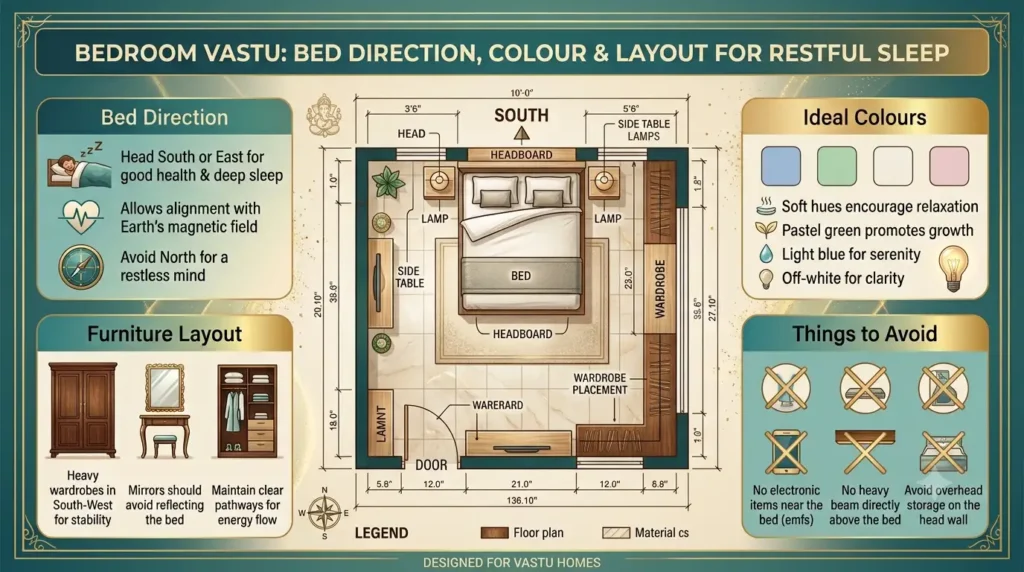
Sleeping direction raises more questions than any other bedroom Vastu rule, and for good reason. Vastu recommends sleeping with your head towards the south and your feet towards the north. The reasoning is more concrete than most people expect. Earth itself behaves like a giant magnet, with its field running from north to south. A south-facing head position is said to align your body’s field with the earth’s, supporting deeper, more restful sleep.
Vastu advises strongly against a north-facing head position. It is thought to conflict with the earth’s field directly, chipping away at sleep quality over time. East works as a solid second choice, especially for students chasing sharper focus. West sits below south and east, though it carries none of the concern linked to north.(Source)
If your room’s shape rules out a south-facing head position, do not force it at the cost of comfort. A good night’s sleep in a slightly imperfect direction still beats a restless night in a perfect one.
Bed Placement and the “Coffin Position” to Avoid
One mistake shows up again and again in bedrooms, and most people have no idea they are making it. It goes by the name “coffin position,” and it happens when a bed sits directly in line with the bedroom door, so a sleeping person ends up placed the way a body would be laid out. Vastu treats this as inauspicious, and it tends to unsettle people even when they cannot name why.
Fixing this rarely means moving the entire bed frame. Angling the bed so it no longer sits in a straight line with the door usually solves the problem. If the room’s shape allows no other option, a decorative screen, a tall headboard, or a well-placed piece of furniture between the bed and the door can break that direct line.
While rethinking bed placement, also keep the headboard off a wall shared with a bathroom, and avoid placing the bed directly under an exposed ceiling beam. Vastu treats both as small but avoidable sources of disturbed rest.(Source)
Colours for the Bedroom, by Room Type
Colour plays a bigger role in bedroom Vastu than most guides admit. A master bedroom does best with soft, calming tones. Light blue, gentle green, pale pink, and warm beige all come up often, since they support relaxation without feeling cold or flat. Bright red, harsh orange, and heavy dark shades work against a room meant purely for rest, though small touches of red do show up in some traditional advice for newlyweds.
Kids’ bedrooms call for a different palette entirely. Light, cheerful colours such as pale yellow, soft green, or light blue tend to work best, since Vastu links them to calm energy and sharper focus, both useful traits in a child’s room without tipping into too much excitement.
Guest bedrooms sit somewhere in the middle. Neutral, welcoming tones like beige, cream, or a soft off-white work well here, since they feel comfortable to a short-term guest without feeling too personal.
For a full, room-by-room breakdown of Vastu-recommended colours across the rest of a home, ASBL’s guide to Vastu zones and colours makes a useful companion to this section.
Mirror Placement: What to Do and What to Avoid
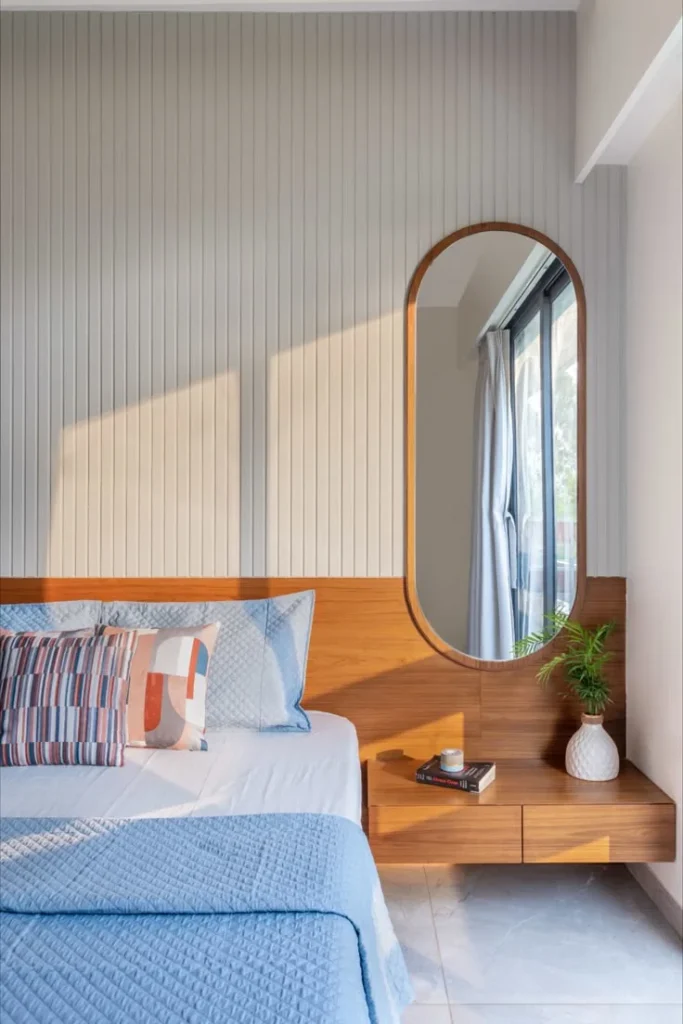
Mirrors rank among the most commonly misplaced objects in Indian bedrooms, and the logic behind their placement is worth knowing. Vastu holds that a mirror reflecting a sleeping person disturbs the room’s energy and can lead to broken, restless sleep. A mirror facing the bed also creates an unconscious sense of being watched, which works against real rest.
Do’s
- Place mirrors on the north or east wall of the bedroom wherever possible.
- Cover a mirror at night with a cloth or a sliding panel if moving it is not practical.
- Keep dressing table and wardrobe mirrors angled away from the bed’s direct line of sight.
Don’ts
- Position a mirror directly opposite or facing the bed.
- Place two mirrors facing each other in the bedroom, since this is thought to trap and bounce energy rather than let it settle.
- Fix a mirror on the ceiling above the bed, an arrangement Vastu treats as especially unsettling.
For a deeper, room-by-room look at mirror placement across the whole house, ASBL’s guide on mirror direction as per Vastu pairs well with this section.
Kids’ Bedroom and Guest Bedroom: Different Rules Apply
Treating every bedroom the same way is one of the more common oversights in Vastu planning. Children’s rooms and guest rooms each carry their own rules, and master bedroom guidance does not simply transfer over.
Vastu places a child’s bedroom best in the west or northwest zone. This direction carries calm, focused energy, which Vastu links to steadier focus and better discipline, both useful for a growing child. Keep the room clutter-free, favour light colours over dark or overly bright ones, and avoid placing a study desk hard against a blank wall.
Guest bedrooms work a little differently. The northwest direction generally suits these rooms too, since Vastu links it to movement and change rather than staying put, a fitting match for short stays. Comfortable, neutral decor tends to work best here, since it feels welcoming without turning into an extension of the family’s own space.
What Not to Keep in a Bedroom
A few kinds of items consistently work against good bedroom Vastu, no matter the room’s direction or colour scheme.
Vastu generally advises against keeping a pooja shelf or idols inside a bedroom. A dedicated pooja room elsewhere in the home always works better. Without one, any shrine or idols kept in a bedroom should sit inside a closed cabinet, ideally in the northeast corner, and should never face the bed directly.
Clutter causes the second major issue, and it is often the easiest to fix. Piles of clothes, storage boxes shoved under the bed, and general mess are said to block the free flow of positive energy. Broken electronics, dead clocks, and appliances that no longer work fall into the same trap. If it is broken and unused, it has no place in a room meant for rest.
Practical Fixes When You Can’t Change the Room’s Position
Most readers here do not have the option of rebuilding a home around Vastu rules, and that is completely fine. A rented flat, a fixed floor plan, or a bedroom door that simply will not move still leave plenty of room to improve.
Start with colour, since repainting a wall is one of the simplest changes around and still carries real impact. Mirror placement comes next, since moving or covering a mirror costs nothing. Decluttering the room, especially under the bed, takes effort rather than money.
If the bed’s exact spot is fixed, focus on smaller details instead. Angle the bed away from a direct line with the door, choose a solid headboard over an open one, and keep the space around the bed clutter-free. Anyone with a bathroom attached to the bedroom should also think about its position and door placement. ASBL’s guide to bathroom Vastu covers this for readers dealing with a shared wall or an awkward door.
Bedroom Vastu Do’s and Don’ts at a Glance
Do’s
- Sleep with your head towards the south, or east as a solid second choice.
- Choose soft, muted colours over bright or heavy dark tones.
- Keep the space under the bed clear and free of clutter.
- Angle the bed away from a direct line with the door.
Don’ts
- Sleep with your head pointed north.
- Place a mirror facing the bed or fixed above it on the ceiling.
- Keep a pooja shelf, idols, or broken electronics inside the bedroom.
- Leave the bed directly opposite the door with no adjustment at all.
Key Takeaways
- The southwest corner works best for a master bedroom, and a south-facing head position ranks as the top sleeping direction.
- The coffin position, a bed lined up directly with the door, is a common mistake that is genuinely easy to fix.
- Soft, calming colours suit a master bedroom. Kids’ rooms do better with cheerful light tones, and guest rooms with neutral ones.
- Mirrors should never face the bed directly, and the north or east wall makes the safest spot.
- Pooja shelves, clutter, and broken items do not belong in a bedroom, whatever its direction or colour.
- None of these fixes need structural change, which makes bedroom Vastu genuinely useful for renters and homeowners alike.