Property Allotment Letter, Agreement to Sell & Sale Deed: Importance for Flat Buyers
Quick Answer
An under-construction flat purchase moves through three crucial documents: the allotment letter, agreement to sell and sale deed, and each gives you a different level of legal protection. The allotment letter confirms your unit but does not make you the owner; the registered agreement to sell establishes your contractual and RERA rights; and the registered sale deed finally transfers ownership. Knowing what each document does and what it does not, can help you avoid costly mistakes before signing or paying.
Three documents sit at the centre of every under-construction flat purchase in India; the allotment letter, the agreement to sell, and the sale deed. Most buyers have a vague sense that these exist and that they arrive at different points in the process. Very few understand exactly what each one confers, what it does not confer, and what their exposure is at each stage.
This matters more than it might seem. An allotment letter does not give you ownership of the flat. An agreement to sell protects you legally, but only if it is registered. A sale deed is the document that transfers ownership, but it cannot be executed until construction is complete. Each stage has specific rights, specific risks, and specific things you should check before signing.
This guide walks through all three in plain language, with a comparison table and checklists you can use when going through your own paperwork.
1.The Three Most Important Documents in Your Property Purchase Journey
Before going into each document individually, it helps to see how they connect. Your flat purchase; from the day you pay a booking amount to the day you get a registered title; moves through four distinct document stages.(Source)
Stage 1. Booking. You pay an initial booking amount (typically 5-10% of the flat price). The builder acknowledges receipt. At this stage you have a booking receipt, not an allotment letter. You have no RERA protection, no legal claim to the specific flat, and no right that survives the builder’s insolvency in a meaningful way.
Stage 2. Allotment Letter. The builder issues a formal allotment letter, typically within weeks of booking. This assigns a specific unit, tower, floor, and configuration to you. It records the agreed price, payment schedule, and broad possession timeline. You are now on record as the allottee, but you are not yet the owner. The allotment letter is issued by the builder and is not registered with any government authority.
Be Among the First to Own a Legacy
Stage 3. Agreement to Sell. This is the document where the legal relationship between you and the builder is formally established and, critically, registered. Under the RERA Act 2016 and TS-RERA specifically, a builder cannot collect more than 10% of the flat’s cost without first executing a written agreement to sell and getting it registered. The registered agreement gives you RERA protection, the right to enforce possession timelines, and the primary document banks use to process home loans in under-construction projects.
Stage 4. Sale Deed. The sale deed is executed after construction is complete, the occupancy certificate is obtained, and the full consideration is paid. The registered sale deed is the document that transfers legal title from the builder to you. Until this document is executed and registered, you are not yet the legal owner of the property in the full statutory sense, regardless of possession.
Understanding this sequence is the foundation. Every other question : about home loans, builder defaults, resale rights, and legal protection is answered by knowing which stage you are at and what document you hold.

2.What is a Property Allotment Letter?
A property allotment letter is a formal communication from the builder confirming that a specific unit has been allocated to a buyer against an initial payment. It is the first property-specific document in the transaction; the booking receipt tells you that your money has been received, the allotment letter tells you which flat your money is against.
The allotment letter is a builder-issued document. It is not registered, it does not transfer any property rights from the builder to the buyer. What it does is establish your position in the builder’s records as the allottee for a specific unit and create a contractual basis for the payments that follow.
In practical terms, the allotment letter is the starting point for your relationship with the flat; it is the reference document against which your payment receipts, your builder-buyer agreement, and eventually your sale deed will all trace back.
What Must an Allotment Letter Contain? (Checklist)
Before accepting your allotment letter, verify that it contains all of the following:
| 1 | Full legal name(s) of the buyer(s) exactly as they appear in identity documents — errors here create problems during sale deed registration. |
| 2 | Builder’s full legal name and entity type (private limited company, LLP, partnership firm, etc.). |
| 3 | Project name and RERA registration number. Every TS-RERA registered project should have a registration number. If absent, ask why. |
| 4 | Specific flat details: unit number, tower/block identifier, floor, type (2 BHK / 3 BHK), carpet area and super built-up area in sq. ft. |
| 5 | Agreed total consideration and the basis of pricing; base price, preferential location charges, and other applicable charges clearly broken out. |
| 6 | Payment schedule linked to construction milestones or calendar dates. |
| 7 | Tentative possession date or an approximate construction completion timeline. |
| 8 | Parking details; number, type (covered/open/stilt), and whether included in the consideration or charged separately. |
| 9 | Cancellation and refund clauses; what happens if you cancel, and the builder’s liability if they cancel. |
| 10 | Date of issuance and authorised signatory with company seal. |
Practical note: If any of these are absent, ask for a corrected allotment letter before making subsequent payments. Do not assume these details can be filled in later.
What Can You Do With an Allotment Letter?
The allotment letter, by itself, does limited heavy lifting. What it does allow:
•Establishes your claim to the specific unit in the builder’s internal records and with RERA if a dispute arises after agreement registration.
•Provides a basis for requesting a refund if you wish to cancel before the agreement to sell is executed; the refund terms should be in the allotment letter itself.
•Is sometimes used by banks at the initial sanction stage for under-construction home loans. Some banks will issue an in-principle sanction based on the allotment letter, but this is not the same as a full disbursement. Most banks require the registered agreement to sell before disbursing against construction milestones.
•Serves as supporting documentation if you need to establish your timeline of payment or your claim to the unit in any dispute.
Important: The allotment letter does not transfer ownership, does not give you RERA’s full suite of remedies, and does not give you a registerable claim to the property. If the builder goes into insolvency with only an allotment letter in your hands and no registered agreement to sell, your position is significantly weaker than a buyer who holds a registered agreement.
3.What is an Agreement to Sell?
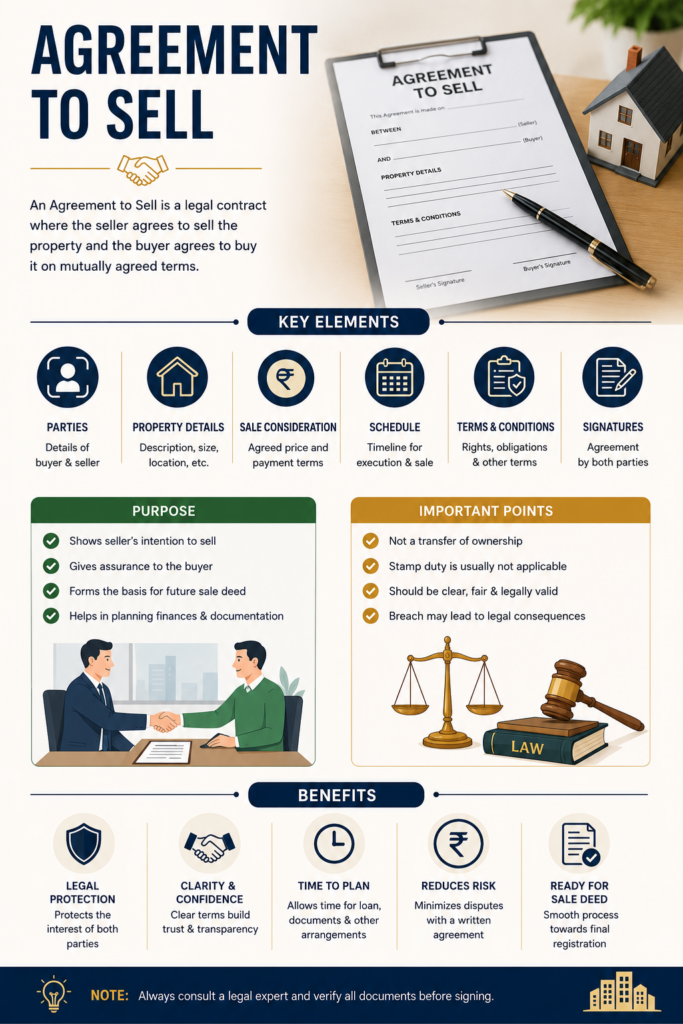
The agreement to sell, also called the builder-buyer agreement or agreement for sale, is the central legal document in an under-construction flat purchase. It is a binding contract that sets out all the terms of the sale: price, payment schedule, construction specifications, possession timeline, penalties for delay, force majeure provisions, and the conditions under which the sale deed will eventually be executed.(Source)
Unlike the allotment letter, the agreement to sell must be executed on non-judicial stamp paper and, under RERA, must be registered with the Sub-Registrar’s office. The registration requirement is not optional; TS-RERA prohibits a builder from collecting more than 10% of the flat’s cost without a written and registered agreement to sell.
When you sign a registered agreement to sell, you move into RERA’s protection framework: the builder is obligated to deliver by the stated possession date, any modifications to the plan require your consent, and the builder cannot sell the same unit to another buyer.
Key Clauses in an Agreement to Sell
When you receive the draft agreement to sell, do not sign it without reading ,and ideally having a lawyer review , these specific clauses:
•Total consideration and payment schedule. Each milestone payment should be linked to a specific, verifiable construction stage. Confirm the total adds up correctly including GST and all applicable charges.
•Possession date and delay compensation. The RERA-mandated compensation for delay is interest at the applicable rate for the delay period. Confirm the rate is stated and is RERA-compliant. Watch for clauses that attempt to limit delay compensation below the RERA floor.
•Carpet area definition. Under RERA, sale must be on carpet area basis. Confirm the carpet area in sq. ft. is per the RERA Act definition and that pricing is on this basis, not super built-up area.
•Construction specifications. Brand specifications for fittings, flooring, electrical, and fixtures should be attached as an annexure. Vague or missing specs cause disputes at possession.
•Force majeure clause. A legitimate force majeure clause covers genuine acts of God and regulatory delays. An overly broad clause can allow a builder to claim extension for almost any delay without penalty.
•Default and termination clause. The terms should be roughly symmetrical. One-sided default clauses that penalise the buyer heavily while offering minimal remedy in builder default are a red flag.
•RERA registration number of the project. It must appear in the agreement.
Does an Agreement to Sell Need to Be Registered?
Yes and this point is frequently misunderstood by first-time buyers.
Under Section 13 of the RERA Act 2016, a promoter cannot accept an amount exceeding 10% of the cost of the apartment without first entering into a written agreement for sale and having it registered. This applies nationally, and TS-RERA enforces this in Telangana.
Registration means the agreement is presented to the Sub-Registrar’s office, the required stamp duty is paid, and the document is officially recorded. An unregistered agreement is valid between the parties as a contract but does not create an enforceable interest in the property against third parties and cannot be produced in court as evidence of title.
Why this matters: A registered agreement to sell becomes an encumbrance on the builder’s title. The builder cannot sell the same flat to another buyer without the new buyer discovering this encumbrance in an encumbrance certificate search. It also gives you standing to approach the RERA authority if the builder breaches the agreement. In Telangana, stamp duty on the agreement to sell is typically 0.5% of the total consideration, subject to a cap.
4.What is a Sale Deed?
The sale deed is the document that actually transfers ownership of the property from the builder to the buyer. Until the sale deed is executed and registered, the buyer does not hold legal title to the flat, regardless of how much has been paid, how long they have been in possession, or what other documents they hold.
The sale deed is executed after: construction is complete, the builder has obtained the occupancy certificate from GHMC or HMDA as applicable, all dues between builder and buyer are settled, and the buyer has full financing in place. In most Hyderabad high-rise projects, the sale deed process is coordinated by the builder alongside handing over possession.
The sale deed must be executed on appropriate stamp paper, presented to the Sub-Registrar’s office, signed by both parties and two witnesses, and registered. Once registered, it is the conclusive evidence of ownership recognised by all courts, banks, and regulatory bodies.
Sale Deed Registration- Process and Requirements
1.Prepare the sale deed document on non-judicial stamp paper. The builder’s legal team typically prepares the draft; the buyer should review it and confirm it accurately reflects the agreed consideration and flat details.
2.Pay stamp duty. In Telangana, stamp duty on residential property is currently 4% of the market value or the consideration amount, whichever is higher. A registration fee of 0.5% and a transfer duty of 1.5% also apply, bringing the total to approximately 5-6% of the property value. These figures are indicative; confirm current rates with the Sub-Registrar’s office or your legal advisor.
3.Present the document at the Sub-Registrar’s office. All parties: the builder’s authorised representative and the buyer, must appear in person with identity documents. Biometric verification is conducted.
4.The document is registered and returned. The registered sale deed is the buyer’s primary ownership document and should be stored securely in original form.
On guideline value vs transaction value: Telangana maintains a Schedule of Rates for all localities setting the minimum value for stamp duty calculation. If the actual transaction price is below the guideline value, stamp duty is calculated on the guideline value. Confirm the guideline value for your project’s locality before budgeting for registration costs.
5.Allotment Letter vs Agreement to Sell vs Sale Deed – Comparison Table
The table below gives a side-by-side reference for the three documents, covering the dimensions that matter most in a home purchase decision.
| Parameter | Allotment Letter | Agreement to Sell | Sale Deed |
|---|---|---|---|
| Purpose | Assigns a specific unit to the buyer post-booking | Binding contract with all terms of sale | Transfers legal ownership from builder to buyer |
| When issued | Shortly after booking payment | After 10% paid; mandatory under RERA | After construction complete and OC obtained |
| Legal rights conferred | No property rights; allottee status only | Contractual right to demand delivery; RERA remedies | Full legal ownership and title |
| Registration required? | No | Yes : mandatory under RERA | Yes, it is mandatory; invalid without registration |
| RERA protection | None directly | Full RERA protection once registered | N/A : construction complete at this stage |
| Useful for home loan? | Limited : in-principle sanction only | Primary document for loan disbursement | Required for final mortgage / MoD |
| Proof of ownership? | No | No : contractual right only | Yes : conclusive proof of ownership |
| Stamp duty (Telangana) | None | ~0.5% of consideration (subject to cap) | ~4% stamp duty + 0.5% regn + 1.5% transfer duty |

6.Common Mistakes Buyers Make With Property Documents
1.Treating the allotment letter as ownership proof
A surprising number of buyers believe that receiving an allotment letter means the flat is ‘theirs.’ It is not. The allotment letter is a booking confirmation with a unit assignment. Until the sale deed is registered in your name, you do not hold legal title and the property cannot be sold, mortgaged, or gifted by you without the builder’s involvement.
2.Not registering the agreement to sell
Some builders present the agreement to sell as a notarised document rather than a registered one. A notarised agreement is witnessed by a notary; it is not the same as a Sub-Registrar-registered agreement. Only a registered agreement creates an encumbrance that protects against double-selling and gives you RERA standing. If a builder resists registering the agreement, that resistance itself warrants scrutiny.
3.Signing without reading the delay compensation clause
Builder-buyer agreements sometimes contain delay compensation clauses framed to be TS-RERA-compliant in headline terms but with carve-outs that reduce your effective remedy. The most common version: compensation is stated at the RERA-prescribed rate, but triggered only after an arbitration process the builder controls. Read the dispute resolution and compensation trigger clauses specifically.
4.Skipping encumbrance verification before the sale deed
Before the sale deed is executed, your lawyer should obtain an encumbrance certificate from the Sub-Registrar’s office for the property. This lists all registered transactions including mortgages. If the builder has mortgaged the land to a bank and that mortgage has not been released, it will appear on the encumbrance certificate. Executing a sale deed on a property with an unreleased developer mortgage is a significant legal risk.
5.Underestimating stamp duty and registration costs
Stamp duty and registration charges in Telangana add approximately 5-6% to the property’s cost. In a flat priced at Rs. 1 crore, the stamp duty and registration cost alone can be Rs. 5-6 lakh. This amount is typically payable at the time of registration and cannot be rolled into a home loan in most cases. Budget for this separately from the first month of the purchase process.
6.Assuming the home loan disbursement covers everything
Banks disburse home loans in tranches linked to construction milestones for under-construction properties. The final disbursement and mortgage creation happen when the sale deed is about to be registered. Many buyers are surprised to discover a gap between the total home loan sanction, the actual amount disbursed at various stages, and the final consideration due; this gap may need to be funded from personal savings if timelines shift.
Key Takeaways
- The allotment letter assigns the specific flat but does not transfer ownership.
- Under RERA, the builder cannot collect more than 10% of the apartment’s cost without first entering into a written and registered agreement for sale.
- The registered agreement to sell establishes the buyer-builder contractual framework and provides the key RERA protections during construction.
- The sale deed is the ownership-transfer document and is registered after construction completion and the required approvals.
- A registered agreement should be checked for price, payment milestones, carpet area, possession date, delay compensation, specifications and default clauses.
- Before the sale deed, an encumbrance check is important to identify registered mortgages or other claims affecting the property.
- In Telangana, stamp duty, registration and transfer charges form a significant additional cost that buyers should budget for separately.