GST on Under-Construction Property: Can You Actually Claim Input Tax Credit?
Quick Answer
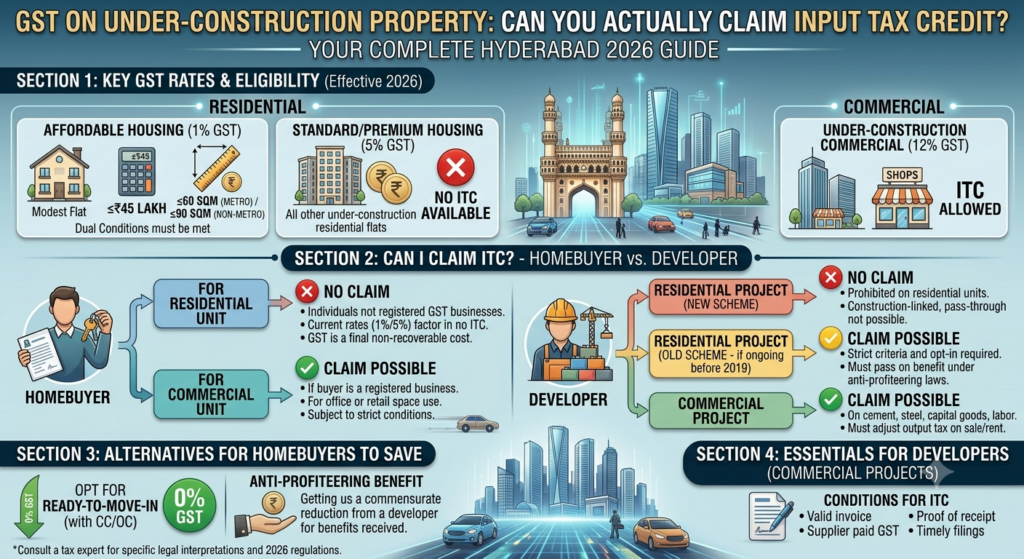
No. Individual homebuyers cannot claim Input Tax Credit (ITC) on the GST paid for an under-construction residential property. Since April 1, 2019, residential flats are taxed at 1% (affordable housing) or 5% (other residential properties) without ITC. Only eligible GST-registered businesses can claim ITC under specific conditions.
There are few questions about taxes that confuse homebuyers more than this one. One can easily search on the internet for GST on property, and you will quickly come across forum threads, blogs, and all sorts of people claiming that buyers can get GST back. That is not possible. Understanding why this is not possible requires an explanation of what Input Tax Credit means, who is eligible to claim Input Tax Credit, and how a recent Supreme Court ruling on business properties changed things.
This article provides answers to these issues in a clear manner and explains to whom Input Tax Credit may be claimed. It also elaborates the different amounts of GST that you will be paying on the purchase of an under-construction property.
Can a Homebuyer Claim GST Input Tax Credit?
No. If you are a person purchasing a flat under construction for personal use, you cannot apply Input Tax Credit on GST paid on the purchase of any under-construction residential flat since April 1st, 2019, when GST Council changed the tax rates on residential real estate. The affordable housing category has an applicable tax of 1% and other residential properties have a tax of 5% without the benefit of Input Tax Credit.
Be Among the First to Own a Legacy
Before this change, residential property was taxed at a higher rate of 12% (effectively around 8% after a land abatement), but builders were permitted to claim ITC on their construction inputs and, in principle, pass some of that benefit downstream. The 2019 reform did away with that entirely for residential purchases. The lower headline rate was the trade-off for removing ITC, not an addition on top of it.
So when a buyer asks whether they can claim ITC on their flat, the honest answer has two parts. First, no, not under the current residential GST structure, regardless of when the project was launched or how the builder chooses to describe it. Second, even under the earlier regime where ITC technically existed in the supply chain, it was the builder who claimed it against materials and services purchased for construction, not the individual buyer against the price paid for the flat. There has never really been a scenario where a residential homebuyer, as a private individual with no GST registration of their own, could personally claim credit on their own purchase.
What Is Input Tax Credit (ITC) Under GST, in Plain Terms
To understand why the answer is no, it helps to understand what ITC is actually built for.
GST is a multi-stage tax. At every point in a supply chain, from raw material to finished product or service, GST gets charged. Without some mechanism to offset this, tax would compound at each stage, a phenomenon known as cascading. Input Tax Credit exists precisely to prevent that. It allows a GST-registered business to reduce its own GST liability by the amount of GST it has already paid on the goods and services it purchased to run its business.
A simple example outside real estate makes this clearer. A furniture manufacturer buys wood and pays GST on that purchase. When the manufacturer sells finished furniture, GST is charged again, this time on the sale price. Instead of paying tax on the full sale value, the manufacturer offsets the GST already paid on the wood against the GST collected on the furniture, and pays only the difference to the government. That offset is Input Tax Credit.
The critical requirement is GST registration. ITC is a mechanism available to registered taxpayers operating within the supply chain, not to the final consumer who buys the finished product or service for personal use. An individual purchasing a flat to live in is, in GST terms, exactly that: a final consumer. There is no further supply chain step where the GST paid on the flat gets offset against anything, because the transaction ends there. This is the structural reason a residential buyer was never really the intended beneficiary of ITC in the first place, even before the 2019 rate change made the point moot for residential property specifically.
Why ITC Was Removed for Residential Property in 2019
The pre-2019 structure sounded reasonable on paper. Builders paid GST on cement, steel, and various construction services, claimed ITC on those inputs, and were expected to pass the resulting cost reduction on to buyers through a lower effective price, even while the headline GST rate on the flat itself sat around 12%, or roughly 8% after the standard land value deduction.
In practice, this rarely worked as intended. An investigation performed by the GST Council and tax authorities revealed that a significant portion of builders were not transferring the benefit of ITC to their customers in a transparent manner. Instead, these builders were eating into their margins without making any reflection of ITC on the actual prices paid by the buyers. The enforcement of anti-profiteering provisions, aimed at stopping this behavior, was challenging to effectively implement across numerous projects.(Source)
There was also a genuine compliance burden on builders, who had to track and apportion input credits across multiple projects, some entirely residential, others mixed with commercial components, each with different eligibility.
Faced with this, the GST Council opted for a structural fix rather than a compliance fix. From April 1, 2019, new residential projects were shifted to a simpler regime: sharply reduced headline rates of 1% for affordable housing and 5% for other residential property, with ITC removed from the equation entirely.
The logic was straightforward. If builders could no longer claim credit on their inputs, that cost would be baked into the price they charged, but the buyer’s final GST liability would be calculated at a much lower rate than before, arguably producing a more predictable and transparent outcome than relying on builders to pass through an opaque credit.
Ongoing projects as of March 2019 were given the option to continue under the old 12% or 8% regime with ITC, or move to the new lower-rate, no-ITC structure, but this transitional choice is now largely historical, since very few such projects remain under construction today.
Who Can Actually Claim ITC: Developers, Contractors, and Commercial Buyers
This is where the picture genuinely does have more than one answer, and where most of the confusion online originates from conflating different categories of buyers and builders.
Developers on residential projects under the current regime cannot claim ITC on their construction inputs. This is the direct counterpart to the lower 1% and 5% rates. The trade-off cuts both ways: builders accepted the loss of ITC in exchange for a simpler, lower headline tax rate that is easier to price and sell against.
Contractors and sub-contractors working on commercial projects, or on residential projects that remained under the old ITC-eligible scheme, can generally claim ITC on the materials and services they purchase, subject to the usual GST conditions around registration, invoicing, and timely filing.
Buyers or lessors of commercial property occupy a genuinely different position, and this is the category most relevant to the Safari Retreats ruling discussed below. A business that constructs or buys a commercial building, such as an office tower, warehouse, or shopping complex, with the specific intention of leasing it out and earning taxable rental income, may in certain circumstances be entitled to claim ITC on the GST paid during construction.
This is not automatic, and it does not apply to buying commercial space simply as an investment to sit on. It requires that the property be used to generate a further taxable supply, in this case rental income on which GST is charged, and that the specific conditions carved out by the courts and the law are satisfied.
The dividing line, in short, runs between property built or bought to generate further taxable business activity, where ITC has a genuine, if conditional, place, and property purchased by an individual for personal residential use, where it structurally does not.
The Safari Retreats Ruling, Explained (and Why It Doesn’t Apply to Your Flat)
This is the ruling that gets cited most often, and misapplied most often, in online discussions of GST and property.
The case involved Safari Retreats, a company that constructed a shopping mall with the intention of leasing out units to tenants and earning rental income, on which it was liable to pay GST.However, the tax authorities refused the claim on the ground of Section 17(5)(d) of the CGST Act, which prohibits the input tax credit on purchase of goods and services used in the construction of immovable property owned by the taxpayer except for the case when it relates to the acquisition of plants and machinery.
In October 2024, the Supreme Court ruled in the company’s favour on the central legal question, introducing what has since been called the functionality test. The Court held that a building such as a mall or warehouse could, depending on the specific facts, be treated as a plant if it was constructed to serve a taxpayer’s particular business function, such as generating rental income through leasing, rather than simply serving as a passive setting for unrelated activity. Whether a given building actually meets that test, the Court said, must be assessed case by case, and it sent the specific question back to the Orissa High Court for a detailed factual determination on Safari Retreats’ own mall.
Two details matter enormously here, and both are frequently left out when this ruling gets cited to homebuyers. First, and most importantly for this article, the ruling applies specifically to commercial property constructed for renting or leasing as part of a taxable business activity. It has no application whatsoever to an individual buying a residential flat for personal use. A homebuyer is not registered under GST, is not leasing the flat out as a taxable commercial supply, and residential renting itself is exempt from GST in any case, which removes even the conceptual basis the ruling relies on. Nothing in the Safari Retreats judgment extends, directly or by implication, to a residential buyer’s ITC position.
Second, the practical strength of this ruling has itself been narrowed since the judgment was delivered. The tax authorities reject the plea on the basis of section 17(5)(d) of the CGST Act which prohibits the input tax credit on goods and services used for construction of the immovable property for one’s own use except wherein the property is treated as plant and machinery.
The upshot is that commercial developers and lessors now face a considerably more constrained path to claiming ITC than the original 2024 ruling suggested, even though the functionality test the Court established remains part of the legal reasoning on record. This is a live and evolving area of tax law, and commercial property investors relying on it should do so only with current professional advice, not a general understanding of a headline from 2024.
For a residential homebuyer, none of this changes anything. The ruling was never available to you, and the subsequent amendment only affects a category of taxpayer you were never part of.
How GST Is Actually Calculated on Your Under-Construction Flat
With the ITC question settled, the more useful exercise is understanding what you will actually pay.
GST on an under-construction residential property is not charged on the entire agreement value. Because a portion of what you pay is attributable to the value of the underlying land, and land itself is outside the scope of GST, the law provides a standard deduction of one-third of the total property value as deemed land value. GST is then charged only on the remaining two-thirds, which is treated as the construction or service component of the transaction.
The applicable rates will vary based on the classification of the property. Affordable housing is defined as residential dwellings with a carpet area of no more than 60 square meters in metropolitan cities and 90 square meters in non-metropolitan cities and costing no more than Rs. 45 lakhs, which attracts GST at 1% on the cost of construction without benefit of input tax credit.Any residential property that does not meet this definition is taxed at 5% on the construction value, also without ITC.
It is worth being clear about what this GST is charged on and what it is not. Stamp duty and registration charges are a separate state-level levy, calculated independently on the property’s guidance value or sale price, and are not part of the GST calculation at all. Some buyers often confuse the two terms and think GST covers the whole cost of buying the property, when in fact it is only applicable to the construction part of the under-construction purchase, and the registration fees are charged and paid separately.
Example Calculation:
GST on an under-construction flat of 75 Lakh. Let us consider case of an individual buying an under-construction flat in Hyderabad for an overall value of 75,00,000, in a project that is not considered as affordable housing which puts it in 5% GST slab.
Step 1: Deduct value of the land.The value of land is calculated as one third of 75,00,000 which will not attract any GST. Value of land is 25,00,000 Value of construction is 50,00,000.
Step 2: Calculation of GST amount: Rate of GST at 5% will be applied on value of construction. GST amount payable comes to 2,50,000.
Step 3: Find out total outlay. Value of agreement: 75,00,000 GST:2,50,000 Total cost before stamp duty and registration: 77,50,000
None of the amount of 2,50,000 will be available to the buyer for offsetting against his future liability, as there is no taxable supply coming up against it.
It is a final cost, in the same way stamp duty is a final cost, not a deposit against a future refund.
Do’s
- Confirm the GST rate (1% or 5%) applicable to your property before signing.
- Verify the property’s classification (affordable vs non-affordable housing).
- Ask the builder for a GST breakup in the cost sheet.
- Budget separately for GST, stamp duty, and registration charges, as they are different costs.
- Keep all GST invoices and payment receipts for your records.
- Consult a tax professional if you’re buying commercial property for business purposes.
Don’ts
- Don’t assume you can claim ITC just because you’re paying GST.
- Avoid confusing residential ITC rules with commercial property rules.
- Don’t rely on old articles discussing the pre-2019 GST regime.
- Avoid treating the Safari Retreats judgment as applicable to residential flats.
- Don’t assume the builder’s quoted price includes all statutory charges.
If the same apartment instead qualified as affordable housing under the 1% bracket, the calculation would follow the same structure with a lower rate: GST of ₹50,000 on the same ₹50,00,000 construction value, bringing the total outlay to ₹75,50,000. The difference in classification alone changes the final GST bill by ₹2,00,000 on a property of this size, which is precisely why buyers should confirm which bracket their purchase falls into before finalising a budget, rather than assuming the lower rate applies by default.
Buyers evaluating the true cost of a purchase should also account for stamp duty and registration charges alongside this GST figure, since together these two components, GST and state registration costs, make up the full statutory overhead on top of the builder’s quoted price. A clear breakdown of how stamp duty and registration charges are calculated helps complete the picture, and a broader look at the real cost of buying an apartment in Hyderabad in 2026 walks through how GST, stamp duty, registration, and other charges combine into the actual amount a buyer needs to budget for, beyond the headline price quoted in a brochure.
It is also worth checking, before signing anything, whether your builder is applying GST correctly in the first place. Incorrect classification, applying the wrong rate, or bundling ineligible charges into the taxable value are more common than buyers expect, and a closer look at whether your builder is charging GST correctly is a useful next step for anyone reviewing a builder’s payment schedule or cost sheet.
Key Takeaways
- Residential homebuyers cannot claim GST Input Tax Credit (ITC).
- Under-construction flats attract 1% or 5% GST without ITC.
- ITC is available only to eligible GST-registered businesses.
- The Safari Retreats ruling does not apply to residential homebuyers.
- GST, stamp duty, and registration charges are separate costs.
- Always verify your builder’s GST calculation before payment.