The Real Cost of Buying an Apartment in Hyderabad in 2026: Full Breakdown with Numbers
Here’s a scene that plays out at sales offices across Hyderabad on a near-daily basis. A buyer walks in having mentally budgeted ₹85 lakh, the number printed in the brochure, and walks out holding a cost sheet that reads closer to ₹1.02 crore. Nobody lied to them. The brochure price was accurate. It just wasn’t the whole story.
That gap between what’s advertised and what you actually pay is what this article is about. Stamp duty, GST; the builder’s extra charges for a good floor or a corner unit; the bank’s fees for lending you money; and the costs that show up only after you’ve got the keys – all of it adds up, and almost none of it is optional. If you’re trying to figure out the cost of buying an apartment in Hyderabad in 2026, the base price is really just your starting point, not your answer.
1.Why the Advertised Price Is Never the Final Price
The price you see on a hoarding or a property portal is the cost of the bare unit, the carpet area multiplied by a rate per square foot. That’s it. It doesn’t touch government charges, it doesn’t account for which floor or direction your specific flat faces, it says nothing about parking or the clubhouse, and it has zero relationship to what your bank will charge you for the loan.
This isn’t really a trick on the developer’s part; quoting a base price is just how the industry compares projects since it’s the one number that’s apples to apples across builders. The problem is buyers treat it as the final number and start planning the rest of their savings around furniture and a house-warming party. When you put everything else together, most of the time you end up with about 12 – 15% more than just the base price of a property. Pick a premium tower with a few PLC components stacked on top of each other, and that gap can stretch even further.
Be Among the First to Own a Legacy
Broadly, four categories sit above the base price: government charges (stamp duty, registration, and transfer duty); GST if you’re buying under construction; builder add-ons (PLC, parking, club fee, and maintenance deposit); and whatever your home loan costs beyond the interest rate. Let’s go through each one.
2.Stamp Duty and Registration Charges in Telangana: 2026 Rates
Of everything on this list, stamp duty and registration are at least predictable , the rates are fixed and published, so there’s no ambiguity once you know the property value GHMC or the relevant authority has assigned.
What will be in effect for purchases in Telangana in 2026:
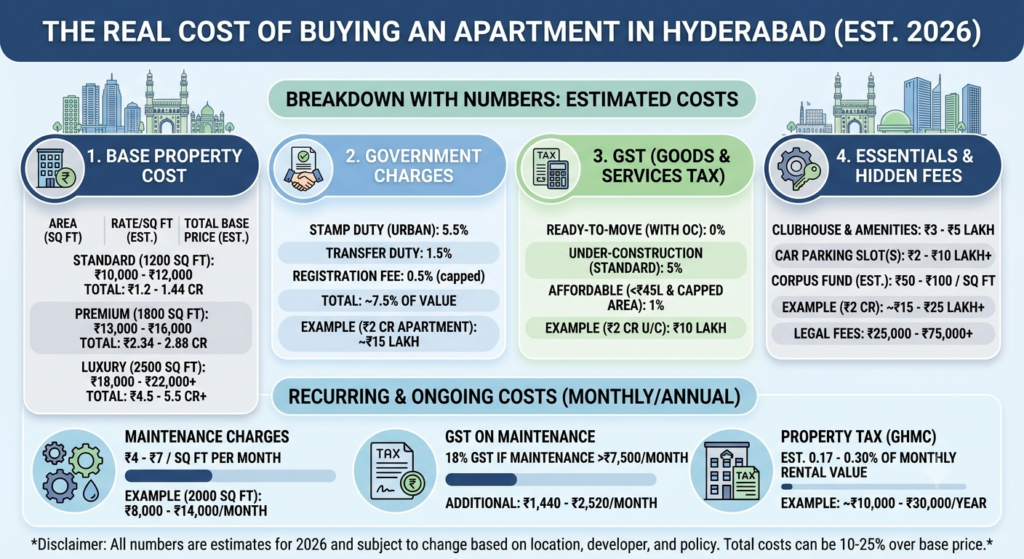
Stamp Duty in Telangana = 4% of the current Market Value of the property OR the actual price the Buyer will pay, whichever is higher. Registration adds another 0.5%, and transfer duty contributes 1.5%. Add the three together and you land at an effective 6% of the property value going straight to the state.
On a ₹1 crore flat, that’s ₹6 lakh ,before the developer has added a single rupee of their own charges.
One thing worth flagging: stamp duty is calculated on whichever is higher between your negotiated price and the government’s guidance value for that area. If you’re buying somewhere that’s recently seen its guidance values revised up, and several pockets of Hyderabad have your actual stamp duty bill could be higher than a back-of-envelope 4% calculation on your agreement value suggests. It’s worth getting your lawyer or the builder’s documentation team to confirm the current guidance value for your exact building and floor before you finalise a budget.
ASBL has covered this in more depth elsewhere, the piece on stamp duty and registration charges is worth a read before you head to the sub-registrar’s office.
3.GST on Apartment Purchase: When It Applies and How Much
This is probably the single most confusing line item for first-time buyers, mostly because it doesn’t apply uniformly.
The rule, stripped down: GST only applies to under-construction apartments. Once a project has its completion certificate or occupancy certificate, it’s no longer considered a “service” under GST law , it’s a property transfer, and that’s outside GST’s reach entirely. So a ready-to-move flat with a valid OC attracts zero GST.
If you’re buying something still being built, GST in 2026 is 5% of the agreement value, and there’s no input tax credit benefit attached to it , meaning the developer can’t offset it against what they’ve already paid on cement and steel and labour, so the full 5% lands on you as a real, unrecoverable cost.(Source)
On a ₹1 crore under-construction unit, that’s ₹5 lakh. There’s also a concessional 1% rate for affordable housing (units under ₹45 lakh meeting certain carpet area conditions), though that’s not particularly relevant if you’re looking at mid-segment or premium Hyderabad projects.
So if you’re looking at a flat that is under construction compared to one that is finished, don’t just look at the base prices of both. In taking an example of a flat sold as under construction for ₹95100000, upon the addition of GST you’ll find this will actually cost you ₹99750000, nearly the same as the full retail value of ₹1 crore for a finished flat that won’t have any GST.
So make sure you establish to yourself that you are getting a cheaper deal than what is shown to you before assuming your initial under-construction flat will be cheaper because you were shown that flat with no consideration for other item costs.Run that comparison before you assume the under-construction option is the cheaper one
4.Builder Charges: PLC, Parking, Club Membership, and Maintenance Deposit
This is where most of the genuine confusion lives, because unlike stamp duty or GST, none of this is standardised. Every developer prices it differently, and brochures almost never spell it out clearly.
PLC , Preferential Location Charge
Builders charge extra for units they consider more desirable: higher floors, corner positions with two open sides, pool or garden views, and east-facing flats.
It’s an add-on priced per square foot, and in Hyderabad in 2026 you’ll typically see anywhere from ₹100 to ₹400 per sq ft depending on the project and exactly what’s being charged for.
On a 1,500 sq ft flat, even a modest ₹200 per sq ft PLC adds ₹3 lakh. Stack a floor premium and a view premium together and you can be looking at 2-5% added to the total cost. Always ask for the complete PLC schedule before you compare units ,the price you saw advertised is almost certainly for the base-floor, no-PLC unit, not the one you actually want.
Parking
Covered parking is rarely bundled into the base price. A single covered slot typically runs ₹3-6 lakh depending on whether it’s stilt, podium, or basement. A second slot, if the project even allows one, costs roughly the same again. This isn’t refundable, and it’s genuinely part of what you’re paying for the unit, not a separate convenience fee you can skip.
Club Membership
Most gated communities in Hyderabad bundle in a clubhouse — gym, pool, function hall, the works — and charge a one-time, non-refundable membership fee for it. Expect ₹1.5 lakh to ₹3 lakh. Worth checking whether this is already folded into the price you were quoted or sitting as a separate line item waiting to surprise you.
Maintenance Deposit
Sometimes called a corpus fund contribution, this is a lump sum the developer collects at possession to keep the building running – security, housekeeping, and lift maintenance – until the Resident Welfare Association is formally set up. It usually works out to 12-24 months of monthly maintenance, somewhere between ₹1 lakh and ₹2.5 lakh for a decent mid-to-premium apartment. Once handed over, it generally becomes part of the society’s reserves and isn’t something you get back , different from a true security deposit. Monthly maintenance after that point is a separate, ongoing cost.
On negotiability: don’t expect much movement here. A PLC on a popular unit basically never moves. Parking is fixed. The club fee is fixed. If there’s room anywhere, it tends to show up during a project’s launch phase, where a developer might throw in a free parking slot or waive one PLC component to move early bookings. Treat that as a bonus if it happens , don’t build your budget assuming it will.
5.Home Loan Costs: What Banks Charge Beyond the Interest Rate
If you’re financing this purchase, and most buyers in Hyderabad are, the loan itself comes with its own set of charges that have nothing to do with the interest rate you’ll spend weeks negotiating.
Processing fee. This is what the bank charges to evaluate and sanction your loan in the first place. Expect 0.25% to 1% of the loan amount, subject to a cap that varies by lender. On a ₹75 lakh loan, even a modest 0.5% fee comes to ₹37,500. Some banks waive this during promotional periods; don’t bank on it (no pun intended) until it’s confirmed in writing.
Legal and technical verification. Before sanctioning anything, the bank sends its own lawyer to check the property’s title and its own valuer to inspect construction quality and confirm the valuation. You pay for both, usually ₹5,000 to ₹15,000 combined, and this is non-refundable even if your loan application doesn’t ultimately go through.
Loan insurance (HLPP). Most banks will strongly push – and some effectively require – a home loan protection plan, which pays off your outstanding loan if you die or are disabled during the tenure. This is paid either as a lump sum upfront (often rolled into the loan amount) or as annual premiums. On a ₹75 lakh loan over 20 years, a lump-sum premium can land anywhere from ₹1.5 lakh to ₹3 lakh depending on your age and health. Unlike the other charges here, this one’s actually doing something useful for you , but it’s still real money out of pocket.
MODT and franking. When the bank sanctions your loan, it registers a charge against the property through a Memorandum of Deposit of Title Deeds. This attracts stamp duty of roughly 0.1-0.2% of the loan amount plus franking charges , on a ₹75 lakh loan, expect another ₹7,500 to ₹15,000.
If you’re weighing whether to dip into your EPF corpus to reduce how much you need to borrow, ASBL’s guide on EPF withdrawal rules and home purchase strategy for 2026 is worth reading before you decide on the financing mix.
6.Post-Possession Budget: Interior, Utilities, and Maintenance
Getting the keys is not the finish line. There’s still a meaningful chunk of spending ahead before the place is actually liveable.
Interior work. A bare-shell apartment needs flooring, a kitchen fit-out, wardrobes, painting, light fixtures, bathroom fittings – none of which is included unless you’ve specifically bought into a furnished or semi-furnished project. Even with restrained taste, budget ₹8-15 lakh for a 1,500 sq ft flat. Semi-furnished or fully furnished units cost less to finish, but you’ve already paid a premium for that at purchase, so it tends to even out.
Utility deposits. Water, electricity, gas pipeline connections where applicable, and internet each come with its own deposit and sometimes a connection fee. Approx you should expect to budget ₹30000 – ₹70000 for other items.
Monthly maintenance. Once the RWA is up and running, maintenance kicks in typically ₹2 to ₹5 per sq ft per month for gated communities in Hyderabad. On a 1,500 sq ft unit, that’s ₹3,000 to ₹7,500 every month, indefinitely. People budget for the one-time costs and somehow forget this is recurring forever. Don’t make that mistake when you’re working out affordability.
And if you’ve taken a floating-rate loan, it’s worth knowing the rules around prepayment before you’re locked into a fee structure you didn’t expect. ASBL’s piece on avoiding home loan foreclosure charges walks through the current RBI rules on this.
7.A Worked Example: Total Cost of a ₹1 Crore Apartment in Hyderabad
Now let’s use an example. You’re buying a flat that is approximately 1500 sq/ft under construction located in a gated community with a base price of ₹100000000.
| Cost Head | Basis | Amount |
| Base Price | Given | ₹100,000,000 |
| Stamp Duty (4%) | On ₹1 crore | ₹400,000 |
| Registration (0.5%) | On ₹1 crore | ₹50,000 |
| Transfer Duty (1.5%) | On ₹1 crore | ₹150,000 |
| Government Charges Subtotal | ₹600,000 | |
| GST (5%) — Under Construction | On ₹1 crore | ₹500,000 |
| PLC (higher floor + east-facing) | ~₹200/sq ft × 1,500 sq ft | ₹300,000 |
| Covered Parking | 1 slot | ₹400,000 |
| Club Membership | One-time | ₹200,000 |
| Maintenance Deposit | ~18-month corpus | ₹150,000 |
| Builder Charges Subtotal | ₹1,050,000 | |
| Home Loan Processing Fee (0.5% on ₹75L) | ₹37,500 | |
| Legal + Technical Verification | ₹12,000 | |
| MODT + Franking | ₹10,000 | |
| HLPP Insurance (approx.) | ₹200,000 | |
| Loan-Related Subtotal | ₹259,500 | |
| Interior Work (modest) | 1,500 sq ft | ₹1,000,000 |
| Utility Deposits & Connections | ₹50,000 | |
| Post-Possession Subtotal | ₹1,050,000 | |
| Grand Total | ~₹1,35,09,500 |
That ₹1 crore flat ends up costing roughly ₹1.35 crore once everything is in, about 35% over the headline number, though admittedly a chunk of that is the interior work, which you could technically defer or do in stages. This flat, after adding all of the associated costs, will cost approximately ₹125000000 and is therefore how you should pretty much budget your funds available to you in comparison to what your builder has quoted you.(Source)
FAQs
1.What is the property registration stamp duty rate in Telangana in 2026?
In Telangana, the stamp duty fee is 4% of your purchase price or the property’s market value, whichever is less. After adding registration fees at 0.5%, plus transfer tax rates of 1.5%, the total amount due will be about 6% of the sale price. For a ₹1 crore apartment, this means ₹6 lakh in government charges alone — before any builder or loan costs.
2. Am I responsible for paying GST on an apartment in Hyderabad?
If you purchase an apartment that has yet to be finished (referred to as an under-construction unit), you must pay 5% GST (without an Input Tax Credit) on your purchase price. However, no GST will be charged on completed apartments (or those having received a Completion Certificate or Occupancy Certificate prior to sale). If you’re in the market to buy an under-construction flat, be sure to take into account GST will increase your total purchase price by quite a bit of money.
3. What is a Preferential Location Charge (PLC) in a real estate project?
A PLC is an additional charge levied by builders for apartments considered more desirable, such as those on higher floors, with garden-facing or corner views, or in a premium tower. PLC is over and above the base price and can add 2–5% to your total cost depending on the project and the specific unit. Always ask for a full PLC schedule before comparing projects.
4.Is the maintenance deposit refundable when I sell the apartment?
The maintenance deposit collected by the builder or society is typically a one-time refundable security deposit held for the life of your ownership. It is returned when you sell or transfer the apartment, subject to any dues owed to the society. Confirm this in writing in your sale agreement, as practices vary between projects.
5.What other costs should I anticipate in addition to the base cost of an apartment in Hyderabad?
Generally speaking, if you are attempting to figure out what type of funds (in addition to your base purchase price) you are going to need at closing, plan (minimally) on funding for an additional 12% -15% added to your base purchase price for potential closing costs related to Stamp Duty ($5K – 6K), GST if purchasing an under-construction apartment (5%), induction chilling unit placement fee or parking fees ($2K – 3K), and home loan closing costs ($3K – 4K – typically this can run anywhere from $200 – $600, but can go as high as $2K or more).For a ₹1 crore apartment, this translates to roughly ₹12–15 lakh in additional costs before you move in — more once you factor in interiors.
6.What are the hidden costs of buying a flat in Hyderabad that people usually miss?
The ones buyers consistently underestimate: PLC (because it’s never in the brochure price), MODT and franking on the loan, club membership, the maintenance deposit, and HLPP insurance. Together these can add ₹7-10 lakh on a ₹1 crore flat, over and above what most people already expect to pay in stamp duty and GST.
7.Can any builder charges be negotiated when buying a flat?
Not really, for the most part. A PLC on a desirable unit almost never moves. Parking and club charges are fixed line items. Where you sometimes find flexibility is during a project’s early launch window, when developers occasionally throw in a complimentary parking slot or waive part of a PLC charge to move bookings. Once a project is well into its sales cycle, those concessions tend to vanish — so plan as if every charge is fixed, and treat any waiver as a pleasant surprise.
8.What home loan charges should I account for beyond the interest rate?
Beyond interest, factor in the processing fee (0.25-1% of the loan amount), legal and technical verification (₹5,000-15,000), MODT and franking charges (0.1-0.2% of the loan amount), and home loan protection insurance. Together these typically add ₹2.5-3.5 lakh on a ₹75 lakh loan worth knowing before you pick a lender purely on the interest rate they’re quoting.