Complete Vastu Guide for Apartments & Homes in 2026 (Room-by-Room)
Quick Answer
Vastu Shastra links each direction of a home to a natural element, such as fire in the southeast or earth in the southwest. In 2026, most Indian apartment buyers will use it as a practical checklist rather than a rigid rulebook. The ideal setup places the entrance and pooja room in the north or northeast, the kitchen in the southeast, and the master bedroom in the southwest. Where a flat cannot match this exactly, simple remedies like colour, lighting, and furniture placement can correct most imbalances.
Buying or furnishing a home in 2026 still brings up one old question for many Indian families. Is this flat aligned with Vastu? The answer matters less for superstition and more for daily comfort. A well-planned layout gets more sunlight, better airflow, and smoother movement between rooms.
This guide walks through every major room, explains the reasoning behind each placement, and shows what to do when a flat’s layout cannot be changed.
What Vastu Shastra Actually Is, and the Framework Behind It
Vastu Shastra is an ancient Indian system of architecture. It guides how rooms, doors, and furniture should sit in relation to the eight cardinal and intercardinal directions. The goal is a home that feels balanced, healthy, and quietly prosperous, according to a room-by-room guide from Koltepatil.
The system rests on five elements, known as the Panch Tatva: earth, water, fire, air, and space. Each element governs a specific direction. Northeast holds water and spiritual energy. Southeast holds fire. Southwest holds earth and stability.
Northwest governs air and movement. North is tied to wealth, while the centre of a home, called the Brahmasthan, should stay open and light.
This direction-to-element logic explains why the same handful of rules repeat across every room. A kitchen sits in the southeast because fire belongs there. A pooja room sits in the northeast because water and spirituality belong there. Once this framework is clear, individual room rules stop feeling random.
| Direction | Element | Best Used For |
|---|---|---|
| Northeast | Water, space | Pooja room, entrance, open areas |
| Southeast | Fire | Kitchen, electrical equipment |
| Southwest | Earth | Master bedroom, heavy storage |
| Northwest | Air | Guest room, storage, staircase |
| North | Wealth energy | Living room, main entrance |
Main Entrance and House Facing Direction
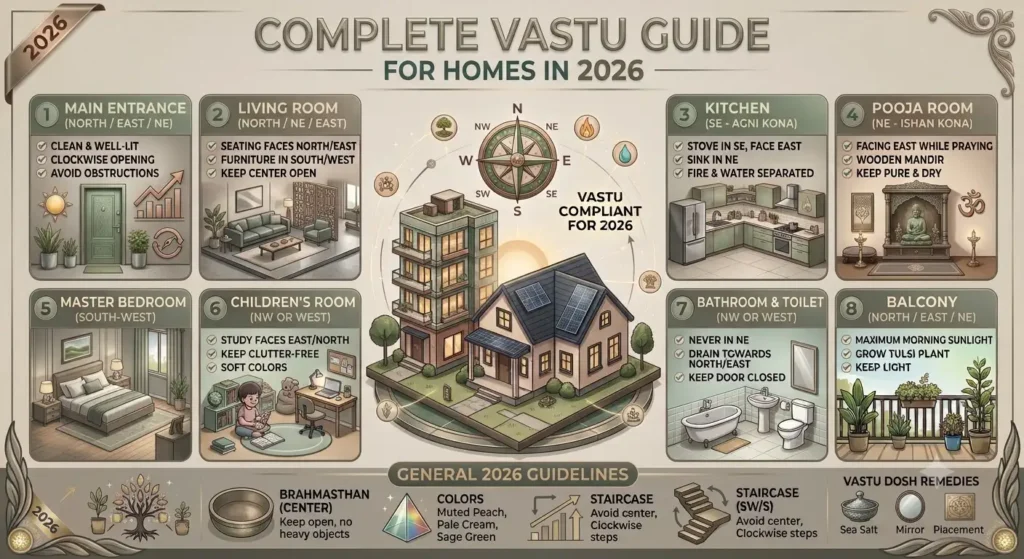
The main entrance is the point where energy, light, and air first enter a home, and it sets the tone for everything behind it. North, east, and northeast are considered the most favourable directions for a main door, since they welcome morning sunlight into the house.
Be Among the First to Own a Legacy
A north-facing entrance is often linked to Kuber, the deity of wealth, which makes it a popular pick among business owners, according to a 2026 guide from Savitar Realty. West-facing homes are not considered inferior. They simply follow a different set of placement rules for the same auspicious outcome.
Worked example: A buyer is choosing between two 2BHK flats in the same tower. Flat A has its main door in the northeast corner with an open corridor outside. Flat B has its door in the southwest, right beside a lift shaft. Former is the stronger Vastu choice, since the entrance direction and surrounding openness both favour the northeast zone.(Source)
Do’s and don’ts for the entrance:
- Do keep the entrance well lit and free of clutter.
- Do use a threshold or step that is slightly raised.
- Don’t place a staircase directly facing the main door, since this is believed to drain energy before it settles inside.
- Don’t paint the entrance in dark, heavy colours.
Living Room and Common Areas
The living room works best in the north, east, or northeast, since these zones stay naturally open, social, and sunny. Even in a compact apartment, the underlying principle holds: keep shared seating areas close to light and air.
Furniture placement matters as much as the room’s direction. Sofas placed against the south or west wall, facing north or east, allow residents to face the direction of incoming energy. The northeast corner of the living room should stay clean and open rather than crowded with furniture.
Heavy showpieces, oversized furniture, or dark colour schemes work against the room’s purpose. Light yellow, cream, and soft green are commonly recommended shades for this space, since they keep the mood calm without feeling closed in.
Kitchen: The Fire Element and Where It Belongs
The kitchen is one of the most important rooms in Vastu, since it feeds the entire household. Southeast is the ideal direction, aligning directly with the fire element that governs cooking.
The stove should sit in the southeast corner of the kitchen. While cooking, the person at the stove should ideally face east. This detail is repeated consistently across multiple 2026 Vastu guides, which points to it being one of the more settled recommendations in the tradition.
Where southeast is not available in a fixed floor plan, northwest is treated as the next best option. Kitchens should never be placed in the northeast, since fire and water elements are believed to clash there.
| Kitchen Element | Ideal Placement |
|---|---|
| Stove | Southeast corner |
| Cook’s facing direction | East |
| Sink and water storage | Northeast within the kitchen |
| Refrigerator | Southwest or west |
Master Bedroom and Other Bedrooms
Bed placement carries its own set of rules. The head of the bed should point south or east, never north, since sleeping with the head pointing north is thought to disturb rest. A bed placed directly in line with the door, sometimes called the coffin position, is flagged as a common mistake across several guides.
Children’s or guest bedrooms fit comfortably in the west or northwest zones. These directions carry lighter energy, suited to rooms used less often than the master bedroom.
Worked example: A couple’s master bedroom sits in the southeast of their flat, the fire zone, rather than the southwest. Instead of relocating a fixed wall, they can shift the bed itself to the southwest-facing corner of that same room and repaint using cooler, calming tones. This keeps the sleeping zone aligned even though the room itself sits in a less ideal direction.
Pooja Room: The Spiritual Heart of the Home
Northeast is the most auspicious direction for a pooja room, with north and east also considered acceptable. Idols should ideally face west, so the person praying faces east while worshipping.
The pooja room should never sit under a staircase, against a shared bathroom wall, or inside a bedroom, since these placements are believed to disturb the sanctity of the space. Keeping this corner clutter-free is treated as more important than almost any other single Vastu rule in the home, since the northeast governs the entire property’s energy flow.
Pros and cons of common pooja room locations:
- Northeast corner: Strongly recommended; supports spiritual focus and natural morning light.
- Living room alcove: Workable if kept separate from shoe racks or television units, though not ideal.
- Kitchen corner: Common in small flats, but discouraged, since fire and spiritual energy are considered a mismatch.
- Under the staircase: Avoided entirely; treated as one of the most common mistakes in Indian homes.
Bathroom and Toilet Placement
Bathrooms and toilets represent drainage and waste elimination, so Vastu treats this energy as something to contain rather than let spread through the home. Northwest is the recommended zone for toilets, while northeast should always be avoided.
Cleanliness and plumbing quality matter more day to day than direction alone, and a well-maintained bathroom will always feel better than one placed in a technically perfect corner but poorly built.
Common bathroom mistakes worth avoiding include placing a toilet directly beneath a staircase and positioning a bathroom door facing the kitchen or pooja room.
Staircase, Balcony, and Water Elements
Staircases are treated as the spine of a home, carrying energy between floors. South, west, and southwest are considered the strongest locations, since these directions are naturally heavier and suit the weight of a staircase.
The northeast and the exact centre of the home should never carry a staircase, since both zones are meant to stay light and open. Stairs are also recommended to rise in an odd number of steps and move in a clockwise direction where possible.
Balconies work as the interface between a home and the outside world, receiving outdoor energy before it reaches interior rooms. North and east balconies are considered ideal, and these should generally be kept more open than balconies on the south or west side.
Applying Vastu to an Apartment You Can’t Change
Most apartment buyers cannot move a fixed kitchen wall or shift a bathroom to another corner after construction. This is the single biggest gap between traditional Vastu texts and modern apartment living, and it deserves an honest answer rather than a workaround dressed up as a full fix.
Two situations cover almost every reader here. The first is choosing a flat before signing, where alignment can still be evaluated and compared across units. The second is living in a flat that is already built, where remedies rather than redesign become the practical path forward.
For those still choosing a flat, the priorities are the entrance direction, the kitchen zone, and the placement of the pooja corner, since these three are hardest to correct later. For those already settled in, colour choices, furniture repositioning, mirrors, and decluttering specific zones can meaningfully soften a layout that isn’t textbook perfect.
| Situation | What Can Be Adjusted | What Usually Cannot |
|---|---|---|
| Choosing a flat | Entrance direction, unit orientation | Nothing yet, decision stage |
| Living in a fixed layout | Furniture, colour, lighting, clutter | Kitchen or bathroom wall position |
| Renovating | Non-structural walls, storage zones | Load-bearing walls, plumbing lines |
Do’s
- Keep the northeast area clean, open and clutter-free.
- Prefer north, east or northeast for the main entrance.
- Place the kitchen in the southeast where possible.
- Position the master bedroom in the southwest.
- Keep the pooja room in the northeast, north or east.
- Consider ventilation, sunlight and construction quality alongside Vastu.
- Use furniture, lighting and colours to make practical adjustments in fixed layouts.
Don’ts
- Don’t treat Vastu as a substitute for good planning and construction quality.
- Avoid cluttering the northeast corner.Avoid placing the kitchen in the northeast.
- Avoid placing the master bedroom in the southeast when alternatives are available.
- Don’t place the pooja room under a staircase or against a bathroom wall.
- Avoid placing toilets in the northeast.Don’t compromise everyday functionality just to follow a Vastu rule.
What to Check for Vastu During a Site Visit
A site visit is the best chance to evaluate a flat’s Vastu before signing anything. Carry a compass or a reliable compass app, since even a small directional error can throw off the entire assessment.
Start at the main entrance and confirm whether it faces north, east, or northeast. Then walk through and note where the kitchen, bathrooms, and staircase actually sit relative to the unit’s overall shape. An irregular or cut floor plan is generally considered weaker than a simple square or rectangular layout.
Beyond direction, structural quality deserves equal attention. Dampness, uneven flooring, and poor ventilation affect daily comfort regardless of what the compass says. A flat with strong construction quality and a reasonably good directional fit will usually outperform one that is textbook perfect on paper but poorly built.
Key Takeaways
- Vastu maps five elements to eight directions, and this logic explains almost every room rule in this guide.
- Northeast suits the pooja room and entrance, southeast suits the kitchen, and southwest suits the master bedroom.
- A fixed apartment layout can still be improved through colour, furniture placement, and decluttering, even without structural changes.
- Site visits should combine directional checks with basic construction quality, since both affect daily living.
- Consistent small habits, like keeping the northeast corner clear, matter more than chasing perfection in every single room.