Home Selling Document Checklist 2025: Every Paper You Need to Sell Property in India
Most of the time when you sell a property in India it gets delayed because of missing papers. This happens after someone wants to buy your property. If you are getting ready to sell your flat or plot in Hyderabad you should get all your papers in order before you put it up for sale. This is the way to make sure you can sell your property on time and for a good price.
What follows is a list of all the papers you need to sell a property in India in Telangana and in areas that are under the GHMC and HMDA. We will let you know which documents to obtain, from where to obtain them, and what could happen if you do not have them.
Key Takeaways:
You should have five different documents in order to sell a property, such as Sale Deed, Title Deed, Encumbrance Certificate, Occupancy Certificate, and Property Tax Receipts.
In Hyderabad you need to pay any money you owe to the GHMC before you sell your property.
If you do not have an Occupancy Certificate it will be hard for buyers to get a home loan. That means you will have fewer people who want to buy your property.
If you got the property from someone who passed away you need to get a Legal Heir Certificate and a No Objection Certificate from all the people who have a claim to the property.
If you sell a property after you have owned it for two years you will have to pay a tax of 12.5% on the money you make from the sale.
Why You Need to Have All the Papers When Selling a Property
When you sell a property in India it is not a private deal between you and the buyer. It is a transfer of ownership that the government records. The government will not record the sale unless you have all the papers. The buyers bank will also not give them a home loan unless they can verify all the papers.
If you are missing any papers the buyers lawyers can. Cancel the sale. Even if you are missing one paper it can delay the sale by six to twelve weeks.
You should start getting all your papers in order soon as you decide to sell your property not when someone wants to buy it.(Source)
The Master Checklist: Legal, Financial and Building Approval Papers
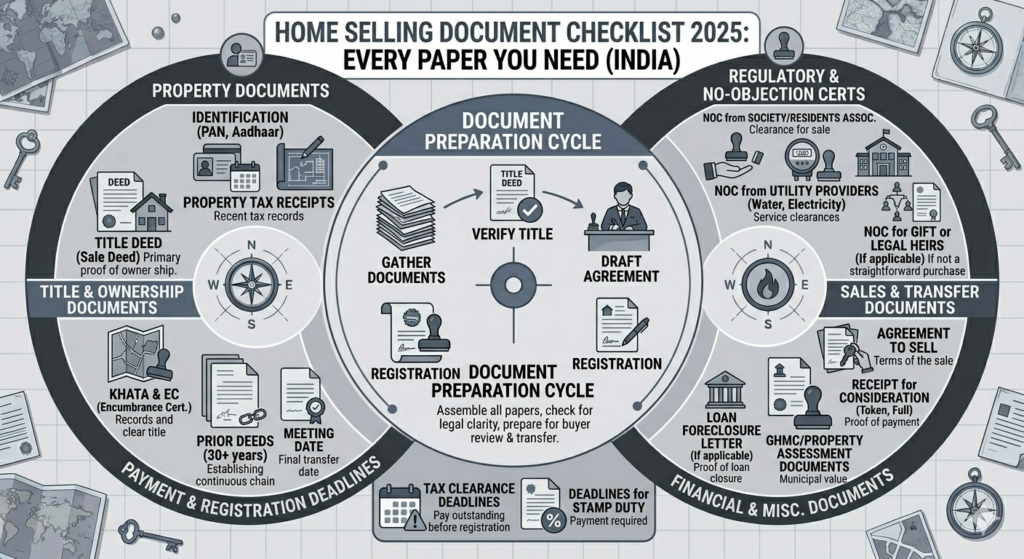
The table below lists all the papers you need to sell a property in India what each paper proves and where you can get it in Telangana.
You need to have all the papers from the financial and building approval categories before you can sell your property. If you are missing any papers it can delay the sale.
| Document | What It Proves | Where to Obtain |
|---|---|---|
| LEGAL DOCUMENTS | ||
| Original Sale Deed | Proof of ownership of the property | Sub-Registrar Office or from the seller from whom the property was purchased |
| Title Deed / Mother Deed | Establishes the chain of ownership and title history | Sub-Registrar Office or IGRS Telangana records |
| Encumbrance Certificate (EC) | Confirms that the property is free from legal liabilities, loans, or claims | IGRS Telangana portal or Meeseva Centre |
| General Power of Attorney (GPA) | Authorizes another person to act on behalf of the owner in property transactions | Registered or notarized GPA document |
| FINANCIAL DOCUMENTS | ||
| Property Tax Receipts | Proof that all property taxes have been paid | GHMC online portal or local GHMC ward office |
| Home Loan NOC / No Dues Certificate | Confirms that the home loan has been fully repaid | Lending bank or financial institution |
| Society No Dues Certificate | Confirms that all maintenance and society charges have been cleared | Apartment Association or Housing Society |
| TDS Certificate (if applicable) | Proof that Tax Deducted at Source has been deposited with the government | Buyer’s accountant or Form 16B records |
| BUILDING APPROVAL DOCUMENTS | ||
| Occupancy Certificate (OC) | Certifies that the building is fit for occupation and complies with approved plans | GHMC or HMDA portal |
| Sanctioned Building Plan | Confirms that construction was carried out according to approved plans | GHMC, HMDA, or Developer Records |
| HMDA Layout Approval | Confirms that the plot is part of an approved layout | HMDA records |
| TS-RERA Registration Certificate | Confirms that the project is registered under Telangana RERA | TS-RERA portal |
| Completion Certificate (CC) | Confirms that construction has been completed as per approved plans | GHMC or HMDA |
Legal Papers: Sale Deed, Title Deed, Encumbrance Certificate
Original Sale Deed
The original sale deed is the paper that proves you own the property. It is the agreement that you signed when you bought the property. You need to have the sale deed to sell the property. If you do not have it you need to get it from the bank or the person who sold it to you.
You should keep the sale deed in a safe place. You can get a copy of it from the Sub-Registrar Office. The buyer and their lawyers will need the original when they register the sale.
Title. Mother Deed
The title deed shows who owned the property before you. It is like a history of the property. The mother deed is the paper that shows who owned the property. You need to have both the title deed and the mother deed to prove that you own the property.
If there is a break in the chain of ownership it can cause problems when you sell the property. The buyers lawyers will check the title deed and the mother deed to make sure that you own the property.
Encumbrance Certificate
The encumbrance certificate is a paper that shows if there are any loans or other claims on the property. You can get it from the IGRS Telangana portal or from a Meeseva office. The encumbrance certificate should show that there are no loans or other claims on the property.
Financial Papers: Property Tax Receipts, Home Loan NOC, Capital Gains
Property Tax Receipts
You need to pay your property taxes before you sell your property. If you do not pay your property taxes the buyer will have to pay them. You can get the property tax receipts from the GHMC portal or from the GHMC ward office.
You should get the property tax receipts for the three years. If you have any dues you need to pay them before you sell your property.
Home Loan NOC and No Dues Certificate
If you took a home loan to buy the property you need to get a No Objection Certificate from the bank. The No Objection Certificate shows that the bank has no problem with you selling the property. You also need to get a No Dues Certificate that shows you paid off the loan.
You can get these certificates from the bank that gave you the loan. You should get them before you start selling your property.(Source)
Building Approval Papers: OC, HMDA Plan Approval, TS-RERA Certificate
Occupancy Certificate
The occupancy certificate is a paper that shows that the building is safe to live in. You can get it from the GHMC or HMDA portal. If you do not have an occupancy certificate it can be hard for buyers to get a home loan.
You should get the occupancy certificate before you sell your property. You can read our guide to learn more about the occupancy certificate and how to get it.
Hyderabad-Specific Requirements: GHMC, HMDA and TS-RERA
If you are selling a property in Hyderabad you need to follow some rules. You need to get a No Objection Certificate from the GHMC if you are selling a property within the GHMC limits. You also need to pay any property taxes before you sell your property.
If you are selling a property outside the GHMC limits but within the HMDA area you need to get an HMDA layout approval. This shows that the plot is in an approved area. You also need to pay any betterment charges that’re due.
You should get all the papers before you sell your property. This will make the process easier and faster. You can read our guides to learn more, about the papers and how to get them.
When you are selling a property in Hyderabad you need to do the TS-RERA verification. Buyers in Hyderabad always check the RERA registration details before they commit to buying a property. So you should keep the RERA certificate and the project registration number where you can easily find them.
For projects where the original developer registered under RERA the certificate should be available in the documents that are handed over to you when you take possession of the property.
Selling Inherited Property: Documents Needed in Telangana
When the property is inherited and being sold then there are some additional documents which are required to be produced at the Sub Registrar Office prior to its registration.
*Death Certificate: In order to prove that the property has been passed on to the owner via the inheritance route, he will have to present the death certificate of the previous owner.
*Legal Heir Certificate: It is issued by the Tahsildar of the revenue division and bears the names of all the legal heirs of the deceased person.
This certificate is very important when you are selling an inherited property. It usually takes two to four weeks to get it.
*Succession Certificate: You need this certificate for assets but sometimes courts also ask for it in property matters if the inheritance is disputed or complex.
*Probate Order: If the deceased person left a will and that will is being executed you may need a Probate Order from the court depending on the state and the value of the estate.
*Mutation of Records: The revenue records at the Mandal Revenue Office must show the inherited property in your name. If the property is not mutated it can create title ambiguity that buyers banks will not accept.
*NOC from All Co-Heirs: If there are legal heirs and only one or two of you are selling the property the others must give you a No Objection Certificate. If any co-heir is living abroad the NOC needs to be notarised and apostilled in the country where they live which can take a lot of time and coordination.
I know of a case that shows the risk. Three siblings were selling an inherited flat in Kukatpally. They found out at the SRO that they needed both the Legal Heir Certificate and a signed notarised NOC from all co-heirs. One sibling was living overseas. Getting the overseas NOC notarised, apostilled and couriered to Hyderabad took three months. The buyer waited,. The deal almost collapsed twice. If they had done a document audit six weeks before listing the property they would have known about this requirement in time to manage it.
Capital Gains Tax When Selling Property: What You Owe and How to Reduce It
There are two types of capital gains: term and long-term.
* Short-term capital gains happen when you sell a property within 24 months of buying it. The gain is added to your income and taxed at the applicable income tax slab rate, which can be as high as 30% plus surcharge for higher income brackets.
* Long-term capital gains happen when you sell a property after holding it for than 24 months. The gain is taxed at 12.5% (this is a rate that was introduced after the Budget 2024). You do not get the indexation benefit that used to allow sellers to increase the cost of acquisition for inflation if the property was sold after July 23 2024.
For example lets say you bought a flat in 2019 for ₹60 lakh and sold it in 2025 for ₹1.2 crore. The long-term capital gain is ₹60 lakh.The tax liability is ₹7.5 lakh with no indexation adjustment available under the revised rules. You should plan for this number before you commit to a sale price. If the net proceeds after tax do not meet your goal you may want to think about your timeline or reinvestment plan first.
You can reduce your tax liability under Sections 54 and 54EC.
* Section 54: If you reinvest the sale proceeds in a residential property the capital gains are exempt from tax. You must buy the property within 2 years or construct it within 3 years. One new property qualifies for the exemption.
* Section 54EC: If you invest the long-term capital gains in bonds issued by NHAI or RECL within 6 months of the sale the gains are exempt up to ₹50 lakh. These bonds have a lock-in period of 5 years.
Both exemptions are time-bound and require action after the sale is complete. You should talk to an accountant before the sale to structure your reinvestment plan not after the proceeds are in your account.
There is a lesson to learn from a planning failure. A seller in Kondapur listed their flat. Quickly got an offer.. When the buyers bank did the due diligence they found out that the sellers lender had not yet issued a No Dues Certificate. The bank put the disbursement on hold. The timeline slipped by six weeks while the seller coordinated with their lender to clear the NOC. The lesson is to start the NOC process least 8 to 10 weeks before listing the property not after you get an offer.
FAQs
Q1: What are the important documents to sell property in India?
The main documents you need to sell a property in India are the Sale Deed, Title Deed, Encumbrance Certificate, Occupancy Certificate, Property Tax Receipts, TS-RERA registration details and NOC from the housing society. If the property has a home loan you also need a Bank No Dues Certificate.
Q2: Is Occupancy Certificate mandatory to sell a flat?
Yes in Indian states, including Telangana, an Occupancy Certificate is required for legal occupancy and sale. Without it buyers may have trouble getting home loans. The transaction can be legally challenged.
Q3: What is an Encumbrance Certificate. Why is it needed?
An Encumbrance Certificate is a record of all transactions registered against a property, including mortgages, liens and charges. Buyers and banks need it to confirm that the property is free of legal encumbrances before they complete the sale.
Q4: How is capital gains tax calculated when selling property?
If you sell a property within 24 months of buying it it is short-term capital gains. The tax is the applicable income tax slab rate. If you hold the property for than 24 months it is long-term capital gains and the tax is 12.5% (post Budget 2024 without indexation). You can get exemptions under Sections 54 and 54EC if you reinvest the proceeds in property or specified bonds.
Q5: Can an NRI sell property in India?
Yes NRIs can sell property in India subject to FEMA regulations. The buyer must deduct TDS at 20% (or higher for short-term gains) on the capital gains at source. The sale proceeds can be repatriated through an NRO/NRE account, within limits after taxes are settled.