Land Patta Format Explained: History, Legal Standing & How to Get It in Telangana
Whenever you purchase or think of purchasing an agricultural land or a residential plot anywhere in Telangana, there’s a term you would most prominently get to heart: Patta.Whether you ask a property lawyer, a revenue official, or a seasoned buyer in Hyderabad whether a piece of land has a clean Patta, and if you are asking , in a single word ,whether its ownership is formally recognised, legally transferable, and safe enough to build on, borrow against, and pass to the next generation, you would get the same answer from almost everyone.
This blog gives a clear explanation of what a land Patta format contains,its origin, how it differs from Inam and other categories of the land, and how you can apply and verify one for yourself in Telangana’s current land records system.
What is Patta land? A plain-language definition
A Patta (or Pattadar Passbook) is an official land ownership document issued by the state government to the recorded owner, or Pattadar, of a plot of land. Derived from the Telugu and Urdu administrative lexicon, the word Patta has its roots in the governance of the Hyderabad area. The term Patta refers to a document proving a person has legal title over land and that they have to pay taxes on that land as required by law.
When it comes to administering Patta, the land has been identified as belonging to a particular person or entity and is located in government tax records; Patta has an established surveying boundary with an identified survey number and an established classification by use (residential, commercial, agricultural, etc.); and the owner has a legal right to sell, buy, mortgage, transfer, or inherit the land as permitted by other applicable laws. If the land is not held in Patta status, it will be difficult if not impossible to establish and enforce ownership.
No Sub-Registrar will register a sale deed, no bank will sanction a land loan, and no court will easily settle a dispute without reference to the Patta record. It is the foundational proof of private land ownership in Telangana.
Be Among the First to Own a Legacy
The historical roots of Patta: from Nizam era to modern Telangana
The land classification system Telangana inherited reaches back directly to the administrative structure of the Nizam’s Hyderabad State, which ruled the region until Operation Polo in 1948.
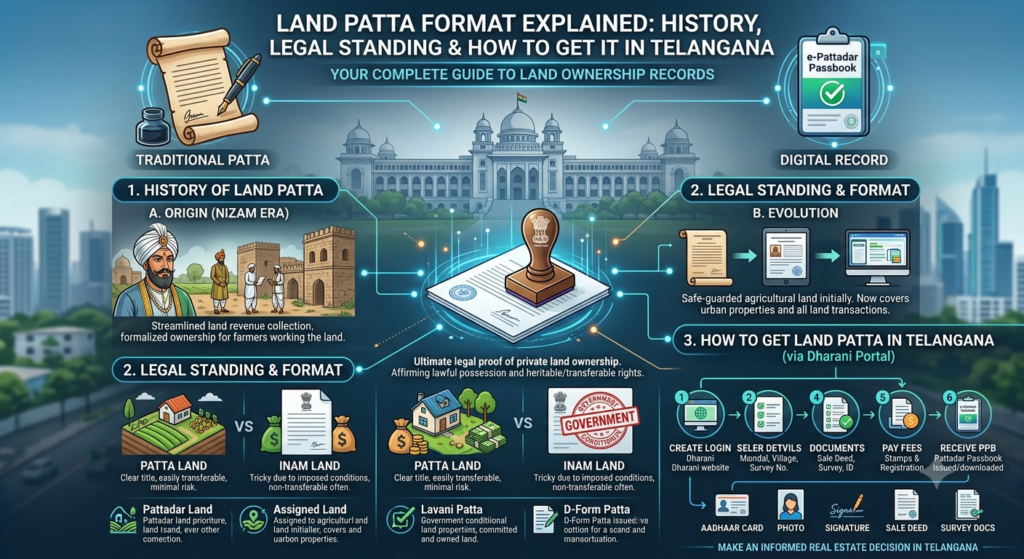
Under Nizam rule, land was broadly divided by revenue administration. Khalsa or Diwani land was held directly under the state revenue department. Farmers who cultivated this land and paid revenue to the government were recognised as Pattedars — cultivating owners with a documented right to the land they worked. The 1907 CE Land Revenue Act, enacted by the British, established guidelines and regulations to govern these lands’ revenue collection, surveying, and ownership documentation.(Source)
Jagir and Paigah lands were owned by the state despite being controlled by Nizam-appointed nobles who collected taxes from cultivators.
Inam and Manyam lands had been assigned to individuals or institutions : temples, mosques, service providers, in recognition of services to the state. Sarf-e-Khas was the Nizam’s personal estate. On all of these, cultivators had far weaker rights than Pattedars on Khalsa land.
After 1948, successive governments abolished Jagirs and Inams, surveyed land, and issued Pattadar Passbooks to formalise ownership. The 1989 Pattadar Passbook system in undivided Andhra Pradesh was a landmark moment , creating a physical document combining the Record of Rights (Pahani) with a title deed. This lineage runs directly into the Pattadar Passbook-cum-Title Deed under Telangana’s Bhu Bharati Act, 2024.
This history has a very practical implication today: significant pockets of land in Telangana’s peri-urban and agricultural corridors still carry legacy Inam, assigned, or partially regularised classifications, because the conversion of all Nizam-era grant land into full private Patta ownership was never fully completed. This is precisely why checking a land’s historical classification remains a genuine due diligence step, not a bureaucratic formality.
What does a Land Patta format contain?
Under Telangana’s Bhu Bharati system, the Pattadar Passbook-cum-Title Deed is issued in a standardised format. A correctly issued document contains:
Owner details. Full name of the Pattadar, their father’s or spouse’s name, and registered address. For jointly held land, all co-owners are listed.
Survey number and sub-division. The unique revenue survey number for the parcel, and any sub-division number if the land has been divided from a larger holding.
Extent (area). The area is in acres, guntas, or square yards depending on land type and zone.
Village, mandal, and district. The revenue administrative location , essential for cross-referencing with the Pahani and Record of Rights.
Land classification. Any specific use classification, wet (irrigated), dry (rain-fed), or non-agricultural.
Mode of acquisition. How the current Pattadar came to own the land , purchase, inheritance, partition, gift, or government assignment.
Liabilities and encumbrances. Any mortgage, charge, or government loan recorded against the land. Under Bhu Bharati, banks verify this column digitally.
Bhudhar number. Each land parcel is assigned a unique 11-digit Bhudhar number ,GPS-confirmed and tied to geo-referenced survey data, functioning like an Aadhaar for land. Parcels with a Bhudhar have their ownership and boundary digitally locked, making fraudulent transfers substantially harder.
Enjoyment details. Who is currently in actual possession and use , which may differ from the registered owner where tenancy or inheritance is involved. Bhu Bharati restored this column that the previous Dharani system had dropped.
In combination, these fields give the buyer or lender a complete picture of the legal status of the land.(Source)
Patta vs Inam vs Assigned land: key differences
Not all land in Telangana is the same in the eyes of law and a buyer who looks at all the three categories as interchangeable is taking a serious risk.
| Feature | Patta Land | Inam Land | Assigned Land |
| Ownership type | Private, registered in individual name | Historically granted, may be under government or trust | Government-assigned to specific beneficiary |
| Legal title | Full legal title in Pattadar’s name | Title may be conditional or disputed post-abolition | Conditional — often with restrictions on transfer |
| Transferability | Freely transferable (sale, gift, inheritance) | Restricted unless fully regularised | Often non-transferable; sale may be prohibited |
| Bank loan eligibility | Generally accepted by banks as collateral | Usually not accepted until regularised | Usually not accepted |
| Buyer risk | Low, if Patta is clean and unencumbered | High — requires thorough legal title search | High — government can reclaim if conditions violated |
| Regularisation path | None needed | Possible through state regularisation schemes | Only by specific government order |
Inam land in modern Telangana refers to land that was originally granted by the Nizam’s government to individuals or institutions and has not been fully absorbed into the private Patta system. Many Inam abolition laws were passed after 1948, but their implementation was uneven, and pockets of former Inam land ,particularly those tied to temples, charities, and service grants , still carry disputed or conditional titles. The critical question when encountering Inam-classified land today is whether it has been regularised — formally converted to Patta through a state government order. Without that, a buyer effectively inherits the legal cloud.
Assigned land is land that the state government has allocated to specific beneficiaries — typically landless farmers or marginalised communities — under welfare distribution schemes. Assignment orders usually contain explicit conditions: the assignee can possess and cultivate the land but cannot sell, mortgage, or transfer it without government permission. In practice, much assigned land has been transacted informally in Telangana’s peri-urban corridors, sometimes under forged documents. A buyer who purchases assigned land without government approval can have the transaction voided, and the land reclaimed by the state.
Legal standing of Patta land in today’s real estate market
Clean Patta land occupies the strongest legal position in Telangana’s property market, reinforced by the Bhu Bharati Act, 2024 — the most significant land records reform since the 1989 Pattadar Passbook system.
Under Bhu Bharati, the Pattadar Passbook-cum-Title Deed is explicitly recognised as both proof of ownership and a valid document for securing bank loans — lenders can verify records online and cannot demand a physical passbook if digital records are accessible. The Bhudhar number creates a GPS-confirmed, tamper-resistant land identity. The restored 11-column Pahani captures a fuller picture of each parcel, making title searches more reliable. And a structured appeals mechanism gives Pattadars a clear legal path to correct errors, replacing the old Dharani portal’s dead-end rejection system.
For the Hyderabad real estate market, where peri-urban land values have appreciated sharply, the transparency that Bhu Bharati is bringing to Patta records is directly relevant to buyers evaluating plots and gated community developments.
How to apply for and verify a Patta certificate in Telangana
From April 14, 2025, the agricultural and non-agricultural land records of Telangana state will be managed through the Bhu Bharati portal at bhubharati.telangana.gov.in, replacing the earlier Dharani system completely. Any reference to the old Dharani portal in relation to Patta transactions is outdated.
To view or download an existing Patta record:
- Visit bhubharati.telangana.gov.in, click on Land Details Search (without login you can avail of informational services).
- Enter District, Mandal, Village & Survey No. or search by Pattadar Name / Bhudhar Number.
- Current Record of Rights such as Pattadar name, extent, liabilities and classification are shown in the portal.
- After confirmation of the record, an electronic Pattadar Passbook (ePPB) can be downloaded.
To apply for mutation (Transfer of Patta to a new owner on sale, inheritance, partition or gift):
- Register as citizen user with your mobile number and Aadhaar or succession document, Aadhaar, PAN — and submit.
- The Tahsildar verifies the application. On approval, the Record of Rights is updated and an ePPB is issued with SMS notification.
- Local Tahsildar’s Office also accepts walk in applications.
To verify a Patta certificate’s authenticity:
- Cross-check the survey number, extent, and owner name against the Bhu Bharati portal’s live records. Any mismatch is a red flag.
- Confirm whether the parcel has a Bhudhar number : GPS-confirmed parcels are harder to falsify.
- Request an Encumbrance Certificate (EC) through the IGRS portal (registration.telangana.gov.in) to confirm whether any mortgage, charge, or court attachment is registered. Checking the property’s IGRS market value at the same time helps calibrate the transaction price.
- Check the Pahani classification to confirm the land is private Khalsa — not government, endowment, wakf, or prohibited.
What buyers must check before purchasing Patta land
Having a Patta document is necessary but not sufficient for a safe purchase. Here is what a careful buyer should verify:
Confirm the land type. Is it truly private Patta, or does it carry legacy Inam, assigned, or government classification? Check the Pahani’s “mode of acquisition” and “type of land” columns specifically.
Run an Encumbrance Certificate check. An EC going back at least 13 years — ideally 30 years for agricultural land — reveals whether the land has been sold, mortgaged, or subject to a court order during that period. Gaps in the EC chain are worth investigating.
Verify the survey number on the ground. Boundary disputes are common where sub-division has occurred across generations. A revenue measurement at the Tahsildar’s office can confirm that the land you are being shown matches the survey number in the Patta.
Check for Part B listings. Some parcels were classified as “Part B” — quarantined from normal transactions due to disputes, errors, or uncertain status. A Part B classification prevents registration until resolved. Check this on the Bhu Bharati portal before committing.
Apartment buyers: check the underlying land. For flat purchases in Hyderabad’s gated communities and apartment projects, the Patta of the developer’s land matters even if you are buying an apartment, not land directly. Unresolved Inam, assigned, or government classification on the developer’s land can affect the title chain of the entire project. A property lawyer will check this during title investigation — and just as mutation of property must be updated after a purchase, the underlying Patta must be clean before you buy.
Home loans. Banks and housing finance companies will not typically sanction a land loan against Inam or assigned land. If you plan to borrow, confirming clean Patta status early prevents complications at the loan approval stage.
FAQs
1.What is Patta land?
Patta land is agricultural or non-agricultural land officially registered in the name of a specific owner in the government’s revenue records. The Pattadar Passbook-cum-Title Deed is the legal document confirming this ownership, required for any property transaction, bank loan, or succession.
2.How to Apply for Patta Certificate in Telangana?
In Telangana, Patta records are now being maintained through the Bhu Bharati portal at bhubharati.telangana.gov.in which replaced the earlier Dharani portal in April 2025. You can search for and download existing records online. To apply for mutation you need to apply in the portal or in your local Tahsildar office with your sale deed, identity proof and supporting ownership documents.
3.What is the difference between Patta and Inam land?
Patta land is privately owned with full legal title and freely transferable. Inam land was historically granted by the Nizam’s government or later rulers, and may carry restrictions on transfer or conditional title unless formally regularised. Buying Inam land carries meaningful legal risk without verified regularisation.
4.Why is it important to verify Patta authenticity?
Patta authentication helps you confirm that there are no forged ownership records, encumbrances, Part B restrictions or classification issues. If the Patta is fraudulent or absent, the purchase can be nullified, a bank loan can be rejected,Ownership can be challenged later, leaving the buyer with no legal recourse.
5.Do I need a Patta certificate to buy a flat in Hyderabad?
For a flat purchase, the underlying land should have clean Patta records. Buyers and their lawyers should check the developer’s title chain to ensure the land on which the project stands is free of unresolved Inam, assigned, or government classification.
6.Can I get a bank loan against Patta land?
Yes. Clean, unencumbered Patta land is generally accepted as collateral by banks and housing finance companies. Inam or assigned land without proper regularisation is typically not.
7.What happens if the land I want to buy does not have a Patta?
Absence of a Patta — or Inam, assigned, or government land classification — means the seller may not have full legal ownership to transfer. At a minimum, this requires a thorough legal opinion before any money changes hands, and in many cases means the transaction cannot safely proceed.
8.What is the Bhudhar number and why does it matter?
A Bhudhar is an 11-digit unique identifier assigned to each land parcel under Bhu Bharati, GPS-confirmed and tied to geo-referenced survey data. It works like an Aadhaar for land — making the parcel’s identity tamper-resistant and fraudulent transfers significantly harder to execute.