Mutation of Property in Real Estate: Process, Documents & Telangana Guide (2026)
You’ve registered the sale deed. The stamp duty is paid. The Sub-Registrar has handed you a certified copy. By every popular measure, the property is yours , so why does your property lawyer still say there is one more step?
That step is mutation of property, and it is the one most first-time buyers in Telangana discover only when they need to pay their first property tax bill, apply for a loan, or try to sell a few years later. This guide covers what mutation is, when it is required, how to complete it in Telangana, and what happens when it is skipped.
What is mutation of property?
Mutation, also called transfer of khata in urban Telangana ,is the process of updating the municipal or revenue authority’s records to reflect the new owner’s name after a property changes hands. Simply put, it is a name-change in the government’s property tax ledger.
The significance of difference from Registration; Registration Registration (under the Registration Act, 1908) constitutes title and must be made by a Sub-Registrar. Whereas, the mutation is a local municipal body operation process; which is carried out either by municipal corporation, municipal council or the gram panchayat depending on the location of the property. A registered sale deed does not automatically trigger mutation, the new owner must separately initiate it.
Until mutation is done, the old owner’s name remains on the property tax roll. Property tax notices go to the wrong person, the new owner has no official standing in municipal records, and the property’s administrative identity has not caught up with its legal one.
Be Among the First to Own a Legacy
When is property mutation required?
Mutation becomes necessary whenever property ownership changes hands. The main triggers are:
After a sale. The most common scenario ,once a sale deed is registered, the buyer must apply for mutation to transfer the property tax liability to their name.
After inheritance. When a property passes to legal heirs through a will, intestate succession, or a legal heir certificate, the heirs must apply for mutation to update records.
After a gift deed. When property is transferred by gift deed, the donee must initiate mutation after registration. If you are deciding between a gift deed or will for property transfer, both routes require mutation as a follow-up step.
After partition. When jointly owned property is formally divided through a partition deed, mutation is needed to reflect each owner’s share in the records.
After a court order or auction. Property acquired through a court decree or government auction also requires mutation once the acquisition document is final.
Mutation vs Registration: what is the difference?
This is the question most property buyers get confused about, and it is worth being precise.
| Factor | Registration | Mutation |
| What it does | Creates legal title; transfers ownership in law | Updates municipal records; reflects new owner for property tax |
| Where it happens | Sub-Registrar’s office (IGRS Telangana) | GHMC, local municipality, or gram panchayat |
| When it is done | At the time of the property transaction | After registration; separately initiated by the new owner |
| Is it mandatory? | Yes, for all immovable property transactions above ₹100 | Yes, required for property tax and future transactions |
| Does it prove legal ownership? | Yes , registered deed is primary legal proof | No ,mutation alone does not transfer or prove ownership in court |
| Fee basis | Percentage of market/agreement value (stamp duty + registration) | 0.1% of market value (GHMC); varies for municipalities |
Mutation is not a substitute for registration, and registration is not a substitute for mutation. Both serve different purposes. A registered deed without mutation creates legal title but no municipal recognition; mutation without a registered deed would update records without legal basis. You need both, registration first, mutation after.(Source)
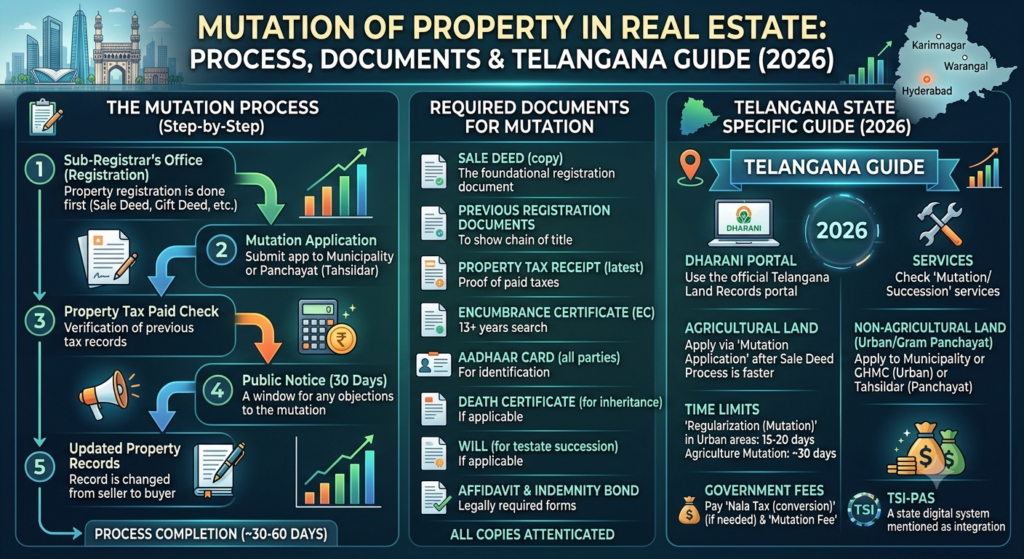
Property mutation process in Telangana : offline and online steps
The GHMC has a June 2016 dividing line that determines which route applies to your property.
For properties registered after June 1, 2016 (integrated online process)
GHMC introduced an integrated mutation system for properties registered after this date, under which much of the initiation happens at the Sub-Registrar’s office itself.
Step 1 : Pay mutation fee at registration. At the time of registering the sale deed, prepare a Demand Draft for 0.1% of the market value, made in favour of the Commissioner, GHMC. This DD is submitted at the Sub-Registrar’s office along with the other documents.
Step 2 :Registration Department shares data with GHMC. During registration, property and transaction details are captured digitally and shared automatically with the relevant GHMC circle office.
Step 3 : SMS acknowledgement. Once the mutation request is received and processed in the GHMC system, the applicant receives an SMS with a unique mutation application number, which can be used to track status online.
Step 4 : Tax Inspector verification. The assigned Tax Inspector physically visits the premises to verify the property and check whether the current property tax assessment is as per the benchmark rate. If any under-assessment is found, the tax may be revised before mutation is finalised.
Step 5 :Deputy Commissioner approval. The Revenue Officer circulates the file to the Deputy Commissioner, who approves the mutation subject to confirmation that all property tax dues have been paid.(Source)
Step 6 : Mutation proceedings issued. Once approved, the mutation order is made available on the GHMC circle office’s website and served to the applicant. The process is expected to complete within 30 days of the circle office receiving the application.
For properties registered before June 1, 2016 (offline process)
Step 1 : Visit the Citizen Service Centre (CSC) or Deputy Commissioner’s office for the circle in which the property is located.
Step 2 : Submit documents with the completed mutation application form along with a Demand Draft for 0.1% of market value in favour of the Commissioner, GHMC.
Step 3 : Physical verification. The Tax Inspector visits the premises, verifies the property, and checks property tax compliance.
Step 4 : Deputy Commissioner approval and mutation proceedings. On approval, the mutation order is digitally posted on the GHMC circle website and served to the applicant. Timeline: up to 30 days from receipt by the circle office.
For properties outside GHMC limits
For premises falling under the Municipal Corporations of Warangal, Khammam, or Karimnagar or any gram panchayat or town panchayat administration the underlying process of submitting registered deed, tax receipts, proof of identity, and payment of prescribed fee largely remains the same; however the designated website/portal, form number, and fee structure may vary. Enquire at your local body or Tahsildar’s office to ascertain the appropriate procedure.
Documents required for property mutation
The exact set of documents varies by the trigger for mutation. Here is what you usually need for each situation:
After a sale (most common case):
- Notice of Transfer under Section 208 of the GHMC Act, signed by both the vendor and the vendee
- Registered sale deed (attested copy, along with link documents going back at least 13 years)
- Latest Encumbrance Certificate from the IGRS portal
- Up-to-date GHMC property tax receipts
- Non-Judicial Stamp Paper (₹20 per document)
- Notarized Affidavit cum Indemnity Bond on ₹50 stamp paper
- Identity proof of buyer (Aadhaar, PAN)
- Mutation fee Demand Draft (0.1% of market value, in favour of Commissioner, GHMC)
After inheritance (without a will):
- You will need a Legal Heir Certificate or a Succession Certificate that is issued by the people in charge.
- Death Certificate of the original owner
- All of the above common documents (tax receipts, EC, affidavit, DD)
After a gift deed:
- Registered gift deed (attested copy)
- Proof of relationship between donor and donee (relevant for concessional stamp duty claimed)
- All of the above common documents
After partition:
- Registered partition deed (attested copy)
- All parties’ identity proofs
- All of the above common documents
Across all scenarios, up-to-date property tax receipts and a clean Encumbrance Certificate are non-negotiable. Unpaid property tax dues must be cleared before the Deputy Commissioner will approve mutation.
Mutation fees and timeline in Telangana
Fee. The mutation fee in GHMC limits is uniformly 0.1% of the market value of the property, calculated at the same government-assessed market value used for stamp duty at registration. This must be paid as a Demand Draft addressed to “Commissioner, GHMC” — not cash or online transfer. For properties outside GHMC limits, the fee structure varies by local body and is typically lower, but confirmed with your local municipality or panchayat.
To get the government-assessed market value of your property — the figure GHMC uses as the basis for this fee ,you can generate an IGRS market value certificate online before the process begins, which helps you prepare the exact DD amount.
Timeline. GHMC’s stated processing period is 30 days from the date the application is received at the circle office. In practice, this clock assumes documents are complete and no physical verification complications arise. When both buyer and seller jointly submit the mutation application at the time of registration, some sources indicate the turnaround can be as fast as 14 days. Delays typically occur when property tax is not fully paid, when there is a discrepancy in documents, or when the Tax Inspector’s visit is pending.
Common problems in property mutation and how to solve them
Pending property tax dues. The Deputy Commissioner will not approve mutation until all property tax dues are cleared — including arrears from before your purchase. Check the property’s GHMC property tax status before completing the purchase, since undisclosed arrears are a common hidden cost that surfaces at mutation.
Name mismatch between the sale deed and existing records. If the seller’s name in the registered deed does not exactly match the name in the current property tax record due to spelling variations or a name change, the application may be held up. An affidavit explaining the discrepancy, with supporting identity documents, usually resolves this.
Survey number or area discrepancy. When the extent in the sale deed differs from what is in the property tax records ,common in older properties where buildings have been modified , a correction application may be needed before mutation can proceed.
Absence of the Section 208 Notice of Transfer. This form must be signed by both vendor and vendee. If the seller is unavailable or has moved abroad, obtaining the signature becomes difficult and may require legal assistance and a submission to the Deputy Commissioner explaining the situation.
Third-party objection. Sometimes other people can object to what you’re trying to do. These people can be co-heirs or ex-spouses or someone who claims they have a right to the property. When they object it stops the process from movingThis must be resolved by agreement or court order before mutation can be approved.
Delay beyond 30 days. If your application has been pending beyond the statutory period with no communication, file a written complaint with the zone’s Additional Commissioner. An RTI application to GHMC citing the application reference number is an effective escalation , the RTI obligation creates administrative pressure to act.
What happens if mutation is never done? The consequences compound over time. Property tax notices go to the previous owner. The new owner has no documented standing in municipal records, which creates problems in future sales, loan applications, and disputes. Correcting a long-delayed mutation, especially when the original seller is no longer accessible , is significantly harder than doing it promptly after registration.
FAQs
1.What is the mutation of property?
Mutation is the process of updating official government and municipal records to reflect the new owner’s name after a property changes hands through sale, inheritance, gift, or partition. It is distinct from registration and must be done separately after the sale deed or other transfer deed is registered.
2.Is property mutation mandatory in Telangana?
Yes. In Telangana, mutation , also called transfer of khata , is legally required for all property ownership changes. Without mutation, the new owner cannot be assessed for property tax in their own name and will face complications in future sales, loan applications, and legal disputes.
3.What documents are required for mutation of property after a sale?
A registered sale deed (with link documents), Notice of Transfer under Section 208 of the GHMC Act signed by both parties, latest Encumbrance Certificate, up-to-date property tax receipts, identity proof, a notarized affidavit cum indemnity bond on ₹50 stamp paper, and a Demand Draft for 0.1% of market value in favour of the Commissioner, GHMC.
4.How long does property mutation take in Telangana?
GHMC’s official timeline is 30 days from the date the mutation application is received at the circle office. When both buyer and seller apply jointly at registration, it can be faster. Delays occur when property tax dues are outstanding, documents are incomplete, or a physical verification is pending.
5.What about the fees to mutate a property in Telangana?
The fee to mutate a property in the GHMC area is a percentage of what the government thinks the property is worth. This fee is 0.1 percent. You have to pay it using a Demand Draft made out to the Commissioner of GHMC. If the property is not in the GHMC area the fee is different. You have to check with the local municipality or town panchayat or gram panchayat to find out how much it is.
6.What is the difference between mutating a property and registering a property?
Registration creates legal title to a property and is handled by the Sub-Registrar under the IGRS system. Mutation updates municipal records for property tax purposes and is handled by GHMC or the relevant local body. Registration must happen first; mutation follows separately. Mutation alone does not prove legal ownership in a court of law.
7.What happens if property mutation is not done after purchase?
The property tax records continue to show the previous owner’s name. This can complicate future sales, block loan applications, and create vulnerability in ownership disputes. The longer mutation is delayed, the harder it becomes to initiate — particularly if the original seller is unavailable or if the documents have aged.
8.Can mutation be done online in Telangana?
For properties registered after June 1, 2016, the initiation is integrated with the registration process and involves a digital workflow within GHMC. For properties registered before that date, the application must be submitted in person at a Citizen Service Centre or the Deputy Commissioner’s office. Status can be tracked online at ghmc.gov.in using the mutation application number.