Mirror Direction as Per Vastu: Room-by-Room analysis for Indian Homes
Mirror placement is one of those Vastu topics where advice is abundant, contradictory, and rarely explained. One source tells you to never let a mirror face the bed. Another says mirrors in the north multiply wealth. A third warns that any mirror near the entrance will reflect good energy back outside. All three statements contain partial truth, and all three are routinely misapplied.
For buyers setting up a 2 BHK or 3 BHK apartment in Hyderabad, the practical question is not ‘what does Vastu say about mirrors?’ in the abstract. It is: where should the dressing mirror go in a bedroom that is already fixed in layout? Does the bathroom mirror need to follow directional rules? And when should you stop worrying and just pick what works?
This guide answers those questions room by room, with the reasoning behind each rule and a clear checklist you can actually use.
1.What Does Vastu Say About Mirror Placement?
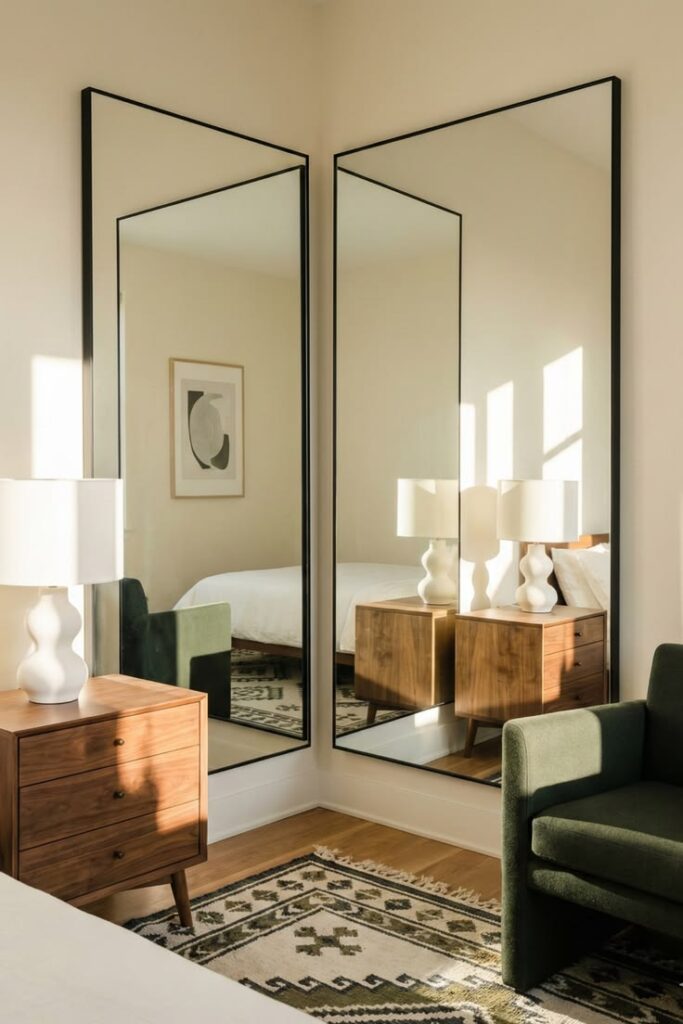
Vastu Shastra treats mirrors as amplifiers; objects that extend and multiply whatever energy is present in a space. Unlike a wall or a piece of furniture, a mirror reflects; in Vastu terms, it doubles the quality of the energy it faces.
That logic is the foundation for every mirror-specific Vastu rule. A mirror facing the north wall amplifies the energy of the north, associated with Lord Kuber and the accumulation of wealth. A mirror facing the east amplifies the energy of sunrise; associated with health, new beginnings, and positive vibration. A mirror facing south or southwest amplifies those directions’ energies; which in Vastu are associated with instability, excessive expenditure, and the domain of Yama.
Be Among the First to Own a Legacy
The practical implication is straightforward: position mirrors so they reflect beneficial directions and avoid pointing them toward zones that are already considered energetically challenging in your flat’s layout.
Key point most guides miss: In Vastu, the ‘direction a mirror faces’ means the direction the reflective surface is oriented toward, the direction it looks into. A mirror mounted on the north wall faces south (it looks toward the south wall). A mirror mounted on the east wall faces west. This distinction matters and causes a lot of placement errors when buyers read rules hastily.
In a typical 2 BHK or 3 BHK apartment, you rarely have unlimited flexibility on where walls are or where furniture can go. The more useful question is not ‘is this placement perfect?’ but ‘is this placement acceptable, and if not, what is the simplest correction?’ Vastu mirror rules are most practical when applied with this proportional framing.
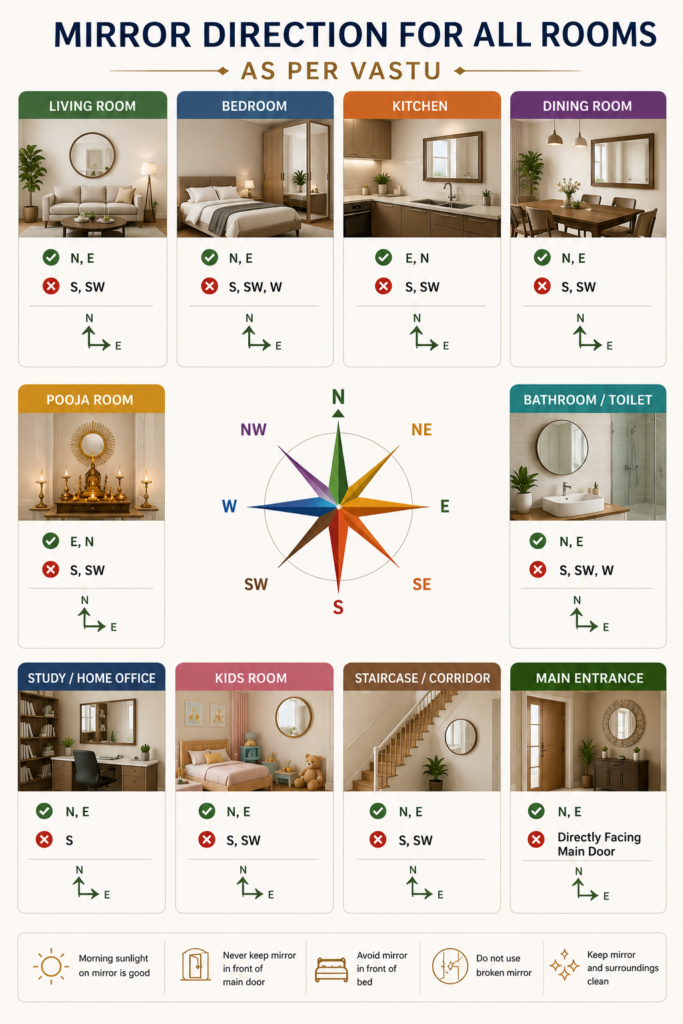
2.Best Mirror Direction as Per Vastu (Direction Reference Table)
The table below gives you a quick reference for mirror placement across the major rooms in a standard Indian flat. Use it alongside the room-specific sections below for context.
| Room | Recommended Mirror Wall | Wall to Avoid | Notes |
| Bedroom | North or east wall | South or southwest wall; facing the bed | Dressing mirror on north wall is ideal; wardrobe-door mirror works well |
| Living Room | North or east wall | South or southwest wall | North-wall mirror reflects wealth-zone energy inward |
| Bathroom | North or east wall | South wall; directly facing the door | Above wash basin on north or east is standard |
| Main Entrance | North or east wall of foyer | Directly opposite the main door | Must not reflect the entrance door back on itself |
| Dining Room | North wall | South or west wall | Reflects dining table; amplifies abundance traditionally |
| Kitchen | Avoid mirrors; if needed: north or east wall only | South and southeast walls; facing the stove | Elemental conflict between fire and water; keep mirrors out if possible |
3.Mirror Direction as Per Vastu in the Bedroom
The bedroom is where most Vastu mirror concerns concentrate; and where most of the popular advice is either overstated or misunderstood.
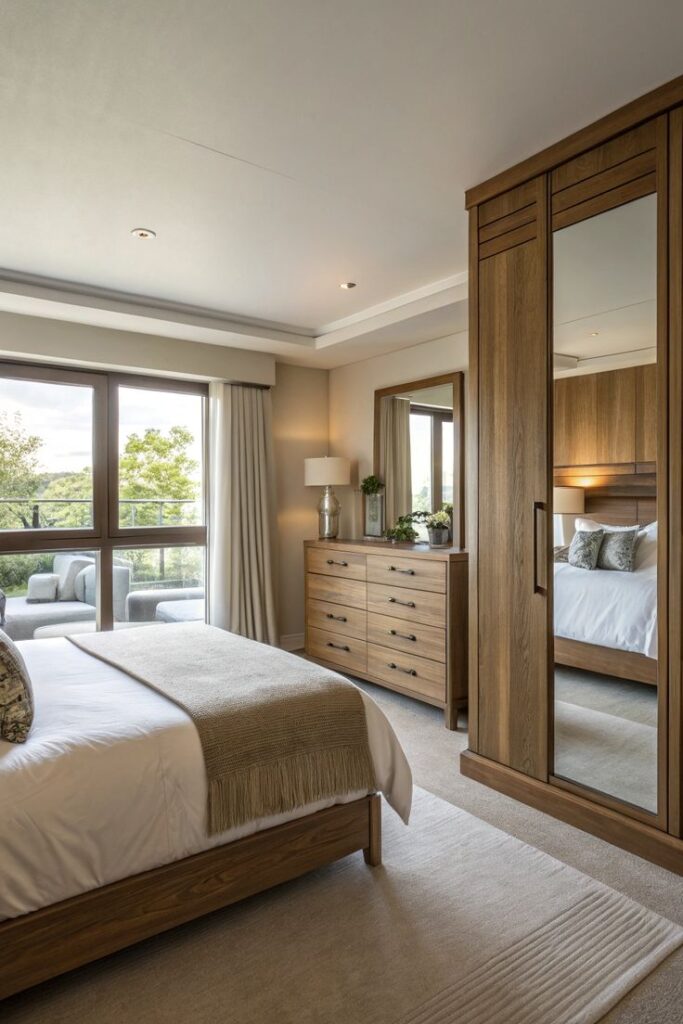
The primary rule is this: a mirror should not directly face the bed in a way that reflects the occupants while they sleep. The reason Vastu gives is that during sleep, the body’s energy is in a passive, receptive state. A mirror facing the bed reflects this low-energy state back into the room, which is considered inauspicious; associated with disturbed sleep, negative thoughts upon waking, and in some traditions, the attraction of non-physical entities.(Source)
The practical correction is not to remove the bedroom mirror; it is to position it so the sleeping occupant is not reflected. In a standard 2 BHK master bedroom, this usually means placing the dressing mirror on the north or east wall, angled so the bed is outside the line of reflection, or inside a wardrobe door that can be closed at night.
Ideal Placement in a 2 BHK or 3 BHK Bedroom
In a typical master bedroom of approximately 150 to 180 sq. ft. with a fixed wall for the bed and a dedicated dressing area, the north wall is the preferred location for a full-length mirror. The east wall is the second choice. Both placements mean the mirror faces south or west respectively, keeping it away from the Vastu-unfavourable south and southwest zones.
A mirror on the south or southwest wall of a bedroom is the configuration most consistently flagged across Vastu schools. The southwest is the direction of stability and the earth element; Vastu considers mirrors there energetically disruptive, introducing movement and reflection into a zone that should feel grounded and settled.
The Myth About ‘No Body Part Visible While Sleeping’
A common, stricter version of the bedroom mirror rule states that no body part should be visible in a mirror while sleeping, and that even a glimpse of a foot or arm reflected is problematic. This is a folk extension of the underlying principle, not a Vastu textual rule. The original concern is about the face or the full body being reflected during sleep.
A small dressing mirror on the north wall that catches the corner of a pillow is not a Vastu issue. It is not worth repositioning the entire bedroom layout over a partial, incidental reflection of non-sleeping positions.(Source)
4.Mirror Position as Per Vastu in the Living Room
The living room in a flat serves multiple functions: it is the primary social space, the first impression guests receive, and in Vastu terms, the zone where the household’s collective energy is most visible and active.
The north wall is the best location for a mirror in the living room. Placing a mirror on the north wall means it faces south, but more usefully, it reflects the north zone of the room back inward, amplifying the energy of Lord Kuber’s direction. This is the origin of the popular advice to place mirrors in the north for wealth. A well-placed mirror on the north wall, particularly one that reflects a tidy, well-lit space, is considered strongly positive.
The east wall is the second option. An east-wall mirror in the living room reflects morning light and the energy of the sunrise direction back into the space, associated with health, vitality, and positive beginnings.
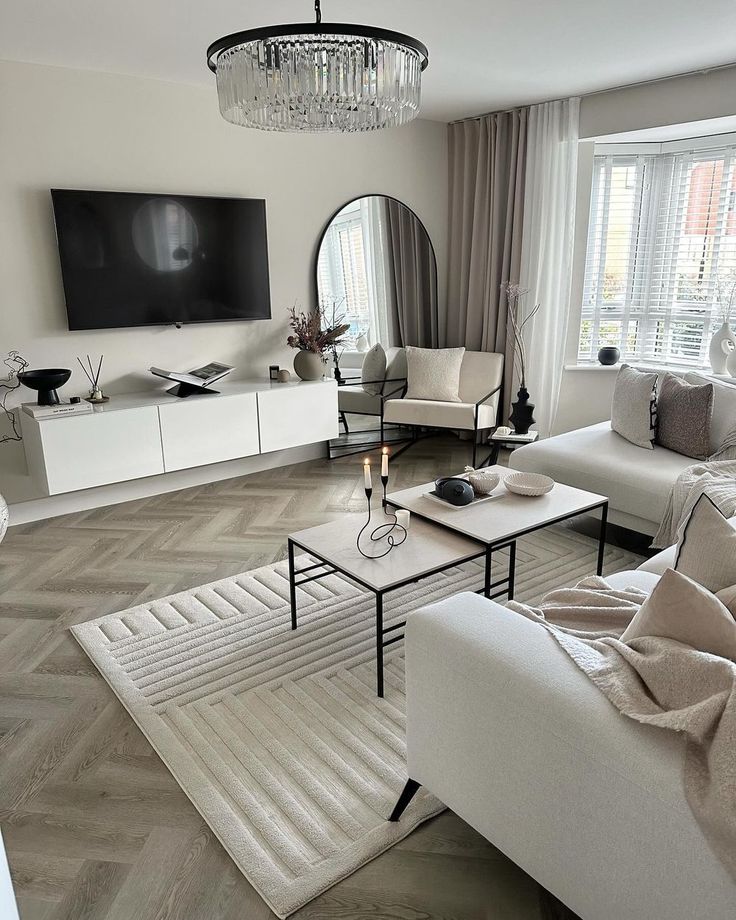
Avoid the south and southwest walls. A large mirror on the south wall of the living room reflects the energy of Yama’s direction throughout the space. The southwest wall is worse; a mirror there is associated with instability, unnecessary expenses, and the unsettling of what should be the most grounded zone of the flat.
For open-plan 2 BHK layouts: In a compact 2 BHK where the living room and dining area share an open plan, the north wall of the combined space is almost always the most practical location for any mirror element, whether a wall mirror, a mirrored console, or a reflective art piece.
5.Mirror Placement in the Bathroom as Per Vastu
Bathrooms are a practical space where Vastu flexibility is accepted more readily than in the bedroom or living room. A mirror is functional rather than decorative here; it serves grooming rather than energy amplification.
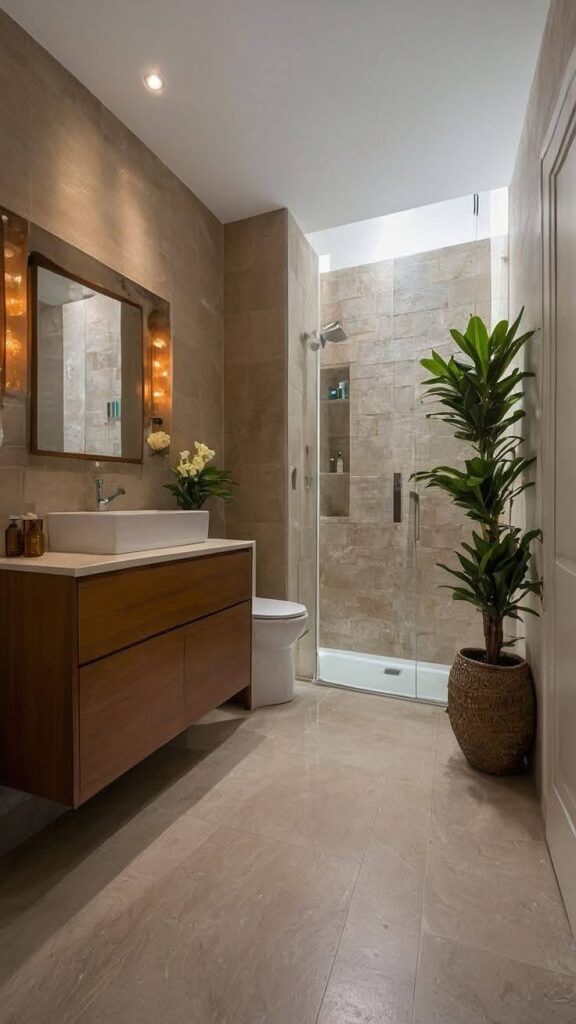
The vanity or wash-basin mirror should ideally be positioned on the north or east wall of the bathroom, meaning the mirror faces south or west. This keeps the reflective surface aligned with the more beneficial directions.
The specific concern with south-facing bathroom mirrors is less about energy dynamics and more about a practical Vastu principle: the south wall is associated with heaviness and inertia, and placing the grooming mirror there is considered to start the day on an unfavourable note.
Compact bathroom guidance: In a standard 2 BHK bathroom of 40 to 60 sq. ft., there is often limited choice in mirror placement. If the wash basin is on the south wall, keep the mirror small and consider an enclosed medicine-cabinet style that can be partially closed. Also avoid mirrors that directly face the bathroom door from the inside; a mirror reflecting the open door back out is considered disruptive at the threshold of the space.
6.Mirror at the Entrance / Main Door – Vastu Rules
The main entrance mirror is the placement most buyers get wrong; usually because the advice they have heard is incomplete.
The popular version of the rule is: do not place a mirror facing the main door, because it reflects good energy back outside. This is broadly correct as a principle, but the full guidance is more nuanced.
A mirror directly opposite the main entrance door, one that a person entering would see their full reflection in immediately, is the configuration Vastu specifically discourages. The concern is that a reflective surface at the entrance creates energetic confusion at the threshold: what is entering is immediately bounced back.
What works instead:
•A mirror on the north or east wall of the entrance foyer, positioned so someone entering sees it to their left or right, not directly ahead.
•Another set at a recessed or angled position that does not create a straight reflection of the door.
•A narrow vertical mirror on the side wall of an entrance corridor, which is functional for a quick check before leaving without creating the reflective-threshold problem.
For open-plan flats: In a typical Hyderabad flat where the main door opens directly into a combined living-dining space without a defined foyer, keep the living room mirror on the north wall and ensure it does not directly face the main entrance across the room.
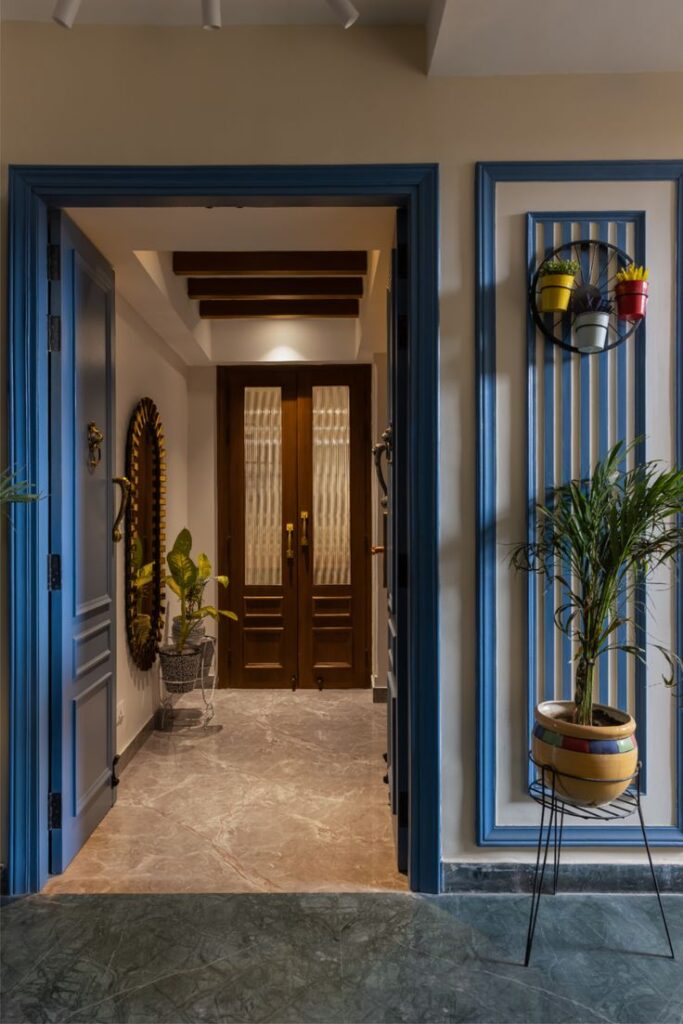
7.Mirror Direction in the Dining Room and Kitchen as Per Vastu
Dining Room
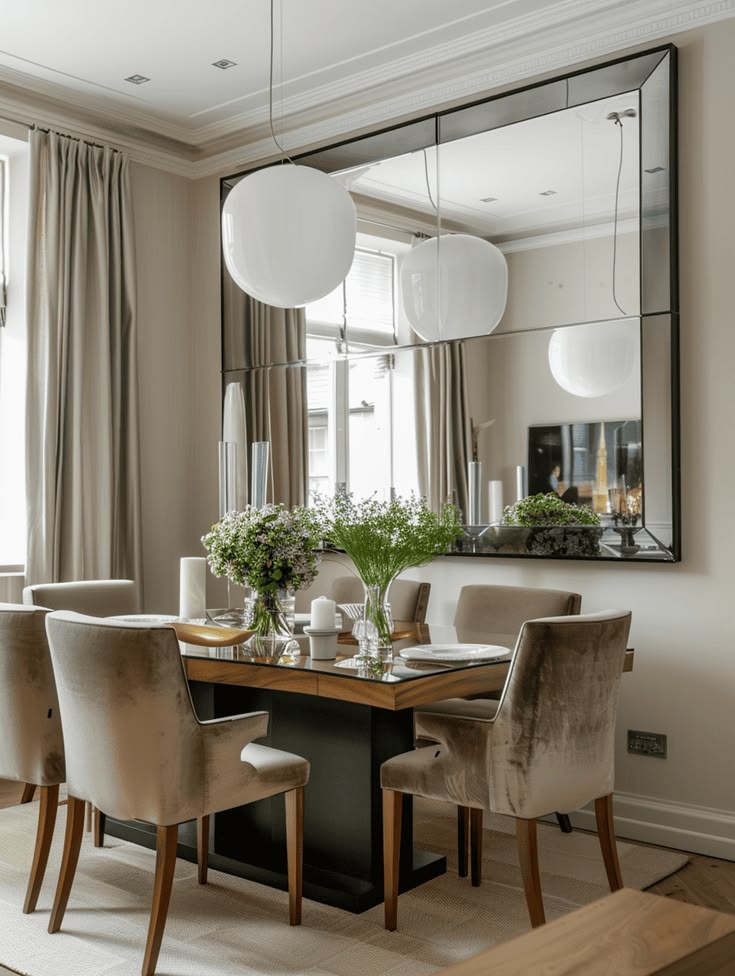
A mirror on the north wall of the dining room, one that reflects the dining table, is considered auspicious. The logic is that it amplifies the food and abundance on the table, which in Vastu terms represents wealth and nourishment being multiplied. This is one of the most traditionally accepted mirror placements in Indian homes.
In a flat where the dining area is part of an open-plan living-dining space, this placement serves the living room guidelines simultaneously. A mirror or mirrored panel on the north wall of the combined space covers both zones.
The south wall should be avoided for dining room mirrors. A reflection of the dining table toward the south is considered to direct the energy of abundance toward Yama’s direction; inauspicious for a space meant to represent family harmony and nourishment.
Kitchen
The general guidance is to avoid mirrors in the kitchen. The kitchen is governed by Agni (fire) and is associated with the fire element and the southeast direction. Mirrors introduce the water element, and water and fire in the same space create elemental conflict in Vastu terms.
If a kitchen has a backsplash or countertop with a reflective tile or finish, this is considered manageable; it is not a directive mirror. But a standalone mirror or large mirrored surface in the kitchen is not recommended.
If a kitchen mirror is unavoidable: A small mirror on the north or east wall is the least problematic placement. Keep it away from the cooking zone and the southeast corner specifically. Reflective tile backsplashes are not subject to the same guidance as directive mirrors.
8.Directions to Avoid for Mirror Placement as Per Vastu
Across all rooms and contexts, these are the consistent no-placement zones according to Vastu:
•South wall. The south is associated with Yama and is considered energetically heavy. Mirrors amplify this heaviness and are consistently considered inauspicious on the south wall in any room.
•Southwest wall. The Nairiti corner; associated with instability, excessive expenditure, and the earth element. Mirrors on the southwest wall introduce movement and reflection into a zone that Vastu considers should be grounded and stable. Particularly problematic in the bedroom, where the southwest wall is often behind the bed head.
•Directly facing the main entrance. Any mirror that creates a straight reflection of the main door, inside the flat or at the building entrance, is considered to reflect entering energy back out.
•Directly facing the bed. The sleeping position should not be reflected. The full body or face in a mirror during sleep is the specific concern; partial reflections of non-sleeping positions are not considered significant.
•Inside the kitchen facing the cooking zone. A mirror that reflects the stove or cooking area directly is considered to double the fire element, associated with conflict, aggression, and health-related heat disorders.
9.Vastu Mirror Do’s and Don’ts (Checklist)
A scannable reference for placement decisions in any room of a 2 BHK or 3 BHK flat.
DO’S
- Place mirrors on the north or east wall in the bedroom, living room, and bathroom where possible.
- Reflect the dining table with a north-wall mirror to amplify abundance; a widely accepted traditional practice.
- Use enclosed or cabinet-style mirrors in the bedroom if the layout does not allow a placement that avoids facing the bed.
- Position entrance mirrors to the side (north or east wall of the foyer) rather than directly opposite the door.
- Keep mirrors clean, uncracked, and well-lit. Vastu considers a damaged or dirty mirror to multiply negative or stagnant energy.
- Use rectangular or square mirrors as the primary recommendation; stable and grounding. Round mirrors are acceptable. Irregular shapes are not.
- Place mirrors where they reflect natural light, open space, or plants, amplifying positive elements in the room.
DON’TS
- Do not place mirrors on the south or southwest wall in any room, particularly the bedroom.
- Do not let a mirror directly face the main entrance door; it should not reflect the door back on itself.
- Do not position a mirror so it reflects the bed, specifically the sleeping face or full body.
- Do not place mirrors in the kitchen facing the cooking zone or the southeast corner.
- Do not use broken, chipped, or distorted mirrors anywhere in the home; replace them promptly.
- Do not place mirrors on the ceiling, associated with disorientation and energetic instability in Vastu.
- Do not use multiple opposing mirrors that create infinite refle
- amplify confusion rather than positive energy.
- Do not obsess over perfection if the primary placement rules are broadly met. In a compact apartment, some compromises are inevitable; the overall directional alignment matters more than exact positioning to the centimetre.
FAQs
1.Which direction should a mirror face as per Vastu?
In Vastu, a mirror should face south or west, meaning it should be placed on the north or east wall respectively. The north wall placement is considered most auspicious because the mirror then reflects the north zone, amplifying the energy of Lord Kuber’s direction. The east wall placement amplifies the energy of sunrise, associated with health and vitality. Avoid placing mirrors on south or southwest walls in any room.
2.What is the best mirror position in the bedroom as per Vastu?
The north wall of the bedroom is the ideal location for a full-length or dressing mirror. The east wall is the second choice. The key condition is that the mirror should not directly reflect the sleeping occupant. In a compact 2 BHK master bedroom, a mirror inside a wardrobe door that can be closed at night satisfies both the directional and the bed-reflection rules simultaneously.
3.Can a mirror face the main entrance of a house?
No. A mirror directly opposite the main door, creating a straight reflection of the entrance, is consistently considered inauspicious in Vastu. The concern is that it reflects entering energy back outside the home. The correction is to place the entrance mirror on the north or east wall of the foyer so it sits to the side of the door rather than directly facing it.
4.What happens if a mirror is placed in the wrong direction as per Vastu?
Vastu associates south-facing or southwest-facing mirrors with sleep disturbances, financial instability, and interpersonal conflict, particularly in the bedroom. A mirror facing the bed is specifically associated with disturbed sleep and negative thought patterns upon waking. That said, a single misplaced mirror in an otherwise well-organised flat is unlikely to create dramatic consequences; the overall directional alignment of the home matters more than any single element.
5.What is the significance of placing a mirror in the north direction?
The north is governed by Lord Kuber in Vastu, the deity of wealth and the guardian of the north direction. A mirror on the north wall reflects and amplifies the energy of this direction back into the space. In the living room, this is associated with financial prosperity. In the dining room, a north-wall mirror reflects the dining table and is considered to amplify abundance. This is one of the few Vastu mirror placements with consistent, cross-school agreement.
6.What mirror shapes are recommended as per Vastu?
Rectangular and square mirrors are considered the most auspicious shapes in Vastu; they represent stability and clear boundaries. Round mirrors are generally acceptable, associated with completeness and harmony. Oval mirrors occupy a middle ground. Irregular shapes, such as hexagonal, octagonal, or jagged forms, are considered energetically unstable and not recommended as primary room mirrors. Triangular mirrors are specifically avoided.
7.Can mirrors be placed in the kitchen as per Vastu?
Vastu generally advises against mirrors in the kitchen because of the elemental conflict between the fire element (kitchen/Agni) and the water-element quality that mirrors are considered to carry. If layout or light requirements make a mirror practical, the least problematic placement is a small mirror on the north or east wall, away from the cooking zone and the southeast corner. Reflective tile backsplashes are considered a managed form of reflection and are not subject to the same guidance as directive mirrors.