Hyderabad’s Smart City Journey: What It Actually Means for Real Estate
Quick Answer
Hyderabad was not India’s first smart city under the Smart Cities Mission. However, the city’s investments in metro connectivity, digital governance, traffic management, and IT infrastructure have significantly strengthened its real estate market. Areas such as the Financial District, HITEC City, and Gachibowli have benefited from better infrastructure, stronger employment growth, and sustained demand, making them some of Hyderabad’s most attractive property destinations.
Infrastructure has always influenced real estate values.
Better roads, reliable public transport, improved civic services, and employment opportunities make a locality more desirable. As demand increases, property prices often follow.
This relationship became even more important after the Government of India introduced the Smart Cities Mission. The programme aimed to improve urban living through technology, efficient governance, sustainable infrastructure, and better public services.
Hyderabad was one of the cities selected under the mission.However, a common misconception continues to circulate that Hyderabad was India’s first smart city.
That claim is incorrect.More importantly, it also distracts buyers from the real story.Hyderabad’s property market did not grow because of a title. It grew because the city consistently invested in infrastructure that improved connectivity, attracted businesses, and enhanced the overall quality of urban life.
Today, buyers are less concerned about whether Hyderabad was part of a national programme.Instead, they want to know whether these infrastructure improvements have actually increased property values.The answer is yes.The benefits are especially visible across Hyderabad’s western growth corridor, where transport infrastructure, IT expansion, and civic development have worked together to create sustained real estate demand.
Be Among the First to Own a Legacy
This article explains what Hyderabad’s smart city journey actually delivered, how infrastructure has influenced property values, and why certain localities continue to outperform others.
Setting the Record Straight: Was Hyderabad India’s First Smart City?
Before discussing real estate, it is important to correct one widely repeated misconception.
Hyderabad was not India’s first smart city.When the Government of India announced the first batch of 20 Smart Cities on 28 January 2016, Bhubaneswar ranked first in the selection process.Hyderabad joined the Smart Cities Mission in a later round.Although Hyderabad participated in the programme, it was never designated as the country’s first smart city.
This distinction matters because many articles continue to repeat the incorrect claim.Accurate information is especially important when buyers use online resources to evaluate long-term investments.
The Smart Cities Mission itself also requires proper context.The programme officially concluded on 31 March 2025 after several years of implementation across participating cities.Therefore, it should no longer be described as an ongoing initiative.
Instead, buyers should evaluate what the programme actually delivered and how those improvements continue to influence Hyderabad’s property market today.Rather than asking whether Hyderabad was the first smart city, investors should ask a more meaningful question.
Did infrastructure improvements make Hyderabad a stronger real estate destination?
The city’s performance suggests that they did.The value lies in the quality of infrastructure rather than the label attached to it.
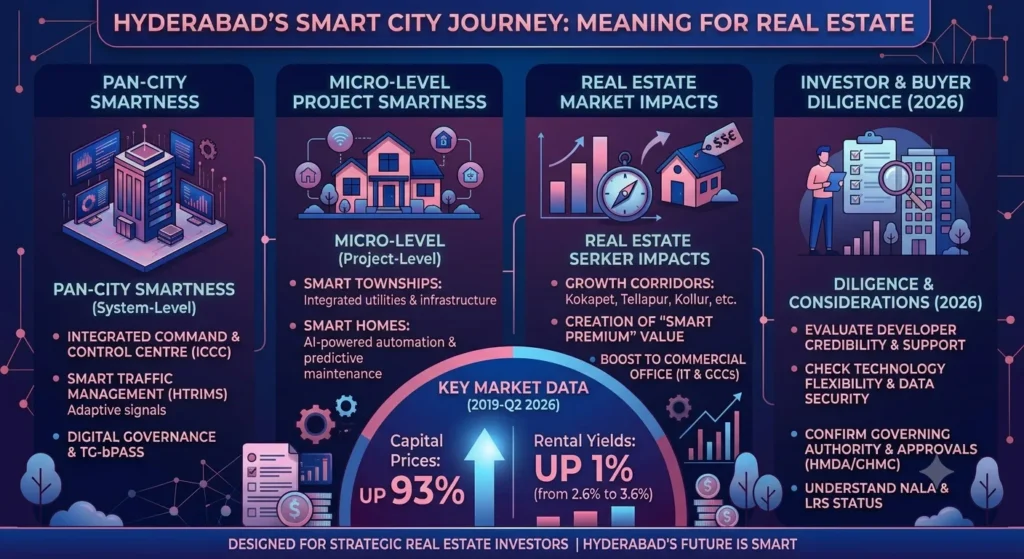
What Hyderabad’s Smart Cities Mission Projects Actually Delivered
The Smart Cities Mission focused on improving urban governance rather than simply constructing new buildings.
Many initiatives addressed long-standing civic challenges through technology and better planning.Several improvements have continued to benefit residents even after the mission concluded.
Smarter Urban Governance
One major objective was improving how city services are managed.
Digital platforms simplified access to several municipal services and reduced dependence on manual processes.Residents could report civic issues more efficiently, while authorities gained better visibility into service delivery.Although these improvements may seem administrative, they contribute to a more organised urban environment.
Well-managed cities generally attract stronger residential and commercial investment.
Better Traffic Management
Traffic congestion remains one of the biggest challenges in growing metropolitan areas.
Smart traffic management systems helped improve signal coordination, traffic monitoring, and incident response across several important corridors.
While congestion has not disappeared, technology has helped improve traffic flow in many locations.For real estate buyers, shorter commute times often translate into higher demand for nearby residential projects.
Improved Civic Infrastructure
Infrastructure upgrades extended beyond transportation.
Several areas benefited from improvements in street lighting, water supply systems, and public utilities.These investments strengthened everyday urban services rather than focusing only on landmark projects.Reliable civic infrastructure improves the overall quality of life.
It also increases buyer confidence when evaluating residential neighbourhoods.
Digital Service Delivery
Technology also improved communication between citizens and local authorities.
Digital grievance systems, online municipal services, and integrated monitoring created faster responses to many civic issues.Although these developments may not directly increase property prices, they contribute to a better living experience.
For long-term investors, governance quality is becoming almost as important as physical infrastructure.Cities that manage services efficiently often maintain stronger investor confidence over time.However, Hyderabad’s real estate success cannot be explained by the Smart Cities Mission alone.Several independent infrastructure projects have played an equally important role in shaping the city’s growth.
Among them, the expansion of the metro network and the continued development of the western IT corridor have had the greatest influence on residential demand.
The Integrated Command and Control Center and What It Changed
Modern cities generate vast amounts of information every day.
Traffic movements, emergency calls, surveillance feeds, public utilities, and civic complaints all require constant monitoring. Managing these services independently often slows decision-making and reduces operational efficiency.
To address this challenge, Hyderabad established the Integrated Command and Control Center (ICCC) as part of its broader smart governance initiatives.The ICCC functions as a central monitoring hub that brings multiple civic systems together on a single platform.
Instead of working in isolation, different departments can share information in real time and coordinate faster responses.
The centre supports several essential city functions, including:
- Traffic monitoring
- CCTV surveillance
- Emergency response coordination
- Public safety monitoring
- Civic grievance management
- Disaster response support
For residents, many of these improvements remain largely invisible.
However, they contribute to a safer, more responsive, and better-managed city.From a real estate perspective, efficient governance plays an increasingly important role in buyer confidence.
Modern homebuyers no longer evaluate only the apartment.They also consider how effectively the surrounding city functions.Neighbourhoods supported by reliable civic services generally maintain stronger long-term demand than locations struggling with poor infrastructure and delayed public services.(Source)
Although the ICCC alone does not increase property prices, it strengthens the governance ecosystem that supports sustainable urban growth.As Hyderabad continues expanding, integrated city management is expected to become even more important.

Metro Rail Expansion and Its Real Impact on Property Corridors in 2026
Among all infrastructure projects in Hyderabad, few have influenced real estate as significantly as the metro rail network.
Road infrastructure continues to improve.However, metro connectivity has fundamentally changed how residents evaluate residential locations.Before the metro, buyers often prioritised properties located close to their workplaces.Long travel times reduced the appeal of otherwise affordable neighbourhoods.
Metro connectivity has gradually altered that equation.Areas connected to rapid transit have become more accessible, reducing dependence on private vehicles while improving daily commuting convenience.The benefits extend beyond transportation.Metro stations often stimulate commercial development, retail activity, office space, and residential demand around surrounding corridors.
This creates a cycle of sustained economic activity.As employment opportunities grow, housing demand usually follows.Developers also respond by launching new residential projects near major transit routes.This relationship between transport infrastructure and property demand has become increasingly visible across Hyderabad.
Neighbourhoods with strong metro connectivity have generally experienced healthier demand than areas with weaker public transport access.For investors, accessibility has become one of the strongest indicators of future appreciation.While infrastructure alone cannot guarantee higher returns, improved connectivity consistently strengthens a locality’s long-term investment potential.
Which Localities Have Actually Benefited: Financial District, HITEC City, and Gachibowli
Hyderabad’s western corridor demonstrates how infrastructure investment and economic growth can reinforce each other.
Three locations stand out consistently.
Financial District
The Financial District has transformed into one of Hyderabad’s leading business destinations.Global corporations, financial institutions, multinational companies, and technology firms continue expanding their presence here.Infrastructure improvements have supported this growth through better roads, improved connectivity, and continuous commercial development.
Demand for quality housing has grown alongside employment opportunities.Professionals working in the area increasingly prefer residences located close to their workplaces.This has supported steady appreciation across both premium apartments and gated communities.
Rather than depending on speculative demand, the Financial District benefits from sustained end-user demand driven by employment.That creates greater market stability.
HITEC City
HITEC City remains one of Hyderabad’s strongest commercial engines.
It combines office space, technology parks, retail developments, hospitality projects, and residential communities within a highly connected urban ecosystem.
Continuous infrastructure investment has strengthened its position over the past two decades.Road improvements, metro connectivity, and commercial expansion have increased accessibility while supporting rising residential demand.For many professionals, living near HITEC City reduces commuting time and improves work-life balance.
This practical advantage continues to support healthy property demand.The locality also attracts investors seeking consistent rental income because of its large working population.
Gachibowli
Gachibowli has evolved from a peripheral suburb into one of Hyderabad’s most established residential and commercial destinations.The area benefits from several growth drivers.
These include:
- IT employment
- Educational institutions
- Healthcare facilities
- Sports infrastructure
- Excellent road connectivity
- Proximity to major business districts
Unlike locations that depend on a single economic driver, Gachibowli enjoys diversified demand.This broader economic base strengthens its long-term investment potential.Residential projects continue attracting both homebuyers and investors because the locality offers employment access alongside well-developed social infrastructure.
Smart Infrastructure and Property Values: What the Data Actually Shows
Property prices rarely increase because a city receives a particular designation.
They increase when infrastructure creates measurable improvements in accessibility, employment, and quality of life.Hyderabad provides a strong example of this principle.The city’s western corridor has consistently attracted investment because several growth factors have developed simultaneously.
These include expanding IT employment, improved metro connectivity, stronger road infrastructure, and continuous commercial development.Together, these factors have created sustained housing demand.Buyers are willing to pay a premium for locations that reduce commuting time and provide reliable urban infrastructure.
Developers also prefer launching projects where long-term demand appears stable.This further strengthens market activity.However, buyers should avoid assuming that every infrastructure announcement guarantees appreciation.Announcements create expectations.(Source)
Completed infrastructure creates value.When evaluating investment opportunities, consider the following factors together:
- Employment generation
- Public transport connectivity
- Existing social infrastructure
- Civic services
- Future development plans
- Supply of residential inventory
A locality that performs well across all these parameters is generally positioned for healthier long-term growth than one relying on a single proposed project.
This explains why areas such as the Financial District, HITEC City, and Gachibowli continue outperforming many emerging micro-markets.Their growth reflects years of sustained infrastructure investment rather than short-term speculation.
What’s Next for Hyderabad’s Urban Infrastructure
Although the Smart Cities Mission has concluded, Hyderabad’s infrastructure development has not slowed down.
The city continues to evolve through projects led by HMDA, GHMC, Hyderabad Metro Rail, and other state agencies. These initiatives aim to improve mobility, strengthen public infrastructure, and support the needs of a growing urban population.For homebuyers and investors, this shift is important.
Future appreciation is unlikely to depend on the “Smart City” label. Instead, it will be driven by continued investments in transport, employment hubs, civic infrastructure, and planned urban expansion.Several ongoing developments are expected to influence Hyderabad’s real estate landscape over the coming years.
Metro Network Expansion
The metro network continues to expand beyond its existing corridors.
Improved public transport is expected to increase accessibility across more residential areas, reducing travel time and encouraging balanced urban growth.
Neighbourhoods that gain new metro connectivity often attract greater residential and commercial interest over time.However, buyers should evaluate completed and approved projects rather than relying solely on proposed routes.
Road and Connectivity Improvements
Road infrastructure remains a major focus for Hyderabad’s urban planners.
New link roads, flyovers, junction improvements, and strategic corridor upgrades continue to improve connectivity between residential communities and employment centres.Better connectivity generally makes emerging localities more attractive for both end users and developers.
Growth of the Western Corridor
The Financial District, HITEC City, and Gachibowli are expected to remain important employment hubs.At the same time, surrounding micro-markets are gradually benefiting from the outward expansion of commercial activity.
As businesses continue to establish offices in these regions, demand for nearby residential developments is likely to remain healthy.
Digital Governance
Technology will continue playing an important role in urban management.
Digital municipal services, integrated monitoring systems, and data-driven planning can improve service delivery and strengthen overall governance.
While these developments may not directly influence property prices, they improve the quality of urban living and reinforce buyer confidence.
For investors, the most promising opportunities will continue to emerge in locations where infrastructure, employment, and civic planning develop together.
Key Takeaways
- Hyderabad was not India’s first smart city under the Smart Cities Mission.
- The Smart Cities Mission officially concluded on 31 March 2025.
- Hyderabad’s real estate growth has been driven by infrastructure improvements rather than the Smart City designation.
- The Integrated Command and Control Center has strengthened urban governance through real-time monitoring and coordinated civic services.
- Metro expansion has improved accessibility and increased demand across several residential corridors.
- The Financial District, HITEC City, and Gachibowli remain the strongest infrastructure-led investment destinations.
- Property appreciation depends on infrastructure, employment, connectivity, and quality civic services working together.
- Buyers should evaluate completed infrastructure and long-term fundamentals instead of relying on “Smart City” branding alone.