Urban Land Ceiling Act Repeal: The Hidden Force Behind Hyderabad’s Growth
Quick Answer
The Urban Land Ceiling Act limited how much vacant urban land an individual or family could own until it was repealed in 1999 to increase land supply and encourage development. While the repeal helped fuel Hyderabad’s real estate boom, older plots may still carry unresolved ULC-era claims. Buyers of legacy properties should verify ULC clearance before proceeding with a purchase.
If you are purchasing an apartment in Gachibowli through any TGRERA-approved project, the urban land ceiling act is a matter of the past for buyers of Hyderabad property. For owners of an old family plot in places like Uppal or Abids, however, it can still make the difference between a successful transaction at the sub-registrar’s office and a case that needs to go to court.
This divide shapes Hyderabad’s skyline. While the Parliament scrapped the central law in 1999 and Telangana continued to develop, starting the construction boom in the west corridor, papers from the ceiling period of the 1970s and 1980s still show up in courts and title searches until now. This guide explains what the Act was about, what did the repeal of the urban land ceiling act lead to, and what you need to check before signing.
What Was the Urban Land Ceiling Act, and Why Did It Exist
The Urban Land (Ceiling and Regulation) Act of 1976, which was adopted during the period of Emergency is known to have been a central law in India. The law imposed limitations on the amount of unutilized urban land owned by an individual or a family with the ceiling on area varying from 500 sq metres in case of large cities to 2000 sq metres in smaller urban areas, with the individual states permitted to impose stricter limits.
Be Among the First to Own a Legacy
The objective was mentioned to be quite simple- fight hoarding and open up land for housing for the underprivileged population through the acquisition of surplus land.
On paper, the urban land ceiling act of 1976 was a tool for redistribution but in reality it was hardly followed by many of the owners who used various tactics to delay the declaration of ownership or divided ownership among family members. By 1990s, many state governments began to argue that the act was contributing to stagnation in development instead of providing cheap housing.
For Hyderabad, then part of undivided Andhra Pradesh, the Act applied across the expanding municipal footprint. Prime corridors that later became Banjara Hills extensions and early suburban layouts sat under ceiling scrutiny.
How the Act Played Out in Hyderabad Before 1999
Before the act was overturned, Hyderabad was a small to moderately sized town in the southern section of India with a concentrated core area. The Act touched anyone holding vacant plots above the ceiling in notified urban agglomerations. Developers could not easily assemble large parcels for gated layouts or high-rise projects without clearing ceiling proceedings first.
Family land often passed through generations without formal surplus declarations. Promoters who did declare surplus waited years for government release orders. Banks grew cautious about lending against properties with open ceiling files.
When older properties in Secunderabad periphery or Himayatnagar come to market today, a careful lawyer’s first question is whether the ceiling file was ever closed. A resale flat in Kondapur usually has a clean RERA trail. An independent plot in East Marredpally may need a chain search going back to the 1970s.
The 1999 Repeal: What Actually Changed, and Which States Moved First
Parliament enacted the Urban Land (Ceiling and Regulation) Repeal Act in 1999 (https://www.indiacode.nic.in/). The central logic was that municipal planning tools could handle urban growth better than a uniform ceiling. Repeal stopped new ceiling actions and left states to wind down existing cases.
Haryana, Punjab, and all Union Territories annulled their respective state laws shortly after the central law. Maharashtra continued to enforce it until 2007. In the case of the former Andhra Pradesh state, which included Hyderabad, ceiling laws were maintained for several years before total alignment was achieved.(Source)
The following table displays the responses of the various states in the wake of the central repeal legislation in 1999.
| Region / state | Approximate timing | Notes |
| Haryana, Punjab | 1999-2000 | Early adopters; freed land around Delhi NCR growth nodes |
| Union Territories | 1999 onward | Repealed with central push |
| Maharashtra | 2007 | Mumbai and Pune supply unlocked later |
| Andhra Pradesh (undivided) | Early 2000s | Hyderabad benefited once state law aligned |
| Assam, Bihar, West Bengal | Varied; several retained longer | Slower release of urban land supply |
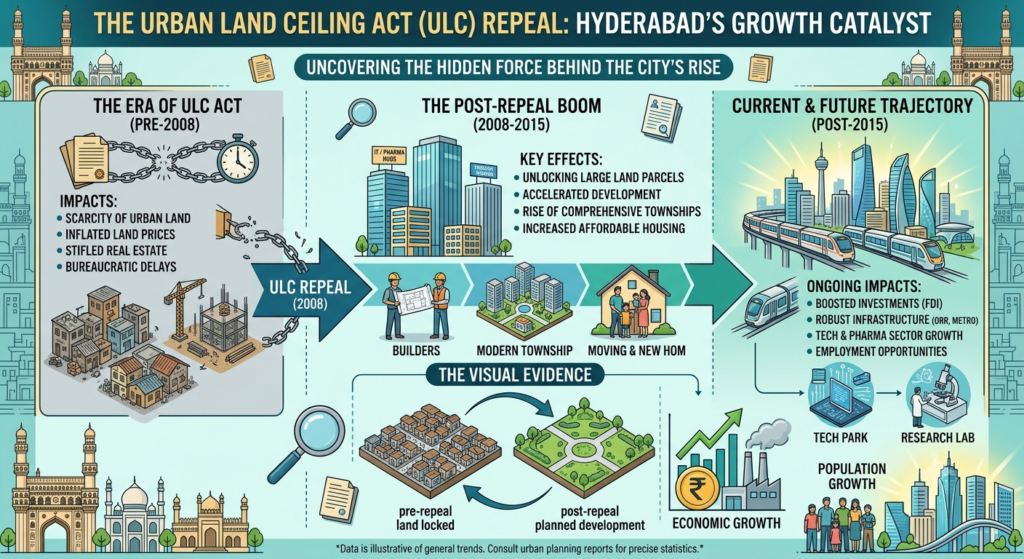
For Hyderabad, the practical shift arrived when state rules stopped treating large vacant holdings as automatic surplus. Developers could combine land parcels and obtain layout approvals through HMDA or GHMC, allowing them to build on higher densities. The corresponding period coincided with the start of the Outer Ring Road project and the first wave of IT development at the Gachibowli and Nanakramguda regions.
From Restriction to Skyline: How the Repeal Fuelled Hyderabad’s High-Rise Boom
Strip away the policy language and the market effect was simple. More buildable land met rising office demand. FAR norms on key corridors allowed taller structures where infrastructure could support them. The Hyderabad real estate growth history after 2000 is inseparable from that supply release.
Industry estimates cited in Hyderabad property market reports indicate that, around 2000, there were more than a few dozen buildings with the height greater than 15 floors, while by the beginning of the 2020s, their number had already surpassed 200. Towers built along the Financial District, Kokapet, and ORR belt would not have been possible to put together under active ceiling restrictions.
The ORR improved east-west connectivity. Pharma and IT campuses clustered in the west. Metro Phase I linked HITEC City to the core. Repeal removed one major legal barrier to assembling the large parcels those projects needed.
Micro-markets that were fringe in the 1990s, Manikonda, Narsingi, Tellapur, became primary residential destinations. For current pricing context, see the Hyderabad property rates area-wise guide (https://asbl.in/blog/hyderabad-property-rates-2026-area-wise-per-sq-ft-price-guide/).
Buyer scenario 1
A family in 2004 bought a 2 BHK in Gachibowli when the area was still called peripheral. Their builder had consolidated ceiling-cleared plots into one layout. The price looked high against Banjara Hills resale at the time. Twenty years on, the westward job corridor validated the bet.
Does the Urban Land Ceiling Act Still Matter Today
Yes, but not for every purchase. If you are booking a new tower with a valid TGRERA registration and a builder with a clean track record, ceiling law is background history. If you are buying an independent plot or an old low-rise building with a 1980s title, it can be foreground risk.
Telangana courts still hear cases tied to pre-repeal surplus declarations and allegations of undeclared holdings. A property can look fine on a recent encumbrance certificate yet carry an open ceiling proceeding that predates the repeal.
Most online explainers treat repeal as a clean break. Lawyers in Hyderabad know it was a break for new supply, not a blanket amnesty for every old file.
For new projects, how to verify a builder’s RERA track record in Hyderabad (https://asbl.in/blog/how-to-verify-a-builders-rera-track-record-in-hyderabad/) is the right starting point. For legacy land, start with ceiling clearance.
Buyer scenario 2
An investor in 2025 agreed to buy a 400 sq. yard plot near Tarnaka at a discount. A lawyer’s search found a 1983 surplus declaration still in litigation after a family partition. The bank refused the mortgage. The deal died because the ceiling file never closed.
What to Check if You’re Buying an Older Plot or Building
Run this checklist before you pay a token advance on any property that predates 2000 or sits on a large legacy plot.
1.Title chain back 30 years. Look for ceiling-related endorsements, government acquisition notices, or court orders in the sale deed history.
2.Urban land clearance act certificate. Obtain or verify a ULC certificate Telangana confirming no outstanding ceiling claim. The [steps to obtain your clearance certificate](https://asbl.in/blog/urban-land-ceiling-act-urgent-steps-to-obtain-your-clearance-certificate/) walk through the revenue department process.
3.Revenue court search. Ask your lawyer to check whether the survey number appears in pending ceiling or surplus land disputes.
4.Bank panel review. Even if you are not borrowing, a bank’s legal vetting standard is a useful stress test.
5.Layout status for assembled land. If the plot is part of an older layout, confirm the promoter obtained release from ceiling proceedings before sub-dividing.
Skipping step two is how buyers discover problems at registration. Sub-registrar scrutiny has tightened since the 1990s.
Do’s
- Verify whether the property has a valid ULC clearance certificate.
- Conduct a 30-year title and legal history search.
- Get the property vetted by a property lawyer or the bank’s legal team.
- Check for pending court cases or surplus land claims.
- Verify RERA registration for newer developments built on legacy land.
Don’ts
- Assuming the repeal automatically cleared every old ULC issue.
- Relying solely on the latest Encumbrance Certificate for title verification.
- Paying a token advance before verifying legacy land records.
- Overlooking inconsistencies in historical ownership documents.
Telangana’s Land Policy Since the Repeal
After repeal, Telangana leaned on master planning, RERA, and digital approvals rather than ceilings. HMDA and GHMC master plans set land use and density. TGRERA (https://tsrera.telangana.gov.in/) brought project-level accountability from 2017 onward. TS-bPASS later compressed building permission timelines.
The policy mix shifted from “how much land you may own” to “what you may build on titled land.” HYDRA and lake buffer rules now constrain some corridors that ceiling law once constrained for different reasons.
For new projects, the TS-RERA guide for beginners (https://asbl.in/blog/ts-rera-guide-for-beginners-how-to-verify-projects-stay-safe/) covers what to verify today. Legacy plots still need the older layer checked once.
Key Takeaways
- The Urban Land (Ceiling and Regulation) Act of 1976 placed limits on vacant land in urban areas between 500 and 2,000 sq.mt. depending on the size of the cities to eliminate land hoarding and provide land for housing.
- The Urban Land Ceiling Act Repeal Act of 1999 was passed by Parliament when states realized the limits were affecting land supply; Haryana, Punjab, and Union Territories quickly implemented reforms, whereas undivided Andhra Pradesh took longer.
- The building boom in Hyderabad post-1999 was due not only to the availability of new land parcels for purposes of construction but also due to the increase of floor area ratio standards along the ORR corridor.
- The unresolved declarations of surplus holdings and possessions from the time before the ULC repeal are still a subject of court cases in Telangana and can cause issues with land titles of older properties.
- A ULC clearance certificate can confirm the absence of any pending claim against the land in question and indicate that there are no unresolved ULC claims affecting the land ownership rights.