Internal Rate of Return in Real Estate 2025: What It Is, How to Calculate It & India Benchmarks
When people buy flats in areas like Kokapet and the Financial District they see the price go up a lot. For example from 2019 to 2021 the price of flats in these areas went up by 60 to 80 percent in five years.. When you look at the actual return on investment it is not as high as you would think. It is somewhere between 12 percent and 20 percent per year. This is because the Internal Rate of Return or IRR takes into account the income and the costs of holding the property.
If you only look at the price of the flat when you bought it and the price now you are not getting the picture. IRR is a way to compare different investments, like real estate and mutual funds. It looks at every rupee that went into the investment, every rupee that came out as rent and the final sale price all adjusted for when these things happened.
What follows will explain how to calculate IRR, how to use Excel to do the calculation, what the benchmarks are for residential real estate in 2025 and how taxes affect the final figure.
Key Takeaways
* IRR is the rate of return that takes into account the timing and size of every cash flow, not the price gain.
* For real estate in India, an IRR of 12 to 18 percent is generally considered good. Below 10 percent is not as good as options.
* You can use Excel’s IRR function to calculate the IRR. You need a column of cash flows and one formula cell.
* You should always look at the -tax IRR. After taxes a pre-tax IRR of 14 percent can drop to around 11 to 12 percent.
* Properties that are still being built can show price increases but they often have lower IRR than properties that are already built because they do not produce any rental income while they are being built.
What is IRR in estate?
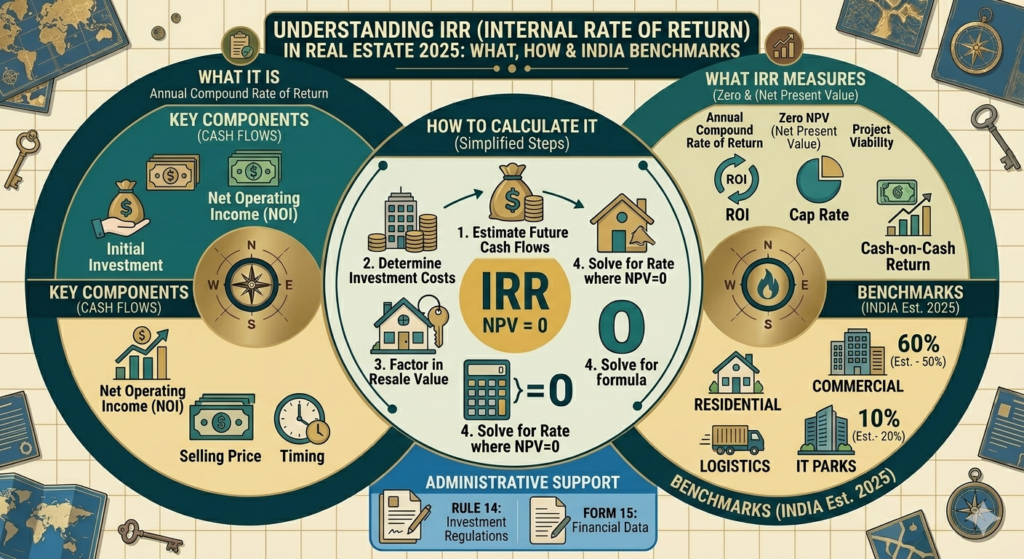
IRR is the rate at which the present value of all cash flows from an investment equals zero. In terms it is the rate of return that makes the present value of what you receive equal to the present value of what you paid. For estate the cash flows include the initial purchase price, the rental income and the final sale price. A higher IRR means the investment generates value per rupee invested adjusted for time.
IRR is more useful than a return percentage because it takes into account the time. A property that doubles in value over 10 years and pays no rent is different from one that doubles in 5 years and pays rent throughout. IRR captures this difference in a number.(Source)
How to calculate IRR: formula and step-by-step guide
IRR is defined as the value of r in the equation:
NPV = CF0 + CF1/(1+r)^1 + CF2/(1+r)^2…. + CFn/(1+r)^n = 0
Where CF0’s the initial investment, CF1 through CFn are the net cash flows in each period and r is the IRR. You need to solve this equation which is why spreadsheet functions like Excels IRR function exist.
You need three inputs: the purchase price, the net rental income and the expected sale price. Once you have these numbers you can use Excels IRR function to calculate the IRR.
Worked example: IRR for a Hyderabad investment
Lets say you buy a 2 BHK flat in Kokapet for 80 lakh rupees. You receive 25,000 rupees per month in rent, which’s 3 lakh rupees per year. You sell the property at the end of Year 7 for 1.2 crore rupees. The table shows the year-by-year cash flows.
| Year | Cash Flow (₹) | Event |
|---|---|---|
| 0 | -1,00,00,000 | Property Purchase Price |
| 1 | +3,00,000 | Annual Rental Income |
| 2 | +3,00,000 | Annual Rental Income |
| 3 | +3,00,000 | Annual Rental Income |
| 4 | +3,00,000 | Annual Rental Income |
| 5 | +3,00,000 | Annual Rental Income |
| 6 | +3,00,000 | Annual Rental Income |
| 7 | +1,23,00,000 | Annual Rent + Property Sale Proceeds |
How to calculate IRR in Excel or Google Sheets
You can calculate IRR in Excel or Google Sheets by following these steps:
* Open a sheet and label column A as “Year” and column B as “Cash Flow”.
* Enter the cash flows in cells B1 through B8.
* In a cell type: =IRR(B1:B8)
* Format the result cell as a percentage.
IRR vs ROI vs CAGR: which metric should you use?
Many people use ROI, CAGR and IRR interchangeably. They are not the same. Each measures something using the wrong one can lead to poor comparisons.
| Metric | What It Measures | Considers Time Value of Money? | Best Used For |
|---|---|---|---|
| ROI (Return on Investment) | Total profit earned relative to the total investment cost | No | Quick comparison of investment profitability |
| CAGR (Compound Annual Growth Rate) | Annualized growth rate from the starting value to the ending value | Partially | Tracking property price appreciation over time |
| IRR (Internal Rate of Return) | Annualized return accounting for all cash flows and the timing of those cash flows | Yes | Comprehensive investment performance analysis |
What is an IRR for real estate investment in India?
To decide if a property is a good investment you need to compare its IRR to the market benchmarks.
Below 10 percent: Not good. Other investments like funds and fixed deposits offer better returns with lower risk.
10 to 14 percent: Okay. This range is in line with term residential real estate averages, in India.
14 to 18 percent: Good. Typically seen in high-appreciation areas or timed purchases.
Above 18 percent: Very good.Be careful as this range often reflects underestimated costs or overstated terminal value.
If you are looking to invest in estate in Hyderabad you should know that some areas are better than others. Places like the Financial District and Kokapet have given buyers returns on their investments in the past. Between 2019 and 2021 people who bought properties in these areas got returns of 14 to 20 percent before taxes.
You can look at data on the Hyderabad real estate market to see how different areas have done over time. If you buy a property in one of these areas in 2025 you might not get as good of a return because the prices are higher now. For buyers in Kokapet or the Financial District a more realistic return would be 12 to 15 percent.
However there are some areas that are still developing and might give you a return on your investment. These areas have prices and new infrastructure projects are being built, which can increase the value of the properties.. You should be aware that investing in these areas also comes with more risk.(Source)
Lets consider an example. An investor looked at two properties in Hyderabad. One was a to-move-in flat in Gachibowli that cost ₹1.2 crore and could be rented out for ₹35,000 per month right away. The other was an under-construction flat in Narsingi that cost ₹90 lakh. The investor would not get any rent for 2.5 years. On paper the Narsingi flat seemed like a deal because its price was expected to go up by 33 percent.. When the investor calculated the internal rate of return (IRR) they found that the Gachibowli flat would actually give them a better return of 12.4 percent over 5 years.
Taxes can greatly affect the return on your investment in estate in India. The biggest tax you will pay is the long-term capital gains tax, which’s 12.5 percent of the profit you make from selling a property that you have owned for more than 24 months. You can check the Income Tax India website to see the tax rate. If you sell a property within 24 months of buying it you will have to pay short-term capital gains tax, which can be as high as 30 percent.
When you buy a property you also have to pay stamp duty, which’s typically 6 percent of the purchase price in Telangana.. Every year you will have to pay municipal property tax, maintenance charges and loan interest which will reduce your net annual income.
For example an NRI who was thinking of buying a flat in Kokapet for ₹1.5 crore calculated that they would get a return of 14 percent over 7 years.. After paying 12.5 percent long-term capital gains tax and 6 percent stamp duty their actual return would be around 11.8 percent.
The internal rate of return (IRR) is a tool for evaluating investments but it has some limitations. One problem with IRR is that it assumes you can reinvest your money at the rate as the IRR, which is not always possible. It also does not take into account the size of the investment, which can be important.. In some cases the IRR calculation can give you multiple answers, which can be confusing.
To get an accurate picture you can use the modified internal rate of return (MIRR) which takes into account the rate at which you can reinvest your money. In Excel you can use the MIRR function to calculate this.
If you are thinking of investing in an estate you might have some questions about IRR. What is IRR in estate? It is the rate at which the net present value of all cash flows from an investment equals zero. What is an IRR for real estate investment in India? A good IRR is typically between 12 and 18 percent per annum. How is IRR different from return on investment (ROI)? IRR takes into account the time value of money while ROI does not.
You can calculate IRR in Excel by using the IRR function. Just enter your cash flows in a column. The function will give you the IRR. If your cash flows are not regular you can use the XIRR function to get an accurate answer.. Do not forget to consider the impact of capital gains tax on your IRR. It can reduce your proceeds from selling a property, which will lower your actual IRR.
FAQs
Q1: What is IRR in estate?
IRR is the annualized return rate at which the net present value of all cash flows from a real estate investment equals zero.
Q2: What is a good IRR for real estate investment in India?
A good IRR for real estate in India is typically 12–18% per annum.
Q3: How is IRR different from ROI?
IRR accounts for the time value of money and expresses the annualized return making it an accurate metric, for comparing investments held over different durations.
Q4: How do I calculate IRR in Excel?
Enter your cash flows in a column and use the formula =IRR(range) to get the IRR.
Q5: How does capital gains tax affect estate IRR?
Capital gains tax reduces your proceeds at the point of sale directly lowering your actual IRR.