OC and CC in Real Estate: What Every Indian Homebuyer Must Know Before Taking Possession
Many homebuyers incorrectly assume that signing the sale agreement will assist with tracking construction milestones and that possession day refers only to receiving keys to the property. However, possession day actually involves much more than just receiving your keys, such as determining whether or not utility accounts will be created in your name, confirming whether or not the bank will disburse funds to you, and verifying whether or not you can legally reside in your new home. In order to accomplish all of these tasks, you will need to obtain two separate documents: a Completion Certificate (CC) and an Occupancy Certificate (OC).
The CC is issued by the local municipal body upon completion of an inspection of a building and is used by the municipal body to verify that a builder has completed construction in accordance with the plans submitted for approval. It serves as evidence of the validity of the builder’s permit and should be carefully reviewed before accepting possession of any property, as many builders misappropriate and/or misinterpret CCs and OCs for personal gain.
In fact, it is common for builders to attempt to transfer possession of a property before obtaining the CC or OC when they believe that the buyer will not successfully contest his/her right to possession. You will find out exactly what the CC and OC mean, how they work, and what items to inspect prior to accepting possession of your property in this guide to purchasing a property in Hyderabad.
Be Among the First to Own a Legacy
The issuance of a Certificate of Compliance (CC) provides proof an actual building structure is legal as long as it meets the approved floor, setback and structural specifications. A CC relates specifically to whether a building has been constructed according to the laws. It is issued after construction is fully complete, which includes an inspection of the completed building. If the completed building has been constructed according to the plans, the CC is granted. Deviations from the approved plans, such as additional floors, reduced setbacks and/or altered floor plans, can be cause for a delay or the inability to obtain a CC.
If your builder is unable to provide you with the CC on your completed building, it would indicate an issue with the building’s structure and/or construction compliance, and not just a delay in providing paperwork.
What is the Occupancy Certificate (OC), and how is it different?
An OC is an official government document that indicates a building has passed all necessary inspections and meets the minimum safety standards required to allow people to live there. Sometimes this document is required before people can enter or occupy a building. Sometimes, OC’s certification and compliance can be granted for several different reasons (i.e., based on certain codes or regulations).
The OC is different from a CC in that it is issued after construction is finished, while an OC is issued after the CC has already been issued.
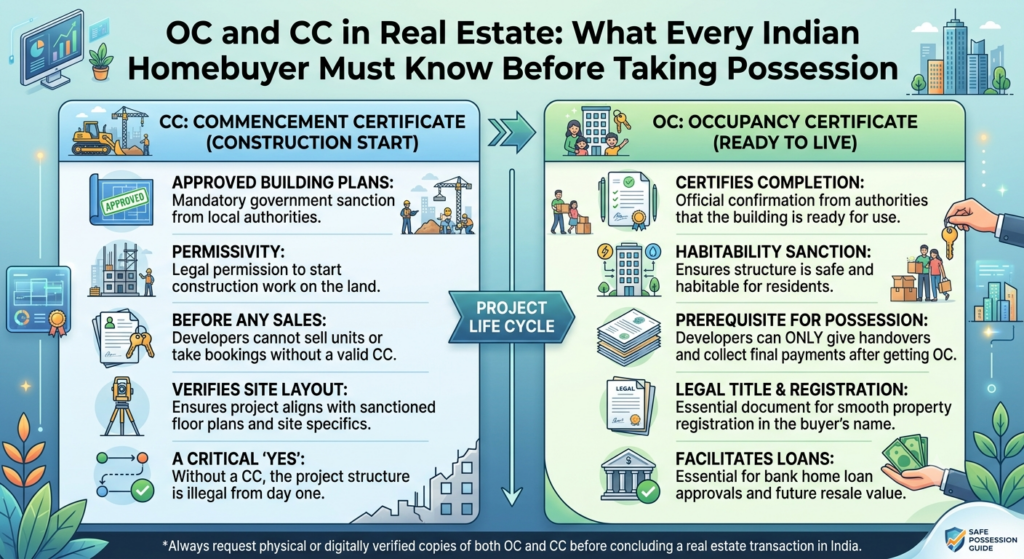
The two types of occupancy classifications outlined in the table below will help clarify their respective differences:
| Completion Certificate (CC) | Occupancy Certificate (OC) | |
| What it confirms | Construction matches sanctioned plan | The building is safe and ready to occupy |
| Sequence | Always comes first | It always comes after CC |
| Focus | Legal construction | Functional habitability |
| Issued by | Municipal / planning authority | Same authority, post-habitability inspection |
The CC is always issued before the OC. A building cannot receive an OC without first having a CC. If a builder is offering possession but can’t show you both documents, that’s a serious red flag, not a paperwork technicality.
The OC and CC Process in Hyderabad: Which Authority Issues What
Hyderabad operates under multiple planning jurisdictions. It depends on which authority would handle your project’s OC and CC, depending on where the project is located.
- Greater Hyderabad Municipal Corporation (GHMC): There are two main types of construction approvals from the GHMC regarding properties in the city proper (core parts of the city and established suburbs): the construction approval (CC) and the occupancy certificate (OC).
- Hyderabad Metropolitan Development Authority (HMDA): Projects located within the major growth regions (aka growth corridors) of Hyderabad (Kokapet, Narsingi, Tellapur, Mokila and Kollur) will be approved or rejected by the local municipal offices, which issue CC and OC’s as appropriate under the jurisdiction of the HMDA.
- District Town & Country Planning (DTCP): For construction approvals and occupancy permits outside of the boundaries of the GHMC and HMDA, construction requests must be made through the DTCP office in each of Hyderabad’s respective districts.
This distinction matters practically. For instance, a project in Tellapur and a project in Madhapur answer to different issuing authorities, owing to their own respective parameters. Before accepting possession, you should confirm which authority your building falls under and should also ask the builder to show you the original CC and OC documents issued by that specific body. Under no circumstances should you accept photocopies for your primary verification; instead, always inspect the originals. (Source)
What Are the Legal Risks of Accepting Possession Without OC?
If you accept a flat without an OC, it would expose you to several specific legal and practical risks in Hyderabad later.
Some of the risk factors are listed below:
1. Utility connections can be denied. GHMC and HMDA hold the authority to refuse permanent water and electricity connections to buildings without a valid OC. Many buyers in such buildings end up on provisional or informal connections for years, which becomes a problem during resale, redevelopment, or any formal inspection.
2. Eviction notice risk. In enforcement actions, municipal authorities can issue notices to residents in buildings without OC. It doesn’t happen often, but the legal exposure exists and has been exercised in specific cases across Hyderabad. (And when it does happen, it’s the buyers who bear the cost – not the builder who handed over early.)
3. Home loan complications. Most banks and housing finance companies require the OC before disbursing the final tranche of a construction-linked home loan. If you move in without OC and later try to refinance or take a top-up loan, you’ll face document gaps that are difficult to resolve after the fact.
4. Resale difficulty. Buyers and their banks increasingly ask for OC at resale. A flat without OC is harder to sell and harder to get a loan against — which means a lower price and a smaller buyer pool when you eventually want to exit. That’s a direct financial cost of accepting possession early.
5. Registration risk. While the sale deed can technically be registered before OC, buyers who do so take on the legal exposure of being in an unauthorised structure. Our step-by-step guide on flat registration before possession explains when and why registration timing matters.
OC, CC, and RERA: What the Law Requires Builders to Do
Builders are required under the Real Estate (Regulation and Development) (RERA) Act of 2016 to obtain necessary approvals from authorised government agencies before giving possession of real estate to their buyers and, at the same time, provide their buyers with an Occupation Certificate (OC).
Possession of property must not be delivered by the builder unless accompanied by an OC; otherwise, RERA considers it a service defect to have delivered property without the OC. In Telangana, the approved government agency with authority to issue Occupation Certificates (OC) is the Telangana State Real Estate Regulatory Authority (TSRERA). If your builder delivered possession of the property without an OC, you may:
- Refuse possession until the OC is obtained
- File a complaint at rera.telangana.gov.in
- Seek compensation for any delay in obtaining the OC
For a clear walkthrough of how to verify RERA registrations and use the TSRERA portal, read our beginner’s guide to verifying RERA projects in Telangana.
Worth knowing on phased projects: the OC may be issued tower by tower or phase by phase. An OC for Phase 1 doesn’t automatically cover Phase 2. The OC you receive from the builder must specifically name your block and tower — not just the broader project or an earlier phase.
How to Verify That Your Apartment’s OC Covers Your Specific Tower
In large gated communities built in phases, this is the step most buyers miss. A project may have received OC for earlier towers while your tower is still pending. Here’s how to verify before you accept possession:
- Request the original OC document from the builder. The document will specify the survey numbers, block or tower designations, and floor range it covers.
- Cross-check your tower number against what appears on the OC. Your sale agreement will have your block and unit numbers — make sure they match.
- Check the issuing authority and date — an OC issued two years ago for an earlier phase doesn’t apply to a tower completed recently.
- Check RERA project status at rera.telangana.gov.in using your project’s RERA registration number. Completion and occupancy status should be reflected on the portal.
A legitimate builder won’t hesitate to show you the full, original OC document. If the builder produces an OC for “the project” without specifying your tower, push back and ask directly which towers are covered.
Possession Checklist: Documents to Collect From Your Builder
At the time of possession, collect and retain the following. Keep originals where possible and make certified copies for your records.
- Completion Certificate (CC) — issued by GHMC, HMDA, or DTCP covering your block
- Occupancy Certificate (OC) — explicitly covering your tower and floor range
- RERA registration certificate along with the project’s completion intimation on RERA
- No-Objection Certificates (NOCs) from the fire department and relevant utility bodies
- Possession letter from the builder signed and dated
- Utility connection documents — water, electricity, piped gas where applicable
- Society formation documents or the interim maintenance agreement
This is also the moment to inspect your flat room by room and raise a snag list with the builder in writing. Your right to get defects rectified extends well beyond possession day. The following is a guide for homebuyers during the defect liability period. It also outlines how many days builders are responsible and how to enforce the corrections for defects.
FAQs
1.Do you see a difference between a Completion Certificate (CC) and an Occupancy Certificate (OC) on properties listed on this site?
The CC verifies that the site has been constructed according to the approved construction plans and has been issued by the local municipality. An Occupancy Certificate (OC) is issued after a further inspection confirming the building is safe to live in—with working utilities, fire safety systems, and drainage in place. CC confirms lawful construction; OC confirms safe habitability. CC always comes before OC.
2.Is it legal to occupy a property in Hyderabad without an OC?
It is illegal to inhabit a GHMC (Greater Hyderabad Municipal Corporation) registered property, such as an apartment or single house, until a CC has been issued. If the fledgling occupier moves into the unit before the issuance of the OC, the GHMC is able to deny permanent utility connections and may also issue a vacate notice should they issue an enforcement order. Additionally, buyers may file a complaint against the builder through the Tribunal for Regulating Real Estate Activities of Value in Developing Areas (TSRERA) for possession prior to issuance of the OC; this is a breach by the builder as defined by RERA.
3. Who is responsible for issuing OCs and CCs, and how is this done in Hyderabad?
In GHMC jurisdictions, the GHMC is responsible for issuing both OCs and CCs. Outside of GHMC limits but still within the Hyderabad Metropolitan Development Authority area (HMDA) are issued by HMDA or other applicable municipal authorities.For plots in DTCP areas, the District Town and Country Planning office handles these certificates.
4.Is OC mandatory for final home loan disbursement?
Yes. Most banks and housing finance companies require the OC before disbursing the final tranche of a home loan for a completed property. The OC confirms the property is legally habitable, which protects the lender’s security interest. Without OC, neither the buyer nor the lender has full legal protection.
5.Can I complain to RERA if my builder gives possession without OC?
Yes. Under RERA 2016, handing over possession without OC is a service default. You can file a complaint with TSRERA at rera.telangana.gov.in and seek compensation or compel the builder to obtain the OC before handover.