Why “Walkability” Could Become a Bigger Residential Advantage in Hyderabad
Quick Answer
Walkability means you can meet your daily needs, groceries, school runs, a gym session, a quick dinner, on foot instead of in a car. Hyderabad is not walkable as a city today, but some large integrated townships now deliver this experience inside their own gates. For a working professional, this matters most around commute. A typical Hyderabad office-goer loses over 200 hours a year just driving to work. Local errands often add another 80 to 90 hours, time a walkable township would remove entirely. Together, that is close to 300 hours, or roughly 12 full days, given back every year. This guide explains the real math behind that number, and how to judge it on your next site visit.
How many hours of your one life have you spent sitting at a traffic signal between your home and your office?
If you are in your 30s, 40s, or 50s in Hyderabad, you probably know the answer in your gut, even without a calculator. You feel it on the drive back from Gachibowli at 7 PM, or the Saturday morning spent running errands instead of resting. This article puts a real number on that feeling, and explains why the answer to it is starting to change how smart buyers choose where to live.
Be Among the First to Own a Legacy
The Real Question: How Much of Your Life Does Your Commute Actually Cost?
Most people judge a home by its price per square foot. Few people calculate what its location actually costs them every single week, in fuel and in hours. Let’s fix that with real numbers.
Hyderabad’s traffic data makes for sobering reading. According to the TomTom Traffic Index 2025, the city’s average congestion level sits at 55.5%. A 10 km drive takes about 32 minutes on average. During the evening peak, that stretches to nearly 40 minutes, as average speeds drop to just 15.2 km/h. Across a full year, the average Hyderabad commuter loses 123 hours purely to congestion delays, not including the baseline travel time itself.
Now apply this to a real commute. Take a professional living 12 km from their office in the Financial District or Gachibowli, working a hybrid schedule of three office days a week. Here is what that commute actually costs, using Hyderabad’s verified petrol price of Rs 115.70 per litre and a realistic city-driving efficiency of 13 km per litre.
| Cost Type | Office Commute Only | Plus Local Errands (groceries, gym, school runs) |
|---|---|---|
| Distance per year | 3,744 km | +832 km |
| Fuel cost per year | Rs 33,300 | +Rs 7,400 |
| Time spent per year | 202 hours | +87 hours |
| Combined total | Rs 40,700 and 289 hours |
Notice something important here. The office commute itself is hard to avoid unless your job allows full remote work. But the second column, the local errands, is exactly what walkability targets. A grocery run, a school pickup, or a gym visit inside a walkable township takes minutes on foot, not a 25-minute round trip by car. Over a year, that difference alone adds up to roughly 87 hours and Rs 7,400, money and time you simply keep.
Why Hyderabad Became a Car-Dependent City
Hyderabad did not plan to become car-dependent. It grew into it. The city’s IT corridor expanded fast along Gachibowli, HITEC City, and the Financial District, pulling jobs toward the west while housing sprawled outward to keep up with demand.
Footpath infrastructure never quite caught up with this growth. Many arterial roads still lack continuous, usable footpaths, and public transit coverage remains uneven across the newer growth corridors. The result is a city where owning and driving a car became the default, not a choice.
Understanding this matters because it sets expectations correctly. A reader should not expect Hyderabad to suddenly become a walkable city. The more realistic shift is happening at the project level, inside gated boundaries, not across public streets.
What “Walkability” Actually Means in a Real Estate Context
In a real estate context, walkability measures how many of your daily needs you can meet on foot. Think groceries, a pharmacy, a school, a clinic, a park, and casual dining. It is increasingly treated as a genuine quality-of-life metric, sitting alongside price and connectivity rather than behind them.
The idea traces back to the “15-minute neighborhood” concept, popularized in cities like Paris and Melbourne. Its promise is simple: everything you need daily sits within a 15-minute walk or cycle ride from your front door. Hyderabad does not offer this at a city level today.
The Rise of the Self-Contained Township: Hyderabad’s Practical Answer to Walkability
This is where large integrated townships step in. Instead of waiting for the public city to become walkable, these developments build the daily-needs ecosystem directly inside their own boundary.
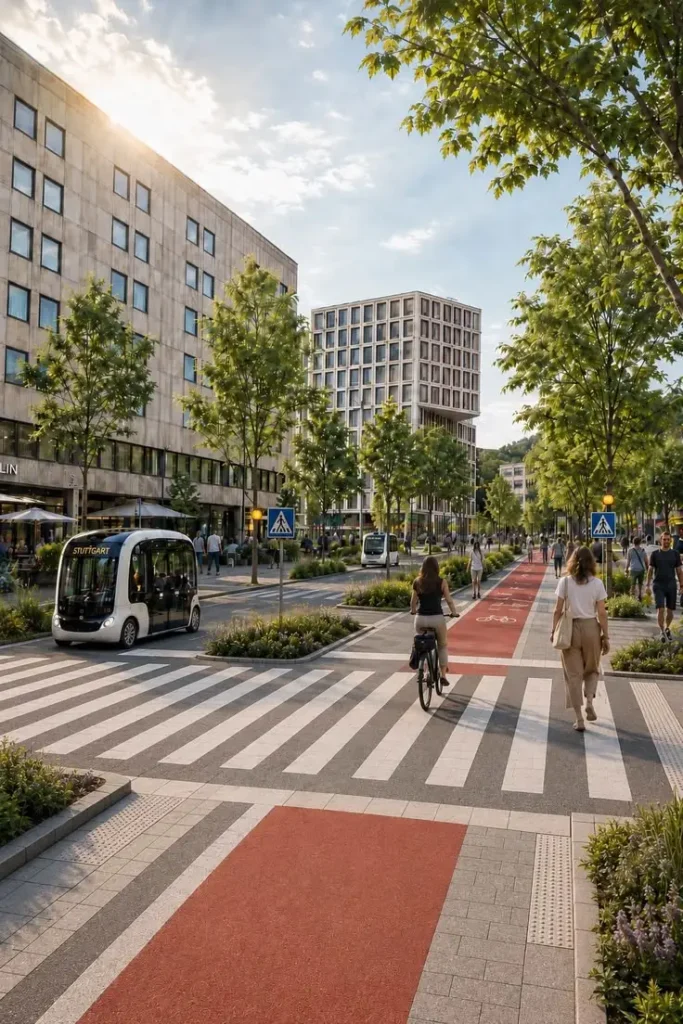
A well-designed township co-locates a school, a clinic, a supermarket, a gym, and open green spaces within walking distance of the residential towers. Internal footpaths and cycle paths connect these amenities directly, so a resident genuinely can run most errands without starting a car.
This matters most for the 30 to 50 age group specifically. You are likely managing a career, children, and perhaps ageing parents, all at once. Reclaiming even an hour a day by removing small, car-dependent errands is not a luxury at this life stage. It is real time back for your family, your health, or simply your own sanity.(Source)
Gated Walkability vs. Public Walkability: An Important Distinction
Honesty matters here, so let’s be direct about it. Gated walkability and public walkability are not the same thing, and pretending otherwise would be misleading.
A genuinely walkable city lets you walk to amenities across open public streets, regardless of which building you live in. Gated walkability only works inside a specific development’s boundary, managed privately, and bounded by its own walls.
Think of gated walkability as an engineered, scaled-down version of the real thing. It solves the daily-needs problem effectively within its footprint. Hyderabad’s wider car-dependency problem stays unsolved, though, and no one should market or understand it as doing so.
Does Walkability Actually Affect Property Value?
No Indian agency has run a formal Walk Score study. Real estate industry data does, however, show a closely related pattern already. Homes with daily-needs amenities built in, which is effectively what walkability means in a gated Indian context, consistently sell and rent for more.
| Market or Segment | Observed Premium |
|---|---|
| Integrated townships across India | 15% to 20% higher than comparable non-township properties |
| Lifestyle and amenity-rich communities in Kondapur, Gachibowli, and HITEC City | 15% to 25% price premium |
| Kokapet, post-Neopolis, versus comparable HITEC City inventory | 15% to 25% premium |
| Gated community villas in Hyderabad versus a similar independent house nearby | 30% to 50% higher |
| Rent for fully amenitised properties versus comparable space without those amenities | Rs 5,000 to Rs 15,000 extra per month |
These figures come from Indian real estate industry reports and brokerage data, not one peer-reviewed study. No report isolates “walkability” alone as the single driver. Even so, the direction is consistent and worth taking seriously. Hyderabad buyers already pay real money for daily-needs convenience built into their community. As commute costs and fuel prices keep climbing, it is a reasonable bet that this premium only grows.
How to Judge a Project’s Walkability Before You Buy
A site plan can show a school and a clinic right next to a residential block. That drawing tells you nothing about whether the walk actually works in real life. Check these things yourself, in person.
- Walk the actual distance from a residential block to the nearest school, clinic, and grocery store, and time it.
- Check whether internal footpaths are complete, shaded, and usable, not just drawn on a brochure map.
- Confirm whether cycle paths exist and are separated from vehicle traffic, not painted lines that disappear at the first turn.
- Ask whether daily-need amenities are genuinely inside the project boundary, or just “nearby” in marketing language.
- Visit during a weekday evening, not just a weekend showcase walk, to see real foot traffic and lighting.
Do’s and Don’ts for Evaluating Walkability
Do’s
- Time your own walk to each promised amenity during your site visit.
- Ask current residents how often they actually walk versus drive within the township.
- Check lighting and shade along footpaths, since an unusable path at night defeats the purpose.
- Factor in your own commute pattern, since walkability saves the most time for hybrid or remote workers.
Don’ts
- Don’t assume a site plan equals a finished, walkable reality.
- Avoid confusing gated walkability with a truly walkable public neighbourhood.
- Don’t expect walkability to eliminate your office commute entirely unless your work is remote.
- Avoid skipping asking about footpath maintenance, since an overgrown or broken path quietly turns into a driveway again.
Key Takeaways
- A typical hybrid-working Hyderabad professional loses close to 300 hours a year to driving, between office commutes and local errands.
- Walkable townships cannot remove your office commute, but they can remove most of the smaller, repetitive car trips around it.
- Hyderabad is not broadly walkable today, and the more credible near-term answer is gated, project-level walkability, not a citywide shift.
- Indian industry data already links amenity-rich, integrated-community living to real price and rent premiums, often 15% to 25%, even without a formal walkability study.
- Judge walkability on foot yourself; a beautiful site plan is not proof that the walk actually works.