Bank vs Housing Finance Company: Where Should You Take Your Home Loan?
Quick Answer
Banks may offer competitive interest rates and standardised loan terms, while Housing Finance Companies may provide greater flexibility when assessing borrowers. However, the benefits vary by lender and depend on the borrower’s income, credit score, and loan eligibility. The right choice depends on the total borrowing cost, repayment terms, and the borrower’s financial capacity.
The Cheaper Home Loan May Not Be the Better Deal
Think of a scenario where you had to choose a home loan that saves you ₹1,500 a month, even if it puts your flat’s registration at risk?
Most people would say no in this aspect. Yet, when buyers start comparing home loans, they often focus on one number: the interest rate, and the rest parameters get ignored.
Imagine you are buying a ₹1 crore apartment in Hyderabad. You have saved for years,you have your monthly budget planned and have alreadyshortlisted a home that fits your family’s needs. Now, the twist is,two lenders have given you different offers.
One quotes a lower interest rate. The other seems better suited to your income and promises a smoother approval process. Suddenly, the decision is no longer as simple as choosing the cheaper loan.
And this is where many homebuyers get it wrong.
A bank and a Housing Finance Company (HFC) can both finance your home. However, there’s a possibility that they may assess your income differently, charge different fees, and follow different terms for interest rate changes and loan disbursement.
Be Among the First to Own a Legacy
If you are a salaried professional, a bank may be a good place to start. If you run a business or have a less predictable income, an HFC may also deserve a closer look. And if your flat is under construction, the lender’s approval of that specific project could matter just as much as the rate.
The real question is not which lender is better. It is which lender makes more sense for your home, your finances, and your plans.
Let’s break that down in this guide.
1. What Is a Housing Finance Company?
A Housing Finance Company is a financial institution that focuses on housing loans and related finance. It can lend money to people who want to buy, build, or improve a home.
An HFC is not the same as an ordinary bank. However, it is a regulated lender. The Reserve Bank of India (RBI) oversees HFCs under its regulatory framework. Not every non-banking financial company is an HFC.
So, should you see an HFC as a second choice?
Not at all. Both banks and HFCs can be suitable lenders. The difference lies in their lending policies, pricing, service, and assessment of your application.
For example, a salaried buyer with a regular income and a strong credit history may find a suitable offer from a bank. A self-employed buyer with seasonal income may also want to compare HFC offers, as some lenders may assess such income differently.
That does not mean an HFC will always approve a difficult application. Nor does it mean a bank will always offer a lower rate. Your profile and the lender’s policy decide the outcome.
One more point matters when you compare names. HDFC Ltd merged with HDFC Bank in 2023. Therefore, HDFC home loans are generally offered by HDFC Bank, not by a separate HFC called HDFC Ltd.(Source)
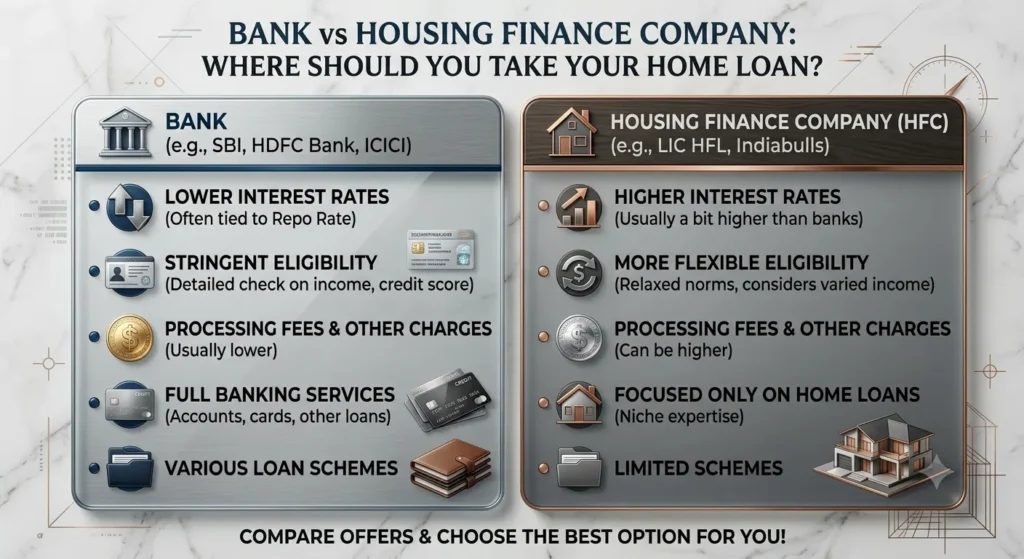
2. Bank vs HFC: What Should You Compare?
A lender’s name tells you very little about the deal you will receive. Instead, compare the terms that affect your budget and purchase.
| What to compare | Bank | Housing Finance Company |
|---|---|---|
| Interest rate | May offer competitive rates to eligible borrowers | May offer competitive rates based on its pricing policy |
| Income assessment | Depends on income type, documents, and credit profile | May offer different assessment methods for some income profiles |
| Processing time | Depends on the lender and application | Depends on the lender and application |
| Loan amount | Based on income, property value, and policy | Based on income, property value, and policy |
| Property approval | Must be checked for the exact project and unit | Must be checked for the exact project and unit |
| Interest rate changes | Depends on the loan’s benchmark and terms | Depends on the loan’s benchmark and terms |
| Fees | Vary by lender and loan offer | Vary by lender and loan offer |
| Prepayment terms | Depend on the applicable rules and loan terms | Depend on the applicable rules and loan terms |
| Other banking services | May offer wider banking services | May offer a more focused housing finance service |
There is no guaranteed winner. A bank may suit your profile and offer a lower rate. An HFC may also offer terms that work better for you. The only reliable way to decide is to compare actual offers.
Ask both lenders for a written quote. Check the interest rate, fees, loan amount, tenure, and conditions. Then compare the full deal, not just the headline rate.
3. Why a Small Interest Rate Difference Matters
Let’s look at the numbers.
Suppose you borrow ₹50 lakh for 20 years. One lender offers an annual interest rate of 7.25%, while another offers 7.75%.
| Loan detail | Offer A | Offer B |
|---|---|---|
| Loan amount | ₹50 lakh | ₹50 lakh |
| Loan tenure | 20 years | 20 years |
| Illustrative annual rate | 7.25% | 7.75% |
| Approximate monthly EMI | ₹39,500 | ₹41,000 |
| Approximate total interest over 20 years | ₹44.8 lakh | ₹48.4 lakh |
The difference is around ₹1,500 a month. Over time, that gap can add up to several lakh rupees.
However, do not stop at the EMI.
Suppose the lender offering the lower rate also charges a higher processing fee or requires other paid services. Those costs could reduce your savings. A longer approval process could also affect your purchase timeline if you have a deadline.
Therefore, ask each lender for the Key Facts Statement (KFS). It helps you review the main loan terms, charges, and annual percentage rate (APR), which reflects the annual cost of credit, including applicable charges.
The best offer is the one that works for your budget and purchase, not simply the one with the lowest advertised rate.
4. What Happens When Interest Rates Change?
Your home loan does not always stay at the same interest rate. If you take a floating-rate loan, your rate may change during the tenure.
For bank loans, the applicable external benchmark and loan terms can affect how changes in policy rates reach your EMI or tenure. HFC loans may use different pricing and benchmark arrangements, so you should check the terms of the specific offer.
This difference matters because two lenders can react differently to the same change in market rates.
Before you sign, ask these questions:
- Is the loan fixed-rate or floating-rate?
- If the rate is floating, what benchmark does it use?
- How often can the lender reset the rate?
- If the rate rises, will the EMI increase, the tenure increase, or both?
- Can you request a higher EMI to reduce the tenure?
- What happens if you want to switch lenders later?
Do not assume that every lender will pass on a rate cut at the same time or in the same way. Read the loan terms and ask the lender to explain its rate-reset process in plain language.
Also, avoid choosing a loan based on a rate that may change soon. Instead, check whether your budget can handle a reasonable rise in your EMI.
5. Buying a Flat in Hyderabad? Check the Project, Too
Here is a question worth asking before you focus on the interest rate: Has the lender approved the exact project and unit you plan to buy?
This matters even more when you are buying an under-construction apartment.
A lender may approve you as a borrower but still need to complete its checks on the property. Your personal loan approval and the project’s legal or technical approval are two different things.
For a Hyderabad homebuyer, check the following before paying a booking amount or making a firm commitment.
Project approval: Ask whether the lender has cleared the specific project and tower. Do not rely only on a verbal statement that it finances homes in the area.
RERA details: Check the project’s registration details where applicable. Also, verify the project documents and approvals relevant to your purchase.
Construction-linked payment plan: If your flat follows a construction-linked plan, ask how the lender releases each instalment. Confirm which construction milestones and documents it needs.
Disbursement timeline: Ask how long each disbursement may take after you submit the required documents. This helps you plan payments to the developer.
Occupancy Certificate: If you are buying a completed property, check the applicable completion and occupancy documents. If you are buying an under-construction flat, ask what documents the lender will need before the final disbursement, where relevant.
These checks can help you avoid delays and last-minute surprises. They also help you understand whether the lender’s process fits your payment schedule.
Remember, a project’s approval by one lender does not automatically mean every lender has approved it. Confirm the details directly with your chosen lender.
6. Which Lender Fits Your Situation?
Your income, credit history, and property matter more than a general rule about banks or HFCs.
If you are salaried
Start by comparing banks, especially if you have a stable salary, a good credit history, and clear income records. Then compare HFC offers if they provide a better overall deal.
Do not assume that your salary alone guarantees approval. Existing EMIs, credit card dues, job history, and the loan amount can also affect the decision.
If you are self-employed
Compare both banks and HFCs. Your income may vary across months or years, so ask how each lender assesses business income.
Keep your income tax returns, bank statements, financial records, and business documents ready. Ask whether the lender needs more documents to understand your cash flow.
An HFC may suit some self-employed borrowers, but approval and pricing still depend on its policy and your financial profile.
If you have a limited credit history
A short credit history does not automatically rule you out. However, lenders may have less information to assess your repayment habits.
Compare eligibility rules and ask what documents can support your application. Do not submit multiple applications without first checking the likely fit, as lenders may review your credit report during the process.
If you are an NRI
Check whether the lender offers home loans for your residency status and income source. Ask about eligible co-applicants, required documents, repayment arrangements, and any specific rules that apply to your case.
The lender’s process should fit your location, documentation, and property plans.
If the property is under construction
Give project approval and disbursement terms extra weight. A small difference in interest rate may not be worth a process that does not fit your payment schedule.
In short, choose the lender that fits both your financial profile and the property you plan to buy.
7. Fees, Prepayment, and Tax Benefits: What Should You Check?
Interest is only one part of your home loan’s cost. Before you decide, review these points in writing.
Processing and legal fees: Ask for a full list of charges. Check which fees are refundable, if any, and whether third-party costs apply.
Insurance: Ask whether any insurance is optional or required under the offer. Review the cost and terms before agreeing to a policy.
Part-payment and foreclosure: If you plan to make extra payments or close the loan early, check the applicable charges. RBI’s Pre-payment Charges on Loans Directions, 2025 introduced rules for covered loans from 1 January 2026. The treatment depends on the loan and borrower category, so confirm the rules that apply to your agreement rather than assuming every loan has zero charges.
Balance transfer: You may be able to move your outstanding loan to another lender if the new offer works better. However, compare the new rate with processing, legal, valuation, and other applicable costs. Check the remaining tenure, too.
Tax benefits: Tax treatment does not depend on whether you borrow from a bank or an HFC alone. Eligibility for deductions on principal and interest depends on the applicable tax rules, property use, and tax regime. Review your situation before counting any tax benefit as a saving.
These checks may seem small when you are excited about buying a home. Yet, they can make a real difference to the amount you pay over time.
8. Your Checklist Before Signing the Sanction Letter
Before you accept a home loan, make sure you can answer these questions.
- Have I compared the interest rate and total loan cost?
- Have I checked the EMI against my monthly budget?
- Do I understand the benchmark and rate-reset terms?
- Have I reviewed the KFS and all applicable fees?
- Is the loan amount enough for my planned purchase?
- Has the lender confirmed approval requirements for my exact property?
- Do I understand the disbursement process and expected timeline?
- Have I checked prepayment and balance transfer terms?
- Did I read the conditions in the sanction letter?
- Have I kept enough money aside for the down payment, registration, taxes, moving costs, and emergencies?
If any answer is unclear, ask the lender to explain it before you sign. A clear answer now is better than an expensive surprise later.
Key Takeaways
- Do not choose by lender type alone. Banks and HFCs can both offer suitable home loans.
- Compare the full cost. Look beyond the interest rate to fees, charges, and loan terms.
- Match the loan to your income. A lender’s assessment process matters, especially if you are self-employed.
- Check the property separately. Your approval as a borrower does not guarantee project approval.
- Read the rate-reset terms. Understand how your EMI or tenure may change.
- Get everything in writing. Review the KFS and sanction letter before accepting the offer.