Cancellation Before Agreement: How to Exit a Flat Booking Legally and Recover Your Money
You paid the booking amount. A few weeks later, something changed — the project timelines shifted, another option came up, or the financials no longer work. Now you want to exit before signing the Agreement of Sale, and you are wondering how much of your money you will get back.
The answer depends on exactly where you are in the transaction, and most buyers do not know that the legal ground shifts significantly the moment the Agreement of Sale is signed. This guide explains your rights at each stage, what a builder can legitimately deduct, and what to do if the refund does not come.
1.Before Agreement vs After Agreement of Sale: Why the Stage Matters
This is the most important distinction in any flat booking cancellation, and almost no guide explains it clearly enough.
Before the Agreement of Sale is signed and registered, your transaction is a pre-contractual booking. You have paid a booking amount (typically 1–2% of the flat’s value or a fixed sum), which reserves the unit. However, the full contractual terms — payment schedule, penalty clauses, cancellation fees — have not been finalised and registered under the Registration Act.
At this stage, your position is relatively strong. The booking is not a completed sale contract. RERA provides some protection on what the builder can deduct, and excessive forfeitures are challengeable.
After the Agreement of Sale is signed and registered, a formal legal contract exists between you and the builder. The cancellation terms in that agreement now govern the transaction. Deductions at this stage can be significantly higher, and exit is more complicated — potentially involving stamp duty implications and formal cancellation deed registration.
The practical rule: if you are considering an exit, act before signing the Agreement of Sale. The further you go in the transaction, the more it costs to come out.
Be Among the First to Own a Legacy
2.What RERA Says About Booking Amount Deductions and Refunds
RERA does not prescribe a fixed percentage that builders can deduct on cancellation, but it does establish principles that make excessive forfeitures challengeable.
Under RERA, any amount paid by a buyer must be refunded within the timelines specified in the agreement, and the agreement itself must be fair and not contain one-sided conditions. An agreement that allows a builder to forfeit the entire booking amount on a pre-possession cancellation by the buyer — with no corresponding penalty if the builder defaults — has been treated as an unfair term in several TSRERA and RERA adjudications.
The key points RERA establishes:
- The booking amount, any advance payments, and any instalments paid must be refundable upon cancellation, subject to permitted deductions specified in the agreement
- If the builder causes the cancellation (through delay, non-delivery, or deficiency), the buyer is entitled to a full refund with interest
- If the buyer initiates the cancellation before the Agreement of Sale, the builder may deduct a reasonable cancellation charge — but this must be disclosed upfront
For a complete overview of buyer protections under RERA and how to use the TSRERA portal, read our beginner’s guide to verifying RERA projects in Telangana.
3.What Can a Builder Legally Deduct From Your Booking Amount?
Industry practice and TSRERA adjudications give us a reasonable picture of what is defensible and what is not.
What is generally considered reasonable:
- A cancellation charge of 1–2% of the apartment’s agreed value for a pre-Agreement of Sale cancellation
- Administrative costs directly incurred by the builder related to your booking (these are typically minimal)
What is generally considered unreasonable and challengeable:
- Forfeiture of the entire booking amount (especially when the amount paid is more than a nominal sum)
- Deduction of GST paid on the booking amount, which the builder is typically required to claim as a credit or refund from the authorities
- “Processing fees,” “brokerage recovery charges,” or other vaguely defined heads that inflate the deduction beyond the actual cancellation cost
If your builder’s sale brochure or booking form states that the booking amount is “fully non-refundable,” that term can be challenged under RERA for pre-Agreement cancellations, particularly where the booking amount represents a significant percentage of the flat value. (Source)
Keep the booking form, any correspondence confirming your booking, and your payment receipts. These documents establish what was represented to you at the time of booking.
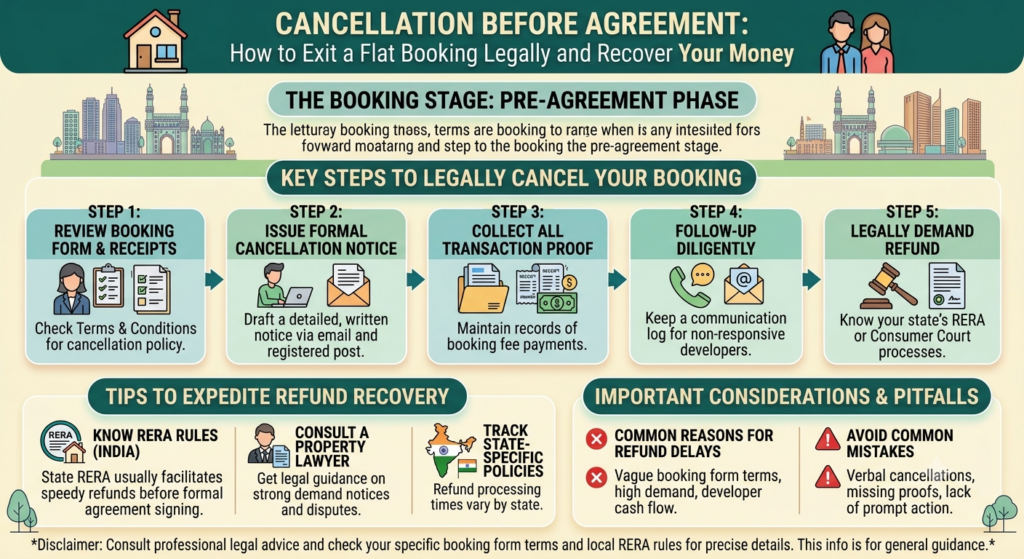
A verbal cancellation request is not sufficient. In case a dispute arises over your refund, you will want to have a trail of documentation showing that you requested cancellation. In order to effectively document your request make sure you follow this process:
Step 1 — Write a formal cancellation letter.
Address it to the builder’s customer care or booking management department. State clearly:
- Your booking reference number
- The flat/tower/unit you booked
- The amount paid and the date of payment
- Your request for cancellation and refund
- Your bank account details for the refund transfer
Use formal, fact-based language throughout your correspondence.
Step 2 — Send by email and registered post simultaneously.
Email creates a timestamped digital record. Registered post (RPAD — Registered Post with Acknowledgement Due) creates a physical delivery record with postal acknowledgement. Both together are your strongest paper trail.
Step 3 — Note the delivery date.
The 45-day refund clock under RERA starts from the date the builder processes your cancellation. Your delivery confirmation establishes when they received the request.
Step 4 – If you have not received written confirmation of the cancellation had been processed or when you could expect to receive a refund within 30 days after having submitted your cancellation request, you must email the builder referencing your original request for cancellation and requesting written confirmation of the date that your cancellation is expected to be processed.
For context on how buyer-initiated cancellations interact with RERA registration requirements, our guide to RERA project search for homebuyers explains how to locate the project’s agreement and complaint history on the TSRERA portal.
4.If the Builder Refuses to Refund: Your Escalation Options
If the builder ignores your cancellation request, disputes the refund, or makes deductions you consider unreasonable, you have two formal escalation paths.
TSRERA complaint. File at rera.telangana.gov.in under the complaints section. Attach:
- Your booking receipt and payment confirmations
- Your cancellation letter with proof of delivery
- The builder’s response (or evidence of non-response)
- Any sale brochure or booking form that shows the terms represented to you
TSRERA can direct the builder to process the refund, award interest on delayed refunds, and levy penalties for non-compliance.
Consumer forum. You can also approach the District Consumer Disputes Redressal Commission under the Consumer Protection Act 2019. Consumer forums can award compensation for mental harassment and deficiency in service, in addition to the refund amount. Both avenues can be pursued simultaneously, though most buyers find RERA faster for straightforward refund disputes.
The critical input for both proceedings: your written cancellation request with delivery proof. Without it, the dispute becomes “he said, she said.”
5.Refund Timelines: How Long Should You Wait?
Builders must process refund requests from buyers within 45 days of receiving the buyer’s request for cancellation according to RERA rules and regulations. Should the builder choose not to issue a refund to the buyer in accordance with the above timeframe, the buyer may charge the builder interest on the funds held by the builder for those 45 days according to the rates provided for in the buyer’s contractual agreement with builder per RERA, or 2% above the current MCLR (whichever rate is higher).
Two important caveats:
First, the 45-day clock starts from when the builder processes your cancellation — not when you send the request. Builders sometimes delay acknowledging the cancellation to push back the refund date. Your registered post delivery confirmation protects you if this happens.
Second, if GST was collected on the booking amount, the GST component is refundable to you by the builder — the builder then claims it back from the tax authority. Do not let the builder retain GST as part of their deduction.
6.Refund Timelines: How Long Should You Wait?
TDS deducted from the booking amount at that time will be deemed to have been paid to the income tax office for your benefit and you will receive credit for the amount of TDS that was deducted when preparing your income tax return.
The TDS that will be reimbursed to you when you have cancelled your booking will not be considered to be taxable. A returned booking amount will also be considered to be a reimbursed capital amount – not a gain (the amount will not have been taxed as you would have been taxed if you had not cancelled your booking). A returned booking amount will not be taxed the buyer unless the amount of the refunded deposit payable to the buyer exceeds the buyer’s actual cost for the total amount to be paid as consideration for the amount of the cancelled booking.
What the buyer should collect from the developer when they refund the buyer:
- A formal cancellation letter on builder letterhead confirming the unit, amount deducted, and net refund
- Form 16B if TDS was deducted (this is the TDS certificate that allows you to claim the tax credit)
Having these documents in order before the refund is transferred avoids complications later at the time of filing returns.
Our guide to the defect liability period covers what happens if you continue with the purchase and later need to enforce builder obligations post-possession — useful context if you are reconsidering the cancellation decision.
FAQs
1.Can I cancel a flat booking prior to signing the Sale Agreement?
Yes. Before the Agreement of Sale is signed and registered, your booking is a pre-contractual arrangement. While RERA provides some protection on booking amounts and requires a real estate developer to deduct a reasonable cancellation fee from the refund, a buyer has more standing to claim a timely refund for cancellations made before the Sale Agreement is signed compared to after the Sale Agreement is signed, primarily because the full contractual obligations have not yet been established.
2.How much of the booking amount can a builder deduct on cancellation?
RERA does not specify a fixed percentage, but requires that any forfeiture be reasonable and specified in the agreement. Industry practice sees builders deducting 1–2% of the apartment’s value as a cancellation charge for pre-Agreement cancellations. Deductions significantly above this level may be challengeable before TSRERA as an unfair trade practice.
3.How long does a builder have to refund my booking amount?
As per RERA guidelines, once a cancellation request has been acknowledged, builders must process refunds within a maximum period of 45 days. In the event of a failure to refund by this deadline, purchasers have the option to recover interest, either based on the rate established in their RERA contract, or by using the applicable MCLR plus an additional 2% on the existing MCLR; whichever amount is in excess of or greater than the amount specified under the RERA agreement.
4.What action(s) can I take against my builder in the event that they refuse to refund my deposit?
File a complaint on the TSRERA portal at rera.telangana.gov.in. Attach your booking receipt, cancellation request with delivery proof, and any written communication from the builder. TSRERA can direct the builder to refund the amount with interest and levy penalties for non-compliance. You may also approach the consumer forum.
5.What are the tax implications of receiving a refund of my booking fee?
If TDS was deducted from your booking fee under Section 194-IA, then you should receive a Form 16B from the builder. You will be able to use this form to claim the amount deducted from your booking fee against your income when you file your tax return for the year. The amount of the refund itself will not be subject to tax; rather, it will simply represent a recovery of your capital (rather than a profit).