Corpus Fund in Apartments: What It Is, How It Works & What Residents Must Know
Quick Answer
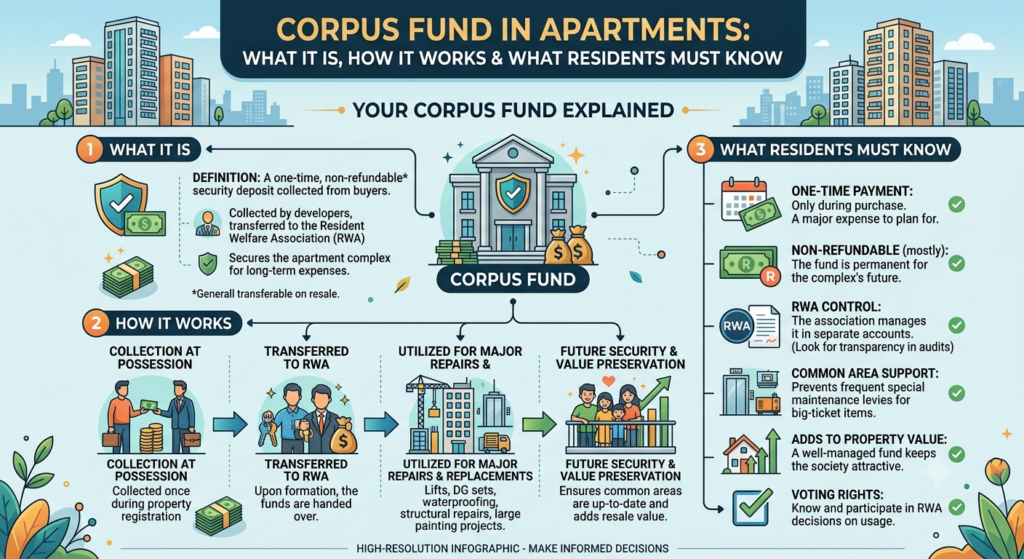
Corpus fund is a one-time reserve collected for major repairs, redevelopment, and long-term society expenses. It is usually kept as a capital reserve, and builders hand it over to the society when it is formed. Proper accounting helps protect it from misuse.
When you buy an apartment, you’re likely thinking about the property price, registration charges, monthly maintenance fees and your home loan EMI. But there’s one more aspect of apartment life which most homebuyers don’t fully appreciate until years later – the corpus fund.
A strong corpus fund often makes all the difference between a smooth major repair or a housing society struggling with sudden financial pressures. Whether it’s lift replacement or repairing the terrace or upgrading common infrastructure, the corpus fund serves as the backbone of apartment life.
Yet many residents still ask:
- What is a corpus fund in an apartment?
- Why do builders collect it?
- Is it refundable?
- How is it different from maintenance charges or IFMS?
- What rights do residents have over its usage?
In this guide, we’ll explain everything you need to know about corpus fund in apartments, including how it is calculated, how Resident Welfare Associations (RWAs) use it, what RERA expects regarding transparency, and why every apartment owner should understand how this reserve works.
What Is a Corpus Fund in a Housing Society?
A corpus fund is essentially a long-term financial reserve held by your housing society or RWA to cover large future expenses that cannot sensibly be covered through regular monthly maintenance collections.
Think about it as your apartment building’s emergency and capital expense account.
Every housing project has assets that gradually wear down over time. Though monthly maintenance helps keep those assets running, significant repairs and replacement frequently call for much bigger sums of money. (Source)
Examples include:
- Lift replacement
- Terrace waterproofing
- Structural repairs
- Generator replacement
- Clubhouse refurbishment
- Fire safety system upgrades
- Sewage treatment plant overhauls
- External painting of towers
- Major plumbing replacement
Without a corpus fund, residents may suddenly face large special assessments whenever expensive repairs become necessary.
A properly funded corpus reserve helps prevent such financial shocks.
Be Among the First to Own a Legacy
Why Is a Corpus Fund Important?
Your apartment communities were created to last for decades. While most properties run smoothly in their first few years, major repair needs begin surfacing when the project gets older. (Source)
A corpus fund helps ensure that:
- Essential infrastructure remains functional.
- Property values are protected.
- Major repairs can be executed without delay.
- Residents don’t want large one-time emergency contributions.
In simple terms, monthly maintenance keeps the community running today while the corpus fund prepares it for tomorrow.
Corpus Fund vs IFMS vs Monthly Maintenance: Key Differences
One of the biggest sources of confusion among apartment buyers is understanding the relationship between corpus funds, IFMS, and maintenance charges.
Although all three involve money collected from homeowners, they serve completely different purposes.
| Parameter | Corpus Fund | IFMS | Monthly Maintenance |
|---|---|---|---|
| Purpose | Long-term reserve for major repairs | Maintenance security deposit | Daily operational expenses |
| Collection Timing | Usually during purchase or by society | During purchase | Monthly |
| Control | RWA or Housing Society | Builder initially, then RWA | RWA or Facility Manager |
| Frequency | One-time or periodic | One-time | Recurring |
| Usage | Capital-intensive expenses | Maintenance-related reserve | Routine operations |
| Examples | Lift replacement, waterproofing | Maintenance support | Security, housekeeping, electricity |
Corpus Fund
The corpus fund exists to support major future expenditures that arise over a building’s lifecycle.
It is essentially a long-term capital reserve.
IFMS (Interest-Free Maintenance Security)
IFMS is collected at the time of purchase and serves as a maintenance security deposit.
While both IFMS and corpus funds contribute to the financial health of the community, their objectives are different.
If you’d like a detailed breakdown of IFMS and how it works, read our guide on What Is IFMS Full Form in Real Estate?
Monthly Maintenance Charges
The day to day expenses are maintained for intermittent payments like:
- Security staff salaries
- Housekeeping
- Landscaping
- Common-area electricity
- Water management
- Facility management services
A good rule of thumb is:
Maintenance charges cover today’s expenses.
Corpus funds prepare for tomorrow’s expenses.
How Is the Corpus Fund Calculated?
One of the most frequently asked questions is about corpus fund calculation in apartments.
Unlike registration charges or property taxes, there is no universal formula prescribed across all residential projects.
The amount depends on several factors.
Factors That Influence Corpus Fund Requirements
Project Size
A larger community typically requires a larger reserve because it contains more infrastructure and amenities.
Number of Amenities
Projects with:
- Swimming pools
- Clubhouses
- Sports courts
- Large landscaped areas
- Multiple elevators
usually require higher corpus reserves.
Age of Infrastructure
Older buildings generally need larger reserves because major repairs become more frequent over time.
Replacement Costs
The expected future cost of replacing critical systems significantly influences corpus fund planning.
A Practical Hyderabad Example
Imagine a residential community with:
- 200 apartments
- Four towers
- Eight lifts
- Clubhouse
- Swimming pool
- Generator backup
- Sewage treatment plant
The RWA estimates that over the next 15 years it may require:
| Expense Category | Expense Category |
|---|---|
| Lift replacement | ₹2 crore |
| Waterproofing | ₹75 lakh |
| Generator overhaul | ₹50 lakh |
| Clubhouse renovation | ₹1 crore |
| Structural repairs | ₹75 lakh |
Total projected major expenditure:
₹5 crore
If the community decides to build this reserve proportionately:
₹5,0000000 ÷ 200 = ₹2,50,000 , for every apartment.
This example illustrates why corpus fund contributions in Hyderabad often range between ₹1 lakh and ₹3 lakh per flatdepending on project scale and amenities.
Is a Higher Corpus Fund Always Better?
It’s not about accumulating as large a reserve as possible. It’s about maintaining one that adequately serves the community’s long-term needs while providing for transparency and accountability.
What is the usage of Corpus Fund?
Many residents assume the corpus fund should never be touched.
In reality, the fund exists precisely so that it can be used when significant capital expenditure becomes necessary.
Common Uses of Corpus Funds
Lift Replacement
Elevators are some of the most expensive assets in an apartment building.Eventually, as they get old, you might need to replace all of them.
Terrace Waterproofing
Water seepage can be extremely damaging, if neglected.Heavy duty water proofing tasks are often undertaken using the corpus reserves
Generator Replacement
Diesel generators have an end life and need to be replaced / overhauled at some point of time.
External Building Repairs
Over time, apartment exteriors require:
- Structural restoration
- Crack repairs
- Repainting
- Façade maintenance
These costs can be substantial.
Fire and Safety Upgrades
Changes in regulations or aging equipment may require expensive upgrades to:
- Fire alarms
- Sprinkler systems
- Emergency lighting
- Safety infrastructure
What Corpus Funds Should Not Be Used For
A healthy RWA should avoid using corpus funds for routine operational expenses such as:
- Security salaries
- Housekeeping costs
- Gardening
- Common electricity bills
- Daily maintenance activities
These should be funded through monthly maintenance collections.
Using corpus reserves for recurring expenses can weaken the society’s financial position over time.
What RERA Says About Corpus Funds
Homebuyers increasingly want clarity regarding corpus fund RERA rules and how developers are expected to handle these funds.
One of RERA’s key objectives is improving transparency and accountability in residential real estate transactions.
Disclosure of Charges
Builders are expected to clearly disclose charges collected from buyers, including any corpus fund contributions.
Homebuyers should understand:
- Amount collected
- Purpose of collection
- Transfer mechanism
- Management process
before taking possession.
Transfer to Resident Associations
Once the Resident Welfare Association or apartment association is formed, applicable funds and financial records should be transferred according to governing regulations and project documentation.
This enables residents to take control of community finances.
Importance of Documentation
Residents should ensure that the society receives:
- Financial statements
- Collection records
- Transfer documents
- Supporting account information
A transparent handover process helps avoid disputes later.
Why This Matters
A poorly documented corpus fund creates confusion.
A properly documented corpus fund creates accountability.
For buyers purchasing their first apartment, understanding these financial aspects is just as important as understanding registration costs, maintenance fees, and ownership responsibilities. You can explore more in our guide to Buying Your First Home in Hyderabad.
Tax Treatment of Corpus Fund Interest
Another commonly searched topic is corpus fund tax treatment in India.
The corpus fund itself is generally considered a capital reserve of the housing society.
However, many RWAs invest portions of their reserve in:
- Fixed deposits
- Savings accounts
- Other permitted financial instruments
These investments may generate interest income.
Why Interest Matters
Over time, a big corpus can earn substantial amount. For e.g., A ₹5 crores corpus, assuming return of 6%, could earn you ₹30 lakhs every year as interest alone!
Is This Interest Taxable?
The tax treatment depends on multiple factors, including:
- The structure of the housing society
- Applicable tax provisions
- Nature of income
- Available exemptions
Since taxation rules can evolve, RWAs should seek professional advice from qualified tax consultants or chartered accountants before making decisions regarding corpus fund investments.
Why Residents Should Care
Interest earned on corpus reserves belongs to the community.
Residents should ensure that:
- Earnings are properly accounted for.
- Financial statements reflect interest income.
- Investments align with society policies.
- Annual audits reveal everything.
Transparency builds trust and protects your community’s long-term financial health.
Advantages and Disadvantages of Corpus Fund
Advantages
- Helps society handle big repairs and emergency expenses.
- Reduces sudden financial pressure on residents.
- Keeps the society financially prepared for the long term.
- Can improve maintenance and overall property value.
- Supports smooth redevelopment or major upgrade work.
Disadvantages
- It is usually a one-time amount, so buyers may feel the upfront cost is high.
- If not managed properly, the money can be misused.
- Members may not always agree on how it should be used.
- Poor accounting can create confusion and disputes.
- The fund may lose value over time if it is not managed well.
Resident Rights and How to Request a Corpus Fund Audit
Many apartment owners contribute to the corpus fund but never review how it is managed.
This is a mistake.
As a resident and owner, you have legitimate rights regarding financial transparency.
Right to Financial Information
Residents should have access to:
- Audited financial statements
- Annual reports
- Fund utilisation records
- Budget disclosures
Right to Attend General Meetings
Annual General Meetings (AGMs) provide opportunities to:
- Review corpus fund status
- Understand major expenditures
- Question management decisions
- Propose financial improvements
Right to Seek Clarification
If residents have concerns regarding corpus fund usage, they can request explanations regarding:
- Particular expenses
- Decisions regarding financial investments
- Reserve balances
- Planned future utilisation
When should residents request an audit?
An independent review may be appropriate if:
- There’s a long term planning
- There’s participation of the resident in the process of making the decision.
- Structured control financially keep both the property and the community value high.
Signs of a Well-Managed Corpus Fund
Healthy apartment communities generally demonstrate:
- Annual audits
- Transparent reporting
- Documented expenditure approvals
- Long-term maintenance planning
- Resident participation in decision-making
Strong financial governance helps preserve both community quality and property value.
Key Takeaways
- Corpus fund covers major future repairs.
- It is different from maintenance and IFMS.
- The amount depends on the project’s needs.
- It should only be used for capital expenses.
- Residents have the right to financial transparency.
- A healthy corpus fund supports long-term property value.