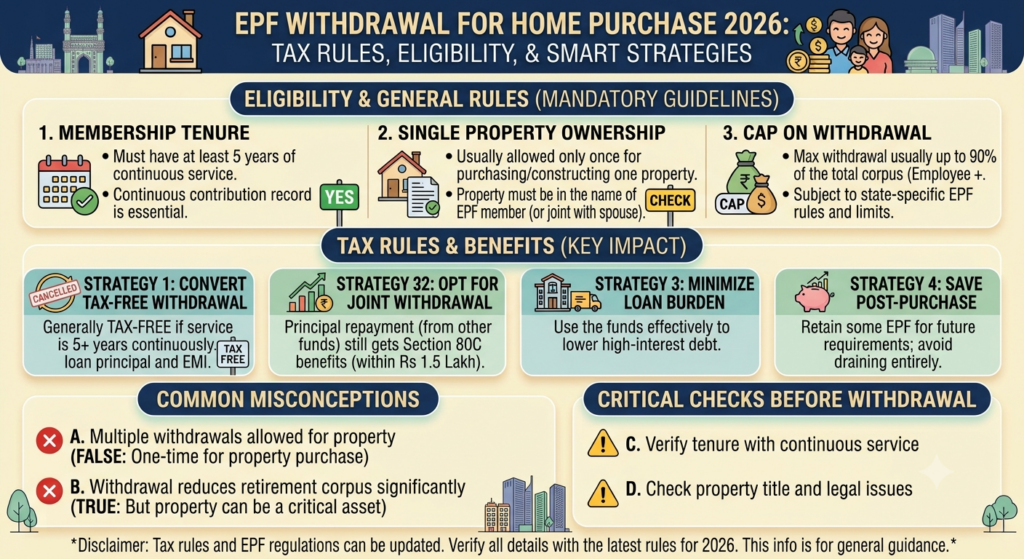
EPF Withdrawal for Home Purchase 2026: Tax Rules, Eligibility and Smart Strategies
Many workers with salaries consider their Employees’ Provident Fund (EPF) balance as being off-limits until they retire.That instinct is broadly right, but it misses a specific provision that EPFO has had in place for decades. You can withdraw from your provident fund for housing purposes, it’s legal, and in most cases it’s tax-free. The question is whether it’s actually the smartest use of those funds.
This guide covers what you can withdraw, when the 5-year rule makes it tax-free, how to apply online in 2026, and the question most guides avoid answering directly: EPF or bigger loan?
1.Can You Use EPF Savings to Buy a Home? The Basics Explained
Yes. Paragraph 68B of the EPF Scheme 1952 specifically permits partial withdrawal of your provident fund for housing purposes. Three categories are allowed:
- Purchase of a residential plot
- Purchase or construction of a house or flat
- Repayment of an existing home loan
This is a partial withdrawal, not a full account closure. Your remaining balance continues to earn interest at the declared EPF rate (8.25% for FY 2026) and compounds until retirement. Withdrawing for a home doesn’t close your account or affect your future contributions.
One important constraint: this is a once-in-a-lifetime facility for the purchase or construction purpose. You can use it only once for buying or building a property. The home loan repayment facility is treated separately and may be used more than once if your account has sufficient balance.
Be Among the First to Own a Legacy
2.Eligibility Conditions for EPF Housing Withdrawal
Most people think of EPF withdrawal as something that helps with the initial purchase of a home. Far fewer realise that the EPF Scheme also allows eligible members to use their accumulated savings to reduce an existing home loan.
For borrowers who have been paying EMIs for a few years, this can become a useful way to reduce the outstanding principal without dipping into emergency savings or redeeming long-term investments.
The eligibility conditions remain largely the same:
- Minimum 5 years of continuous EPF membership
- The property must be in your name or jointly with your spouse
- The loan should be from a recognised bank or housing finance company
- The withdrawal is limited to 90% of your employee contribution plus accumulated interest. The employer’s contribution is not included when calculating this limit.
To understand how this works in practice, consider a simple example.
Suppose you’ve been servicing your home loan for several years and your finances look like this:
- Outstanding home loan: ₹45 lakh
- Total EPF balance: ₹15 lakh
- Employee contribution (including interest): ₹10 lakh
- Employer contribution (including interest): ₹5 lakh
At first glance, it might seem that you can withdraw 90% of your total EPF balance. However, for home loan repayment, only your own contribution is considered.
This means your eligible withdrawal works out to 90% of ₹10 lakh, which is ₹9 lakh.
If you use that ₹9 lakh to make a lump-sum prepayment, your outstanding loan immediately reduces from ₹45 lakh to ₹36 lakh. Depending on your lender’s policy, you can either reduce your monthly EMI while keeping the loan tenure the same or continue paying the existing EMI and finish the loan earlier. In most cases, keeping the EMI unchanged and reducing the tenure results in greater interest savings over the life of the loan.
That said, this option shouldn’t be viewed as an automatic financial win.
Every rupee withdrawn from your EPF is a rupee that stops compounding for your retirement. Before making a withdrawal, compare the interest you’re saving on your home loan against the long-term growth you’re giving up in your EPF account. If the withdrawal allows you to eliminate a high-cost portion of your loan or significantly improve your monthly cash flow, it may be worth considering. Otherwise, allowing your EPF corpus to continue compounding while servicing the loan through regular EMIs may be the stronger long-term strategy.
For context on how a lump-sum prepayment affects loan tenure, foreclosure charges, and RBI guidelines, our guide to home loan foreclosure charges and RBI rules explains the decision-making process in greater detail.
3.How Much EPF Can You Withdraw for a Home Purchase?
The limit depends on what you’re withdrawing for:
| Purpose | Maximum Withdrawal |
| Purchase or construction of house/flat | 90% of total EPF accumulation (employee + employer + interest), or property cost, whichever is lower |
| Repayment of existing home loan | 90% of employee’s own share only (your contributions + interest, not employer’s share) |
Example: Total EPF balance Rs. 18 lakh (Rs. 10 lakh your contributions plus interest, Rs. 8 lakh employer contributions plus interest).
- For purchase: up to Rs. 16.2 lakh (90% of Rs. 18 lakh), capped at the property cost
- For loan repayment: up to Rs. 9 lakh (90% of Rs. 10 lakh employee share)
This distinction catches many people off guard. If you’re using EPF for home loan repayment, the employer’s share is excluded from the calculation. That’s a meaningful difference when employer contributions have been accumulating for years.
Our guide to the true cost of buying an apartment in Hyderabad in 2026 maps out all the upfront costs (stamp duty, registration, GST, down payment) so you can calculate exactly how much of a gap you’re trying to fill.
4.Is EPF Withdrawal Taxable? The 5-Year Service Rule Explained
This is the most misunderstood part of the EPF withdrawal process. A common assumption: “I’m withdrawing for a home purchase, so it must be tax-free.” That’s incorrect.
What determines taxability is your total continuous service period, not the reason for withdrawal.
| Service Period at Withdrawal | Tax Treatment |
| 5 or more years of continuous EPF membership | Entirely tax-free: no TDS, no income addition |
| Less than 5 years | Taxable as income in the year of withdrawal. TDS at 10% with valid PAN, at 30% without PAN |
Housing purpose doesn’t grant a separate tax exemption. If you’re three years into your EPF and withdraw for a home purchase, the amount is added to your income for that year and taxed at your slab rate, with TDS already deducted at 10%.
What counts as continuous service: changes in employer are fine as long as the PF was transferred and not withdrawn between jobs. A gap in employment with no EPF contributions can break the continuity. Check your account history if you’ve had career breaks.
If you’re approaching but haven’t yet completed 5 years, waiting a few more months before applying can make the entire withdrawal tax-free. It is good to wait!(Source)
5.Is EPF Withdrawal Taxable? The 5-Year Service Rule Explained
The EPFO member portal handles housing withdrawals entirely online for members with a verified UAN.
Before you start, confirm your UAN has:
- Aadhaar linked and OTP-verified
- PAN linked
- Bank account details registered and confirmed by the employer
Application steps:
- Log in at member.epfindia.gov.in with your UAN and password
- Go to Online Services, then Claim (Form 31, 19 and 10C)
- On the claim page, verify your KYC details shown on screen
- Under “I want to apply for”, select PF Advance (Form 31)
- Select the appropriate purpose: Purchase/Construction of House or Repayment of Housing Loan
- Enter the withdrawal amount (within the permitted limit)
- Upload supporting documents: sale agreement, registered document, or builder letter, as applicable, depending on the purpose
- Submit the claim
Processing Time: approximately 15-20 working days from date submitted for completed applications. If you have a UAN number that is Aadhaar-seeded and your KYC has been confirmed, processing will most likely be on the shorter side. Claims with incomplete documents or mismatched KYC take longer.
You’ll receive an SMS on your registered mobile number at each stage: claim submitted, claim approved, and amount transferred.
6.Using EPF to Repay Your Home Loan: The Lesser-Known Option
This facility under Paragraph 68B(3) is used by far fewer borrowers than the purchase facility, even though it can be more financially useful in certain situations.
If you already have a home loan and your EPF has grown meaningfully over the years, you can withdraw from your account specifically to prepay the outstanding principal on your loan. The conditions:
- Minimum 5 years of EPF membership
- Property must be in your name or jointly with your spouse
- Loan must be from a recognised financial institution (bank or HFC, not a private lender)
- Withdrawal is limited to 90% of your employee contribution plus interest (not total balance)
This option is useful when you’re a few years into a home loan, your EPF corpus has built up, and you want to reduce the outstanding principal and save on future interest without liquidating other investments. It avoids the trade-off of selling equity mutual funds or fixed deposits prematurely.
For context on how a lump-sum payment into a home loan interacts with foreclosure charges and tenure reduction, our guide to home loan foreclosure charges and RBI rules covers the decision framework in detail.
7.EPF Withdrawal vs Higher Home Loan: Which Is the Smarter Move?
Most guides avoid answering this directly. Here’s an honest breakdown.
The case for using EPF:
- Reduces the down payment gap, making the property purchase possible without stretching liquid savings
- No interest cost on the withdrawn amount, unlike a larger home loan
- If you’ve completed 5 years of service, the withdrawal is entirely tax-free
- Reduces the home loan amount, lowering your monthly EMI burden
The case for keeping EPF intact and borrowing more:
- EPF earns 8.25% (declared for FY 2026), which is effectively tax-free for members completing 5 years of service. After the 30% tax rate adjustment, this is equivalent to a pre-tax return of approximately 11.8%
- Home loan interest rates as of mid-2026 are typically in the 8.5 to 9.5% range. The Section 24(b) deduction of up to Rs. 2 lakh per year reduces the effective borrowing cost further for salaried employees
- The compounding effect of uninterrupted EPF growth is significant: Rs. 10 lakh kept in EPF at 8.25% for 20 years compounds to approximately Rs. 48 to 50 lakh. Withdrawing that Rs. 10 lakh today forfeits that entire compounding chain
The practical guidance for 2026:
If you genuinely need the EPF funds to close the purchase and have no other avenue for the down payment, use it. But withdraw the minimum needed to close the gap, not the maximum you’re permitted to withdraw.
If you can close the purchase without EPF by borrowing slightly more, the math generally favours keeping EPF intact and paying a marginally higher EMI. The compounding loss from early EPF withdrawal typically exceeds the interest saved on a slightly smaller loan over any reasonable horizon.
One exception: if your home loan rate significantly exceeds your EPF return (a scenario more common when rates are elevated), the loan repayment facility starts to make arithmetic sense. Calculate the comparison with your actual numbers before deciding.