Home Loan Foreclosure Charges: What RBI Says and How to Save the Most (2026 Guide)
A year-end bonus lands in your account. The obvious question: should it go toward your home loan? Before you call the bank, you need to know whether closing or prepaying the loan will cost you a penalty fee. For a large share of Indian borrowers in 2026, the answer is that no fee applies at all.
This guide covers who the RBI actually protects, who still faces fees, and how to decide whether prepaying your home loan makes financial sense at your current stage.
1.What Are Home Loan Foreclosure and Prepayment Charges?
Foreclosure means paying off the entire remaining outstanding balance to close the loan before its scheduled end date.Partial prepayment refers to making a one-time payment towards the balance of an existing loan’s principal balance. This payment will reduce either your remaining term or your monthly payment amount, depending on the way you decide to use it.
By using either option, you will pay off your loan more quickly than using the standard method of paying the same amount each month (i.e., making your regular monthly payments). Both methods will reduce your total interest costs over the life of your loan by reducing (free of penalties) the amount of principal that remains outstanding on your loan each month as a result of these payments.
Early payouts are often subject to a penalty at some lenders as a result of losing interest revenue associated with the loan being paid off early.Charges of 2 to 4% of the outstanding principal were standard. That practice has been significantly curtailed for individual borrowers, but not eliminated entirely.
2.The RBI Rule: When Banks Cannot Charge Foreclosure Fees
In a circular dated 2012, the Reserve Bank of India prohibited banks from charging prepayment/foreclosure fees for floating rate home loans of individual borrowers taken for purposes other than business. The National Housing Bank extended this same protection to Housing Finance Companies (HFCs) as well.
If you’re an individual borrower with a floating rate home loan used for residential purposes, your bank can’t charge you anything to close the loan early, regardless of when in the tenure you do it.
Be Among the First to Own a Legacy
The protection applies to:
- All RBI-regulated scheduled commercial banks
- Housing Finance Companies Regulated By National Housing Bank
- Individual Borrowers (excluding business entities, companies, limited liability partnerships (LLPs), and partnerships.)
- Loans at floating rates of interest
If your loan agreement still contains a foreclosure penalty clause for a floating rate loan, that clause is unenforceable under the RBI directive. You can close the loan with a simple written request and pay only the outstanding principal plus interest accrued to the closure date. (Source)
3.Fixed Rate vs Floating Rate: Who Faces Charges and Who Does Not
The RBI exemption applies only to floating rate loans. Fixed rate borrowers face a different picture.
Floating rate borrowers (individual, non-business):
- No foreclosure or prepayment charges: legally prohibited
- Can foreclose or part-prepay at any time, in any amount
- Standard process: written request to the bank, outstanding amount confirmed, transfer made
Fixed rate borrowers:
- Banks can still charge prepayment/foreclosure fees.
- The typical fee charged by banks ranges from 2 – 4 % of the principal amount outstanding upon closure of the loan.
- Some lenders will waive fees after a specified minimum number of monthly EMIs have been paid (e.g. 36 months has been reached).
- Check the exact terms in your loan agreement under the prepayment or foreclosure clause
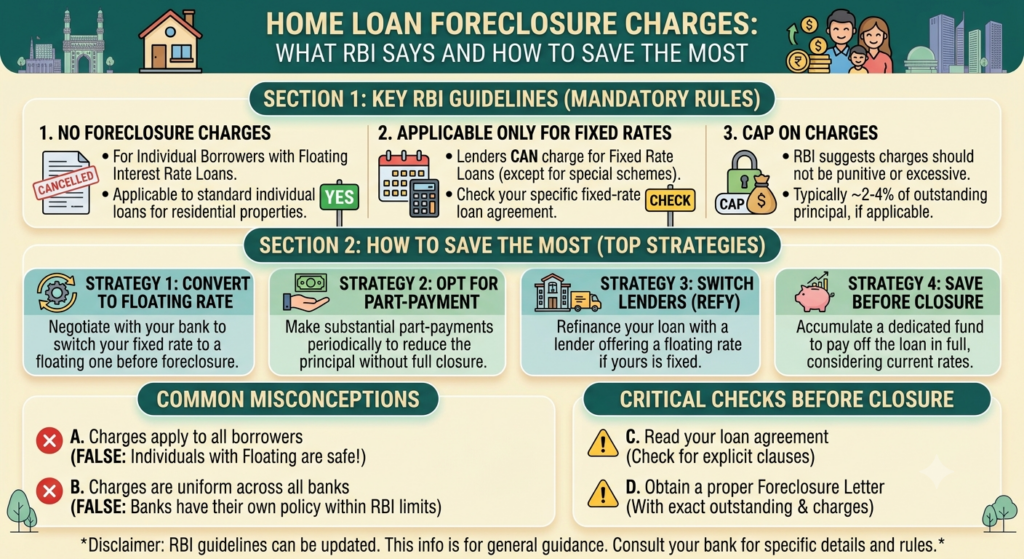
One scenario to watch: hybrid loans, fixed for an initial period (typically 2 to 5 years) and floating thereafter. If you’re in the fixed period, charges may apply. Once the rate converts to floating, the RBI zero-charge rule kicks in. Confirm which rate type is active at the time you want to prepay.
4.Part Prepayment vs Full Foreclosure: Which Saves More Interest?
It is not a matter of ‘either/or’ – it is a matter of how much surplus you have to work with and what you are optimizing.
Part prepayment applies a lump sum to your outstanding principal. Most banks will offer you two different choices when you prepay:
- Reduce your monthly EMI amount (keeps loan tenure the same)
- Reduce your loan tenure (keeps the EMI amount the same)
A shorter loan tenure almost always saves you more interest than reducing your EMI because the shorter loan term results in fewer months of accumulated interest on the loan.
Full foreclosure closes the loan entirely. The benefit is absolute: you’re debt-free, no more EMIs, and the property is unencumbered. The trade-off is deploying a large sum in one go that might otherwise earn returns if invested.
A rough decision framework for 2026:
| Situation | Likely better choice |
| Home loan rate above 9% | Full foreclosure if funds available |
| Home loan rate 8 to 9%, good investment pipeline | Part prepayment plus continue investing |
| Home loan rate below 8% (old low-rate borrower) | Keep the loan, invest the surplus |
| Psychologically stressed by debt | Full foreclosure regardless of rate |
The invest vs. foreclose calculation: if your home loan rate is 9% and you can reliably earn more than 9% post-tax on your investment (equity funds long-term, possibly, but not guaranteed), then investing beats foreclosure on numbers. If you can’t, foreclosure wins.
For context on how home loan decisions interact with your down payment funding choices, our complete guide to the true cost of buying an apartment in Hyderabad helps you map the full financial picture.
5.Part Prepayment vs Full Foreclosure: Which Saves More Interest?
This is the most underused piece of advice in home loan planning, and the math is unambiguous.
Home loan EMIs are calculated on an amortisation schedule: each month’s interest is charged on the outstanding principal. In the early years, the outstanding principal is at its highest, so the interest component of each EMI is at its highest. In later years, the principal has shrunk, and with it the monthly interest charge.
A lump sum prepayment in year 3 of a 20-year loan eliminates a large block of interest that would have compounded over 17 more years. The saving is typically 3 to 4 times the amount prepaid.
The same lump sum in year 17 eliminates interest on an already-small outstanding. The amount of money saved by prepayment and reduced loan principal is approximately equal for both options.
Concretely, Rs. 10 lakh prepaid in year 4 of a Rs. 50 lakh loan at 9% can save Rs. 25 to 30 lakh in total interest. The same Rs. 10 lakh in year 16 saves Rs. 10 to 12 lakh. Same money, same loan. The timing drives an enormous difference.
The practical rule: prepay as early in the tenure as you can. Every bonus, windfall, or maturing investment is more valuable against your home loan in years 1 to 7 than in years 10 to 20.
6.Balance Transfer: Is It Worth Paying Foreclosure Charges to Switch Lenders?
You may want to consider a balance transfer if a competitor is offering you a better rate to see if there are any further savings, but make sure you check the numbers before assuming savings will occur.
Example of Floating Rate Borrower Situation:
- Current Rate of Interest: 9.25% (Floating Rate Borrower); New Lender’s Rate of Interest: 8.50%; Amount Owing (Outstanding): Rs. 40 lacs; Time Remaining on Term: 15 years.
- Monthly EMI Savings if Moving to New Lender: Approx. Rs 1,900; Yearly Savings: Approx. Rs 22,800
- Costs of Transferring Balance: New Bank Charges (Processing Fees ranging from Rs 15 lacs to 20 lacs) + Legal/Technical Fees (Rs 5000-8000) = Approx. Rs 25 lacs (Total)
For a floating-rate borrower, a balance transfer to a 0.75% lower rate with Rs. 40 lakh outstanding is almost always worth it. The break-even is quick, and the savings accumulate for years.
Fixed-rate borrower scenario: if your old bank charges 2% foreclosure on Rs 40 lakh, that’s Rs 80,000. Add the new bank’s processing costs: the total switchover cost is approximately Rs. 1 lakh. At Rs 22,800 annual savings, break-even is 4 to 5 years. If fewer than 5 years remain on your tenure, the transfer doesn’t pay off.
The general rule: floating rate borrowers should seriously evaluate any rate differential above 0.5 per cent. Fixed-rate borrowers need to run the break-even calculation before committing.
Our guide to home loans and tripartite agreements explains the documentation involved when changing lenders on a property under construction.
7.Tax Implications of Home Loan Foreclosure
Before you close the loan, run the tax numbers. Two deductions are at stake.
Section 80C: principal repayment deduction. The principal component of your home loan EMI qualifies for deduction up to Rs. 1.5 lakh per year. Once the loan is foreclosed, this deduction disappears for all future years. At the 30% tax slab, that’s Rs. 45,000 per year in tax saving that ends the moment the loan closes.
Section 24(b): interest deduction. Interest paid on a home loan for a self-occupied property qualifies for deduction up to Rs. 2 lakh per year. Foreclosure ends this deduction too. At the 30% slab, that’s Rs. 60,000 per year gone.
Combined, a borrower in the 30% bracket could be giving up Rs. 1,05,000 per year in tax savings by foreclosing. If 8 years remain on the tenure, that’s Rs. 8.4 lakh in future deductions. A real number that should enter the foreclosure decision.
The 5-year property sale rule: if you sell the property within 5 years of original purchase, all Section 80C deductions previously claimed for principal repayment on that property are reversed and added to your taxable income in the year of sale. This has nothing to do with foreclosure directly, but if you’re considering both foreclosing and then selling, factor this in.
For a complementary financial strategy, our guide on using EPF withdrawal smartly for a home purchase covers how your EPF decisions and home loan decisions interact on the tax side.
8.FAQs
1.Can a bank charge foreclosure fees on my floating rate home loan?
No. The Reserve Bank of India has banned all banks and Housing Finance Corporations FROM CHARGING a floating rate loan borrower for CLOSING (Foreclosure) or PREPAYING their loan taken for a non-business related performance, as long as it is a floating rate loan taken by the individual borrower. Therefore, all floating rate loans may be prepaid or closed at any time without incurring a prepayment penalty.
2.What about foreclosure charges on fixed rate home loans?
For Fixed Rate Home Loan Borrowers, depending on the lender, may still incur prepayment foreclosure costs, as the RBI exemption for floating rate individual borrowers only. Fixed Rate Loan’s Prepayment Charges will differ for each lender and, on average, Fixed Rate Loan Prepayment Charges are between 2% and 4% of the outstanding principal. Check your loan agreement and confirm with your lender before proceeding.
3.Is it better to do part prepayment or full foreclosure?
Prepaying a home loan saves the most interest in the early period of the loan when both outstanding principal and EMI interest are highest for the majority of home loan borrowers who typically utilize their home loan as a ten to twenty year loan. For a typical 20 year loan, total interest savings on similar prepayment amounts will be much greater during years 1 through 7 compared to years 15 through 20. If you want to see how much money you can save by prepaying a home loan based on your outstanding loan balance and your interest rate, you should try using an online home loan prepayment calculator.
4.Will I still receive my Section 80C Tax Benefits When I Pay Off My Home Loan?
Section 80C allows you to deduct principal repayment of a home loan up to 1.5 lakh per year. Once you pay off your home loan, you cannot use this deduction in the future. If you sell your house within five years from the date you purchased the home, you must reverse any deductions taken in prior years that you have already claimed. You will also add these reversed deductions to your taxable income. It’s worth considering this if you are currently in a high-tax bracket.