Form 27Q for NRI TDS: Filing Process, Due Dates & Common Mistakes
Quick Answer
When an Indian buyer purchases property from an NRI, the buyer is responsible for deducting TDS and completing the applicable compliance. For transactions before 1 October 2026, this generally involves obtaining a TAN, deducting TDS and filing quarterly Form 27Q. From 1 October 2026, the process changes for eligible individual and HUF buyers, making the transaction date important
If you’ve just bought property from an NRI seller, or sold one to a resident buyer, and you’re trying to work out what Form 27Q actually requires, this is written for both sides of that transaction. The rules are specific, the dates are fixed, and the penalties are real if you miss them. Here’s exactly what applies, stated plainly.
What Form 27Q Is, and Why Buying From an NRI Makes You a Deductor
Form 27Q is the quarterly TDS return covering payments made to non-residents. When you buy property from an NRI, Indian tax law makes you, the buyer, the deductor. You’re responsible for deducting tax at source from the payment, depositing it with the government, and filing this return in your own name, not the seller’s.
This surprises most first-time buyers. If you’d bought from a resident seller, none of this would apply to you directly. Buying from an NRI puts you squarely into compliance obligations most people only associate with employers running payroll, obtaining a TAN, filing quarterly returns, issuing certificates. It’s a genuine administrative burden layered on top of an already complex transaction, and it’s worth understanding before you’re mid-deal and short on time.
[PROJECT_PROMTION]
Form 27Q vs Form 26QB: The Distinction That Costs People Money
This is the single most expensive confusion on this entire topic, so it’s worth stating without hedging.
Form 26QB applies when the seller is a resident. It’s a simple challan-cum-statement, filed once, using only your PAN, and therefore needs no TAN.
Form 27Q applies when the seller is a non-resident. It requires you to hold a TAN, and it’s a full quarterly return, not a one-time filing. The compliance burden is considerably heavier, and filing the wrong form, or assuming the resident process applies because that’s what you’ve heard from friends who bought locally, is the mistake that causes the most cost and delay on this topic.
Before you file anything, confirm your seller’s residential status in writing. It determines which entire process you’re in.
Before You Can File: TAN, Challan and What Changes in October 2026
For any transaction closing before 1 October 2026, you need a TAN before you can deposit tax or file Form 27Q. So, apply early. TAN issuance isn’t instant, and you cannot deposit TDS on a property purchase from an NRI without one under the current rules.
Here’s the genuinely current development most guides on this topic haven’t caught up with. Budget 2026 amended Section 397(1)(c) of the Income-tax Act, 2025, removing the TAN requirement for resident individual and HUF buyers purchasing property from an NRI. This takes effect from 1 October 2026. From that date, you’ll deposit TDS using a simple PAN-based challan, similar to how Form 26QB already works for resident-to-resident deals, and the quarterly Form 27Q filing requirement falls away for this specific transaction.
Two things worth flagging clearly. First, this relief is for individuals and HUFs only. Companies, LLPs, and partnership firms still need a TAN regardless of when they buy. Second, the exact replacement form for the PAN-based NRI challan hadn’t been notified as of mid-2026, so if your closing date sits right around the transition, confirm the current requirement directly before you act.(Source)
Under the Income-tax Act, 2025, several TDS forms have been renumbered.
Form 27Q is now officially designated as Form 144, while Form 26QB has been renumbered as Form 141.
Similarly, Form 16A is now referred to as Form 131, and the lower deduction certificate application, previously Form 13, is now Form 128.
Importantly, the filing process and requirements remain unchanged. Only the form numbers have been updated.
Therefore, if your CA or the tax portal refers to Form 144 instead of Form 27Q, both refer to the same TDS filing.
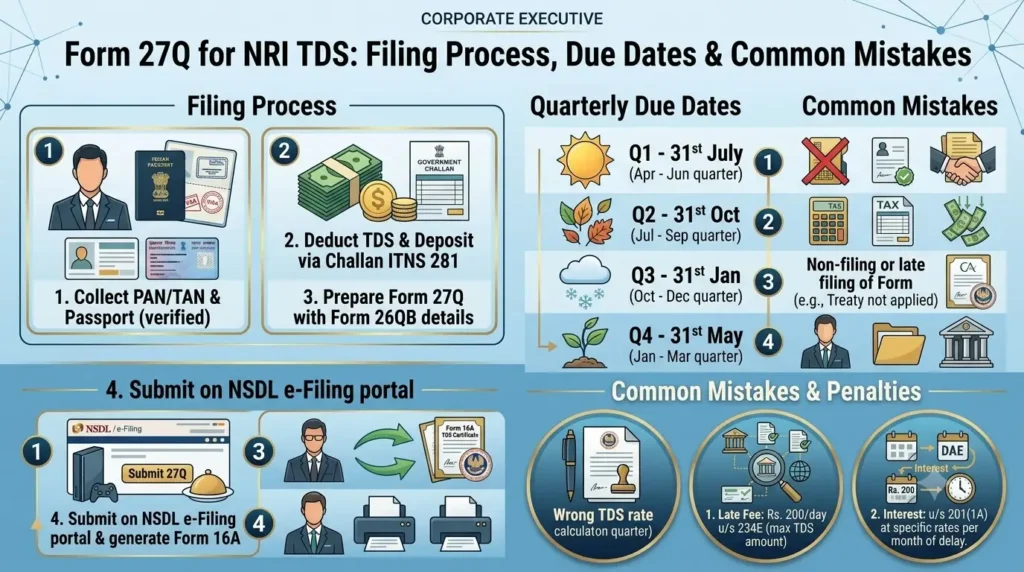
The Filing Process, Step by Step
Obtain a TAN, if your transaction falls before the October 2026 change, by applying through the NSDL or Protean portal.
Deduct TDS from the payment to your NRI seller, at the rate applicable to their capital gains, 20 percent for long-term gains, 30 percent for short-term, plus applicable surcharge and cess, unless a lower deduction certificate specifies otherwise.
Deposit the tax using your TAN through the income tax portal’s e-Pay Tax module, specifying the seller’s non-resident status as part of the challan details.
File the quarterly return through the TIN-Protean TDS return utility, not the regular income tax e-filing portal, a distinction that trips up buyers who search for it in the wrong place.
Download and issue Form 16A to your seller through TRACES once the return is processed, since this is their proof of tax deducted and their basis for claiming credit.(Source)
Due Dates: Deposit, Return and Form 16A
Keep these dates fixed in your calendar, since they don’t move for individual circumstances.
TDS deposit: by the 7th day of the month following deduction. Tax deducted in April is due by 7 May.
Quarterly return filing: 31 July for April to June, 31 October for July to September, 31 January for October to December, and 31 May for January to March.
Form 16A issuance: within 15 days of the return’s due date.
The deposit deadline and the return deadline are separate obligations. Meeting one doesn’t excuse missing the other.
What It Costs to Be Late: Fees, Interest and Penalty
The consequences here are specific enough to state exactly, not just gesture at.
Late filing fee, under Section 234E: ₹200 per day, capped at the total TDS amount involved. This accrues automatically and isn’t waived for a reasonable excuse.
Interest, under Section 201(1A), applies where the deposit itself was late, calculated on the outstanding tax for the delay period.
Penalty, under Section 271H, ranges from ₹10,000 to ₹1,00,000, applied in cases of prolonged default or where the return contains incorrect information, on top of whatever late fee and interest have already accrued.
None of these are trivial amounts on a property-sized transaction. If you’re already late, the priority is filing correctly now, not waiting for a more convenient moment.
The Ten Mistakes That Cause Notices and Mismatches
Most Form 27Q problems trace back to one of these specific errors, not a fundamental misunderstanding of the process.
- Filing Form 26QB instead of Form 27Q because the seller’s non-resident status wasn’t confirmed upfront.
- A missing or inoperative seller PAN, which blocks the credit from ever reaching their Form 26AS correctly.
- The wrong nature of remittance code selected on the challan, misclassifying the payment type.
- Surcharge and cess omitted from the deduction, leaving the TDS amount short of what was actually due.
- A challan that doesn’t match the return, amount, date, or PAN details entered inconsistently across the two filings.
- The certificate number left out where a lower deduction certificate was obtained, covered in more detail below.
- Filing under the wrong quarter, particularly for payments made near a quarter boundary.
- TAN details entered incorrectly, a simple typo that misroutes the entire filing.
- Delayed Form 16A issuance, leaving the seller unable to claim credit even after a correct return was filed.
- Assuming a joint buyer’s obligations are automatically shared, when in fact each buyer with a distinct payment share may need separate compliance.
Each of these is avoidable with a careful first filing. Most are expensive and slow to fix after the fact.
Filing When the Seller Has a Lower TDS Certificate
If your NRI seller has obtained a lower or nil deduction certificate, Form 13, now renumbered Form 128, under Section 197, you deduct tax at the rate stated on that certificate, not the default 20 or 30 percent.
Critically, you must quote the certificate number in your Form 27Q return. Omit it, and the system has no way to reconcile your lower deduction against the certificate on file. It will treat the deduction as short, and you’ll receive a demand notice for the difference, even though you deducted exactly what the certificate authorised. This is one of the more common, and most frustrating, mistakes on this list, since the buyer did everything correctly except one data field. Our companion guide on the lower TDS certificate and Form 13 process covers how your seller obtains this certificate in the first place, and the timeline you should expect before closing.
Do’s
- Confirm the seller’s non-resident status before choosing the TDS process.
- Obtain a TAN where the transaction falls under the pre-October 2026 rules.
- Deduct TDS at the applicable rate or the rate specified in a valid lower-deduction certificate.
- Deposit the deducted tax within the prescribed deadline.
- Match PAN, TAN, challan, payment and seller details across the filing.
- Quote the lower TDS certificate number where applicable.
- Issue Form 16A to the NRI seller after the return is processed.
- Keep the original return and correction records for future reference.
Don’ts
- Treat an NRI property purchase like a resident-to-resident transaction.
- Use Form 26QB when the seller is a non-resident.
- Miss the distinction between the TDS deposit deadline and quarterly return deadline.
- Omit surcharge and cess where applicable.
- Leave a lower-deduction certificate number out of the return.
- Enter inconsistent PAN, TAN, challan or payment details.
- Delay Form 16A after completing the TDS return.
- Assume joint buyers automatically share the same compliance obligation.
For the NRI Seller: How to Check the Credit Reached You
If you’re the NRI seller and your tax credit isn’t showing in your Form 26AS, this almost always traces to one of two causes: your PAN was entered incorrectly on the buyer’s return, or the return simply hasn’t been filed yet.
Start by asking your buyer directly whether they’ve filed Form 27Q for the relevant quarter, and ask them to confirm the PAN they used matches yours exactly. If an error is confirmed, the buyer needs to file a correction statement through TRACES, since this is the only way to fix a mismatched or missing credit. The corrected credit will only appear in your Form 26AS once that correction statement has been processed, which can take some time, so it’s worth following up rather than assuming it will resolve itself. For a fuller picture of what you owe and can claim as an NRI seller, our guide on NRI capital gains tax on property is worth reading alongside this.

How to Correct a Form 27Q You Have Already Filed
Errors in an already-filed return are corrected through a revised or correction statement, filed via the TIN-Protean TDS return utility, the same system used for the original filing.
You’ll need the original return’s provisional receipt number to file a correction against it. Common corrections include fixing a PAN, updating a challan mismatch, or adding a certificate number that was left out originally. Once the correction is processed, updated details flow through to the seller’s Form 26AS automatically, so there’s no separate step needed to notify them beyond confirming the fix went through. If you’re new to NRI property transactions generally, our broader guide on what NRIs need to know before buying property in India and our NRI real estate FAQ cover related ground, and our guide on currency exchange for NRI real estate gains is useful once the compliance side is settled and repatriation becomes the next question.
Key Takeaways
- Form 27Q applies to payments to non-resident sellers, while Form 26QB is used for resident sellers.
- For transactions completed up to September 2026, individual buyers purchasing from an NRI need a TAN for the existing process.
- From 1 October 2026, the TAN requirement is removed for eligible individual and HUF buyers under the new regime described in the article.
- TDS must be deposited by the 7th of the following month, while Form 27Q has separate quarterly filing deadlines.
- Late compliance can result in ₹200-per-day late fees, interest and applicable penalties.
- A valid lower TDS certificate changes the deduction rate, but its certificate number must be correctly reported in the return.
- Errors in PAN or other filing details can prevent the NRI seller from receiving TDS credit in Form 26AS and may require a correction statement.