How to File a TDR in Telangana: A Clear Guide for Property Owners
Quick Answer
A Transferable Development Rights (TDR) Certificate compensates landowners who surrender land for public purposes such as road widening without receiving monetary compensation. In Hyderabad, TDR certificates are issued by HMDA or GHMC, depending on the property’s jurisdiction. Eligible owners can apply online by submitting ownership documents, a registered gift deed, and supporting land records. Under Telangana’s current rules, eligible land surrendered for road widening can generate TDR equal to 400% of the surrendered area, subject to applicable regulations.
Infrastructure projects often require private land.Road widening, flyovers, junction improvements, and master plan roads all depend on acquiring portions of privately owned land.Traditionally, governments compensate owners through cash payments.
However, many urban development projects now offer another option.This option is known as Transferable Development Rights, or TDR.Instead of immediate financial compensation, eligible landowners receive additional development rights that can be used on another property or transferred to another person.
For many owners, this provides greater long-term value than cash compensation.However, obtaining a TDR Certificate involves more than simply surrendering land.Applications must be submitted to the appropriate authority.Ownership records must be verified.
Supporting documents should be complete.Recent amendments have also changed how TDR can be used in Telangana.These changes make it even more important for landowners and developers to understand the current process.
This guide explains who is eligible, where to apply, the documents required, the calculation of TDR entitlement, the impact of the latest government amendments, and the common mistakes that delay approval.
Be Among the First to Own a Legacy
What TDR Means, and Who Is Eligible
Transferable Development Rights are development rights granted to a landowner after voluntarily surrendering land required for a public purpose.
Instead of receiving cash compensation, the owner receives a TDR Certificate representing additional buildable area.
These development rights can generally be:
- Used on another eligible property.
- Sold to another developer.
- Transferred according to the applicable planning regulations.
TDR is commonly granted when land is surrendered for:
- Road widening.
- Master Plan roads.
- Public infrastructure.
- Parks and open spaces.
- Other notified public purposes.
The surrendered land must satisfy the conditions prescribed under the applicable planning rules.
Not every acquisition automatically qualifies for TDR.Eligibility depends on factors such as the purpose of acquisition, ownership status, planning approvals, and compliance with the governing regulations.Property owners should therefore confirm eligibility before beginning the application process.
For developers, purchasing TDR provides additional development potential without acquiring larger plots.This makes TDR an important planning tool in rapidly growing cities like Hyderabad.
HMDA and GHMC: Where to Actually Apply
One of the most common mistakes applicants make is approaching the wrong authority.TDR applications are processed by different authorities depending on where the property is located.
Within the Hyderabad Metropolitan Region, the two primary authorities are:
- Hyderabad Metropolitan Development Authority (HMDA)
- Greater Hyderabad Municipal Corporation (GHMC)
Both authorities now operate on the following websites : http://tdr.ghmc.telangana.gov.in and http://tdr.hmda.telangana.gov.in for processing TDR applications and digitising certificates. Applicants should use the portal that corresponds to the property’s jurisdiction.
The authority first examines whether the surrendered land qualifies for TDR.Officials then verify ownership records and supporting documentation.Where necessary, site inspections may also be conducted before approval.Submitting the application through the correct authority helps avoid unnecessary delays.
Applicants should also ensure that the ownership details appearing in all supporting documents remain consistent.
Even small discrepancies in survey numbers or ownership records can increase verification time.
The Real Conversion Ratio: 400 Percent of Surrendered Land
Many property owners know they are entitled to TDR.
Fewer understand how that entitlement is calculated.
Under Telangana’s planning framework, eligible land surrendered for road widening under approved plans can generate TDR equal to 400% of the surrendered land area. In simple terms, a landowner may receive development rights equal to four times the surrendered area, subject to the applicable rules and approval process.
This conversion ratio helps compensate owners without requiring immediate cash expenditure by the planning authority.
Documents You’ll Need, Including the Registered Gift Deed
Preparing the correct documents before applying can significantly reduce processing time.
Most delays occur because ownership records are incomplete or supporting documents do not match official land records.Although additional documents may be requested in specific cases, the following are generally required for a TDR application in Telangana.
- Registered Sale Deed.
- Encumbrance Certificate (EC).
- Market Value Certificate.
- Registered Gift Deed transferring the surrendered land to the concerned authority.
- Latest survey sketch or site plan.
- Property tax receipts, where applicable.
- Government-issued identity proof.
- Passport-size photographs of the applicant.
- Any previous correspondence relating to the land.
The registered gift deed is particularly important.
It formally transfers the surrendered land to the planning authority for the intended public purpose.Applications are generally not processed until this requirement has been completed.Applicants should also verify that the survey number, plot dimensions, and ownership details remain consistent across every document.Minor discrepancies often lead to additional scrutiny and longer processing times.
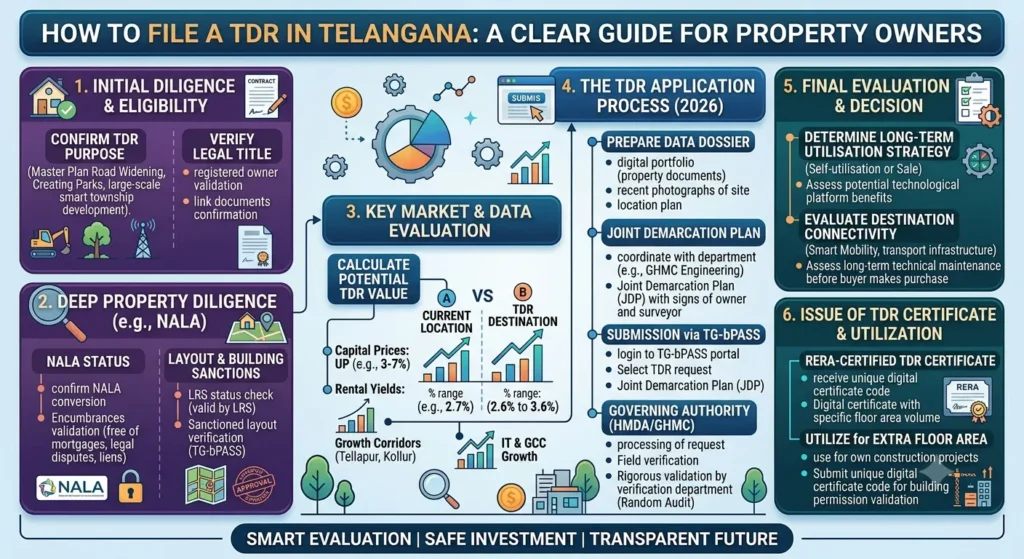
Step-by-Step: The Online TDR Application Process
HMDA and GHMC have introduced online systems that simplify the TDR application process.
Although individual cases differ, the overall workflow follows a similar pattern.
Step 1: Confirm Eligibility
Begin by verifying whether the surrendered land qualifies for TDR under the applicable planning regulations.Eligibility usually depends on the purpose of land surrender and the approved development plan.
Step 2: Execute the Registered Gift Deed
Before applying, execute the required registered gift deed in favour of the concerned authority.This legally transfers the surrendered land for the approved public purpose.
Step 3: Prepare Supporting Documents
Collect all ownership records, certificates, and survey documents.Ensure every document reflects the same ownership information and survey details.
Step 4: Submit the Online Application
Submit the application through the appropriate HMDA or GHMC TDR portal based on the property’s jurisdiction.Upload the required documents and complete the prescribed application details.
Step 5: Document Verification
Officials verify ownership records, survey information, planning approvals, and the registered gift deed.Additional clarification may be requested if inconsistencies are found.
Step 6: Site Inspection
Where necessary, technical officials inspect the surrendered land to confirm its dimensions and verify compliance with approved plans.Not every application requires an inspection.However, inspections are common for larger or more complex cases.
Step 7: Certificate Issuance
After successful verification, the authority issues the TDR Certificate.The certificate can then be retained, utilised on an eligible project, or transferred according to the applicable planning regulations.Applicants should keep both digital and physical copies for future transactions.
What Is the Difference Between TDR and FSI?
Although they are closely related, Transferable Development Rights (TDR) and Floor Space Index (FSI) serve different purposes in urban planning. FSI determines the maximum built-up area permitted on a plot based on its size and the applicable planning regulations. TDR, in contrast, is an additional development right granted to eligible landowners who surrender land for public purposes, such as road widening. Subject to the applicable rules, these rights can be used on another eligible property or transferred to another person. Developers often use TDR to increase the permissible built-up area beyond the base FSI wherever planning regulations allow.
| Basis | TDR (Transferable Development Rights) | FSI (Floor Space Index) |
|---|---|---|
| Meaning | Additional development rights granted for surrendering land for public purposes. | The maximum built-up area permitted on a plot. |
| Purpose | Compensates landowners without cash payment. | Regulates the density and scale of development. |
| How It Is Obtained | Issued by the planning authority after verifying eligibility. | Prescribed under planning and zoning regulations. |
| Can It Be Transferred? | Yes, subject to applicable regulations. | No. It remains linked to the specific plot. |
| Use in Development | Can increase the permissible built-up area where regulations permit. | Determines the base construction limit for the property. |
This distinction is important because FSI defines how much you can normally build, while TDR provides additional development rights that may allow you to build beyond that base limit, wherever the applicable planning regulations permit.
A Worked Example: Calculating TDR on a Road-Widening Plot
Understanding the calculation becomes easier through a practical example.Assume a landowner owns a 450 square metre residential plot.The approved master plan proposes widening the adjoining road.As a result, the owner voluntarily surrenders 100 square metres to the planning authority.
The remaining plot measures 350 square metres.Under the applicable Telangana rules, the surrendered land qualifies for a 400% TDR entitlement.
The calculation would be:
Surrendered Land = 100 sq. m
Eligible TDR = 100 × 4 = 400 sq. m
Instead of receiving cash compensation, the owner receives development rights equal to 400 square metres.
Those rights may later be:
- Used on another eligible property.
- Sold to another developer.
- Transferred according to the governing regulations.
This flexibility is one of the biggest advantages of the TDR system.It allows landowners to recover value without delaying important public infrastructure projects.Actual eligibility remains subject to verification by the competent planning authority.
What Changed Under G.O. Ms. No. 95 in March 2026
Telangana introduced important planning reforms through G.O. Ms. No. 95, issued in March 2026.These amendments updated several development regulations affecting TDR utilisation and high-rise construction.
Some of the most significant changes include:
- Revised definition of high-rise buildings as structures measuring 21 metres or more.
- Updated setback relaxation provisions for projects utilising TDR.
- Revised floor-loading requirements for taller buildings.
- Greater clarity regarding TDR utilisation under approved planning regulations.
These amendments aim to improve development flexibility while maintaining safety and planning standards.For developers, the changes may increase opportunities to utilise TDR more effectively within eligible projects.
For landowners, the amendments improve the practical value of TDR certificates by supporting broader utilisation under updated planning norms.Anyone planning to purchase, transfer, or utilise TDR should understand the latest regulations before proceeding.Professional planning advice may be beneficial for projects involving significant additional development rights.
Common Mistakes That Delay Approval
Most TDR applications are delayed because of document errors rather than eligibility issues. Preparing your application carefully before submission can significantly reduce verification time.
Common mistakes include:
- Choosing the wrong authority.
- Missing the registered gift deed.
- Submitting incomplete documents.
- Incorrect survey or ownership details.
- Delaying clarification responses.
Before applying, ensure all ownership details, survey numbers, and plot dimensions match across every document. A thorough review before submission can help avoid unnecessary delays and improve the chances of faster approval.
Key Takeaways
- TDR compensates eligible landowners through additional development rights instead of cash.
- HMDA and GHMC issue TDR Certificates within their respective jurisdictions.
- Eligible road-widening land may generate TDR equal to 400% of the surrendered area.
- A registered gift deed is an essential part of the application process.
- Complete ownership records help reduce approval delays.
- G.O. Ms. No. 95 introduced important planning changes affecting TDR utilisation.
- TDR Certificates can generally be used, sold, or transferred according to applicable regulations.
- Early document preparation improves the likelihood of faster approval.