TDR Policy in Telangana: Why Hyderabad Homebuyers Should Act Early
Quick Answer
TDR is an additional development cost that can affect how much developers ultimately charge for high-rise apartments. Under G.O. Ms. No. 95, developers pay no TDR charges on the first 10 floors, followed by 3% for floors 11-20 and 5% above the 20th floor. Projects with existing approvals may offer a pricing window before future launches factor these costs into their pricing.
You read a headline about TDR policy Telangana reforms and wondered if you should pause your flat search. Fair question. TDR, or Transferable Development Rights, may seem to be a term used by architects and urban planners, but they can make a huge difference to the costs involved in constructing an apartment or building, as well as the price per square foot paid for an apartment.
This guide aims to help you understand what TDR means, what the changes made under G.O.Ms. No. 95 in March 2026 (https://tg-bn-website-assets.flowwlabs.tech/GOs-and-ACTs/G.O.Ms.No.95-TDR-Utilization-21-03-2026.pdf) imply, which regulations on transferable development rights Hyderabad people should take into account in relation to their property, and when people in search of high-rise apartments in Hyderabad in 2026 should book their apartments.
What Is TDR, or Transferable Development Rights
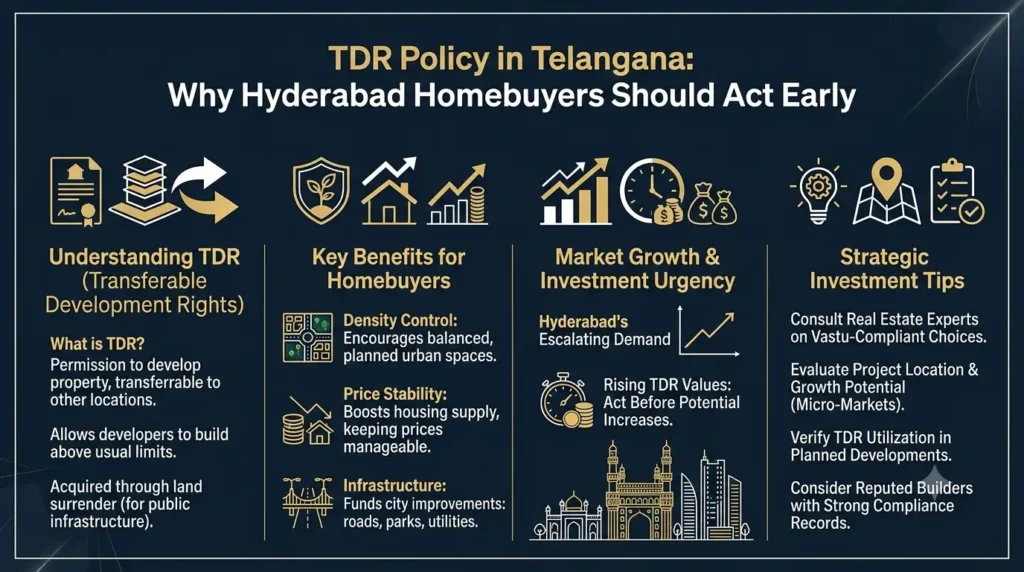
TDR is a planning tool. When the government needs to take some private property for public purposes, like building a roadway or a drain, it may compensate the landowner with TDR instead of money. A builder buys them and uses them to construct more built-up area than base zoning would normally allow.
Think of TDR as a tradable “extra floor space” certificate. It does not change your flat’s carpet area on the sale deed by itself. It changes how much total construction the developer was permitted to put on the plot.
Why buyers should care
- TDR has a market price. When rules require more TDR for tall buildings, project cost rises.
- TDR links urban planning to real estate economics. More mandatory TDR usually means more cost passed into per-sq-ft pricing over time.
- TDR is separate from RERA, stamp duty, and GST. It sits in the building permission layer under GHMC TDR rules and HMDA norms.
Be Among the First to Own a Legacy
The New TDR Policy in Telangana, Explained
The Telangana Building Rules of 2012 have been amended by the state through G.O. Ms. No. 95, which was published in March 2026. The order revises how TDR Hyderabad real estate projects must load development rights, especially for taller residential towers.
Headline changes relevant to buyers
| Feature | Earlier position (pre-March 2026) | Under G.O. 95 |
|---|---|---|
| High-rise definition | 18 metres and above | 21 metres and above (certain plant rooms excluded) |
| TDR on 11 to 20 floor towers | Flat 10% requirement (Jan 2026 rule) | 3% TDR on built-up area for 11 to 20 floors |
| TDR on 21+ floor towers | Flat 10% requirement (Jan 2026 G.O. 16) | 5% TDR on built-up area above the 20th floor |
| TDR payment timing | Often 100% upfront | 50% at permission, 50% before OC |
| Mid-size plots (750 to 2,000 sq.m) | Less explicit TDR linkage | Buildings 18m to 21m height permitted only through TDR |
G.O. 95 is the government order that embeds these TDR slabs, setback relaxations, and payment staging into Telangana’s building rules. It is the legal reference behind headlines about “new TDR policy.” This is used by builders and approving authorities when permitting new high-rise construction.
This rule will allow better granularity and bring the TDR usage to shorter buildings that pay a significantly lower percentage than earlier that counted a flat 10% rate for TDR on high rises.
Which Projects the TDR Policy Applies To
This applies primarily to high-rise residential projects that have new construction exceeding 10 floors in height as well as some of the mid-rise constructions where the plot size and location permits it.
Residential high-rise (most relevant to ASBL readers)
- 11 to 20 floors: mandatory TDR on 3% of built-up area above floor 10
- 21 floors and above: mandatory TDR on 5% of built-up area above floor 20
- Additional floors on large plots may also tie to road width and TDR under separate rule tables
Mid-rise band
- On plots between 750 and 2,000 square metres, buildings from 18 to 21 metres height may proceed only with TDR utilisation, subject to parking and other compliance
What it does not automatically change
- Low-rise walk-up projects within permitted height on small plots
- Completed towers with no plan revision
- Interior fit-out or resale transactions (TDR affects sanction stage, not your sofa choice)
Always confirm the sanctioned plan on file for the specific tower you are buying, not just the brochure render.
How TDR Costs Are Likely to Affect Apartment Prices
TDR is a developer input cost. When mandatory TDR rises, promoters either absorb it temporarily or pass it into launch pricing. In competitive markets, absorption is short-lived.
How the pass-through works
- Builder calculates required TDR certificates for upper floors
- Purchases TDR at market rates (supply and demand in the TDR trading market)
- Adds cost to project feasibility model
- Adjusts base price per sq ft, PLC, or floor-rise charges in subsequent phases
Illustrative logic (not a quote)
On a 15-floor tower, 3% TDR on built-up area above floor 10 might apply to thousands of square feet of super built-up space. Even a modest per-sq-ft TDR acquisition cost multiplies into lakhs or crores at project level. That gap rarely disappears; it shows up in the price list.
Near term vs medium term
- Already launched phases with frozen price lists may move less until the next tranche
- Future launches in the same campus are more likely to internalise TDR
- Resale reacts indirectly when replacement cost for new supply rises
This is why high rise apartment prices Hyderabad 2026 searches spiked after G.O. 95. Buyers are pricing the forward cost curve, not just today’s brochure.
Hyderabad Micro-Markets Most Affected by TDR Policy
Anywhere tall residential towers cluster. In practice, that means West Hyderabad and the Financial District belt.
| Micro-market | Why TDR matters here |
|---|---|
| Financial District / Nanakramguda | Dense high-rise pipeline, premium pricing |
| Kokapet / Neopolis | New luxury towers, multiple phases |
| Gachibowli / Kondapur | Mix of new tall stock and redevelopments |
| Kukatpally | Established corridor with vertical projects |
| Miyapur | Growing mid and high-rise supply near metro |
These zones already dominate transferable development rights Hyderabad conversations because builders there routinely push height. The modification of a policy does not change the Banjara Hills low-rise villas but changes the gated projects of 15-storey buildings located along the IT corridor. While you may be watching the corridors, also compare with the Hyderabad property rates in 2026 area-wise guide for better understanding.
It can, when the developer seeks fresh approvals.
Typically triggered when a promoter:
- Applies for additional floors above what was originally sanctioned
- Requests plan revision or setback relaxation using TDR
- Seeks fresh building permission after a lapsed or amended approval
- Moves from mid-rise sanction to a taller envelope under new rules
Usually not triggered when:
- The building permission and sanctioned height are final, with no upward revision
- You are buying a ready flat in a completed tower with OC
- Only interior changes are proposed
If you booked in an ongoing tower, ask whether the current sanctioned plan already reflects post-G.O. 95 TDR loading. Promoters marketing “pre-policy pricing” should show the permission date and approved height on record.
Verify the project on TGRERA before you rely on verbal assurances. The TS-RERA guide for beginners walks through what to check on the portal.
Does the TDR Policy Apply to Ongoing Projects Too?
No; G.O. Ms No. 95 (Telangana’s revised TDR framework, notified March 21, 2026) does not apply retroactively to ongoing projects with an already-sanctioned building plan on record. However, it does apply if the developer seeks a plan revision during construction.
When TDR gets triggered on an ongoing project:
- The developer applies to add extra floors beyond the sanctioned plan.
- The promoter requests structural or layout modifications requiring fresh HMDA/GHMC approvals under the amended rules.
Once triggered, the built-up area above the applicable floor threshold falls under the new TDR slabs : 3% for 10–20 floor buildings, 5% for buildings above 20 floors : with 50% of the TDR due at the permission stage and the remaining 50% before the Occupancy Certificate is issued.
What buyers should check:
- Verify the TS-RERA portal to confirm your project’s sanctioned height and layout match what you’re being sold.
- Ask the builder directly if any plan revision is underway or planned.
- Treat “extra floors coming soon” claims as contingent, not guaranteed, unless backed by a fresh approval on record.
Why Timing Matters: Should You Buy Now or Wait
There is no universal answer, but there is a clear framework.
Reasons buyers acting now consider locking in
- A project already has sanctioned plans under rules known at booking
- Current phase pricing may not yet reflect the next tranche’s TDR-loaded cost
- Waiting does not remove TDR from the market; it may reprice future supply upward
- Interest rate and possession timeline may matter more to you than marginal policy shifts
Reasons to wait or compare wider
- You want a taller format that only launches after new sanctions (priced with TDR baked in)
- Another corridor offers better value on non-high-rise stock unaffected by slab rules
- You need more clarity on how your shortlisted builder prices the next phase
Practical decision path
- Shortlist only TGRERA-registered projects. Use the RERA Telangana essential checklist.
- Ask for sanctioned height, permission date, and phase price freeze terms.
- Compare carpet efficiency and all-in cost, not headline per sq ft alone.
- If choosing a high-rise, understand construction format. The Mivan construction guide helps you evaluate build quality alongside price.
Policy news favours buyers who do paperwork, not buyers who panic or pause blindly. Act early means act with verified approvals, not rush token money without diligence.
Key Takeaways
- TDR lets builders buy extra development rights, often linked to land surrendered for public projects like roads or open spaces.
- According to the new regulations, developers pay zero TDR charges on the first 10 floors. For higher levels, they must purchase a small percentage of TDR on the extra floor space: 3% for floors 11 through 20, and 5% for any floors above the 20th..
- Developers pay 50% of the required TDR at building sanction and the remaining 50% before receiving the Occupancy Certificate (OC) making developer compliance essential to avoid possession delays.
- West Hyderabad and the Financial District corridor face the heaviest high-rise supply, so price impact may show up there first.
- Projects with approvals already in place may offer a pricing window before new launches bake in added TDR cost.