How to Obtain Certified Copies of Lost Property Documents in Telangana (2026 Guide)
Losing property documents can be an unsettling experience.
Whether it’s a sale deed, gift deed, power of attorney, or another important property-related record, most homeowners immediately worry about ownership disputes, future sales, home loan approvals, or legal complications.
The good news is that losing the original document does not mean losing ownership of the property.
In Telangana, property owners can obtain certified copies of property documents through the Registration and Stamps Department. These certified copies are legally recognized reproductions of the original registered document and are often accepted by banks, government authorities, and courts for various purposes.
If you’ve misplaced your property papers, are preparing to sell a property, applying for a loan, or simply want backup copies for safekeeping, this guide explains exactly how to obtain certified copies of property documents in Telangana, when you may need an FIR, how to use the IGRS portal, and what to do if your records were registered before digitisation.
Be Among the First to Own a Legacy
What Are Certified Copies of Property Documents and When Do You Need Them?
A certified copy is an officially issued duplicate of a registered document maintained by the Registration and Stamps Department.
Since every registered property transaction is preserved in government records, the Sub-Registrar’s Office (SRO) can issue an authenticated copy even if the original document has been lost.
Certified copies are commonly requested for:
- Lost sale deeds
- Home loan applications
- Property resale transactions
- Legal disputes
- Inheritance and succession matters
- Property verification exercises
- Creating backup records
Are Certified Copies Legally Valid?
Yes.
A certified copy issued by the Registration Department carries official authentication and serves as evidence of the registered transaction.(Source)
While it may not entirely replace the practical value of an original document in every situation, it is widely accepted for most legal, financial, and administrative purposes.
Common Documents for Which Certified Copies Are Requested
Property owners typically seek certified copies of:
- Sale deeds
- Gift deeds
- Release deeds
- Settlement deeds
- Power of Attorney documents
- Mortgage deeds
- Partition deeds
- Link documents
Understanding which document you need is the first step in recovering your property records.
Documents You Can Retrieve Online Through the IGRS Telangana Portal
One of the easiest ways to obtain property-related records today is through the Telangana Registration Department’s online platform.
The IGRS Telangana certified copy system allows users to access several property records without immediately visiting a government office.
What Is the IGRS Telangana Portal?
The Integrated Grievance and Registration System (IGRS) is the Telangana government’s digital platform for property registration services.
The portal provides access to:
- Registered document searches
- Certified copy requests
- Encumbrance certificates
- Market value information
- Registration details
For many property owners, this is the quickest way to begin the recovery process.
Documents Commonly Available Online
Depending on the age of the record, users may be able to retrieve:
- Sale deed copies
- Registered document details
- Encumbrance Certificates (EC)
- Registration information
- Transaction records
Information You’ll Need
To search successfully, keep the following details ready:
- Document number
- Registration year
- Sub-Registrar Office name
- Property details (if available)
The more information you have, the easier the search process becomes.
Can I Get a Copy of My Sale Deed Online in Telangana?
In many cases, yes.
If the document has been digitised and is available within the online database, you may be able to obtain a copy of sale deed Telangana online through the IGRS portal.
However, older records may still require manual retrieval through the relevant Sub-Registrar’s Office.
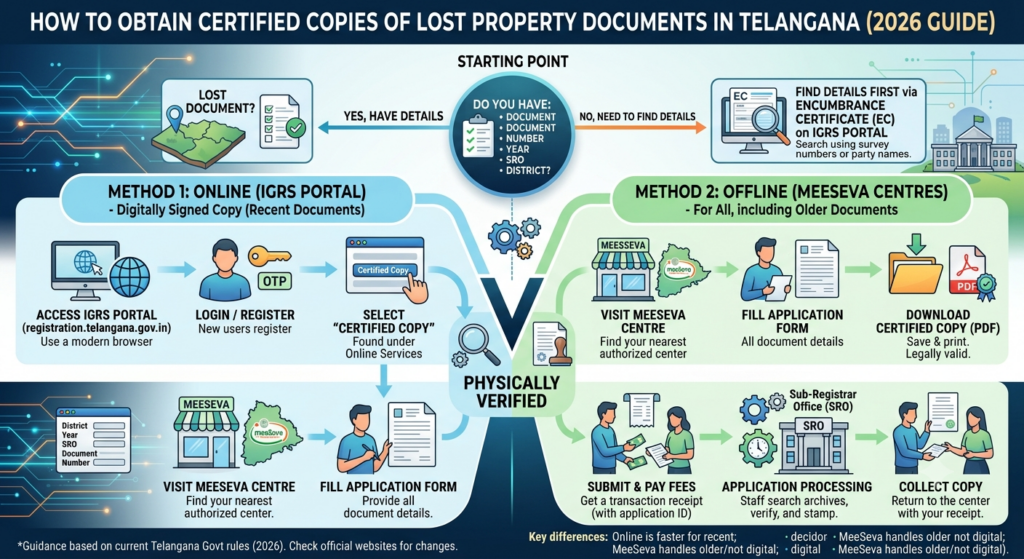
How to Get a Certified Copy From the Sub-Registrar’s Office in Hyderabad
If the required document is unavailable online—or if an official certified copy is specifically required—you will need to approach the concerned Sub-Registrar’s Office.
This remains the most reliable method for obtaining certified copies of registered property records.
Step 1: Identify the Correct SRO
Property documents are maintained by the office where the original registration occurred.
You should identify:
- The Sub-Registrar Office
- Registration year
- Document number
If these details are unavailable, property particulars may help staff locate the records.
Step 2: Submit a Certified Copy Application
Request a certified copy through the prescribed process at the relevant SRO.
You’ll generally need:
- Identity proof
- Property details
- Registration particulars
- Application form (if applicable)
Step 3: Pay Applicable Fees
Certified copies are issued upon payment of prescribed government fees.
The fee depends on:
- Number of pages
- Document type
- Retrieval complexity
Step 4: Record Verification
The office verifies the document against official registration records.
For older records, manual verification may be required.
Step 5: Collection of Certified Copy
Once verification is complete, the certified copy is issued with official certification.
This document can then be used for legal and administrative purposes.
How Long Does It Take?
Digitised records are generally processed much faster than historical records.
Simple requests may be completed within days, while older documents can require additional time.
When Do You Need an FIR or Newspaper Publication for Lost Property Documents?
One of the biggest points of confusion for property owners is whether a police complaint is necessary.
While requirements can vary depending on circumstances and institutional expectations, filing an FIR or Non-Cognizable Report (NCR) is often considered a best practice when original property documents are lost.
Why File an FIR?
A police complaint creates an official record that:
- Documents the loss
- Helps prevent misuse
- Demonstrates due diligence
- Supports future applications
Many banks and legal professionals recommend this step.
Information to Include
The complaint should clearly mention:
- Property details
- Document type
- Circumstances of loss
- Approximate date of loss
When Is Newspaper Publication Required?
In some cases, authorities, banks, or legal advisors may recommend publishing a public notice regarding the loss of documents.
Typically:
- One notice is published in an English newspaper.
- Another is published in a Telugu newspaper.
The objective is to notify the public and provide an opportunity for objections if necessary.
Is It Mandatory?
Not always.
However, for certain transactions, institutions may insist on these precautions before accepting certified copies in place of originals.
If significant financial transactions are involved, taking both steps is often advisable.
Getting Certified Copies for Different Document Types: Sale Deed, EC, Link Documents
Not all property records serve the same purpose.
Understanding which document you need can save considerable time.
Sale Deed Copies
The sale deed is the primary ownership document.
If lost, obtaining a certified copy should usually be the first priority.
The sale deed establishes:
- Ownership transfer
- Property details
- Consideration value
- Registration particulars
Encumbrance Certificate (EC)
Many property owners searching for how to get EC in Telangana online are actually looking for ownership verification.
An Encumbrance Certificate Telangana records registered transactions affecting a property during a specified period.
It helps identify:
- Sales
- Mortgages
- Gifts
- Transfers
The EC is often required during:
- Property sales
- Loan applications
- Due diligence exercises
Link Documents
Link documents establish the historical chain of ownership.
These become particularly important when:
- Selling property
- Verifying title
- Conducting legal due diligence
Buyers often request multiple decades of link documents before completing a transaction.
Power of Attorney Documents
Certified copies may also be required when historical POA transactions affect ownership rights.
These documents can usually be retrieved through the same registration record process.
Fees, Timelines, and Common Obstacles at Telangana SROs
Many applicants worry about cost and waiting periods.
Fortunately, obtaining certified copies is generally affordable.
Typical Fee Range
For most documents, fees are relatively nominal.
Depending on:
- Document length
- Type of record
- Search requirements
costs often fall between approximately ₹100 and ₹500 per document.
EC Search Charges
Online Encumbrance Certificate searches may involve charges calculated based on the search period requested.
Always verify the latest fee schedule before applying.
Common Challenges
Missing Registration Details
Many applicants do not know:
- Document number
- Registration year
- SRO name
This can delay retrieval.
Name Variations
Differences in spelling between historical and current records may complicate searches.
Historical Records
Older records often require manual verification.
Incomplete Property Information
Providing survey numbers, plot numbers, or registration particulars significantly improves retrieval speed.
Practical Tip
Before visiting an SRO, gather as much information as possible.
Even small details can save substantial time during record searches.
What to Do If Your Property Was Registered Before Digital Records Began
One of the most challenging situations involves properties registered before widespread computerisation.
Many Hyderabad properties have ownership histories stretching back decades.
Why Older Records Are Different
Documents registered before digitisation may not appear in online databases.
Instead, they may exist in:
- Physical registers
- Bound volumes
- Historical ledgers
maintained at the relevant Sub-Registrar’s Office.
What Information Should You Carry?
When requesting older records, take:
- Survey number
- Plot number
- Registration year (approximate if exact year is unknown)
- Owner names
- Property location details
Expect Longer Processing Times
Historical searches often require manual retrieval.
Depending on record availability, the process may take longer than a standard digital search.
Don’t Assume Records Are Lost
Many property owners worry that old documents are unavailable simply because they cannot find them online.
In reality, many historical records still exist within departmental archives and can often be retrieved through manual searches.
Patience and complete information are usually the key factors in successfully locating them.
FAQs
1.Can I get a copy of my sale deed online in Telangana?
Yes. If the document has been digitised, you may be able to obtain it through the IGRS Telangana portal using details such as the document number, registration year, and Sub-Registrar Office information. Older records may require an SRO visit.
2.Do I need to file an FIR if I lose my original property documents?
While not always mandatory, filing an FIR or NCR is strongly recommended because many banks, legal professionals, and institutions require proof that the original documents were officially reported as lost.
3.What is an encumbrance certificate and how is it different from a sale deed copy?
An Encumbrance Certificate records registered transactions affecting a property during a specified period, while a sale deed copy is a duplicate of the actual ownership transfer document.
4.How much does it cost to get a certified copy from the Sub-Registrar’s Office in Telangana?
Fees are generally modest and often range between ₹100 and ₹500 depending on document type, number of pages, and retrieval requirements. Always verify current rates before applying.
5.What if my property documents were registered before digital records were maintained?
You may need to visit the relevant Sub-Registrar’s Office and request a manual search of historical records. Providing accurate property details significantly improves the chances of locating the document.