Hyderabad Metro Phase 2: Should Homebuyers Rely on It?
Quick Answer
Hyderabad Metro Phase 2 is expected to improve connectivity across several parts of the city, but its proposed routes should not be confused with operational metro access. For home buyers, the distinction matters because a property’s advertised metro connectivity may influence its price and future appreciation potential without offering any immediate commuting benefit. The actual value of such a location depends on the corridor’s approval and implementation status, its proximity to the proposed station and whether the property remains a practical choice even without the metro.
What if the metro station shown so proudly on a project brochure is still only a line on a government proposal, years away from carrying a single passenger?
Many Hyderabad home buyers meet this exact situation at a site visit. A sales copy of the Hyderabad metro map shows a dotted line passing close to the project, the words “Phase 2” appear beside it, and the asking price quietly reflects that promise. Naturally, the buyer starts to picture a quick, traffic-free ride to the office.
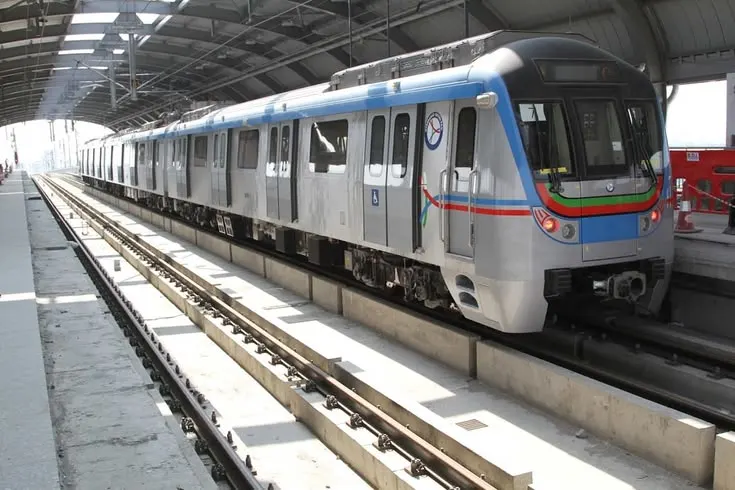
Hyderabad Metro does run today, and it serves a large number of commuters every day. However, the network that runs today and the network on Phase 2 maps are two very different things. One carries passengers now, while the other still waits for central approval.
For buyers in their 30s to 50s, this difference matters a great deal. A home loan usually runs for 15 to 20 years, so a family needs a home that works from the very first month rather than one that depends on a future train. This guide explains what runs today, what remains proposed, how a proposal becomes a working line, and how a buyer can judge a metro claim calmly.
Live Where You Work | Spacious 3 BHKs in the Heart of the Financial District| Ready to move-in | From ₹1.99 Cr .
What You Can Ride Today vs What Is Still a Proposal
On the official Hyderabad metro map, Phase 1 forms the network that commuters can use right now. According to Hyderabad Metro Rail Limited (HMRL), it covers about 69 km across three lines, which opened in stages between 2017 and 2020.
| Phase 1 line (open today) | Route |
|---|---|
| Red Line | Miyapur to LB Nagar |
| Blue Line | Nagole to Raidurg |
| Green Line | JBS to MGBS |
The Blue Line still ends at Raidurg metro station. In other words, no train runs today beyond Raidurg towards the Financial District or Kokapet.
Phase 2, by contrast, consists of two separate packets of proposed extensions on HMRL’s website. Phase II(A) covers five corridors that extend the existing lines, while Phase II(B) adds three further corridors. Since these are two different proposals, each with its own length and cost, their figures should not be added together.
For this reason, a brochure that simply says “Phase 2 metro” without naming the exact corridor and packet gives the buyer an incomplete picture.
The Phase 2 Corridor List (from HMRL, not from a listing site)
The tables below draw directly from HMRL’s Phase II page. Every corridor listed here remains a proposal, so none of them carries passengers today.
Phase II(A): Five proposed corridors, about 76.4 km, estimated at ₹24,269 crore (submitted to MoHUA)
| Corridor | Route | Length | Status |
|---|---|---|---|
| IV | Nagole to RGIA (airport) | 36.8 km | Proposed |
| V | Raidurg to Kokapet Neopolis | 11.6 km | Proposed |
| VI | MGBS to Chandrayangutta | 7.5 km | Proposed |
| VII | Miyapur to Patancheru | 13.4 km | Proposed |
| VIII | LB Nagar to Hayat Nagar | 7.1 km | Proposed |
Phase II(B): Three proposed corridors, about 86.1 km, estimated at ₹19,579 crore (submitted 21 June 2025)
| Corridor | Route | Length | Status |
|---|---|---|---|
| IX | RGIA to Bharat Future City | 39.6 km | Proposed |
| X | JBS New to Medchal | 24.5 km | Proposed |
| XI | JBS New to Shamirpet | 22.0 km | Proposed |
A few details in these tables often get lost in sales conversations. First, Corridor V would extend the Blue Line from Raidurg metro station to Kokapet Neopolis, and HMRL’s table shows it ending there. Until the line receives sanction and opens, no Kokapet metro station exists for commuters. Moreover, the table does not show the corridor reaching Tellapur, Kollur, or areas just outside the ORR. ASBL’s guide on life inside the ORR versus just outside it explores that difference further.
Second, the airport line in Phase II(A) runs from Nagole to RGIA. Meanwhile, the line from RGIA to Bharat Future City belongs to Phase II(B), a separate and later proposal. Buyers who hear “airport metro” therefore benefit from asking which of the two corridors the seller means.
Proposed, Appraised, Sanctioned, Open: Four Different Facts
A metro line passes through several stages before anyone can board a train. Each stage marks real progress, yet only the last one gives a buyer a usable commute.
| Stage | What it means | Where Phase 2 stands (early November 2026) |
|---|---|---|
| 1. Proposed | The line appears on HMRL’s plan and goes to the Centre | Both packets have reached this stage |
| 2. Appraised | MoHUA examines the proposal | Appraisal under the Metro Rail Policy 2017 is under way |
| 3. Sanctioned | The Union Cabinet approves the project and its funding share | No dated sanction order was available to verify |
| 4. Under construction | Civil work begins on the ground | Depends on sanction |
| 5. Open | Trains carry passengers | Depends on construction and safety clearance |
Official records support this picture. In a written reply to the Lok Sabha on 2 April 2026, MoHUA confirmed that it had received both proposals and was appraising them, but it stated that it could not fix a timeline for approval. Later, The Hindu reported on 20 May 2026 that the Centre had shown in-principle willingness to consider a 50:50 joint venture, with a full examination of the detailed project report still to follow.
In October 2026, some news reports claimed a central “green signal” for the 76 km packet and a 2029 completion. However, ASBL could not find a Gazette notification or Union Cabinet order that matches those headlines. Until such a document appears, a buyer can treat 2029 as a reported target rather than a confirmed opening date. Similarly, tenders for consultants show progress in procurement, but they do not put trains on tracks.
Should You Buy Because of a Proposed Station?
As a reason to book, the answer is no. A proposed station may add value someday, yet it cannot help a family reach work, school, or a hospital today. A careful buyer therefore judges the home on the roads they will use this year, or on a Phase 1 station they can actually reach.
Any “metro premium” in the asking price also deserves a close look, because it works like a bet on a future event.
A sample calculation: Suppose a seller asks ₹500 per sq ft more because of a proposed metro line, on a 1,500 sq ft flat. The buyer then pays ₹7.5 lakh extra upfront. If the buyer funds that amount through a home loan at a sample 8.5% over 20 years, it adds about ₹6,509 to the monthly EMI. Over the full loan, the buyer would repay roughly ₹15.6 lakh for that premium, whether or not the train ever runs.
Before signing anything, a buyer can test any claim about metro connectivity in Hyderabad with seven simple questions:
- Is a metro station open now within a walking distance the family would actually use?
- Which HMRL corridor and which packet does the brochure claim?
- Can the buyer find that corridor on hmrl.co.in/phase-ii/?
- Has anything happened on the ground beyond a rendering or a map?
- Would the buyer still choose this home if no train ran for five years?
- How far is the property from the claimed alignment, rather than from “the corridor” in general?
- Do the RERA registration, the occupancy certificate, and the home loan still make sense without the metro story?
If the answer to question 5 is no, the buyer may want to pause and look again. ASBL’s TS-RERA guide for beginners explains how to check a project’s registration, while the guide to the occupancy certificate covers question 7 in more detail.
What to Do Instead of Betting on a Year
Rather than planning around a future opening date, a buyer can test the life they will actually live. The most useful approach involves timing a normal Tuesday from the project gate.
| Trip | What to check |
|---|---|
| Office | The peak-hour drive, or the walk to a running Phase 1 station |
| School | The school-run time and whether a bus enters the gate |
| Hospital | The night-time drive to a 24-hour emergency room |
| Last mile | Autos, buses, or cabs available near the gate |
If the home sits close to Phase 1, the family can include that station in the daily plan right away. Phase 2, meanwhile, works best as a public project to follow over time through HMRL updates and any official sanction notice. In this way, the metro becomes a possible bonus rather than a condition for the purchase.
Lenders follow similar logic, since they assess a home on today’s access rather than on a future line. ASBL’s first home loan guide explains what banks look at. For buyers focused on the west, the Kokapet locality guide and the comparison of Kokapet and the Financial District show how to judge these areas on their current roads and interchanges.
Once the seven questions check out, buyers with further questions can reach out to ASBL.
Do’s
- Check the corridor on HMRL’s Phase II page
- Ask which corridor and packet the brochure means
- Time today’s commute at peak hours
- Treat a future line as a possible bonus
- Measure the distance to the actual alignment
Don’ts
- Rely on a listing site’s metro map
- Accept “Phase 2 metro” as a full answer
- Plan around a 2029 headline
- Pay a metro premium the budget cannot carry without it
- Assume “near the corridor” means near a station
- Let a metro story replace basic paperwork
Key Takeaways
- Phase 1 is the 69 km metro network that runs today across the Red, Blue, and Green Lines.
- Hyderabad Metro Phase 2 consists of two proposed packets: II(A) with five corridors and II(B) with three.
- Corridor V would run from Raidurg metro station to Kokapet Neopolis and, on HMRL’s table, does not reach Tellapur or Kollur.
- A line moves from proposal to appraisal, sanction, construction, and finally opening.
- Parliament confirmed in April 2026 that no approval timeline could be fixed.
- A reported 2029 date is not a confirmed opening until a dated sanction exists.
- A home should work for the family today, with any future metro as a bonus.