North-Facing House Vastu: Why It’s Considered Auspicious + Full Plan Guide
Quick Answer
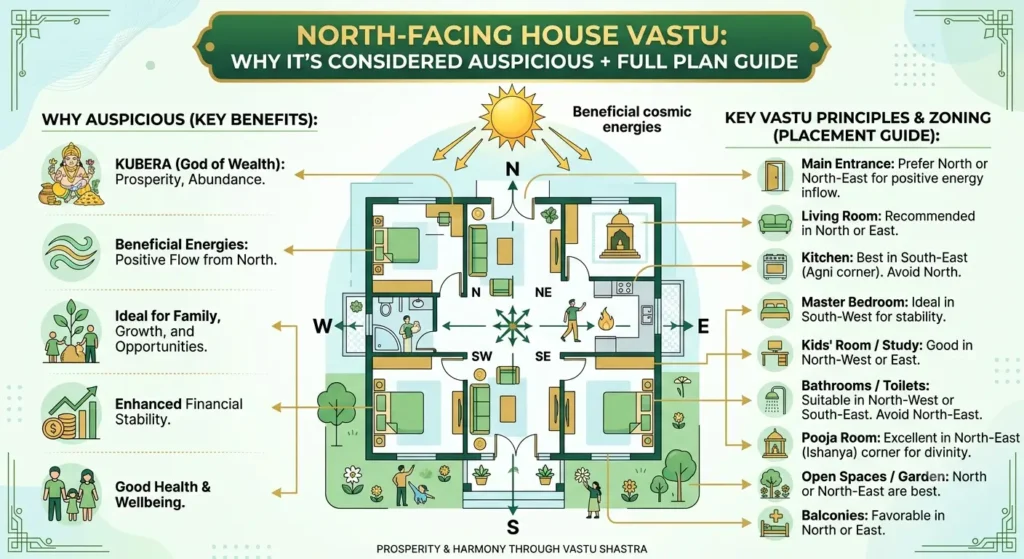
According to Vastu Shastra principles, a home facing north is one of the best orientations since it is the direction of Lord Kuber (god of wealth). It is considered auspicious if the front entrance opens into a third, fourth, or fifth section of the wall facing north, cooking area in the southeast, pooja room in the northeast, and master bedroom in the southwest corner of the house.
Now that you know whether your plot or flat is facing north, perhaps you want to know how to create a proper design plan straight away! In this guide, we’ll tell you where to place your door and how to distribute the rooms in your house. Even if your house does not suit the ideal design plan, you will find out how you can solve this problem.
Why a North-Facing House Is Considered So Auspicious
North is said to be ruled by ‘Kuber’ who is known to represent wealth and is regarded as a deity in Hindu mythology. This relationship is the main explanation why houses that face north enjoy maximum popularity. It brings us to the explanation of why this direction is in great demand in many cities including, Delhi, Gurgaon, and Bangalore.
Apart from this deity relationship, it can be said that the north facing land has some practical properties. A plot facing north gets sunshine naturally during the day while also being protected from the harsh sunlight that the plot facing west has to endure during the hot afternoon.
Thus, north-facing plot can be said to be really clever from both cultural and practical point of view but owning a house that faces north does not mean that everything around is perfect.Its real benefit depends entirely on correct entrance placement and room layout. A poorly planned north-facing home can carry just as many Vastu issues as any other direction. This is worth keeping in mind before assuming direction alone guarantees good results.
Hyderabad and the wider Telangana market see this demand play out clearly. Business owners in particular tend to seek out north-facing units, given the strong Kuber association with commerce and steady income.
Be Among the First to Own a Legacy
How to Confirm Your Flat Is Genuinely North-Facing
A building’s main gate and your specific unit’s entrance direction are often not the same thing. This trips up many apartment buyers. The direction that matters for your Vastu planning is the direction your own front door opens toward. It is not the direction the overall tower faces.
Use a reliable compass app on your phone. Stand directly at your unit’s main door. Face outward through the doorway, and take the reading from that exact spot. Even a few degrees of error can shift your entrance from one pada to another entirely. For an accurate reading of extensive space, it would be advisable to perform a professional land survey, using a proper compass device, despite the expense involved. When using a phone compass, it is important to keep in mind that steel objects or elevators may interfere with the reading, so it should be seen as an approximate value.
The location of the apartment has to be measured again inside the apartment when moving from the lobby.
An example of this concept – a homeowner assumes his apartment is facing north just because the front entrance of the building is situated on the northern side. The homeowner also checks his apartment’s front door with a compass and sees it is based to the northeast. The difference does matter since Vastu principles for northeast-facing homes differ from those for the ones facing the true north.(Source)
Main Door Placement: Finding the Right Pada
Vastu has divided the northern wall of the house into eight equal sections. These sections begin from the northeast corner and go up to the northwest one.Each section is called a pada. Each one carries its own name and its own level of auspiciousness.
The table below lists the eight padas and how they are generally regarded.
| Pada Number | Name | Verdict |
|---|---|---|
| 1 | Roga | Avoid; close to the northeast corner |
| 2 | Naga | Avoid |
| 3 | Mukhya | Favourable |
| 4 | Bhallat | Favourable; linked to wealth |
| 5 | Soma | Most favourable; ruled by Kuber |
| 6 | Bhujang | Avoid; linked to health issues |
| 7 | Aditi | Generally avoided |
| 8 | Diti | Acceptable if 3 to 5 aren’t possible |
The fifth pada, Soma, is considered the strongest possible spot for a north-facing main door. If the fifth pada alone is too narrow for your door, extending it to include the fourth pada, or even the third, still keeps you in favourable territory.
Do’s and don’ts for main door placement:
- Do measure your own wall and mark out the eight padas yourself, or ask your architect to do so, rather than guessing.
- Do leave a small gap from the northeast corner if your door extends into pada 1, since the corner itself should stay clear.
- Don’t place the main door in the sixth pada, Bhujang, since this is consistently flagged as unfavourable across Vastu texts.
- Don’t place your main entrance facing northwest, even on a north-facing plot, since this is treated as a separate and distinct problem from pada placement.
A Complete Room-by-Room Layout for a North-Facing Home
Overall understanding of the Vastu Shastra plan helps one to easily understand it as compared to dealing with the rules individually. For instance a north-facing house is auspicious when the entrance lies in the north (or northeast), pooja room in the northeast, living room in the northeast (for energy), the kitchen in the southeast, master bedroom in the southwest, while guest or children’s room is constructed in the northwest (or west).
This layout follows the same underlying logic used across Vastu generally. Each direction is tied to an element, and each room’s function is matched to the element that suits it best. A north-facing entrance simply gives you a head start, since your main door already sits in the wealth zone before any other planning decisions are made.(Source)
| Zone | Recommended Room |
|---|---|
| North / Northeast | Main entrance |
| Northeast | Pooja room, living room |
| Southeast | Kitchen |
| Southwest | Master bedroom |
| Northwest | Guest bedroom, storage |
| West | Children’s bedroom |
Kitchen and Pooja Room Placement
Kitchen goes into the southeast corner as per the fire element associated with the kitchen – at the southeastern corner of the kitchen you will find the stove, while the cook is facing east direction while preparing the food.
The pooja room belongs in the northeast corner, regardless of which direction the overall home faces. This is the most spiritually significant zone in any Vastu layout, and a north-facing home’s wealth association does not change this rule. Northeast corner should be kept as clear as possible, since that is one of the most serious mistakes made by the homeowners. Never place the kitchen in the northeast corner, where fire and water energy do not get along with each other. This misplacement can be found very often in small apartment layouts.
Bedrooms and Living Areas
The master bedroom fits best in the southwest, the same zone recommended across Vastu generally, since this direction supports stability and restful sleep. The bed itself should have its head pointing south or east, never north, to align with the room’s intended energy.
Guest bedrooms and children’s rooms work well in the northwest or west, zones considered lighter and suited to rooms used less intensively than the master bedroom. The living room, as mentioned earlier, benefits from sitting in the northeast, keeping the home’s most social space in its most open and welcoming zone.
Typically, in the living room, furniture should be placed in a northward or eastward direction because residents benefit from facing the way energy flows and various opportunities come to them.
What to Avoid: Common Mistakes in North-Facing Layouts
A few mistakes come up again and again in north-facing homes, and most competing guides only mention them in passing. Painting the main door red or maroon is one of the most cited issues, since these colours are believed to work against the calm, wealth-focused energy north carries.
A garden or heavy planting in the northwest zone is generally discouraged, as is an underground water tank placed in that same corner. Another important point to note is that water waste pipes should not flow in a north-south direction while mirrors must be placed away from the south and southeast parts of the house. However, the most serious mistake one can make is treating direction as an alternative for planning. Even in a plot oriented toward the north, if the entrance to the house is poorly positioned or clutter in the northeast section of the plot is present, the person will not be able to achieve desired benefits.
Do’s and Don’ts
Do’s
- Keep the northeast section of the plot clean, open and free from unnecessary clutter.
- Choose suitable, calmer colours for the main door instead of shades such as red or maroon.
- Position the main entrance carefully rather than assuming any north-facing entrance will work equally well.
- Plan the house layout around the north-facing plot orientation and the position of key
- spaces.
- Check the placement and direction of water-related elements before finalising the plot layout.
- Review the direction of waste pipe flow to ensure it does not run along a north-south path.
Don’ts
- Use red or maroon on the main door, as these colours are traditionally considered unsuitable for a north-facing home.
- Place a garden or heavy plantation in the northwest zone of the plot.
- Install an underground water tank in the northwest corner of the property.
- Allow water waste pipes to run in a north-south direction across the house.
- Place mirrors in the south or southeast sections of the home.
- Treat the north-facing orientation as a substitute for proper entrance placement and overall planning.
Applying North-Facing Vastu to a Flat or Apartment
Most apartment buyers cannot move a fixed kitchen wall or shift a bathroom to a different corner after construction, and north-facing Vastu is no exception to this reality. Structural elements are usually locked in place by the time a flat goes on the market.
What can still be adjusted is genuinely useful. Arranging furniture, utilizing space, decorating walls, and decluttering particular areas can help any flat conform to these rules because no changes to its structure have to be made. This means that even if a flat has a bedroom in an inconvenient location, one can change the position of the bed inside the bedroom.
For buyers still evaluating options, prioritise the entrance direction and pada placement first, since these are effectively fixed once you sign. For those already living in a flat, focus on the fixes covered in the next section instead.
Common Doshas in North-Facing Homes, and How to Fix Them
A dosha, in Vastu terms, is a specific flaw or imbalance in a layout. North-facing homes have their own common set. Each possible solution is easy to implement. None of the proposed solutions implies any construction work and is therefore convenient for someone already living in their flat.
- Toilet in the north, northeast, or east: A commonly cited dosha, since these zones are meant to stay light and clean. Hanging copper strips near the affected wall and keeping the space spotless are standard remedies where the toilet cannot be relocated.
- Main door painted red or maroon: Simple to fix; repainting the door in a lighter, neutral shade addresses this directly.
- Mirrors placed in the southeast: Considered disruptive to the fire element governing that zone. Relocating mirrors to the north or east wall resolves this without any structural work.
- Main entrance in the sixth pada or facing northwest: The hardest dosha to fix after construction, since it involves the door’s actual position. Where relocation is not possible, some homeowners use a secondary entrance in a more favourable pada for daily use, while keeping the original as a formal entrance.
Key Takeaways
- Homes with the north entrances are said to be associated with Lord Kuber, the god of wealth making them rather favorable.
- One of the best solutions for the main door location is the fifth pada – Soma, while Bhujang, the sixth pada, is to be avoided.
- In such a layout, the kitchen is situated in the southeast, the pooja room and living room in the northeast, and the master bedroom in the southwest.
- At the same time, one needs to remember that the actual direction of the flat should be checked at the flat’s main door, not at the building entrance.
- The direction of a house does not represent the good Vastu of a structure, for a north-facing house, which has been built incorrectly does have the same defects as other directional houses.