Relinquishment Deed 2025: What It Means, Stamp Duty, Format and Registration Process in India
60 percent of property disputes in Indian family courts are about inherited property with unclear ownership. A relinquishment deed is a way to solve this problem before it goes to court.
If you are settling an inheritance with your siblings or combining an owned flat in Hyderabad this guide will tell you what you need to know. You will learn what a relinquishment deed is, how it is different from a gift deed what stamp duty you will pay in Telangana and how to register it correctly at the Sub-Registrar Office.
Key Things to Remember
* A relinquishment deed is a document that lets a co-owner or legal heir give up their share of a jointly owned property to another co-owner or heir.
* It can only be used between co-owners or legal heirs not to transfer property to someone outside the ownership group.
* In Telangana stamp duty is usually 5 percent of the market value of the share being given up. You should always check the rates at the IGRS Telangana portal before signing the deed.
* A registered relinquishment deed is final. Cannot be changed without the agreement of all parties or a court order.
* Not registering the deed not checking the Encumbrance Certificate and missing a heir are the three mistakes that can cause problems later.
What is a Relinquishment Deed? When is it Used?
A relinquishment deed is a document that lets a co-owner or legal heir give up their share of a jointly owned or inherited property to another co-owner or heir. No money needs to be paid. The deed can include a payment if both parties agree to it.(Source)
This usually happens when siblings inherit a together. One sibling wants to own the flat and the other agrees to give up their share. A relinquishment deed makes this arrangement legal and clear.
It applies to:
* Co-heirs who inherit property after the owner dies
* Co-owners who bought property together. One party wants to leave
* Legal heirs who want to combine ownership in one family members name
There is a big limit: a relinquishment deed can only transfer property between existing co-owners or legal heirs. If you want to transfer your share to someone who’s not already a co-owner or legal heir you need a gift deed or sale deed instead.
The deed must be registered at the Sub-Registrar Office of the area where the property is located. If it is not registered it has no power for immovable property under the Registration Act, 1908.
Relinquishment Deed vs Gift Deed vs Sale Deed: What are the Differences?
Choosing the type of deed is a common and costly mistake. Here is a comparison of the three types of deeds that are often confused with each other.
Each type of deed has a purpose and using the wrong one can make the transfer invalid or create unnecessary tax problems.
* Relinquishment Deed: can be used by co-owners or legal heirs only no money is required stamp duty is lower. It cannot be used to transfer property to a third party.
* Gift Deed: can be used by any owner to give property to anyone no money is required stamp duty is higher. It can be used to transfer property to a third party.
* Sale Deed: can be used by any owner to sell property to anyone money is required stamp duty is the highest. It can be used to transfer property to a third party.
The big practical difference is that if the person receiving the property is already a co-owner or legal heir a relinquishment deed is usually the cost-effective and tax-efficient way.
Stamp Duty on Relinquishment Deed: State-wise Rates Including Telangana
Stamp duty is the cost in a relinquishment and rates vary a lot from state to state. The table below shows the rates. They can change.
* Telangana: 5 percent of the market value of the share being given up
* Maharashtra: ₹500 if no money is paid and it is within the family
* Karnataka: 5 percent of the market value of the share
* Delhi: 3 percent of the market value of the share
* Uttar Pradesh: 2 percent of the market value
In Telangana stamp duty is calculated on the circle rate of the share being given up not the negotiated value. For example if you are giving up a 50 percent share in a worth ₹70 lakh the stamp duty applies to ₹35 lakh.
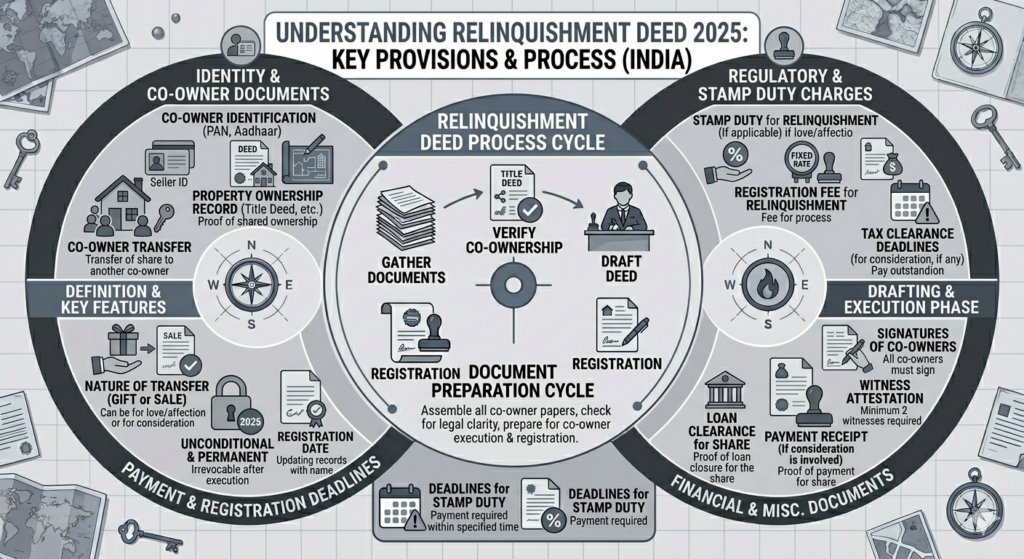
How to Register a Relinquishment Deed: Step-by-Step Process
Registration makes the deed an enforceable document. In Telangana the process is straightforward if you prepare the documents in advance.
Before going to the Sub-Registrar Office review the property sale document checklist to ensure your title chain is clean.(Source)
The step-by-step registration process in Telangana is:
1. Draft the relinquishment deed: use a lawyer or a standard format. The deed must include property details the share being given up names and addresses of all parties their relationship to each other and the consideration amount (if any).
2. Get the deed typed on stamp paper: buy stamp paper of the value from an authorized vendor or use e-stamp paper.
3. Visit the Sub-Registrar Office: go to the SRO of the area where the property is located.
4. Ensure all parties are present: both the person giving up the share and the recipient must appear in person.
5. Arrange two witnesses: both witnesses must appear in person with identity proof. Witnesses cannot be family members of either party to the deed.
6. Pay stamp duty and registration fee: these can typically be paid at the SRO or at designated banks
7. Biometric verification: the Sub-Registrar will verify all documents. Take fingerprint biometrics of all parties.
8. Receive the registered deed: in Telangana the registered deed is typically returned the day or the next working day.
9. Update mutation records: after registration approach the Tahsildars office to update the mutation records.
Documents Required for Relinquishment Deed in Telangana
Not having all the documents is the reason for delays. Prepare this checklist before your appointment.
The documents required at the Sub-Registrar Office are:
* Identity proof of all parties
* Address proof of all parties
* Original property documents
* Encumbrance Certificate
* Latest property tax receipts
* Death certificate of the property owner (if applicable)
* Legal Heir Certificate from the Tahsildar or a Succession Certificate (if applicable)
* Passport-size photographs of all parties
* Identity proof of two witnesses
Tax Implications of Relinquishing a Property Share
The tax treatment depends on whether money changes hands and whether the parties are relatives, under the Income Tax Act.
If no money is paid the tax implications are generally minimal.. If money is paid the recipient may have to pay tax on the amount received. It is always best to consult a tax expert to understand the tax implications of relinquishing a property share.
If you are giving a property to a relative like a sibling, parent or child you do not have to pay tax on it. This is because the Income Tax Act says that property received from relatives is not taxable.
Relinquishment with consideration, which means you get money for the property is different. The money you get is considered capital gains. If you had the property for than 24 months it is called Long Term Capital Gain and you pay 12.5% tax on it. If you had the property for than 24 months it is called Short Term Capital Gain and you pay tax according to your income tax slab rate.
If you transfer a property to someone who’s not a relative and is a co-owner the fair market value of the share they get may be considered as income from other sources.
When you sell a property you have to pay Tax Deducted at Source or TDS. If the sale price is than ₹50 lakh the buyer has to deduct 1% TDS and give it to the Income Tax department. You can check the Income Tax India website to know how to deposit TDS.
It is also good to know about the tax benefits you can get on your home loan under Section 24.
Now can a relinquishment deed be cancelled? A registered relinquishment deed is like a decision. You cannot cancel it easily.
After the deed is registered you cannot take back what you have given up. The only way to cancel it is if both parties agree to cancel it and make a registered cancellation deed.
If someone has been cheated or forced into making the deed a court can cancel it.. This is a long and difficult process.
If the deed is not yet registered you can still stop the process.. Once it is registered it is final.
So it is very important to be careful and make sure everything is correct before you register the deed.
There are some mistakes people make when executing a relinquishment deed.
One mistake is not registering the deed. If you do not register it it is not legally valid.
Another mistake is not checking if there are any loans or liabilities on the property. If you do not check you might end up with debts you did not know about.
You should also make sure all the legal heirs are included in the deed. If someone is left out they can challenge the deed later.
Using the type of deed is also a mistake. A relinquishment deed is for transferring property to a co-owner or legal heir. If you want to give property to someone you need to use a different type of deed.
Not updating the mutation records is another mistake. This can cause problems later when you want to sell the property or get a loan.
Let me give you an example. Imagine three siblings inherit a flat. Two of them decide to give their share to the sibling.. They do not check if there are any outstanding debts on the property. Later the third sibling finds out there are debts they did not know about.
Another example is when a sibling lives abroad and wants to give their share to another sibling. The sibling abroad cannot come to India to sign the deed so they need to make a Power of Attorney that allows someone else to sign on their behalf.
Before you make a relinquishment deed you should check a things.
First make sure you have identified all the heirs.
Next get an Encumbrance Certificate to check if there are any loans or liabilities on the property.
Then check if all the property taxes are paid.
You should also confirm the relationship between the parties to see if the transfer will be tax-free.
After that find out the circle rate of the property to calculate the stamp duty correctly.
Make a list of all the documents you need like identity proofs and property documents.
It is an idea to hire a property lawyer to help you with the deed especially if it is complicated.
Finally remember to register the deed and update the mutation records.
If you are planning to sell the property you should know about the current market value and pricing.
FAQs
1.What is a relinquishment deed?
It is a document that allows a co-owner to give up their share of a property to another co-owner or legal heir.
2.What is the stamp duty for a relinquishment deed in Telangana?
The stamp duty is usually charged on the market value of the share being given up.
3.What is the difference between a relinquishment deed and a gift deed?
A relinquishment deed is for co-owners or legal heirs and does not involve any money. A gift deed can be used to give property to anyone. It may attract gift tax.
4.Can a relinquishment deed be cancelled?
A registered relinquishment deed is usually final. Can only be cancelled with the mutual consent of both parties or, by a court.
5.Who can execute a relinquishment deed?
Only co-owners or legal heirs of an owned or inherited property can make a relinquishment deed.