Repatriation of Sale Proceeds for NRIs: Limits, RBI Rules & FEMA Compliance
Quick Answer
NRIs can transfer property-sale proceeds from India to an overseas account, but repatriation is subject to FEMA rules, the property’s funding history, and tax compliance. For eligible funds held in an NRO account, the general limit is USD 1 million per financial year. If the sale proceeds exceed this limit, the excess requires advance planning through another financial year or the applicable RBI approval route.
The sale deed is registered. Yet the money still sits in India. Meanwhile, your bank asks for forms you have never filed before.
Therefore, repatriation is a separate step from selling. This guide shows the USD 1 million rule, the three FEMA routes, and the exact tax-to-bank sequence. Finally, you will know what to prepare so funds can leave India without a last-minute hold.
What Repatriation Actually Means, and Why It Is a Separate Step From Selling
Repatriation means sending Indian rupee proceeds abroad in foreign currency. Selling only transfers titles and puts money in your account. Afterwards, FEMA and tax rules decide how much can leave, and when.
Importantly, banks will not wire funds on a sale deed alone. First, tax compliance must be clear. Then the authorised dealer bank checks FEMA paperwork. Only after that does the remittance move.
[PROJECT_PROJECTION]
The USD 1 Million Rule: What It Covers and What It Does Not
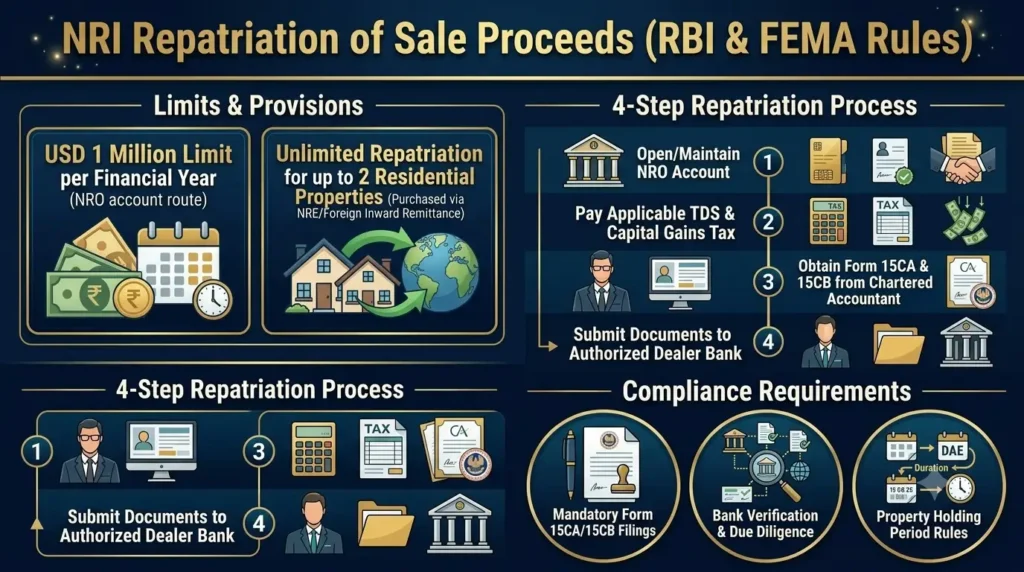
NRIs and PIOs may remit up to USD 1 million per financial year from an NRO account. The year runs from April to March. Also, the ceiling covers remittance of assets generally, not property sale money alone.
So rent, deposits, gifts, inherited assets, and other eligible NRO balances share the same annual bucket. In contrast, freely repatriable NRE balances do not use this ceiling.
Worked Example 1: How the annual ceiling works
Assume you sell a rupee-funded flat and credit ₹7 crore to your NRO account. At a rough rate of ₹83 per dollar, that is about USD 8.4 lakh. Therefore, the full amount can usually fit inside one year’s limit, after tax forms are ready.
| Line | Detail |
|---|---|
| 1. Sale credit in NRO | ₹7,00,00,000 |
| 2. Illustrative FX rate | ₹83 = USD 1 |
| 3. Approximate USD value | ≈ USD 843,000 |
| 4. Annual NRO remittance ceiling | USD 1,000,000 |
| 5. Room left in the same year | ≈ USD 157,000 |
However, other NRO remittances in the same year reduce that headroom. Plan the full year, not only the property wire.
Three Routes, Three Sets of Rules: NRE-Funded, NRO-Funded, and Inherited Property
Most confusion starts here. Three common situations follow different limits.
Route 1: Residential property bought with NRE or FCNR funds
If you paid with foreign exchange through banking channels, special repatriation can apply. RBI allows this for up to two such residential properties. Then sale proceeds linked to that foreign-exchange outlay can leave. They need not use the USD 1 million NRO ceiling in the same way.
Still, keep purchase remittance proof ready. Banks ask for it before they classify the credit.
Route 2: Property bought with rupee or NRO funds
Sale proceeds usually enter the NRO account. Afterwards, remittance follows the USD 1 million facility. This is the most common path for sellers who bought while resident, or from Indian income.
Route 3: Inherited property
You may repatriate inherited property proceeds under the NRO route. Proof such as a will, succession certificate, or legal heir certificate is needed. Likewise, the USD 1 million annual limit still applies.(Source)
| Route | Where proceeds usually go | Typical limit treatment |
|---|---|---|
| NRE / FCNR-funded residential (up to two) | Often treated as repatriable with proof | Special facility; not the same as general NRO blend |
| Rupee / NRO-funded purchase | NRO account | USD 1 million per financial year |
| Inherited property | NRO account | USD 1 million per financial year |
NRE and NRO Accounts: Which One the Money Has to Pass Through
NRE accounts hold foreign funds brought into India. Those balances are freely repatriable in the usual course. NRO accounts hold rupee income earned in India, including many property credits.
Therefore, do not assume every sale can land in NRE. The funding trail of the original purchase decides the bucket. Mixing routes without bank confirmation creates later remittance friction.
For buying-side context before your next purchase, see NRI buying property in India.
Tax First, Transfer Second: Where TDS Fits in the Sequence
Banks look for tax clearance before they release foreign exchange. On an NRI sale, the buyer deducts TDS on the consideration. Then you settle capital gains through your Indian return process.
If over-withholding is a risk, start early with a lower TDS certificate for NRI sale. Also read our guide on NRI capital gains tax on property before you size the remittance.
Correct order of operations
1. Buyer deducts and deposits TDS.
2. Chartered accountant issues Form 15CB.
3. You file Form 15CA online.
4. You submit Form A2 and FEMA papers to the bank.
5. The bank remits after checking the file.
Approaching the bank first usually wastes a visit. Complete tax forms before the remittance desk review.
Form 15CB and Form 15CA, Explained Without the Jargon
Form 15CB is a chartered accountant certificate. It confirms the nature of the remittance and that tax has been handled correctly. Form 15CA is your online declaration on the income tax portal. It usually references the Form 15CB details.
For most taxable property remittances above the small-value threshold, banks expect both. Without them, the transfer does not move.
Keep the amounts consistent across Form 15CB, Form 15CA, and Form A2. A mismatch is a common reason for hold-ups.
The Bank’s Side: Form A2, the FEMA Declaration, and What Else to Carry
Your authorised dealer bank runs the outward remittance. Carry a completed Form A2 with the FEMA declaration. Also take Forms 15CA and 15CB, the registered sale deed, and proof of how you bought the property.
Additionally, carry TDS proof, passport copies, PAN, and NRO account statements showing the sale credit. For inherited assets, add succession papers. An unregistered power of attorney can stall signing when you are abroad, so fix that early.
A Realistic Timeline From Registration to Money Received Abroad
Plan for about three to six weeks from registration to funds abroad. Most time goes into tax working and Form 15CB. Afterwards, the bank remittance often takes three to seven working days once papers are clean.
| Stage | Typical time |
|---|---|
| 1. TDS deposit and certificates | Depends on buyer compliance |
| 2. Capital gains working and Form 15CB | Often one to three weeks |
| 3. Form 15CA filing | Usually same day once 15CB is ready |
| 4. Bank scrutiny and remittance | About three to seven working days |
| 5. Overseas credit | A few more banking days |
Exchange rates also change what lands abroad. For that angle, see currency exchange and NRI real estate gains.
When the Amount Exceeds the Limit: RBI Approval or Splitting Across Years
Worked Example 2: Splitting across two financial years
Suppose net remittable proceeds equal about USD 1.6 million from an NRO-funded sale. You can remit USD 1 million before 31 March. Then remit the balance after 1 April in the next financial year.
| Line | Action |
|---|---|
| 1. Total remittable amount | ≈ USD 1,600,000 |
| 2. Remit in Year 1 (by 31 March) | USD 1,000,000 |
| 3. Hold the balance in NRO | ≈ USD 600,000 |
| 4. Remit after 1 April in Year 2 | ≈ USD 600,000 |
Alternatively, apply for RBI approval through your authorised dealer. That path is slower and needs a clear case. For many sellers, splitting across years is simpler.
Joint owners each have their own annual limit. Consequently, two co-sellers do not automatically share one ceiling.
Why Remittances Get Held Up, and How to Avoid It
Banks often pause files for a missing or stale Form 15CB. Wrong TDS rates also trigger queries. Likewise, DTAA claims filed at the wrong stage create confusion.
Unregistered POA paperwork is another frequent blocker. So is a weak funding trail for NRE or FCNR claims. Fix documents before you book the remittance slot.
Do’s
- Establish whether the property was funded through NRE/FCNR funds, NRO/rupee funds or inheritance.
- Complete TDS and capital gains formalities before approaching the bank for remittance.
- Keep Forms 15CA, 15CB and Form A2 consistent with the remittance amount.
- Maintain the registered sale deed and proof of the property’s original funding or inheritance.
- Keep TDS proof, PAN, passport copies and NRO account statements ready.
- Plan the remittance against the April–March financial year when the USD 1 million limit applies.
- Obtain RBI approval through the authorised dealer when a remittance needs to exceed the applicable facility.
Don’ts
- Assuming that completing the property sale automatically makes the proceeds freely repatriable.
- Treating the USD 1 million limit as applying only to property-sale proceeds rather than eligible NRO remittances generally.
- Mixing NRE and NRO routes without confirming the property’s original funding trail.
- Approaching the bank before completing the required tax documentation.
- Submitting mismatched amounts across Forms 15CA, 15CB and A2.
- Leaving inheritance documents or NRE/FCNR funding proofs until the remittance stage.
- Waiting until the last minute to address an amount that exceeds the annual remittance limit.
Special Cases: Commercial Property, Agricultural Land, and Joint Ownership
Commercial property can usually be sold under general FEMA transfer rules for NRIs. Repatriation then follows the funding route and NRO ceiling logic above.
Agricultural land, plantation property, and farmhouses cannot be bought by an NRI. Inheritance is allowed. Sale is generally only to a resident Indian. Proceeds then follow the NRO route with the annual limit.
Joint ownership needs separate paperwork per seller share. Each holder’s remittance capacity is checked on that person’s own limit and documents.
Key Takeaways
- Property sale and repatriation are separate processes; completing the sale does not by itself permit an overseas transfer.
- The general NRO facility allows eligible NRIs/PIOs to remit up to USD 1 million per financial year.
- NRE/FCNR-funded residential property, NRO/rupee-funded property and inherited property can follow different repatriation rules.
- Tax compliance comes before bank remittance, with Form 15CB, Form 15CA and Form A2 forming part of the process.
- A practical timeline is three to six weeks from registration to overseas receipt, with bank processing often taking three to seven working days once the file is complete.
- Amounts above the applicable annual limit can generally be split across financial years or taken through the RBI approval route, depending on the circumstances.
- The bank’s FEMA review depends heavily on a clear funding trail and complete supporting documents.