RERA and Society Handover: Everything You Need to Know
Quick Answer
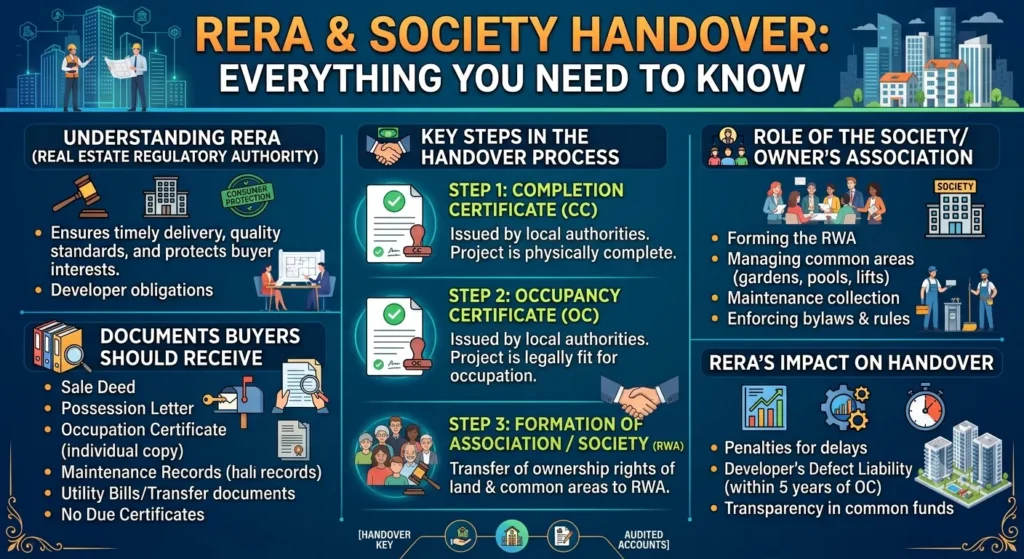
Society handover is when the builder transfers common-area management, records, maintenance responsibilities and funds to the residents’ association. RERA sets key timelines for association formation and common-area handover. Before accepting, residents should verify the documents, finances, amenities and pending defects, and can approach TGRERA if the builder delays the process.
You have the keys. The lift works. But who owns the clubhouse bank account? Who pays the security agency next month? Society handover from builder is the step many Hyderabad residents discover only after moving in, when the builder still signs cheques for common-area expenses.
RERA exists partly to stop that limbo. This guide explains what RERA society handover means, the timelines builders must follow, the documents you should collect, and what to do when a promoter delays.
What Is Society Handover and Why RERA Regulates It
Society handover is the process where a builder transfers ownership, management, and maintenance of shared spaces to the residents’ association (often called an RWA or apartment owners association).
Until handover completes, the promoter effectively controls:
- Common areas (lobbies, lifts, pumps, gates, clubhouses)
- Maintenance contracts and vendor payments
- Technical records needed for future repairs
- Corpus or sinking funds collected from buyers
RERA regulates this transition so residents are not left managing someone else’s project indefinitely. The law sets timelines, document duties, and complaint routes if a builder stalls.
Be Among the First to Own a Legacy
For Hyderabad buyers, the state authority is TGRERA. Before you reach the handover stage, you should already have verified project registration. The TS-RERA guide for beginners (https://asbl.in/blog/ts-rera-guide-for-beginners-how-to-verify-projects-stay-safe/) covers that earlier step; this article picks up at possession and association transition.
Handover is not the same as individual flat possession. You can live in your unit while the builder still runs the society account. That gap is exactly what RERA aims to close.
RERA Timelines for Common Area Handover and Association Formation
Two timelines matter most for RERA society handover and RWA formation after possession.
| Milestone | RERA reference | Typical requirement |
|---|---|---|
| Association formation support | Section 11(4)(e) | Builder facilitates residents’ association within 3 months of majority of units being booked |
| Common area handover | Section 17 | Promoter hands over common areas within 30 days of occupancy certificate (OC) |
| Defect reporting window | Section 14(3) | Structural/workmanship defects in common areas often reportable for 5 years from possession |
Handover of common areas RERA timing starts from the OC, not from your interior fit-out finish. If the builder obtained OC but has not transferred clubhouse keys, vendor contracts, or corpus balances, the Section 17 clock may already be running.
Formation often begins earlier than full handover. Section 11(4)(e) pushes the builder to enable an association once most units are sold. Practical handover of accounts and amenities usually aligns with OC and bulk possession, but do not wait until year three to ask for meeting minutes and member registers.
Telangana may publish state rules that refine central RERA text. Treat TGRERA orders and your sale agreement as the final word if they specify stricter timelines.(Source)
Track dates in writing: OC issue date, first possession batch, association registration date, and handover meeting date. You will need them for any complaint.
Documents the Builder Must Provide During Handover
Paperwork is the handover. Without it, the association cannot maintain the building legally or technically.
| Document | Why residents need it |
|---|---|
| Occupancy Certificate (OC) | Proves lawful habitation; triggers handover duties |
| Completion Certificate (CC) | Confirms project completion per approvals |
| Approved building plans | Baseline for detecting unauthorised changes |
| Title / conveyance of common areas | Proves association ownership of shared land and facilities |
| Electrical single-line diagrams | Essential for faults, upgrades, and audits |
| Plumbing and STP layouts | Required for leakage and sewage troubleshooting |
| Lift AMC and warranty papers | Defines service intervals and defect claims |
| Fire NOC and equipment records | Compliance for high-rises |
| Vendor and maintenance contracts | Security, housekeeping, pump operators |
| Corpus / sinking fund statements | Shows balances collected and interest earned |
| Defect list and snag closure report | Baseline for post-handover claims |
| RERA project completion disclosures | Matches promoter filings on TGRERA |
Ask for digital and stamped copies. Store them in an association drive with version dates.
The RERA Telangana essential checklist to audit developers (https://asbl.in/blog/rera-telangana-your-essential-checklist-to-audit-developers-before-booking/) mirrors many of these items at booking stage. At handover, you are confirming delivery, not discovering requirements for the first time.
If the builder’s RERA track record shows prior handover complaints, scrutinise documents harder. See how to verify a builder’s RERA track record in Hyderabad (https://asbl.in/blog/how-to-verify-a-builders-rera-track-record-in-hyderabad/).
What Counts as Common Areas and Amenities Under RERA
Anything not inside your flat’s four walls that serves more than one owner.
Typical handover of common areas RERA scope includes:
- Lifts, staircases, and lobby flooring
- Basements, parking decks, and driveway paving
- Boundary walls, gates, and security cabins
- Water tanks, pumps, STP, and generator rooms
- Clubhouse, gym, pool, and landscaped pods
- Fire safety systems and common lighting
- Ducts, shafts, and telecom risers serving multiple units
Amenities marketed in brochures but never built are handover failures. Compare the approved plan and RERA disclosure to what exists on site before you sign acceptance minutes.
Shared equipment with commercial portions (retail podiums, office lobbies) needs clear maintenance split deeds. Ambiguity here causes decade-long billing fights.
Individual flat interiors, movable furniture in show flats, and builder sales offices are usually excluded unless your agreement states otherwise.(Source)
A Step-by-Step Checklist Before Accepting Handover
Use this society handover checklist as a gate, not a formality.
Step 1: Verify certificates
Confirm OC and CC numbers on government portals where available. Match tower or phase names to your block.
Step 2: Document audit
Collect every item in the documents table above. Missing electrical or plumbing drawings is a red flag for future maintenance cost.
Step 3: Physical walkthrough
Inspect lifts, pumps, fire panels, clubhouse fittings, and parking markings. Photograph defects with dates.
Step 4: Technical audit
Engage a structural or MEP consultant for larger projects. Amateur walkthroughs miss STP and electrical load issues.
Step 5: Financial reconciliation
Reconcile corpus, sinking fund, and advance maintenance collected from owners. Demand bank statements for the escrow period.
Step 6: Vendor handover
Obtain executed contracts for security, housekeeping, lift AMC, and utilities. Note notice periods for termination.
Step 7: Pending dues and litigation
Request written confirmation of no undisclosed municipal, utility, or contractor liens on common areas.
Step 8: Formal acceptance
Sign handover minutes only after steps 1–7. List open snags as annexures with repair deadlines.
Accepting handover without annexed defect lists weakens leverage. Polite acceptance is not binding kindness; it is a legal record.
Do’s
- Record the OC date, association registration date and handover meeting date.
- Collect approved plans, certificates, technical drawings, warranties and maintenance contracts.
- Reconcile corpus, sinking fund and advance maintenance collections.
- Inspect lifts, fire systems, STP, pumps, parking and other common facilities.
- Record unresolved defects and incomplete work in the handover minutes with clear deadlines.
- Keep copies of all handover correspondence and acceptance records.
Don’ts
- Treat individual flat possession as completion of society handover.
- Sign handover acceptance without reviewing documents, finances and common areas.
- Accept indefinite “interim management” by the builder without a defined transition date.
- Transfer corpus or maintenance funds without proper reconciliation.
- Leave incomplete work or pending defects undocumented.
- Waive legitimate defect claims simply to complete the handover process.
What to Do If the Builder Delays or Resists Handover
Here’s a list of steps you can follow, incase the builder delays the handover or resists is for some reason:
Layer 1: Internal written notice
The association secretary sends a dated letter citing Section 17 and your OC date. Request a handover schedule within 15 days.
Layer 2: Joint owner representation
Collect signatures from a majority of booked owners. Builders respond faster to collective pressure than individual emails.
Layer 3: TGRERA complaint
File on tsrera.telangana.gov.in with OC proof, payment receipts, and correspondence log. RERA adjudicators can direct compliance and penalties.
Layer 4: Legal counsel
Lawyers can seek interim orders preventing the builder from withdrawing corpus balances or terminating essential vendors mid-transition.
Layer 5: Media and regulatory parallel routes
Persistent fire, lift, or STP non-compliance may also engage municipal or fire departments, but RERA is the primary housing remedy.
Do not let the builder trade handover for waivers of legitimate defect claims. Any settlement should be reviewed by the association’s lawyer.
If the builder offers “interim management” indefinitely, treat that as delay. Define an exit date or continue TGRERA proceedings.
Raising Defects After Handover Is Complete
Yes, within limits.
RERA Section 14(3) requires promoters to rectify structural defects or workmanship issues reported within five years of possession, without charge, in many project types. Post-handover, the association raises claims on behalf of owners for common-area defects.
What to document
- Written defect notice with photos and location tags
- Engineer assessment for structural items
- Builder response timeline
- TGRERA complaint if repair stalls beyond reasonable period
Handover acceptance does not waive latent defects that a reasonable inspection could not detect, especially if the builder concealed incomplete work. That is why technical audits before acceptance matter.
After handover, the RWA runs day-to-day maintenance, but the builder may remain liable for RERA-era defect obligations until the statutory window closes. Train committee members on this distinction early.
Key Takeaways
- Society handover is separate from flat possession and transfers common-area management to the residents’ association.
- RERA Section 11(4)(e) requires the promoter to facilitate association formation within the prescribed timeline.
- RERA Section 17 governs the promoter’s handover of common areas after the Occupancy Certificate.
- Handover should include approvals, plans, warranties, maintenance contracts and financial records, not just physical access to amenities.
- Residents should reconcile corpus and maintenance funds before accepting financial handover.
- Pending defects and incomplete work should be documented in the handover record rather than accepted informally.
- If the builder delays or resists handover, residents can escalate through written representation and TGRERA.