Residential Zoning Laws in Hyderabad: Everything You Need to Know Before Buying Property
Quick Answer
Land-use rules and regulations for residential zoning in Hyderabad detail what types of ecosystems exist in a certain area, as well as the rules that govern land use. If you are considering purchasing a property with the intention of building residential apartments or houses, you first need to know its zoning according to the HMDA Master Plan 2031. You should know all the details about the approving committee, and also take into consideration possible restrictions, such as FTL, buffers, and GO 111. This way you will avoid difficulties with legislation, bypassing construction, and other troubles while buying a property.
When buying a residential property, one should not only compare prices of land in the chosen area but also take into account various factors that will influence its future usage. Every piece of property has its own zoning regulations.
One should not expect that registering the land will protect from unforeseen problems while making purchases. While registration might suggest more or less certainty of ownership of the land, it does not guarantee compliance with zoning regulations.
Hyderabad has developed significantly in the past decade. There have been zoning regulations implemented by various authorities for seamless development. Zoning helps regulate housing, transport, jobs, environmental initiatives, and the public infrastructure of the region.
Zoning provides more than legal information to a buyer; it gives the buyer important information about the future of a locality, the infrastructure development, and any zoning restrictions in the locality.
This guideline will help you understand how the residential zoning system works in Hyderabad, who the authorities involved are, what are the different residential density zones, and what must be confirmed before making a purchase by a buyer.
Why Zoning Determines What You Can Actually Build (or Buy)
All cities must have a development plan that consists of zoning. Zoning refers to the ability to categorize land for certain purposes.
Zoning ensures that construction is not carried out mindlessly or haphazardly. Residential areas are the most secure areas for living, while industrial, commercial, and transport zones are established separately.
There would be no zoning regulations; any residential area could end up next to factories, warehouses, or other heavy commercial projects and developments. Such uncontrolled development would greatly reduce the level of safety increase traffic, and cause unnecessary pressure on city infrastructure.
Book Now with Just ₹5 Lakhs
1980 sq. ft. from ₹1.99 Cr + GST
2220 sq. ft. from ₹2.15 Cr + GST
Zoning greatly influences sellers and buyers of the land because thereby zoning influences the way the land can be used in the future. For example, if you buy a residential plot expecting to build a house and then you find out that the land is located in the land reclamation zone, you will have to change your initial plans.
Construction approvals may become difficult or even impossible.Likewise, land bought at a value price may seem to be a profitable venture, but zoning codes may drastically reduce its potential for future development.
Zoning also influences several practical aspects of ownership, including:
- Permitted building type
- Maximum building height
- Floor Space Index (FSI)
- Density of development
- Open space requirements
- Road setbacks
- Parking standards
- Future infrastructure planning
Zoning codes are aimed at creating an orderly process of urbanization without unduly restricting development. High-rise flats, holiday homes, lots, and mixed-used development can only be developed if they comply with the zoning standards determined by the relevant authorities.
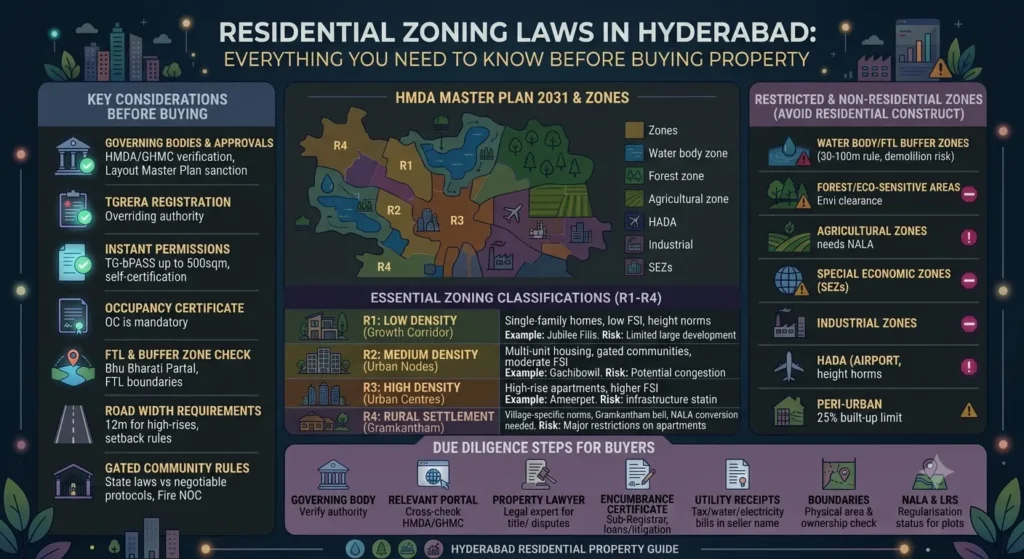
Who Regulates What: HMDA, GHMC, DTCP, and HADA
One common source of confusion is the number of planning authorities involved in Hyderabad’s development.
Each organisation has a different role.Understanding zoning codes can save the buyer from very costly mistakes in the future.
Hyderabad Metropolitan Development Authority (HMDA)
HMDA serves as the main planning authority for the city of Hyderabad.
HMDA is responsible for coming up with strategies for long term development, producing master plans, zoning land partitions, creating growth corridors, and coordinating urban growth in metropolitan area.
The HMDA Master Plan 2031 is the primary basis for planing land use in most areas in its charge.Whenever a buyer seeks to confirm zoning classifications, HMDA records are, in most cases, the first point of contact.
Greater Hyderabad Municipal Corporation (GHMC)
GHMC works only in the municipal administration of Hyderabad.
Some of the activities that GHMC is responsible for are:
- Roads
- Street lighting
- Drainage
- Waste management
- Local infrastructure
- Property taxation
- Civic maintenance
GHMC deals with the implementation of day-to-day operational plans as set by the HMDA. In many housing projects, both authorities perform their specific tasks.
Directorate of Town and Country Planning (DTCP)
DTCP oversees urban planning outside the HMDA metropolitan region.
Many layouts located beyond Hyderabad’s urban boundary fall under DTCP jurisdiction.
Buyers often assume every approved layout belongs to HMDA. This belief is wrong. It is advisable to check whether the plot is covered by HMDA or DTCP prior to making a purchase because the procedure for giving approval differs from one authority to the other.
Hyderabad Airport Development Authority (HADA)
Rajiv Gandhi International Airport is located in a few areas that are in the planning jurisdiction of HADA.
In these areas, the aviation safety norm, the limitations on height, and the airport-related planning are taken into consideration.Depending on the exact location of the plot, other approvals might be required.
Therefore, knowing about the authority in charge would help buyers understand what documents they need to have and what process they need to follow in order to make an investment.
Hyderabad’s Land Use Zones Under Master Plan 2031
The HMDA Master Plan 2031 serves as a clear-cut direction and framework for the future urban development of the area.
The approach followed in the Master Plan does not make all land parcels equal in terms of their value and uses and establishes the zones according to some specific long-term planning objectives.
Each of the zones has its own purpose in the urban development of Hyderabad.
Some of the zones stimulate the residential development of the plan, while some of them enable the development of commercial activities, industries, the environment, and social infrastructure.
The primary land use categories are:
| Land Use Zone | Primary Purpose |
| Residential | Housing developments and residential communities |
| Commercial | Offices, shops, hotels, and trade areas |
| Industrial | Factories, warehouses, and industrial properties |
| Public and Semi-Public | Schools, hospitals, government institutions |
| Recreational | Parks, playgrounds, and public areas |
| Transportation and Utilities | Roads, metro corridors, railway infrastructure, utilities |
| Special Development Zones | Airport influence areas, defence land, and notified special zones |
| Conservation and Water Bodies | Lakes, buffer zones, protected environmental areas |
Each category carries different planning regulations.
Residential construction is generally restricted to residential zones. Likewise, the presence of heavy industries is not allowed within areas used for residential purposes.
In turn, mixed-use redevelopment is only permissible in case the planning regulations allow its implementation.
The master plan defines the future infrastructure developments affecting the surrounding land.
These include:
- Proposed roads
- Metro corridors
- Ring roads
- Growth corridors
- Urban expansion zones
- Public utility projects
Buyers who study these proposals gain a better understanding of both opportunities and future constraints.
The master plan should therefore be viewed as more than a zoning document. It acts like a long-term plan for the growth of Hyderabad city.
A buyer needs these zoning definitions to assess whether the property meets the present laws and future plans.
R1 to R4: The Residential Density Zones Explained
Residential land within the HMDA Master Plan 2031 is divided into four density-based categories. Different zones exhibit a distinct range of development as well as population density. Knowledge of these classifications will assist the buyers to choose a property that fulfills both their lifestyle and investment objectives.
R1: Low-density Residential Zone
There are zones under R1 category that are meant for low-density housing. These zones generally consist of independent houses, villas, duplexes, and other luxury gated villa societies. Low population density construction is the primary aim. These zones are characterized by large road widths and a higher amount of open spaces when compared to densely constructed areas.
Therefore, R1 zones attract buyers looking for privacy, larger spaces, and a peaceful lifestyle.But high land costs in this zone come due to the low supply of land and huge demand for it.This category is suitable for buyers wanting to either construct personal homes or invest in luxurious residential societies.
R2: Medium-density Residential Zone
R2 is the most common residential category in Hyderabad.R2 category allows a mixture of independent houses and apartments as well as gated communities.Most established residential neighbourhoods fall within this classification.
Regions of this kind facilitate better use of land without leading to excessive congestion. Educational institutions, health facilities, commercial outlets, as well as public transport are generally well integrated into these neighborhoods.
Many home seekers prefer R2, as it provides an excellent balance of infrastructure, accessibility, and appreciation in value over time. A number of recently built apartment complexes are situated in R2 zones because they allow for moderate-density residential developments.
R3: High-Density Residential Zone
R3 zones have been created for high-density housing. In these places large apartment buildings and high-rise residential developments are possible. The density of the population is greater; however, infrastructure planning solves this issue.
Metro stations, primary highways, shopping centers and labor markets are linked to high-density zones. High-density zoning helps in managing the swift urbanization process in Hyderabad without unwanted expansion.
For customers, it means wider choices of accommodation and improved access to metropolitan areas. Investors also prefer these parts of the city since rental demand is quite high here.
R4: Rural and Village Settlement Zone
R4 covers village settlements and rural residential areas that remain within the metropolitan planning region.
Development is generally less intensive than in urban residential zones.Basic residential construction is permitted, but planning controls may differ depending on the location.Infrastructure development also varies significantly across different R4 areas.
Some villages may gradually transition into urban neighbourhoods as Hyderabad expands. Others may continue operating under rural planning regulations for several years.Buyers should carefully verify future development proposals before investing in R4 locations.
It is essential to consider more than zone type, especially in terms of aspects like infrastructure, connectivity, job creation, and future planning.
Restricted Zones: Commercial, Industrial, SEZ, and Institutional
Not all land can be used for residential purposes.
There are different land use categories within Hyderabad.
It is important for the buyer to be aware of the zoning so that they don’t buy a property that doesn’t allow residential construction.
Commercial Zones
A commercial site comprises a variety of offices, retail establishments, shopping centers, restaurants, hotels and banks.
Generally, residential construction is prohibited except for those circumstances in which it is explicitly permitted by zoning regulations.
A buyer will face delays or outright rejection of the application if he buys commercial land hoping to build a house on it.
Industrial Zones
Areas designated for industrial use are occupied by factories, warehouses, logistics centres, and production sites.
Industrial zones are properly distanced from residential neighbourhoods to limit pollution, traffic, and security threats.
Residential development is normally not allowed in these areas.
Special Economic Zones (SEZs)
SEZs encourage exports, technological advancement, and industrial investment through specific policies.
Development inside these zones follows separate regulatory frameworks.
Residential construction is usually limited to approved support facilities rather than standalone housing projects.
Institutional Zones
The institutional zone is used for schools, colleges, universities, hospitals or research centres and government institutions.
Residential construction in the private sector is almost impossible unless it is sanctioned.
Before purchasing any plot, confirm that its intended use matches the official land use classification.
A lower purchase price should never replace proper due diligence.
GO 111, FTL, and Buffer Zones: What HYDRAA Actually Enforces
Zoning laws stipulate what types of activities landowners are permitted to engage in with their land use.Environmental restrictions determine where development should not occur.However, people often misunderstand the two concepts when it comes to their functions.
GO 111 was imposed in March 1996 to save water catchment of Osman Sagar and Himayat Sagar. The order restricted certain construction and industrial activities across several villages to safeguard Hyderabad’s drinking water sources.
Full Tank Level, commonly called FTL, refers to the maximum water level that a lake can naturally hold.
No construction is allowed in an FTL area because it disrupts natural processes making flooding more likely.Buffer lands are also created around every notified water body to maintain natural drainage and ecological balance.
These buffer areas provide an additional layer of environmental protection beyond the FTL boundary.HYDRAA was established in July 2024 to strengthen enforcement against unauthorized constructions at sensitive environmental locations.
Its role includes identifying violations, taking enforcement action, and removing illegal structures wherever necessary.
HYDRAA does not create zoning regulations.Instead, it enforces existing planning and environmental laws wherever violations are identified.Properties located inside FTL areas, notified buffer zones, or other restricted lands may face demolition if construction violates applicable regulations.For buyers, this makes environmental verification just as important as title verification.Ignoring these restrictions can place the entire investment at risk.(Source)
How to Check a Property’s Zoning and FTL Status Before You Buy
Many buyers perform only legal verification before purchasing property.
That approach is incomplete.
A property should pass legal, planning, and environmental verification before any payment is made.
Follow these steps before finalising your purchase.
1. Obtain the Property Details
Collect the survey number, plot number, village, mandal, and layout approval documents.
These details are essential for every subsequent verification.
2. Verify the Land Use Zone
Check the property’s classification under the HMDA Master Plan 2031.
Ensure that the intended residential use matches the officially designated land use.
3. Confirm the Planning Authority
Identify whether the property falls under HMDA, GHMC, DTCP, or HADA jurisdiction.
The applicable authority determines which development rules apply.
4. Check Building Permissions
Verify that approvals have been issued through BuildNow Telangana wherever applicable.
Approved permissions reduce the risk of future legal complications.
5. Review Environmental Restrictions
Confirm that the property does not fall within an FTL area or a notified buffer zone.
This verification should never be skipped, especially when purchasing plots near lakes or water bodies.
6. Verify Telangana RERA Registration
If you are purchasing an apartment, ensure that the project is registered with Telangana RERA wherever registration is mandatory.
This adds another layer of buyer protection.
7. Seek Professional Verification
Consult a qualified property lawyer or planning expert before signing the sale agreement.
Professional due diligence often identifies issues that ordinary buyers overlook.
A few days spent on verification can prevent years of legal disputes and financial losses.
Common Zoning Mistakes That Cost Buyers Their Investment
Most property disputes begin long before construction starts. They often result from inadequate research during the purchase process.
Many buyers focus only on location and price. Important planning and regulatory checks are overlooked.
Avoiding the following mistakes can protect both your investment and your peace of mind.
Assuming Registration Confirms Development Rights
A registered sale deed proves ownership.
It does not confirm that construction is legally permitted on the land.
Development rights depend on zoning regulations, approved layouts, environmental restrictions, and planning permissions.
Always verify these aspects separately.
Ignoring the Applicable Planning Authority
Different authorities regulate different parts of the Hyderabad Metropolitan Region.
Buyers sometimes rely on incorrect records because they assume every property falls under HMDA.
Checking the correct authority ensures that you follow the appropriate approval process.
Not Reviewing the Master Plan
The HMDA Master Plan 2031 provides valuable information about both current and proposed land use.
Some plots may lie near planned roads, transport corridors, or public infrastructure projects.
Understanding future development plans helps buyers make informed long-term investment decisions.
Skipping Environmental Verification
Plots located near lakes often attract buyers because of their surroundings.
However, environmental restrictions may apply to such locations.
Always verify whether the property falls within an FTL area, buffer zone, or any other protected land before proceeding.
Purchasing Without Approval Verification
An attractive price should never replace proper documentation.
Ensure that layouts, building permissions, and development approvals have been issued by the appropriate authority.
Incomplete approvals can delay construction or lead to legal complications.
Ignoring Professional Advice
Property transactions involve legal, planning, and technical considerations.
Professional verification may seem like an additional expense, but it often prevents costly mistakes.
A qualified property lawyer can review title documents, approvals, and planning compliance before you commit to the purchase.
Key Takeaways
- Residential zoning determines how land can legally be developed.
- HMDA Master Plan 2031 is the primary reference for land use planning.
- Residential areas are classified into R1, R2, R3, and R4 based on development density.
- HMDA, GHMC, DTCP, and HADA have distinct planning responsibilities.
- Commercial, industrial, institutional, and SEZ lands follow different development rules.
- GO 111, FTL, and buffer zones impose additional environmental restrictions in specific locations.
- HYDRAA enforces existing regulations against unauthorised construction in notified areas.
- Verify zoning, approvals, environmental restrictions, and planning authority before purchasing any property.
- Professional due diligence significantly reduces legal and financial risks.