How to Study and Evaluate a CLP Payment Plan Before Buying a Home
Quick Answer
A Construction Linked Payment (CLP) Plan requires you to pay for your home in stages as construction progresses. Unlike a down payment plan, you do not pay most of the property’s cost upfront. Instead, payments are linked to milestones such as foundation, slab completion, flooring, and possession. Before choosing a CLP plan, understand the payment schedule, loan disbursement, pre-EMI obligations, and RERA safeguards to ensure the plan matches your cash flow.
The price of a home is only one part of the buying decision.Equally important is understanding when you must make each payment.
Many buyers compare apartments based on the total purchase price while overlooking the payment schedule.This can create financial pressure during construction.
A Construction Linked Payment Plan, commonly known as a CLP, spreads payments across different stages of construction instead of demanding most of the amount upfront.For many buyers, this provides greater financial flexibility.
However, a CLP plan should never be evaluated by looking only at the listed percentages.Each milestone represents a future cash outflow.
You should understand when those payments are likely to arise and whether your savings, home loan, and monthly income can comfortably support them.The evaluation becomes even more important when purchasing an under-construction property.
Construction schedules may vary, loan disbursements happen in phases, and buyers usually begin paying pre-EMIs before possession.Understanding these aspects helps avoid unexpected financial stress.
This guide explains how a CLP payment plan works, how to read it like a cash flow schedule, how it compares with other payment structures, and the questions every buyer should ask before signing the agreement.
Be Among the First to Own a Legacy
What a CLP Payment Plan Actually Mean
A Construction Linked Payment Plan is a payment schedule where instalments are linked to construction milestones rather than fixed calendar dates.
Instead of paying most of the property’s price at booking, buyers pay progressively as the project advances.
A typical CLP schedule may include payments at stages such as:
- Booking.
- Agreement for Sale.
- Excavation.
- Foundation completion.
- Slab completion.
- Brickwork.
- Internal finishing.
- Possession.
Each milestone triggers the next payment.This structure aligns buyer payments with the physical progress of the project.It also reduces the amount of money paid before construction actually takes place.
For developers, CLP plans provide funding as construction progresses.For buyers, they reduce the burden of arranging a large lump sum immediately.
Most banks also prefer financing projects under structured CLP schedules because loan disbursements can be linked to verified construction milestones.However, buyers should remember that milestone-based payments depend on construction progress.
If construction moves faster than expected, payment demands may also arrive sooner.Understanding this relationship is essential before committing to any payment plan.
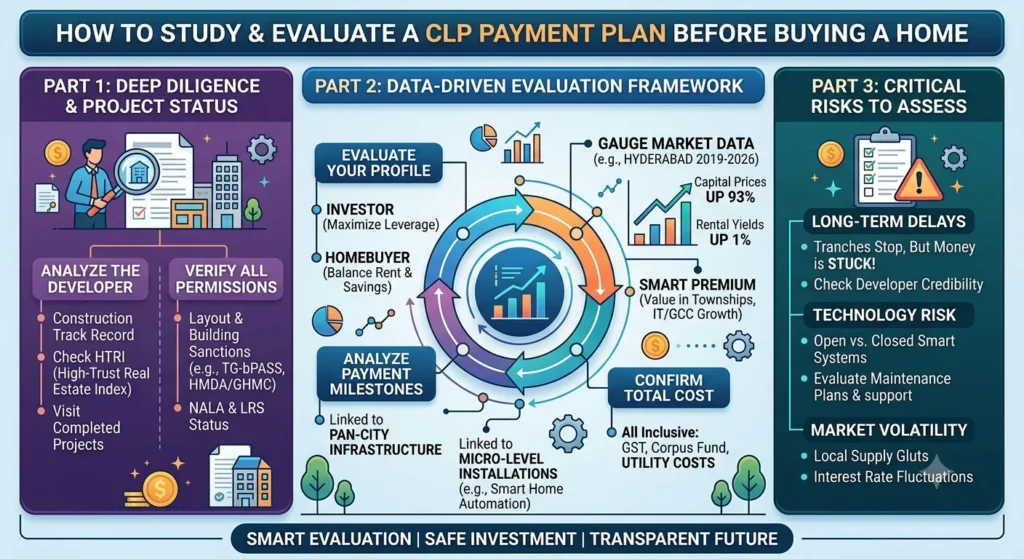
How to Read a CLP Schedule Like a Cash Flow Plan, Not a List of Percentages
Many buyers focus only on the percentage due at each milestone.That approach provides only part of the picture.A better approach is to convert each percentage into actual rupee values.
Doing so allows you to estimate how much money you must arrange throughout construction.Suppose you purchase an apartment worth ₹2 crore.A payment milestone showing 15% may appear manageable.In reality, that single instalment equals ₹30 lakh.(Source)
If two milestones occur within a short period, your financial commitment increases significantly.
You should therefore study:
- The amount payable at each milestone.
- The estimated timing of each milestone.
- The expected loan disbursement.
- Your contribution from personal savings.
- Monthly pre-EMI obligations.
Viewing the schedule this way transforms it into a financial planning tool rather than a simple payment chart.It also helps identify periods where multiple expenses may overlap.
For example, buyers may simultaneously manage rental payments, home loan interest, furnishing expenses, and milestone payments.Planning for these overlapping commitments reduces financial strain during construction.A well-designed CLP schedule should match realistic construction progress while allowing buyers sufficient time to arrange funds.
Understanding that balance is more important than simply comparing percentage figures.
A Corrected Worked Example: What ₹2 Crore Actually Breaks Down To
Consider an apartment priced at ₹2 crore.
A properly structured Construction Linked Payment Plan should account for the full purchase price.
An illustrative payment schedule could look like this.
| Construction Milestone | Percentage | Amount |
|---|---|---|
| Booking | 10% | ₹20 lakh |
| Agreement for Sale | 10% | ₹20 lakh |
| Foundation Completion | 15% | ₹30 lakh |
| Superstructure Completion | 20% | ₹40 lakh |
| Internal Finishing | 20% | ₹40 lakh |
| Occupancy Certificate | 15% | ₹30 lakh |
| Possession | 10% | ₹20 lakh |
| Total | 100% | ₹2 crore |
This example totals the complete purchase value.
Each milestone corresponds to actual construction progress rather than arbitrary payment dates.Instead of asking whether a 20% payment is reasonable, ask whether you can comfortably arrange ₹40 lakh when that milestone arrives.
If the answer is uncertain, reconsider your financing strategy before booking the property.A payment schedule should always be evaluated alongside your expected income, available savings, and sanctioned home loan amount.
This approach provides a much clearer understanding of affordability than focusing only on the property’s advertised price.
How RERA’s Escrow Account Rule Protects You
One of the biggest concerns buyers have with under-construction projects is whether their money will actually be used to build the home they booked.
The Real Estate (Regulation and Development) Act, 2016 addresses this concern through an important financial safeguard.Under RERA, 70% of the money collected from buyers must be deposited into a separate project-specific escrow account.
This rule prevents developers from freely diverting buyer funds to unrelated projects.The money in the escrow account can only be withdrawn to meet the construction and land costs of that particular project.More importantly, withdrawals are not unrestricted.They must correspond with the actual progress of construction and are certified by qualified professionals as required under RERA.
This mechanism creates greater financial discipline throughout the project.
For buyers choosing a CLP payment plan, this safeguard is particularly valuable.Since payments are linked to construction milestones, both the buyer and the developer remain accountable to project progress.While no law can eliminate every construction risk, the escrow requirement significantly improves transparency and reduces the likelihood of project funds being misused.(Source)
Before booking an under-construction home, buyers should also verify that the project is registered with the state’s RERA authority.A registered project provides access to important information, including approvals, construction progress, and completion timelines.
Pre-EMI vs. Full EMI: What Your Loan Actually Covers During Construction
Many first-time buyers believe that full home loan EMIs begin immediately after the loan is sanctioned.That is rarely the case for under-construction properties.Most buyers initially pay Pre-EMI instead of a full EMI.Understanding this distinction is important because it directly affects monthly cash flow.

What is Pre-EMI?
Pre-EMI is the interest charged only on the loan amount that has been disbursed by the bank.Since loan disbursements under a CLP plan happen in stages, interest is calculated only on the amount released to the developer.Suppose your sanctioned home loan is ₹1.5 crore.At booking, the bank may release only ₹20 lakh.During this period, your Pre-EMI is calculated only on ₹20 lakh rather than the entire sanctioned amount.
As additional construction milestones are completed, the bank releases more funds.The Pre-EMI gradually increases because interest is now calculated on a larger outstanding amount.
What is Full EMI?
A full EMI includes both:
- Principal repayment.
- Interest payment.
For most under-construction projects, full EMIs begin after the complete loan has been disbursed, according to the lender’s terms.Because principal repayment also starts, the monthly outflow is higher than the earlier Pre-EMI.
Understanding this transition is essential while planning household finances.Many buyers budget comfortably for Pre-EMIs but underestimate the increase after possession.A realistic financial plan should account for both stages.
CLP vs. Down Payment vs. Possession-Linked vs. Flexi Plans
Every payment plan distributes financial responsibility differently.Choosing the right one depends on your cash flow, borrowing capacity, and risk tolerance.
| Payment Plan | Best For | Main Advantage | Main Consideration |
|---|---|---|---|
| Construction Linked Plan (CLP) | Most under-construction buyers | Payments follow construction progress | Milestones may arrive sooner than expected |
| Down Payment Plan | Buyers with substantial savings | Often comes with pricing benefits | Large upfront financial commitment |
| Possession-Linked Plan | Buyers seeking lower construction-stage payments | Most payment is deferred until possession | Property prices may be slightly higher |
| Flexi or Subvention Plan | Buyers wanting lower initial burden | Reduced early payments | Terms should be reviewed carefully for hidden costs |
No payment plan is universally better.Each works well for a different financial situation.CLP remains one of the most balanced options because payments generally correspond with project progress.
However, buyers should evaluate the entire payment schedule rather than selecting a plan based only on promotional offers.
Where Buyers Usually Misjudge the Timing
The biggest mistake buyers make is assuming that construction milestones will be evenly spaced.Construction rarely progresses at perfectly regular intervals.Some milestones may be completed within a few months.Others may take considerably longer.This uneven timeline affects cash flow.
For example, booking, agreement, excavation, and foundation completion may all occur within a relatively short period.That could require arranging several large payments early in the project.Buyers should also remember that additional costs arise during the purchase process.
These may include:
- Stamp duty.
- Registration charges.
- GST, where applicable.
- Interior work.
- Home insurance.
- Maintenance deposits.
- Moving expenses.
Looking only at the CLP schedule provides an incomplete picture.Your financial plan should include every expected cost until possession.A comfortable payment plan is one that fits your overall budget, not merely your home loan eligibility.
Key Questions to Ask Before You Sign
Before committing to any payment plan, seek complete clarity from the developer and your lender.
Ask questions such as:
- What construction milestone triggers each payment?
- How soon are the early milestones expected?
- How will loan disbursements align with the payment schedule?
- When will Pre-EMI begin?
- When will Full EMI begin?
- Are GST, registration charges, and maintenance deposits included?
- Is the project registered under RERA?
- Can I receive a detailed month-wise payment estimate?
- What happens if construction is delayed?
- Are there penalties for delayed buyer payments?
Clear answers to these questions help you compare projects objectively and avoid unexpected financial commitments later.
Key Takeaways
- A CLP payment plan links instalments to construction milestones.
- Always evaluate payment schedules in actual rupee amounts, not only percentages.
- RERA requires 70% of buyer funds to be maintained in a project-specific escrow account.
- Pre-EMI covers only interest on the amount disbursed during construction.
- Full EMI includes both principal and interest repayment.
- Compare CLP with Down Payment, Possession-Linked, and Flexi plans before deciding.
- Consider all purchase-related costs, not just milestone payments.
- Verify that the project is RERA registered before making any payment.