The Essential Guide to Gross Annual Value of House Property
Quick Answer
Gross Annual Value (GAV) is the annual value assigned to a house property for income tax purposes and forms the starting point for calculating taxable income from house property. For let-out or deemed let-out properties, GAV is generally the higher of the actual rent received and the expected rent based on municipal value and market rent (subject to rent control rules). For up to two self-occupied homes, GAV is treated as nil, while additional vacant properties may be taxed on deemed rental income.
Owning more than one property changes your tax return in ways that catch a surprising number of people off guard. A vacant second flat, sitting empty and earning nothing, can still generate taxable income on paper. A third property, even one you never intended to rent, gets taxed as if you had. None of this is intuitive, and getting it wrong doesn’t just cost you a missed deduction, it can trigger a notice for under-reported income. This guide walks through Gross Annual Value and the calculation that follows it, precisely enough to file correctly, whether you own one home or several.
What Is Gross Annual Value, and Why It Matters for Your Taxes
Gross Annual Value, commonly abbreviated GAV, is the starting point for taxing any income from house property. It represents the annual value the law attributes to a property, not necessarily the rent you actually collected in a given year. This distinction matters more than it might first appear.
GAV can, in specific circumstances, exceed the actual rent received. If your property’s fair market rent or municipal valuation works out higher than what you actually charged a tenant, perhaps because you rented below market rate to a relative, the law still uses the higher figure as your GAV. Conversely, for a property you genuinely occupy yourself, GAV can drop to nil entirely, a benefit with real limits attached, covered in detail further down.
Book Now with Just ₹5 Lakhs
1980 sq. ft. from ₹1.99 Cr + GST
2220 sq. ft. from ₹2.15 Cr + GST
Getting GAV right is the foundation everything else in this calculation rests on. Miscalculate it, and every subsequent step, Net Annual Value, the standard deduction, your final taxable income, inherits that error.
How GAV Is Calculated: Actual Rent, Expected Rent, and Municipal Valuation
The law calculates GAV by comparing a set of specific figures and taking the higher of two results, then applying one further cap where relevant.
Actual rent received or receivable is simply the rent you collected, or were entitled to collect, for the property during the year, whether or not the tenant actually paid on time.
Expected rent is a separate benchmark, calculated as the higher of two figures: the municipal value, meaning the value your local municipal authority has assessed the property at for property tax purposes, and the fair rent, the rent a similar property in the same locality would reasonably command. Where the property falls under rent control legislation, this expected rent figure is further capped at the standard rent fixed under that law, which prevents an inflated fair-rent estimate from overriding a legally controlled ceiling.
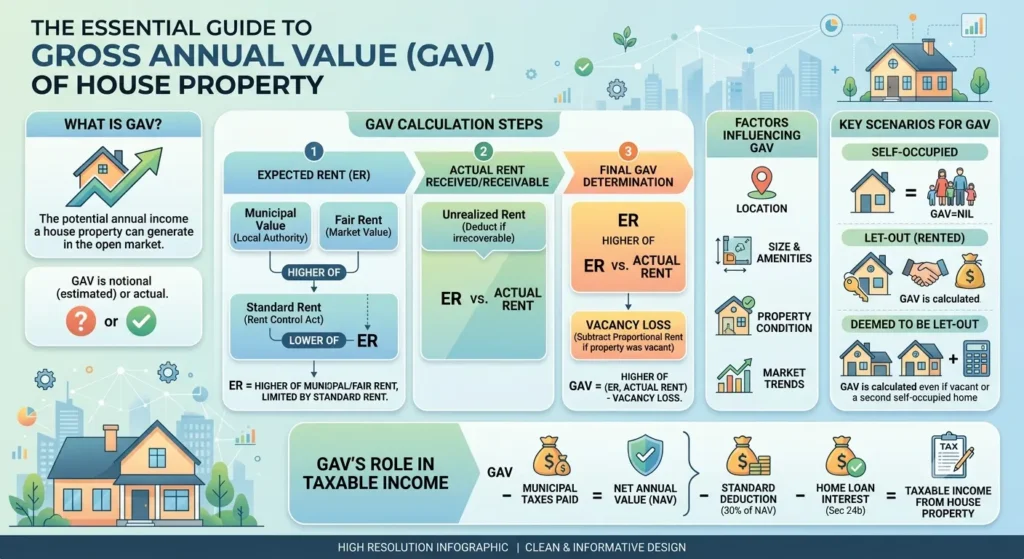
GAV is then taken as the higher of actual rent received and this expected rent figure. In practice, this means a landlord who rents a property below its fair market value cannot simply report the lower actual rent and understate their tax liability, the law substitutes the higher expected rent instead. A landlord charging above-market rent, on the other hand, is taxed on that full actual amount, since it exceeds the expected rent benchmark. This comparison is the mechanism the current live version of this guide’s worked example touches on, comparing actual rent, expected rent, and municipal valuation, but it only tells half the story until it’s connected to which category of property you’re actually calculating this for.
Self-Occupied, Let Out, and Deemed to Be Let Out: The Three Categories That Matter
Every property you own falls into one of three categories for tax purposes, and which one applies changes the entire calculation that follows.
Self-occupied property is a home you or your family reside in, with no rental income arising from it. For a genuinely self-occupied property, GAV is taken as nil, a straightforward and generous position, but one that comes with a limit most single-property owners never need to think about.
Let out property is any property you’ve actually rented to a tenant, for the whole year or part of it. Here, GAV is calculated using the actual rent versus expected rent comparison described above, and the full deduction structure, municipal taxes, the standard deduction, and home loan interest, applies without restriction.
Deemed to be let out property is the category that trips up multi-property owners most often, and it’s worth understanding precisely, since it’s also where the current version of this guide falls short.
Own More Than Two Properties? Here’s How Deemed Rent Works
Here is the rule stated plainly: you can treat at most two properties as self-occupied, with nil GAV, regardless of how many homes you actually own or live in across a year. This limit was raised from a single property to two properties starting FY 2019-20, following Budget 2019, a genuine relief for owners of a second home used personally, a holiday house or a property in a hometown, for instance.
Any property beyond these two, the third, fourth, or further, cannot be treated as self-occupied even if it genuinely sits vacant and unrented for the entire year. The law deems it to be let out, and its GAV is calculated using the expected rent figure, the higher of municipal value and fair rent, exactly as though you had actually rented it out and collected that amount. Whether the property earned you a single rupee during the year is, for this purpose, irrelevant.

This is precisely the gap in the current version of this guide, which states self-occupied GAV as simply “zero” without qualification. For an owner of one or two homes, that statement holds. For an owner of three or more, it’s actively misleading, since the third property onward is taxed on notional rent whether it’s occupied, vacant, or locked up entirely. If you’re in this position, you get to choose which two properties to designate as self-occupied, typically the ones with the highest fair rental value, since minimising the deemed rent on your remaining properties is usually the more tax-efficient choice.
From GAV to Net Annual Value: Municipal Tax and the Standard Deduction
Once GAV is established, two further deductions apply, but only for let-out or deemed let-out property. A genuinely self-occupied property, with nil GAV, has no annual value to deduct anything from in the first place.
Municipal taxes actually paid during the financial year, not merely due, are deducted from GAV to arrive at Net Annual Value (NAV). This deduction only counts taxes genuinely paid within the year, so a landlord who lets a municipal tax bill lapse unpaid doesn’t get to claim it until the year they actually settle it.
From NAV, a flat 30 percent standard deduction under Section 24(a) is available, covering the notional cost of repairs and maintenance, regardless of what you actually spent on the property that year. This deduction applies only to let-out and deemed let-out property. It has no application to a self-occupied home, precisely because that property’s annual value is already nil, leaving no NAV for the 30 percent to apply against.(Source)
Home Loan Interest Deduction Under Section 24(b): Self-Occupied vs. Let Out
This is where the distinction between property categories has the sharpest financial consequence, and where the current version of this guide is vaguest.
For a self-occupied property, home loan interest is deductible under Section 24(b), but capped at ₹2,00,000 per year in aggregate. That aggregate wording matters: the cap applies across both properties you’ve designated as self-occupied combined, not ₹2 lakh for each one separately. An owner with two self-occupied homes, each carrying a home loan, can claim a combined maximum of ₹2 lakh in interest between them, not ₹4 lakh. This deduction is also only available under the old tax regime; taxpayers opting for the new regime cannot claim it against a self-occupied property at all.
For a let-out or deemed let-out property, there is no such ceiling. The entire interest paid during the year is deductible, however large that figure is, a materially different position from the self-occupied cap. This uncapped treatment continues to apply under the new tax regime as well, one of the few house-property deductions the new regime preserves.

There’s a second cap worth knowing about, separate from the interest deduction itself. If your total computation across all house property results in a loss, meaning deductions exceed NAV, only up to ₹2,00,000 of that loss can be set off against your other income, such as salary, in the same year, and only under the old tax regime. Any loss beyond that ₹2 lakh, or any house property loss at all under the new regime, cannot be set off against other income heads; it can only be carried forward for up to eight assessment years, to be adjusted solely against future house property income.
Do’s
- Classify each property correctly before calculating GAV.
- Compare actual rent with expected rent accurately.
- Deduct only municipal taxes paid during the year.
- Choose self-occupied properties strategically if you own multiple homes.
- Apply Section 24 deductions based on property type.
Avoid
- Assuming every vacant property has nil GAV.
- Reporting only the rent actually received.
- Claiming unpaid municipal taxes as deductions.
- Ignoring deemed let-out rules for additional properties.
- Treating deduction limits as the same for every property.
A Complete Worked Example: From GAV to Final Taxable Income
Consider a taxpayer who owns three properties: one self-occupied home, one let-out flat, and one additional flat sitting vacant, unable to be treated as self-occupied since only two properties qualify for that benefit.
Property 1: Self-occupied home. The GAV is nil. The actual amount of interest paid on mortgage during the tax year is ₹2,80,000; however, the maximum amount that the taxpayer can deduct from income is limited to ₹2,00,000. Therefore, the property is deemed to have suffered losses of ₹2,00,000.
Property 2: Rental property. Actual rent received for the year is ₹3,60,000. The municipal value is ₹3,20,000, while the fair rent is ₹3,50,000, making the anticipated rent equal to ₹3,50,000. In this case, the actual rent exceeds the anticipated rent, thus making GAV equal ₹3,60,000. The amount of municipal tax paid during the tax year is equal to ₹15,000. Net Annual Value (NAV) is calculated by deducting the tax from GAV: ₹3,60,000 – ₹15,000, which gives a total of ₹3,45,000. The standard deduction of 30 percent is equal to ₹1,03,500.
The interest payable on mortgage on this property for the year amounts to ₹1,80,000. The income from this property is determined as follows: NAV – standard deduction – home loan interest: ₹3,45,000 – ₹1,03,500 – ₹1,80,000 = ₹61,500.
Property 3:Suppose a rental property remains vacant throughout the year and is treated as a deemed let-out property. The municipal valuation is ₹2,40,000 and the fair rent is ₹2,60,000. Since no municipal taxes were paid during the year, the calculation is as follows:
- Gross Annual Value (GAV) = Higher of Municipal Valuation (₹2,40,000) or Fair Rent (₹2,60,000) = ₹2,60,000
- Net Annual Value (NAV) = GAV − Municipal Taxes Paid = ₹2,60,000 − ₹0 = ₹2,60,000
- Standard Deduction = 30% of NAV = 30% × ₹2,60,000 = ₹78,000
- Taxable Income from House Property = NAV − Standard Deduction = ₹2,60,000 − ₹78,000 = ₹1,82,000
Final taxable income from house property: Combine all three. Minus ₹2,00,000 (self-occupied loss) plus ₹61,500 (let-out income) plus ₹1,82,000 (deemed let-out income), equals a net ₹43,500 in taxable income from house property for the year. Because the total across all properties is positive, there’s no house property loss left to set off against salary or other income this year; the ₹2 lakh self-occupied loss was fully absorbed by the income from the other two properties within this same head.
Had Property 3 not existed, the computation would have shown a loss of ₹1,38,500 overall, of which ₹1,38,500 could have been set off against the taxpayer’s salary income in that same year, since it falls within the ₹2 lakh ceiling. This is exactly why an additional deemed let-out property changes a multi-property owner’s tax position so significantly, it can turn what would otherwise be a set-off-eligible loss into taxable income instead.
For guidance on the broader picture of managing tax on rental income, including how the old and new tax regimes compare for landlords and how TDS applies to rent, our companion guide on how to save tax on rental income in India is worth reading alongside this one. If you’re still working out what rent to actually charge a tenant, which directly affects your GAV calculation, our guide on how to determine the rent for a residential property covers that groundwork. And for NRI property owners specifically navigating these rules from abroad, our piece on 2025, a golden year for NRI real estate in Hyderabad provides useful additional context.
Key Takeaways
- Gross Annual Value (GAV) forms the basis for calculating taxable income from house property.
- GAV is generally the higher of actual rent received and expected rent, subject to applicable rules.
- You can treat up to two properties as self-occupied with nil GAV; additional properties are generally deemed to be let out.
- Municipal taxes paid, the standard deduction, and home loan interest are applied after determining GAV, depending on the property’s classification.
- Correctly classifying each property helps avoid tax errors, missed deductions, and incorrect income reporting.