The Truth About MOU and Contract Agreements in Real Estate
Quick Answer
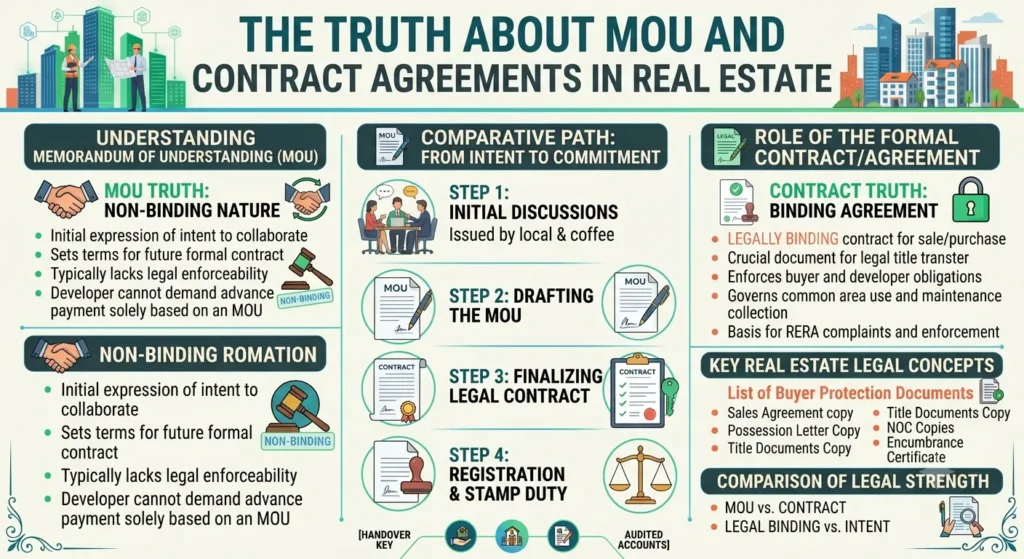
An MOU is a simple document that records intent between a buyer and seller before the real deal is signed. It is usually not legally binding. A sale agreement is different. It is a full legal contract, and courts, banks, and registration offices treat it as the real thing. Knowing this difference protects you before you pay any advance.
You found a home you like. The seller hands you a document called an MOU and asks you to sign it, often along with a token payment. It feels like a big step, so a natural question comes up. Does this paper actually protect you?
Many first-time buyers assume any signed document is legally solid. That assumption can be costly. This guide explains what an MOU really is, how it differs from a sale agreement, and what to check before you hand over any money.
Rules around stamp duty and registration vary from state to state, so always confirm local requirements before signing anything. For buyers in Telangana specifically, ASBL’s RERA guide for beginners is a useful starting point before you even reach the paperwork stage.
What Is an MOU in a Real Estate Deal
MOU stands for memorandum of understanding. In a property deal, it is a short document that records what the buyer and seller have agreed on so far. It might mention the price, the property details, and a rough timeline.
Be Among the First to Own a Legacy
Think of it as a written handshake. Both sides use it to show they are serious about moving forward. An MOU in property transactions is commonly used as a goodwill document, essentially a handshake on paper. An MOU is not meant to replace a full contract. It usually comes before the real paperwork, when both sides are still finalising details like the exact payment schedule or possession date.
What Is a Sale Agreement, and How It Differs From an MOU
A sale agreement, sometimes called an agreement to sell, is a formal legal contract. It fixes the price, the payment schedule, and the date of possession. Once both parties sign it, they are legally bound to follow it.
Unlike an MOU, a sale agreement can be enforced in court.It is legally binding under the Indian Contract Act, enforceable in court, and required for bank loans.This single difference explains why serious property deals eventually move toward a sale agreement rather than staying at the MOU stage.
Here is a simple side-by-side comparison.
| Feature | MOU | Sale Agreement |
|---|---|---|
| Purpose | Records intent to proceed | Legally fixes the deal terms |
| Legally binding | Usually not, unless it meets contract conditions | Yes, under the Indian Contract Act |
| Enforceable in court | Rare, depends on wording | Yes |
| Stamp duty | Usually not required | Usually required |
| Registration | Not standard practice | Often recommended, especially with a large advance |
| Bank loan acceptance | Generally not accepted | Accepted by most banks |
| Best used for | Early-stage discussions | Final commitment before the sale deed |
Neither document actually transfers ownership of the property.Ownership transfer only happens through a registered sale deed, not through either of these earlier documents. That final step comes after both the MOU and sale agreement stages are complete.
Is an MOU Legally Binding? The Truth Behind the Assumption
Most buyers assume an MOU carries no legal weight at all. That assumption is only partly true, and this is where many people get caught off guard.
Under Indian law, any agreement becomes a binding contract if it meets the conditions laid out in the Indian Contract Act. The Indian Contract Act sets out five essential elements for a valid contract, including offer and acceptance, intention to create legal relations, capacity, consideration, and free consent.
If an MOU happens to satisfy all five of these conditions, a court can treat it exactly like a contract, regardless of its title. Indian courts have ruled on the enforceability of MoUs in several cases, establishing precedents for when a document can be considered legally binding.The label on a document matters far less than what it actually says and does.(Source)
A few situations tend to push an MOU toward becoming binding.
- The document clearly states the price, property details, and payment terms
- Both parties have already exchanged money based on the MOU
- The wording uses firm language, such as “shall” or “agrees to,” rather than softer terms like “intends to”
- The MOU includes a clause about resolving disputes, which signals a genuine intention to be bound
Worked example: Suppose a buyer signs an MOU that names the exact property, states a fixed price of 80 lakh rupees, and confirms a 5 lakh rupee advance has already changed hands. If the seller later backs out, a court may treat this MOU as a real contract, since it contains clear terms and proof of consideration. A vague MOU that only says both sides “intend to negotiate further” would carry far less weight.
Stamp Duty, Registration and Bank Loan Acceptance Compared
Money matters tend to separate these two documents most clearly. Stamp duty, registration, and bank loan acceptance each work differently for an MOU compared with a sale agreement.
In most states, an MOU does not require stamp duty, since it is not treated as a formal contract. A sale agreement usually does require stamp duty, and rates vary from state to state.
Registration follows a similar pattern. An MOU is rarely registered, while a sale agreement is often recommended for registration, particularly when a large advance or possession is involved.
Banks are the strictest of all. Banks accept a sale agreement for home loan processing but typically do not process loans based on an MOU alone. If you are planning to fund your purchase with a home loan, a sale agreement is not optional. It is the minimum document your bank will ask to see.
What Happens If Someone Backs Out After an MOU
Deals fall apart for many reasons, and buyers often wonder what protection an MOU actually offers if the other side walks away.
If the MOU is genuinely non-binding, your options are limited. You can negotiate, ask for your advance back, or walk away yourself, but taking the matter to court is difficult without a proper contract behind you.
The situation changes if the MOU meets the conditions of a valid contract described earlier. In that case, the affected party can seek damages or even request specific performance through the courts. Indian courts have declared MOUs legally binding and enforceable in several cases where the obligations were duly performed and the document contained the essential elements of a contract.
This uncertainty is exactly why relying on an MOU alone is risky for anything beyond a small, refundable token amount.
Should You Pay a Token Advance Before a Sale Agreement
This is the moment where buyers face the most pressure, and also the moment where they carry the most risk. A seller may ask for a token advance to “lock in” the deal, often before any formal agreement exists.
A small precautions checklist helps here.
Do’s
- Ask for a written receipt for any amount paid
- Keep the advance amount modest until a proper sale agreement is signed
- Verify the seller’s ownership documents before paying anything
- Check the project’s RERA registration status if it is a new development
Don’ts
- Pay a large advance based on an MOU alone
- Assume verbal promises will hold up if the deal collapses
- Skip legal review of the MOU wording, even for a “simple” deal
- Ignore stamp duty requirements if the MOU starts resembling a full contract
Moving quickly to a proper sale agreement is generally the safer path in serious property transactions. A modest, refundable token payment carries far less risk than a large advance handed over on the strength of an MOU alone.
When to Move From an MOU to a Full Sale Agreement
There is no fixed rule for exactly when to switch documents, but a few signals make the timing fairly clear.
Once both sides agree on the final price, payment schedule, and possession date, it is time to move to a sale agreement. Continuing to rely on an MOU at this stage only adds risk without any real benefit.
It also makes sense to move quickly once any meaningful advance is involved. A sale agreement gives both sides clearer legal footing than an MOU, particularly once real money changes hands.
Before signing a sale agreement, buyers should verify a few essentials.
- Confirm the seller’s clear title to the property
- Check for any pending loans or legal disputes tied to the property
- Verify RERA registration if the property is part of a new project
- Engage a property lawyer to review the draft before signing
For buyers evaluating a builder’s track record before this stage, ASBL’s guide on verifying a builder’s RERA history in Hyderabad and the RERA Telangana developer checklist are worth reviewing alongside any sale agreement.
Key Takeaways
- An MOU records intent and is usually not legally binding on its own.
- A sale agreement is a full legal contract, enforceable in court and accepted by banks for loans.
- An MOU can become binding if it meets the Indian Contract Act’s conditions for a valid contract.
- Stamp duty and registration rules differ by state, so always confirm local requirements.
- Avoid paying a large advance based on an MOU alone.
- Move to a proper sale agreement as soon as price, payment terms, and possession date are finalised.