First Right of Refusal in Real Estate: What It Means and When It Matters for Indian Buyers
You’re thinking about selling your apartment and you come across your co-owner’s old sale agreement, which contains a clause that grants your sibling the first right of refusal (ROFR) to your apartment, and you don’t remember it ever having been read. You’re purchasing a resale flat and the society’s no-objection certificate contains a requirement that the existing members must be offered the folio before being offered to any new members. In both examples, a common question arises, ‘Does this clause create legally binding obligations and if so, what happens if the clause is ignored?’
The first right of refusal (ROFR) clause is much more prevalent in the Indian property market than most buyers realize. However, the ROFR clause is extremely common in the Indian property market. Most buyers realize that the ROFR clause is extremely common in Indian real estate; however, they often do not understand its meaning, how it applies to Indian real estate transactions, and what a buyer, seller, or co-owner should do if there is a ROFR clause involved in the sale of property in India. This article discusses the ROFR in detail, as well as how the ROFR is interpreted by the Indian courts.
1.What Is the First Right of Refusal (ROFR) in Real Estate?
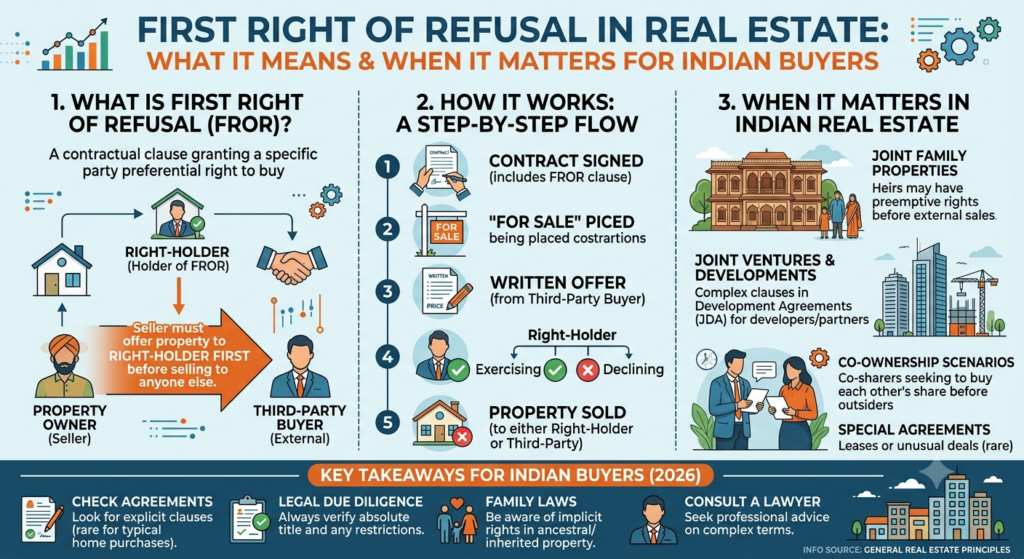
This provision is called “the first right of refusal” (ROFR). It gives a contracting party the “right to first opportunity” rather than an automatic ownership.
The mechanics are straightforward: The seller identifies a willing third-party purchaser, agrees on terms and price for the transaction, and then before completing that transaction, communicates those same specific sale terms to the ROFR holder under contract. Once the ROFR holder receives the notice from the seller, they must then have sufficient time to either match the purchaser’s offer, buy the property, or decline; therefore, the seller may proceed with the third-party purchaser based on terms agreed to with the third party.
First, the ROFR holder has no obligation to buy — it is a right, not a duty. Second, an ROFR does not give the holder the power to set a price or block a sale outright; it only gives them the right to match a price someone else has already offered. This distinguishes it sharply from an option to purchase, where the holder can compel a sale on pre-agreed terms at a time of their choosing.
Be Among the First to Own a Legacy
2.When Does ROFR Appear in Indian Property Transactions?
There are several common instances of how ROFR clauses come up in relation to real estate transactions within India and being aware of them from the start allows both buyers and sellers to be aware of what they are getting into.
Co-Ownership Situations: This is the most frequent context. When a property is jointly owned — by siblings who inherited a family home, by business partners, or by family members holding shares in an undivided property — it is common practice to include an ROFR in favour of the other co-owners.
The intent is straightforward: if one co-owner wants to exit, the others get the first opportunity to buy out that share before it passes to an outsider, keeping the property within the family or partnership where possible. This is closely related to the dynamics involved when families formally divide jointly held property, and ASBL’s guide on the meaning and process of a partition deed is a useful companion read for anyone navigating co-owned family property.
Housing society NOC conditions. Some housing societies, particularly older cooperative societies, embed an ROFR-style condition into their bye-laws or NOC process — requiring that a member intending to sell first offer the unit to existing members or to the society itself before listing it externally. This practice is discussed in more detail later in this article.
Builder-buyer agreements. In certain projects, particularly those with a limited number of units or specific allotment structures, builders may include ROFR provisions giving existing buyers the first opportunity on adjacent units, additional parking, or expansion space that becomes available later in the project lifecycle.
Joint development and investment agreements. When an owner of a parcel of land enters into a joint development agreement with a developer or when there is more than one person that holds an ownership interest in a parcel of real estate, ROFR clauses can frequently be found within transactions to indicate how the buyer or seller is to proceed in the event that one party wants to sell its ownership interest.
In all these cases, the clause exists to give a defined party — not the general market — the first opportunity to acquire an interest before it goes elsewhere.(Source)
3.Is ROFR Legally Enforceable Under Indian Property Law?
The question that arises most is, “Can the holder of a first right of refusal force the seller to allow them to buy the property at any time?” It is possible to answer this question with the following; yes, the holder of a first right of refusal can, but not without some restrictions.
First rights of refusal, provided they are properly executed, have been given enforceability (i.e. the ability to force another to abide by the agreement) under the Indian Contract Act, 1872, as an executory obligation (contract) between the obligated parties. Courts in India have consistently upheld and enforced ROFR clauses within real property disputes between owners of real estate, and for family settlements, provided that there is clear wording of the ROFR clause and sufficient proof that the terms of the ROFR have been violated.
However, enforceability depends heavily on three factors. First, how the clause was drafted — vague language about “giving first preference” without specifying price determination, notice period, or response window is far harder to enforce than a precisely worded clause. Second, whether the agreement containing the ROFR was registered, particularly where it concerns immovable property, since registration strengthens evidentiary value and, in many cases, is a prerequisite for certain remedies. Third, whether the third party who eventually bought the property had notice of the ROFR — this affects whether the sale itself can be challenged, as discussed in the next sections.
It is also worth being precise about what courts can and typically do grant. Where an ROFR is clearly established and violated, courts may grant specific performance — compelling the seller to honour the original terms with the ROFR holder — or award damages for breach of contract. Outright cancellation of a completed sale to a third party is a more complex remedy, generally available only where the third party had actual or constructive notice of the ROFR at the time of purchase.
4.ROFR vs Right of Pre-emption: An Important Legal Distinction
Indian law and Indian real estate practice frequently use “right of first refusal” and “right of pre-emption” loosely, as though interchangeable. The distinction between ROFR and a ROFR is significant in terms of the legal implications associated with it. A statutory ROFR is a legal right that is conferred upon an individual by virtue of a law (statute) or through customary practices for the purpose of providing an individual with an opportunity to acquire property before the property can be transferred to another person, while a contractual ROFR is created through the mutual agreement of both parties and arises as a result of the underlying contract.
Because this right derives from law rather than agreement, it can, in certain circumstances, survive and bind even a third party who had no knowledge of it — making it considerably harder to defeat once established.
A right of first refusal, by contrast, is purely contractual. Typically, a statutory ROFR will be found in legislation dealing with the transfer of property (such as a family law statute that provides for co-ownership of property by co-owners) and provides to co-owners (and other specified relatives) of real property the right to acquire that property at the point of sale, before another party can acquire that property.
A contractually created ROFR will typically be found in a written document that expressly creates a ROFR, such as a purchase and sale agreement, family settlement, by-law of a society or a purchaser of property. The enforceability of a contractually-created ROFR against a third party is dependent on whether that third party had notice (actual or constructive) of the ROFR. Therefore, a purchaser of real property who purchases real property without notice of the existence of a ROFR and who is not otherwise required to make inquiries regarding the existence of a ROFR will be in a significantly better legal position than a purchaser who had notice of the ROFR.
Understanding the difference between statutory pre-emption rights (statutory ROFRs) and contractual ROFRs is important from a practical standpoint because the statutory ROFR documentation provides you with greater inherent protection than the contractual ROFR documentation. If you rely on a clause to protect your interests, understand whether you have a statutory or contractual ROFR.
5.What occurs if the seller sells to someone else without complying with the ROFR?
If the ROFR holder learns of the breach before the sale, the most effective remedy is to apply for an injunction to stop the seller from transferring the property in question while the ROFR holder’s dispute with the seller is pending. It is important to act promptly in this instance because once a signed (registered) deed of sale is recorded in favour of a third party, it will be much more difficult for the ROFR holder to reverse that sale.
If the sale has occurred already, the ROFR holder’s recourse is limited but not completely lost.
A suit for specific performance can be filed, asking the court to compel the original seller to honour the ROFR terms — though this becomes complicated once the property has actually changed hands and a third party holds registered title. Alternatively, the ROFR holder can pursue a claim for damages for breach of contract against the seller, which is often the more practically achievable remedy once a sale to a third party is complete.
In situations where the third-party buyer had clear notice of the existing ROFR — for instance, where the clause was part of a registered document the buyer’s own due diligence should have uncovered — courts have, in appropriate cases, been willing to set aside the sale itself. This is precisely why due diligence before any property purchase should include a careful review of prior agreements, encumbrances, and any registered conditions affecting the title, not just the immediate seller’s documents.
For anyone navigating an exit from a booking or sale before it reaches this stage of dispute, ASBL’s guide on legally exiting a flat booking before the agreement stage outlines the cleaner, less contentious route available earlier in a transaction.
6.Housing Society and ROFR: What Societies Can and Cannot Do
Buyers and sellers transacting resale apartments in Hyderabad and elsewhere often run into a specific version of this question: can a housing society impose its own right of first refusal, requiring a member to offer the flat to the society or to existing members before selling externally?
The answer turns substantially on the society’s bye-laws and on whether the original sale agreement or allotment terms bound the unit owner to those bye-laws as a continuing condition. Cooperative housing societies registered under the relevant state cooperative societies legislation do, in many cases, have bye-laws that include conditions around transfer of membership and resale — including, in some older societies, a requirement to offer first preference to existing members.
However, a society’s ability to actually block or delay a sale is more limited than many members assume. Societies can typically require notice of an intended sale, can insist on dues clearance and NOC formalities, and can enforce bye-law conditions that were validly adopted and binding at the time the seller acquired the unit.
Membership cannot be denied to someone who complies with the bylaws of housing society as long as they do not violate a legal requirement. Owners and buyers must request copies of bylaws for the housing society resale transaction and determine if any preference for first refusal is documented properly, and make sure that they receive an NOC (No Objection Certificate) and conveyance in accordance with the bylaws for the transaction.
7.How to Draft an Effective ROFR Clause: Key Elements
Whether you are a co-owner protecting your interest in jointly held property, or a society documenting a resale condition, a poorly drafted ROFR clause is close to useless in a dispute. A clause intended to be genuinely enforceable should specify the following elements clearly.
Trigger event. The clause must define precisely what triggers the right — typically, the seller’s receipt of a bona fide, genuine third-party offer they are willing to accept. Vague triggers (“if the owner ever considers selling”) create ambiguity about when the obligation actually arises.
Price and terms determination. The clause should state clearly that the ROFR holder must be offered the property on the same price and terms as the third-party offer — and ideally specify what documentation (a copy of the offer, term sheet, or agreement) the seller must furnish to prove those terms.
Notice requirements. The clause must require written notice to the ROFR holder, specifying exactly how that notice should be delivered and what it must contain.
Response window. A clearly defined time period — commonly 15 to 30 days in Indian practice — within which the ROFR holder must respond. Without this, the clause can be argued as creating an indefinite obligation, which courts are reluctant to enforce.
Consequence of non-response or decline.It is necessary for the clause to clearly communicate, that if an ROFR holder fails to respond within the time period specified or declines to exercise their ROFR that the seller can sell the property for the same price and on the same terms to a third party.
Registration of the underlying agreement would greatly enhance the enforceability and evidential strength of the agreement where it relates to real property and is binding on successors or third parties who have notice of it.
To give clarity to both the holder of the ROFR and the seller, and to provide to a court (if needed) clarity on how to resolve an issue, the clause includes all six elements.
A clause that addresses all six elements gives both the holder and the seller clarity — and gives a court something precise to interpret if a dispute ever arises.
FAQs
1.What is a First Right of Refusal (ROFR) in Real Estate?
A first right of refusal is a lock in agreement that grants someone (ROFR holder) the ability to make an offer on a property that is being sold to another buyer (third party), before that buyer can complete their purchase. The ROFR holder has no obligation to purchase the property but must be given an opportunity to make their own offer to the seller at the same price and terms as the third party buyer would pay.
2.Is A First Right Of Refusal Legally Binding in India?
Yes, in general. An ROFR clause in a registered agreement or contract is enforceable under the Indian Contract Act. Courts distinguish between a right of pre-emption (imposed by law or statute) and a contractual ROFR. Courts may grant specific performance or damages if an ROFR is violated, depending on the facts and how the clause was drafted and registered.
3.What happens if a seller sells a property without honouring the ROFR?
The ROFR holder can see legal remedies including an injunction to restrain the sale, a suit for specific performance to compel the seller to offer the property on the agreed terms, or a claim for damages for breach of contract. Where the property has already been transferred to a third party who had notice of the ROFR, courts may set aside the sale.
4.Can a housing society impose a first right of refusal on resale transactions?
Housing societies sometimes include NOC conditions that give the society or other members a right of first refusal on resale. Enforceability depends on whether the bye-laws include such a provision and whether the original sale agreement requires adherence to society bye-laws. Buyers should review society bye-laws and the original sale deed before transacting in any resale.
5.What is the difference between ROFR and right of pre-emption?
A right of pre-emption is a statutory or customary right (often applying to co-sharers of ancestral property or agricultural land) where the law grants certain parties the right to purchase before others. An ROFR is purely contractual — created by agreement between the parties. Pre-emption rights are often harder to waive and may survive sale to third parties even without notice, unlike most contractual ROFR clauses.
6.How long does the holder of a first right of refusal have to respond?
This depends entirely on what the clause specifies. Indian practice commonly uses a window of 15 to 30 days from the date of formal notice, though parties are free to negotiate a different period. A well-drafted clause always specifies an exact number of days; a clause silent on this point creates ambiguity that weakens enforceability.
7.Can a first right of refusal clause be transferred or inherited?
It depends on the drafting of the original clause. Some ROFR provisions are personal to the named holder and lapse on their death or transfer of their own interest; others are drafted to bind heirs, successors, or assigns of the holder. Where the clause is silent, this becomes a matter of contractual interpretation, which is precisely why explicit drafting on succession is advisable when the clause is created.