Unpaid Maintenance : Can Your RWA Legally Disconnect Water or Electricity?
Quick Answer
A Resident Welfare Association (RWA) can recover unpaid maintenance dues, but it generally cannot disconnect essential services such as water or electricity as a recovery measure. Instead, it must follow the legal process, including issuing notices, charging late payment interest where permitted, and pursuing civil recovery if required. This guide explains the legal powers of an RWA, the rights of residents, and the appropriate remedies available to both parties.
Noticed how some messages are pinned on display in lifts or a Whatsapp message circulated from the management association of a community regarding the pending clearances to be done by the month end, or how suddenly the water connection just gets shut off? For any resident who has been through this multiple times, this would feel more like a threat rather than a reminder from the administration! The question succeeding this situation would be: Is it actually in the hands of the RWA to exercise such power?
Honestly, this is more complicated rather than a plain yes or no, and that actually matters. It is therefore mandatory to know where an RWA’s authority stands, and where the legal processes make their way in for protection of the residents, since this can save a household from a painful and entirely avoidable dispute later.
Be Among the First to Own a Legacy
What is an RWA (Resident Welfare Association) and what powers does it have?
RWA stands for Resident Welfare Association, a body curated by the residents of a living community, apartment complex, or a gated community to be able to manage the responsibilities like maintenance of common areas, security, cleanliness and collection of the maintenance charges. Most RWAs are registered under the Societies Registration Act, 1860, though it might not be the case always since in many apartment complexes, they come under a state-specific Apartment Ownership Act, which is responsible for looking after the rights and compulsory duties of individual owners a bit differently.
Once the registration is done, an RWA begins to function as a lawful body with a governing document: the rules and regulations, which is approved by the members of the committee itself through a General body. This is where the real power of the RWA starts taking shape: it can hold responsibility of managing the maintenance charges, straight-up penalise the late payments, put restrictions on certain perks when there’s violation of rules, and pursue legal recovery from defaulters.
What it automatically doesn’t get is, however, is a blank cheque to enforce a payment however it sees fit. An RWA’s exercising powers are held back by the same documents created by itself, that is the terms and regulations document, and then further gets limited by a span of consumer and the laws mentioned in the constitution that is applied irrespective of the what is mentioned in the self-made terms and regulations of the RWA.
This differentiation is the main discussion of the disconnection debate. An RWA is a self-governing body of residents, and not some utility provider, and it does not have the automatic powers to cut off supply even if it has inherited utility’s authority.
Can an RWA Legally Disconnect Essential Services Over Unpaid Dues?
This is where most confusion happens not only with the residents , but also the managing committees, since the law processes in this regard gets misunderstood.
Water and electricity are treated as the necessities for survival by Indian law governing houses, which is closely associated with any resident’s basic living.
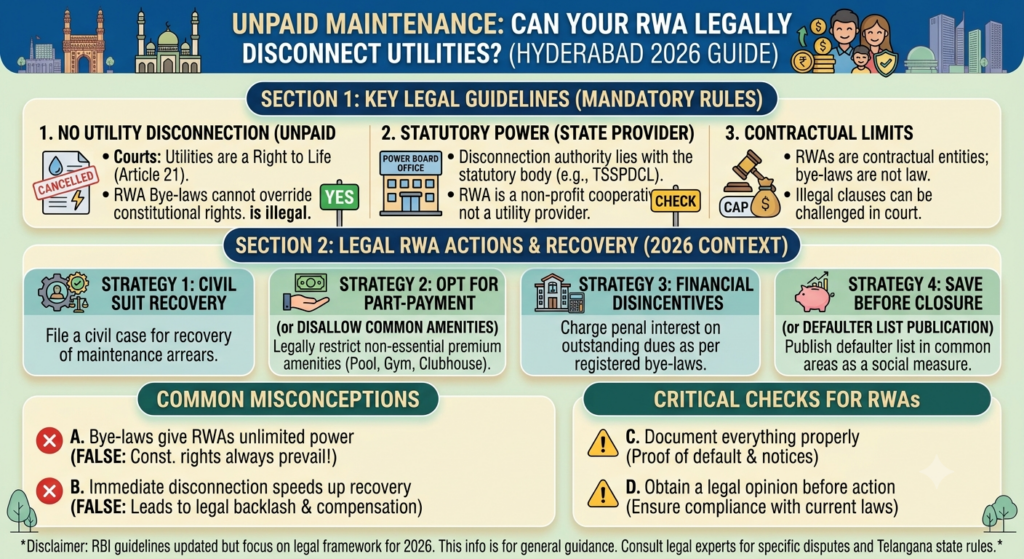
The generic legal positioning, which echoes consistently across consumer forums, cooperative courts, and numerous High Court rules, is that a housing society or RWA exercises no such independent powers to itself cut off these supplies,even if the dues of maintenance haven’t been cleared yet, and the reason is very simple and straightforward: this right is solely reserved by the civic authorities or the utility board which supplies water and electricity and under no condition can this power be exercised by the RWA, the utility board or the civic authorities in this could be the municipal corporation, the water board, or the electricity distribution company, and not the residents’ collective. (Source)
This means that even if a resident has pending maintenance dues, they cannot be denied access to essential services such as water and electricity. An RWA cannot disconnect these services as a means of recovering unpaid dues. Doing so may be considered unlawful and could expose the association to legal action.
Affected residents have successfully challenged such disconnections as illegal interference with the essential amenities, and in certain cases, as conduct serious enough to invite a criminal complaint against the office-bearers responsible.
There’s something important that needs to be highlighted. A number of recent jurisdiction-specific rules and regulations have some exceptions as well. For instance where a for instance, where a society itself purchases water from a private tanker service at a cost, and passes that cost on to residents as a distinct billed item rather than as part of the base maintenance charge.
In such situations, some courts have permitted disconnection of that specific paid-for supply after due process, reasoning that the defaulting household’s private consumption was directly increasing the financial burden on everyone else. But this remains an exception tied to specific facts, not a general licence, and it still requires the RWA to follow a fair process and, in most cases, seek judicial sanction before acting. It should never be read as a general permission slip.
The safest and most accurate way to frame this for residents: disputes over dues are a financial and legal matter, to be settled through the legal recovery process, not a services matter, to be settled through the meter box.
Essential vs Non-Essential Services: Where RWAs Have More Legal Room
The distinction mentioned above is something that is not acknowledged enough, and it should receive more focus than it does currently.
Essential services such as water, electricity or sewage come under a legally safe category.
Courts treat interference with these as touching on a resident’s basic living conditions, which is precisely why disconnection over unpaid dues is viewed so unfavourably.
Unlike essential amenities, Non-essential ones must contend with a much less stringent legal framework. While amenities such as clubhouse access, swimming pools, gyms, or banquet facilities might seem to be necessities to some people, the fact of the matter is that they are privileges provided by a RWA to its members in good standing, rather than basic requirements for livability.
From a legal perspective, courts and legal opinions have been more inclined to accept the limitation of access to non-essential amenities from members who owe significant dues, as long as this restriction is done uniformly, and is founded on the RWA’s legal bylaws and proper notice has been served beforehand. (Source)
In practical terms, this allows RWAs to exercise a legitimate and low-risk leverage in collecting payments on time by restricting access to clubhouse bookings or gym usage for defaulters, without entering the risky realm of denying water and electricity. It is therefore important for both parties to understand the difference between essential and non-essential amenities at hand.
What Legal Recovery Options Does an RWA Actually Have?
In case disconnecting vital utilities is not an option, what options does a Resident Welfare Association have in case the member fails to clear dues? The recovery process is a complicated task bearing various twists and turns in the process itself.
1. A formal written notice. In most cases, the very first step is to have a written notice outlining the total sum due along with the period for which it is being charged and the valid time frame for payment. This should not be overlooked as it serves as very useful evidence in court later on, since it shows that the RWA has acted fairly prior to taking this matter further.
2. Late payment interest. Most society bylaws permit the RWA to levy interest on overdue maintenance, typically at a rate fixed by the General Body in advance. This is one of the more commonly used and least contested tools available.
3. A General Body resolution. For matters of real significance, a long-standing defaulter, a large outstanding sum, or a decision to pursue formal recovery, RWAs are generally expected to seek the sanction of the General Body rather than have the managing committee act unilaterally. This protects the RWA procedurally and demonstrates collective backing for the decision.
4. Civil suit for recovery. If informal efforts fail, an RWA can file a civil recovery suit against the defaulting member, seeking the outstanding amount along with applicable interest. Depending on the state and the nature of the society’s registration, this may be filed before a civil court or, for cooperative housing societies, before the relevant cooperative court.
5. Consumer complaint. Interestingly, the relationship can cut both ways. Under the Consumer Protection Act, 2019, an RWA can, in certain circumstances, be treated as a service provider to its members, which means residents facing arbitrary or unreasonable RWA conduct have a consumer forum available to them too. Where a builder or developer has not yet formally handed over maintenance responsibilities to the RWA, the Real Estate (Regulation and Development) Act (RERA) may also come into play, since maintenance obligations during that period often remain with the promoter.
Together, these tools give an RWA a fully legitimate path to recovering dues, one that simply doesn’t require, or legally permit, cutting off a resident’s water supply along the way.
Key Court Rulings on RWA Service Disconnections
The judicial consensus on this issue has been remarkably consistent over the years, even as it has occasionally been tested by newer, narrower fact patterns.
Across a range of High Court and cooperative court decisions, the recurring principle has been that a housing society or RWA is not entitled to unilaterally disconnect or suspend common amenities, water supply chief among them as a means of pressuring a defaulting member. Courts have repeatedly framed this as a matter going beyond the RWA’s bylaws into more basic protections around a resident’s living conditions, and have directed aggrieved residents toward legal notice and civil recovery as the correct route for societies, rather than direct disconnection.
Nevertheless, fewer recent decisions have revealed some courts willing to give some consideration to regulatory fairness argument in particular issues, including cases where the questioned charge concerned an extra charge item (e.g. water from a tanker) instead of the general maintenance charge, as well as where failure to pay service charge obviously shifted costs onto other residents of the community.
However, in such situations, the courts have still not allowed for complete disconnection; instead, they have drawn narrow conclusions based on the facts of each individual case and required that proper procedures had been completed in every case. The main learning point for residents and cooperatives alike is that courts may have a much more positive attitude towards RWA which are firm in pursuing payment success than to those who settle the issue on the spot.
What to Do If Your RWA Threatens to Disconnect Your Services
Receiving a disconnection threat can be unexpected and unsettling. It’s always better to put forward a calm and well-planned response rather than an emotional one.
Respond to the notice in writing. It is important to acknowledge the notice received by you and mention that the disconnection of essential or important utility services cannot take place according to the law. You must have a proper record of all the relevant documents, texts, and notices for record purposes.
Check the bylaws. Ask for a copy of the RWA’s registered bylaws if you don’t already have one, and see whether disconnection is even mentioned as a sanctioned measure. Very often, it isn’t, which strengthens your position considerably.
Try direct resolution first. A basic, straightforward talk with the committee members, preferably asking for the payment plan in writing where the dues ca not be paid at once, is the best way to resolve almost all the issues before it becomes an ugly and complicated legal mess.
If still not, escalate step by step. In case the threat is upheld or continued, it is good to file a complaint with the Registrar of Societies in case of societies for further action.
In case of continued threat or realizations of the threat, a written grievance to the Registrar of Societies (for RWAs that are registered as societies) is usually the quickest way to escalate formally. Sending a complaint to the consumer forum or the cooperative court if applicable gives a chance to recover the lost connection.
Consider a fairly typical scenario: a resident falls three months behind on maintenance owing to a temporary job loss. The RWA sends a notice, then a follow-up threatening disconnection within a week. Rather than letting the deadline pass in silence or, worse, in an argument at the gate, the resident writes back proposing a two-month payment plan and copies the request to the General Body. In most well-run societies, this alone defuses the situation, committees generally prefer a documented repayment commitment over a fight they are likely to lose in court anyway.
Do’s
- Pay maintenance dues on time whenever possible.
- Respond to RWA notices in writing and maintain records.
- Review the RWA’s registered bylaws before disputing any action.
- Try to resolve disputes through discussion or a payment plan.
- Escalate unresolved issues to the Registrar of Societies or the appropriate legal forum.
Don’ts
- Don’t assume an RWA can legally disconnect water or electricity for unpaid dues.
- Avoid ignoring maintenance notices or legal communications.
- Don’t withhold payments without understanding your legal obligations.
- Check before accepting unlawful disconnections without documenting and challenging them.
- Avoid getting confused essential services with non-essential amenities such as clubhouses or gyms.
Sample Notice: How RWAs Should Formally Notify Defaulters
For RWAs looking to follow due process, and for residents wanting to know what a legitimate notice should actually look like,a properly drafted notice typically includes:
- The resident’s name, unit number, and the exact period of default
- The total amount outstanding, broken down by month and any applicable late interest
- Reference to the specific bylaw clause authorising the charge and any penalty
- A clear, reasonable deadline to clear the dues (commonly 15 to 30 days)
- The next step the RWA intends to take if the deadline passes, such as a General Body resolution or civil recovery,without threatening disconnection of essential services
- The signature of an authorised office-bearer and the official seal or letterhead of the RWA
This type of notice is procedurally sound for the RWA, offers the resident an adequate opportunity to be heard, and ensures that all the steps are in compliance with the respective legal provisions.
A Word on Getting the Fundamentals Right
Disputes like these are rarely just about the money, they’re often a sign of gaps elsewhere: unclear bylaws, poor documentation, or simply a resident and a committee that have never sat down to have a plain conversation. For homebuyers navigating a new community, understanding the paperwork that defines your rights from day one makes a real difference.
It helps to be clear on how yourproperty allotment letter, agreement to sell, and sale deed fit together, since these documents often define when maintenance obligations formally begin. Separately, homeowners should also understand howGHMC property tax works, since municipal dues and society maintenance are frequently, and mistakenly, treated as one and the same. And if your community is still transitioning from builder-managed upkeep to a resident-run RWA, it’s worth reading up on theconveyance deed and its role in housing societies, since that transfer of control often marks the point where these disputes first begin to surface.
Key Takeaways
- RWAs cannot generally disconnect water or electricity for unpaid maintenance dues.
- Recovery must follow legal channels like notices, penalties, and civil proceedings.
- Essential services and lifestyle amenities are treated differently under the law.
- Clubhouse, gym, and pool access may be restricted if permitted by the RWA’s bylaws.
- Residents can challenge unlawful disconnections before consumer forums or courts.
- Knowing your RWA bylaws helps protect your rights and avoid unnecessary disputes.