Conveyance Deed for Housing Societies: What It Is and Why It Matters for Your Flat
Your society has been collecting maintenance for years. The accounts are reasonably clean, the committee meets regularly, and the project looks well-managed. But somewhere in the paperwork, often buried and never asked, is a question that affects every flat owner’s long-term security: does the housing society actually own the land it stands on?
That question is answered by a single document called the conveyance deed. In a significant number of housing projects across Hyderabad and India broadly, that document has never been executed.A lot of flat owners don’t realise that there is no conveyance deed for their society until a redevelopment proposal has been submitted or a bank has rejected a loan request for that society or the lawyer representing a prospective resale buyer finds this out during his due diligence process.
In this guide, we will provide you with an explanation of what a conveyance deed is; the reason so many societies don’t have one and the steps you can take if your society doesn’t have a conveyance deed.
1.What Is a Conveyance Deed? How Does It Differ From A Sale Deed?
Sale deeds and conveyance deeds are different types of documents representing two levels of ownership to property and both documents will provide you with complete legal security.
A sale deed is the document that transfers ownership of your apartment directly from the builder to the person (you) buying it.
It gives you title to the flat: the walls, the floor area, the fixtures within your four walls. It’s executed at the time of purchase and registered at the Sub-Registrar’s Office.
Be Among the First to Own a Legacy
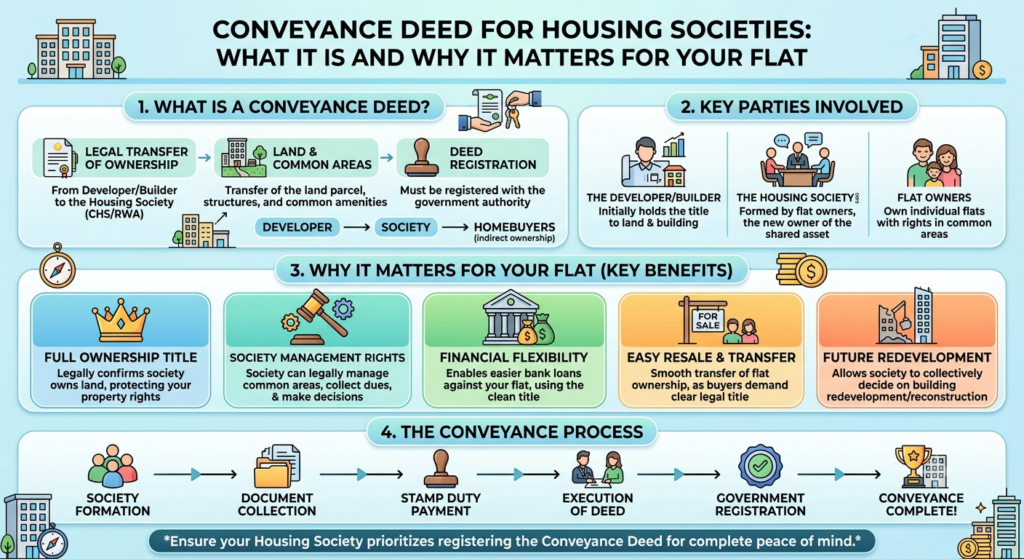
A conveyance deed transfers ownership of the entire plot of land, and in many cases the building structure, from the developer to the registered housing society formed by the flat owners. It’s a collective transfer, not an individual one. The society, on behalf of all its members, becomes the legal owner of the land beneath the building.
| Metrics | Sale Deed | Conveyance Deed |
| What is transferred | Individual apartment unit | Entire land plot (and structure) |
| From whom | Builder to individual buyer | Builder/developer to housing society |
| When executed | At time of individual purchase | After society formation, often post-possession |
| Benefits | Unit ownership for the buyer | Land title for the society collectively |
Both documents are necessary. A sale deed without a corresponding conveyance deed means individual flat owners have title to their units but the society has no legal ownership of the land under the building.
Understanding how your individual ownership connects to the society’s land rights is closely related to the concept of undivided share. Our guide to UDS meaning and your flat ownership rights explains this relationship in detail.
2.Why Housing Societies Need a Conveyance Deed: Land Ownership Explained
When the developer builds the apartments, they’ll buy the land, build the apartments, sell all of the residences, and create individual (i.e. registered) mortgages/deeds on all of the apartments. But as long as the homebuilders own the land upon which the complex sits, they will have no deed conveying the land from the builder to the association (i.e. project association) until that deed is executed.
Without a conveyance deed, the society is in a legally incomplete position:
- The land is technically still the builder’s asset, not the society’s
- The society can’t independently mortgage the land to raise funds for renovation or infrastructure work
- Any future redevelopment of the building requires the builder’s cooperation on land-related permissions. If the builder has wound up, merged, or become uncontactable, this becomes a serious practical problem
- Some building permits and insurance applications require proof of land ownership by the society
Individual flat owners aren’t directly at risk of losing their units. Sale deeds remain valid regardless of conveyance status. But the collective security of the society, and the long-term ability to manage and develop the land, depends on the conveyance deed being in place.
3.Why Many Indian Housing Societies Still Do Not Have Conveyance
This isn’t a rare edge case. A large proportion of older housing societies across India, including a meaningful number in Hyderabad, don’t have a conveyance deed in place, even decades after possession was given. Several factors explain this:
Builder inaction or unwillingness. Executing the conveyance deed involves the builder paying stamp duty on the land value, which can be substantial in high-value locations. Some builders delay or avoid this to reduce their outflow. Others simply never initiate the process.
Society inaction. In many projects, flat owners form the RWA or cooperative society and then focus on day-to-day management without pursuing conveyance. The issue feels abstract until it becomes urgent.
Builder has wound up or is untraceable. In older projects where the original developer no longer exists, finding a signatory for the conveyance deed is practically difficult. This is one scenario where deemed conveyance, covered in the next section, becomes the only route.
Incomplete project phases. In large phased developments, builders sometimes argue that conveyance can’t be executed until all phases are complete. This is a common delay tactic. Individual phases that are complete and have their own registered societies can typically pursue conveyance independently.
Legal disputes. If the builder has pending litigation, mortgage defaults, or creditor claims against the project land, conveyance may be entangled in those proceedings. (Source)
4.Deemed Conveyance: What It Is and When Societies Can Pursue It
The legal answer for when a builder has not done the conveyance deed then doesn’t want or can’t do this work is called Conveyance by Deeming. A housing society will apply to their District Deputy Registrar of Co-operative Society (or the equivalent person depending on where they are located) to obtain a certificate stating that; although the Builder’s signature was not present on a conveyance deed, it is still considered completed by the law. After the society receives the certificate of deemed conveyance, the society can go to the Sub-Registrar’s Office and register the land they received from the builder in their name without having to work with the builder.
The deemed conveyance route is available when:
- The builder has failed to execute the conveyance deed within the period specified in the sale agreements or by the applicable cooperative housing law
- The builder is unreachable, has wound up, or is refusing to cooperate without valid reason
- The society has been registered and has standing to apply
1. The application, including required documentation, such as registrations for each flat’s sale(s) by the registered deed to each flat, the registration of the society itself, as well as the original approvals of the structure, and proof that the builder has failed to execute a conveyance despite requests from the society.
2.In the state of Telangana, the governing legislation of a cooperative housing society and conveyancing is found within the Telangana Cooperative Societies Act. When the society attempts to obtain their “deemed conveyance,” they should consult with a real estate attorney that is familiar with the rollover procedure for the local cooperative registrar as the timing and documentation requirement can differ from contact to contact.
3.The Step by Step Process of Obtaining a Conveyance Deed as a Housing Society
4.Builder cooperation; standard route
5. The society will hold a general body meeting in which they will pass a formal resolution to grant authority to the management committee to pursue a conveyance on behalf of the housing society.
6. The committee shall provide the builder with a formal written demand for the execution of the conveyance deed with a reasonable timeline for completion (30-60 days is typical)
7. A real estate attorney will be retained and asked to prepare the conveyance deed, which will cover the entire original property description, the building specifications and the transfers of rights from the builder to the society.
8.Stamp duty calculation and payment: the deed must be stamped at the applicable rate on the land value. To determine the amount of stamp duty payable when transferring land to a housing society in Telangana State requires reference to the government’s guideline value for that piece of land.
9.Execution and registration involves signing the deed at Sub-Registrar’s Office with the builder and society’s representative as witnesses. Once the deed is signed, it will be registered and society will receive certified copies.
10.Mutation: update at local revenue office to show the society as new owner of title.
Path 2: Builder unresponsive (deemed conveyance route)
- Formally demand conveyance in writing, keep delivery records
- Compile all required documents: sale deeds of all/majority flats, society registration, building approvals, occupation certificate, title documents for the plot
- File application for deemed conveyance with the District Deputy Registrar of Cooperative Societies
- Attend hearings; the authority may issue notice to the builder
- On issuance of deemed conveyance certificate, proceed to stamp duty payment and Sub-Registrar registration
The complete process, from the moment of resolution until the deed has been registered, usually takes 6 – 18 months. The timeline depends on how the process was followed, whether or not the documentation is complete and if there were any disputes during the transaction. (Source)
5.Legal Risks for Flat Owners in Societies Without Conveyance
While the risks associated with the conveyancing process have no immediate impact, they do stack up over time.
Builder can encumber the land. Until the conveyance deed is executed, the land legally belongs to the builder. A financially stressed builder could mortgage or create a charge on the land without the society’s knowledge. If the builder defaults on that mortgage, the lender’s recovery action could affect the land. This places the society in a contested legal position even though individual flat owners have valid sale deeds.
Redevelopment becomes complicated. When an older building reaches the end of its structural life or when residents seek additional FSI through redevelopment, the society needs clear land title to negotiate with new developers and obtain permissions. Without conveyance, the society can’t act as an independent party in redevelopment decisions.
Loans and permits may be refused. Banks may decline loans to housing societies for renovation or infrastructure work if the society can’t prove land ownership. Some government permits for structural alterations also require verified land title.
Future resale complications. A buyer’s due diligence lawyer will check conveyance status. A society without conveyance isn’t a disqualifying factor in itself, but it flags a legal gap that can complicate resale, affect buyer financing, and give the buyer grounds to negotiate on price.
6.Checking Conveyance Status Before Buying a Resale Apartment
Before finalising any resale purchase in a housing society, add these checks to your due diligence list.
Ask for the conveyance deed directly. Request a copy from the society committee or the seller. If the society has a registered conveyance deed, they’ll have certified copies. If the response is vague or the question is deflected, pursue it further.
Check the land records at the revenue office. The pahani (record of rights) or pattadar passbook for the plot should show the housing society, or its designated entity, as the title holder if conveyance has been executed. If the builder’s name still appears, conveyance hasn’t been completed.
Assess what stage the deemed conveyance process is at. If the society is actively pursuing deemed conveyance, confirm the status and expected timeline. A society mid-process is different from one that has never started.
Factor it into your purchase decision. Buying in a society without conveyance isn’t automatically a dealbreaker. Many buyers do so, particularly in older and well-established projects. But price it correctly, understand the risk, and ensure your sale deed is in order regardless. Our guide on flat registration before possession covers the sale deed registration process and why it must be completed on your individual unit regardless of the society’s conveyance status.
Also confirm the society’s maintenance and governance is in order. Our guide on whether an RWA can legally disconnect services for unpaid maintenance gives useful context on the powers and limits of the society committee you’ll be part of.
FAQs
1.What is a conveyance deed in terms of Real estate Property?
A conveyance deed is a legal document through which a builder or developer transfers ownership of the land on which an apartment project is built to the housing society formed by the flat owners. While individual flat owners receive their units through sale deeds, the land under the building is transferred collectively to the society through the conveyance deed. Without it, the society doesn’t hold formal land title.
2.What is the difference between a sale deed and a conveyance deed?
A sale deed transfers ownership of one individual apartment unit from a builder to a buyer, while a conveyance deed transfers ownership of the entire plot of land from the developer to an appointed housing society that has been established as a corporation or other legal entity.Both are necessary for complete legal security: the sale deed gives you the unit, the conveyance deed gives the society the land beneath it.
3.What is deemed conveyance?
The deemed conveyance is a legal remedy that allows a housing society to seek a certificate from the competent authority stating that the conveyance has been made because there was a lack of cooperation from the builder or the builder refused to sign the deed of conveyance. Once the deemed conveyance certificate is issued, the society can register the land in its name without needing to obtain the builder’s signature.
4.What are the legal risks of buying a flat in a society without conveyance?
In a society without conveyance, the land technically remains in the builder’s name. This creates risks including the builder’s ability to mortgage or encumber the land, difficulties for the society in obtaining loans or construction permits, and complications in future redevelopment. Individual flat owners’ title to their units remains intact through sale deeds, but the collective ownership of the underlying land isn’t secured.
5.How does a housing society obtain a conveyance deed from the builder?
The society should first pass a resolution and approach the builder formally requesting execution of the conveyance deed. Once the developer agrees or is unresponsive, the title deed is completed and signed, stamped as per the relevant rates, and filed with the local land records office. If the developer does not respond, the society can then request a formal conveyance from the official land registry under the accepted state statutes through the Cooperative Society Office of the District Registrar.