What You Need to Know About Ingress and Egress in Real Estate
Quick Answer
Ingress and egress refer to a property owner’s legal right to enter and exit their land. Before buying any property—especially plots with shared or indirect access—verify that the access route is legally recorded or protected under the Indian Easements Act, 1882, as unclear access rights can lead to disputes, financing issues, and costly litigation.
A plot looks perfect on Google Maps until you realise the only path to it runs through a neighbour’s compound, and they have started locking the gate. Ingress and egress real estate rights are not abstract vocabulary. They decide whether you can legally reach your own land.
In India, these rights are governed by the Indian Easements Act, 1882, not by IT security manuals or US property glossaries. This guide explains what ingress and egress mean for owners, how easement of necessity India law works under Section 13, and what to verify before you buy a landlocked or shared-access property.
What Ingress and Egress Actually Mean for a Property Owner
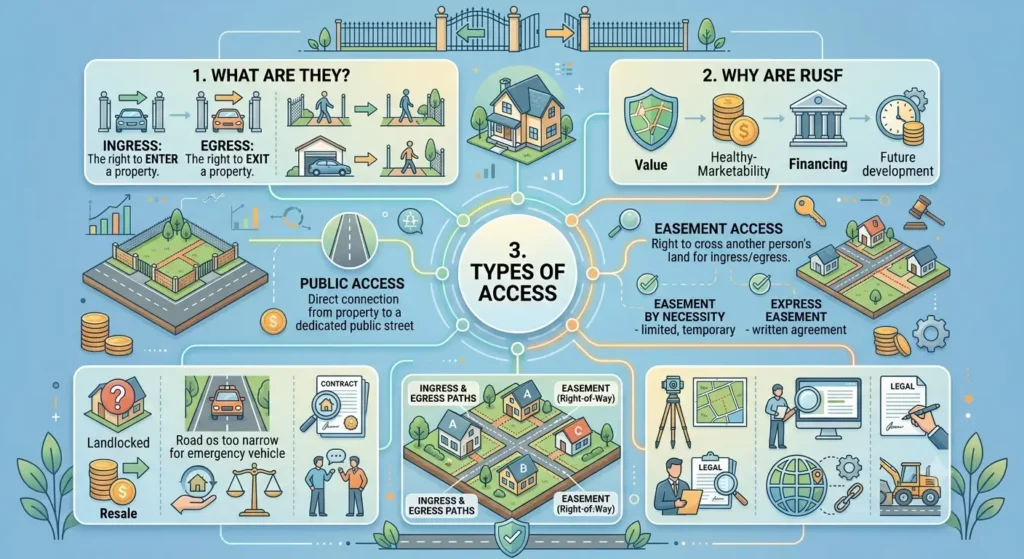
Ingress means the right to enter your property. Egress means the right to leave it. Together, they describe legal access, the bridge between your boundary and a public road or common passage.
Without both, ownership on paper does not translate into usable ownership on the ground. You cannot move furniture in, register utilities reliably, or secure a mortgage if a bank’s legal team flags uncertain access. Lenders treat ambiguous pathways as title risk for good reason.
Access can be:
·Direct — your plot fronts a public road or highway.
·Through a recorded easement — a right of way written in the sale deed or a separate registered document.
·Through long use — sometimes claimed as prescription if conditions are met.
·Disputed — a neighbour blocks a lane you assumed was yours.
Be Among the First to Own a Legacy
Hyderabad buyers encounter this most often on villa plots, agricultural conversions, and older layouts where parcels were subdivided without updating passage rights. Gated apartments rarely face landlock issues because the developer provides internal roads, but verify that the project’s layout connects lawfully to a public thoroughfare before you treat “ORR proximity” as access certainty.
The Indian Easements Act, 1882: The Law That Governs Access Rights
Indian property access is not governed by generic “right of way” blog posts. The primary statute is the Indian Easements Act, 1882, read alongside the Transfer of Property Act, 1882 where transfers create or burden rights.
An easement is a right to use another person’s land for a specific purpose, most commonly a pathway, drainage channel, or light passage, without owning that land. The property that benefits is the dominant tenement. The property burden is the servient tenement.
Key easement types buyers should distinguish:
| Type | How it arises | Typical trigger |
|---|---|---|
| Express easement | Written into deed or registered agreement | Developer layout, explicit grant |
| Easement of necessity | Implied by law (Section 13) | Landlock after sale or partition |
| Easement by prescription | Long continuous use | 20 years of open, peaceful access |
| Easement by custom | Local practice in an area | Rare in urban purchases |
When someone searches right of way Indian Easements Act, they are usually asking whether law will force a pathway when none was documented. Section 13 answers that for genuine necessity cases. It does not apply to every inconvenient route, and not every buyer who chose a cheap landlocked plot without due diligence.
Registration matters. An express easement should appear in title documents and ideally be registered so future buyers inherit clarity. Stamp and registration rules for such instruments tie into how enforceable your access right remains across resale. The Indian Stamps and Registration Act guide (https://asbl.in/blog/how-the-indian-stamps-and-registration-act-protects-your-real-estate-investment/) explains why unregistered arrangements weaken your position in disputes.
Easement of Necessity: Your Rights If Your Property Is Landlocked
Landlocked property access law India centres on Section 13 of the Indian Easements Act, 1882. An easement of necessity arises when a parcel cannot be reasonably used without passing over adjoining land, typically because a single larger holding was split and one piece lost its road frontage.(Source)
When courts recognise it :
·The dominant and servient parcels were once part of one estate.
·After partition or sale, one lot has no practical access to a public road.
·The claimed route is necessary, not merely convenient. A shorter driveway when another legal route exists may fail.
What you can do if you are landlocked :
File a civil suit seeking declaration of an easement of necessity and a defined pathway width over the neighbour’s land that previously formed part of the same parcel. Self-help, such as breaking a wall or forcing a gate open, creates criminal and civil exposure even if you believe you are morally right.
What buyers should note :
Sellers sometimes market landlocked plots at discounts without disclosing that access depends on litigation or neighbour goodwill. A discount is not compensation for years of court process and compulsory compensation payments.
If you are financing the purchase, disclose access status early. The essential guide to your first home loan (https://asbl.in/blog/the-essential-guide-to-your-first-home-loan/) covers how banks evaluate title, and uncertain ingress is a common reason for legal objection.
Easement by Prescription: Access Rights Gained Through Long-Term Use
Not every access right starts with a landlock situation. Easement by prescription arises when a person uses a defined route over another’s land openly, peacefully, and without permission for a statutory period, commonly cited as 20 years under Indian easement law principles applied by courts.
Necessity vs prescription:
| Factor | Easement of necessity | Easement by prescription |
|---|---|---|
| Trigger | Landlock after division | Long continuous use |
| Need for prior common ownership | Typically yes | No |
| Time element | Immediate upon landlock | approx. 20 years of open use |
| Neighbour’s awareness | Often sudden after split | Usually visible daily use |
Prescription claims fail when access is permissive (“use our lane until we say otherwise”) or interrupted by objections. A locked gate every few months can break continuity.
Buyers relying on “everyone has walked this way for decades” should demand documentary proof or legal opinion, not village consensus alone. Oral history does not substitute for a registered easement when you need a clean resale.
NRIs buying remotely face higher risk here because they skip physical verification. The NRI home loans eligibility guide (https://asbl.in/blog/nri-home-loans-eligibility-heres-what-all-you-need/) pairs finance rules with the broader due diligence remote buyers must run, including access confirmation before power of attorney signings abroad.
How Courts Decide Pathway Width and Compensation
Indian courts do not grant arbitrary driveways. They grant what is reasonably necessary for the dominant property’s use, balanced against the servient owner’s rights.
Typical widths cited in case law and legal practice
·Pedestrian access: roughly 3 to 6 feet
·Vehicular access: roughly 10 to 12 feet where genuine necessity is proved, such as construction traffic or regular car use, but not speculative future mansion plans.Judges consider plot size, intended use (residential vs agricultural), alternative routes, and whether a narrower path satisfies necessity. A villa plot may justify vehicular width; a small agricultural field used seasonally may not.
Compensation:
Yes, the beneficiary usually pays reasonable compensation to the servient landowner for the pathway burden, based on land value, extent of use, and permanence of the easement. Section 13 necessity easements are not free passes over a neighbour’s property. Budget compensation alongside litigation costs if you are pursuing rights after purchase.
Court orders often specify maintenance responsibility: who grades the lane, who repairs monsoon damage, and who clears encroachments. Silent orders lead to second disputes within a year.(Source)
Common Access Disputes and How They Get Resolved
Property access dispute neighbour cases usually fall into a few patterns:
Blocked private lane
A neighbour installs a gate, plants trees, or claims the pathway was never legal. Resolution: title search, prior easement documents, prescription evidence, or necessity suit.
Developer layout roads not handed over
Internal roads shown on brochures were never dedicated or registered. Buyers in plotted layouts should verify whether the layout road is a public street, a registered easement, or merely a dirt track on private land.
Width creep
The dominant owner widens a footpath into a car driveway without consent. Servient owner sues for injunction or seeks compensation for expanded burden.
Society vs individual access (apartments)
Rare at unit level but common at project level. Verify the township’s legal connection to the outer road, not only the guard booth experience on site visit day.
Resolution paths
1.Negotiated registered easement — fastest if neighbours cooperate; stamp and register the grant.
2.Mediation — often court-encouraged before trial.
3.Civil suit — declaration, injunction, or necessity/prescription adjudication.
4.Police involvement — only for trespass or breach of peace; title disputes still belong in civil court.
Document every blockage date, photograph the route, and preserve communications. Courts weigh conduct.
What to Check Before Buying a Property With Shared or Uncertain Access
How to check property access before buying should be a written checklist, not a verbal assurance from the broker.
1. Read the title deed and encumbrance certificate
Look for express easements, mentions of right of way, or absence of any access language on a plot that clearly does not touch a public road. Can an easement be recorded in a property’s title deed? Yes, and it should be. An unrecorded “understanding” with a neighbour does not travel automatically to you on resale.
2. Walk the route physically
Drive or walk the exact path from public road to plot boundary during a site visit. Note gates, locks, third-party structures, and whether you cross anyone else’s land. The flat inspection guide before buying (https://asbl.in/blog/a-comprehensive-guide-to-flat-inspection-before-buying/) applies equally to plotted land. Access is part of inspection, not an afterthought.
3. Ask about disputes
Direct question to seller: Is any access litigation pending? Has a neighbour objected in writing? Check with local residents if answers feel thin.
4. Confirm layout and conversion status
For Hyderabad outskirts, verify HMDA or panchayat layout approval and whether the access road is part of the sanctioned plan, not a shortcut across someone else’s survey number.
5. Location context
Even with legal access, a lane that floods every monsoon or bottlenecks at one choke point affects livability. The importance of location when looking for your ideal home (https://asbl.in/blog/importance-of-location-when-you-are-looking-for-your-ideal-home/) frames how connectivity and legal access interact.
6. Lawyer sign-off before token money
Hand your title papers and site photographs to a property lawyer. If they flag landlock risk, price in litigation, compensation, and delay, or walk away.A discounted plot with contested ingress is rarely a bargain. It is a deferred legal bill.
Key Takeaways
- Ingress is lawful entry onto your property; egress is lawful exit, usually via a road, lane, or recorded pathway.
- A landlocked parcel may qualify for an easement of necessity under Section 13 of the Indian Easements Act, 1882.
- Easement by prescription requires roughly 20 years of open, peaceful, continuous use, a different legal path to the same practical right.
- Courts often grant 3–6 feet for pedestrian access and 10–12 feet where vehicular access is proven necessary, with compensation to the neighbour whose land is used.
- Before buying, read the title deed, walk the access route, and confirm no active property access dispute neighbour litigation.