Tripartite Agreements in Home Loans: Why They Matter More Than You Think
Quick Answer
A tripartite agreement safeguards the interests of the buyer, builder, and lender during an under-construction property purchase. It defines payment milestones, responsibilities, and legal remedies, ensuring your home loan is disbursed only as construction progresses and reducing the risk of disputes.
There’s something you might be missing on before you sign the stack of paperwork handed over during a home loan sanction: “THE TRIPARTITE AGREEMENT”. It has rarely gotten the attention that it deserves. Buyers often tend to treat it more of like a formality between them and their house possession, something the bank’s required signature for, along with the other paperwork. That’s a blunder, since this is the document that lays down who would be responsible for the project stalls, the builder defaults, or the money isn’t moving in the way it should .
Understanding what a tripartite agreement actually states, and what you need to look for before doing your signatures, is one of the most overlooked forms of careful action a homebuyer could do.
What is a Tripartite Agreement in a Home Loan?
A tripartite agreement is a law contract signed by three parties: the homebuyer, the developer , and the bank or the financial institution providing the loan, used specifically, when the buyer needs a home loan to make a purchase in an under-construction apartment.
The need for a three-way document arises from a simple structural fact. When you take a loan for a completed, ready-to-move property, the seller hands over a title that transfers directly to you, and the bank’s interest in the property is recorded through a straightforward mortgage.
An under-construction property doesn’t work that way. While the buyer may have signed the documents needed for the acquisition, the builder remains the owner of the building and disburses money as construction gets underway rather than at once upon completion.
Be Among the First to Own a Legacy
This tripartite agreement assures that everyone recognizes the reality of the situation and establishes specific numbers, such as the payment schedule depending on the milestones achieved, the sale price, possession date, and listing of consequences in case something goes wrong.
The builder cannot later claim ignorance of the loan or the bank’s interest in the unit. The bank cannot claim it disbursed funds without the builder’s confirmation of construction progress.In addition, the buyer may possess only one document that specifies in black-and-white what is expected from each party to the deal.
The Three Parties: What Each One Is Responsible For
Every signatory has its own responsibilities under a tripartite agreement and knowing the limits of each party’s obligation will help you grasp the extent of your protection.
The buyer (borrower). A buyer has an essential duty of repaying the borrowings based on the committed timeline and performing all the obligations regarding the purchase like making timely contributions. In consideration of the borrowings, he will commit to providing the bank with a mortgage/lien over the property, thus making the bank the holder of the maximum right for the underlying property until the full reimbursement of the loan.
The builder (developer). The builder’s core responsibility is to complete construction according to the agreed timeline and specifications, and to confirm to the bank that each disbursement tranche corresponds to actual, verifiable progress on the ground. The builder also warrants that the unit being sold is free of prior encumbrances and that no competing claim or sale exists on the same unit. If the builder has separately taken a project loan from another lender, the agreement usually requires a no-objection certificate confirming the specific unit remains free of that lender’s charge before the buyer’s bank disburses funds.
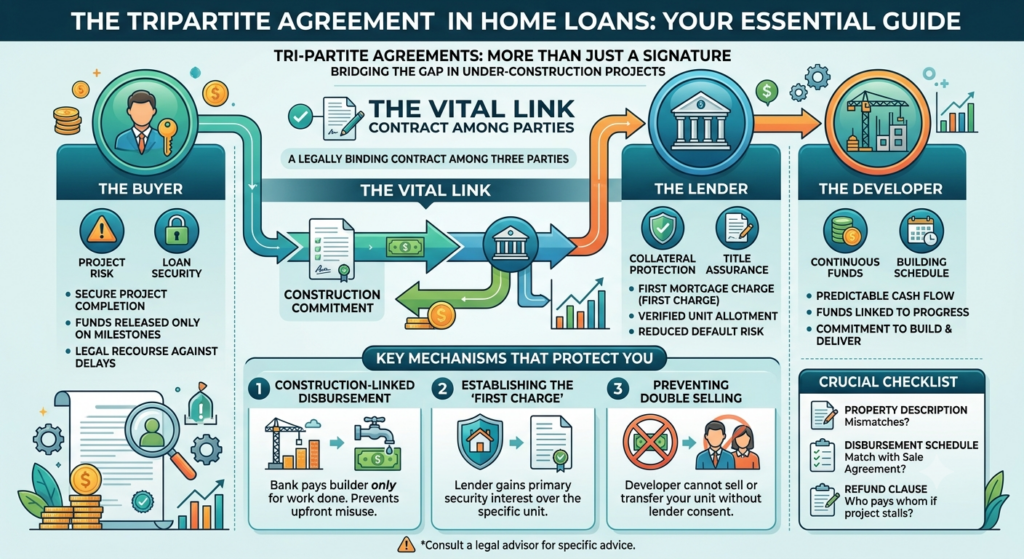
The bank (lender). The bank’s obligation is to disburse the sanctioned loan amount according to the schedule set out in the agreement, generally releasing funds to the builder only after receiving confirmation, often through periodic inspection or the builder’s own certification, that the relevant construction milestone has actually been reached. The bank also holds the primary security interest in the transaction, meaning it retains a first-ranking claim over the unit for as long as the loan remains outstanding, ahead of any other party’s claim.
The interplay between these three roles is what allows the transaction to function without any single party bearing all the risk alone. Most disputes tend to arise when the terms of the agreement are unclear or poorly phrased. (Source)
What Situations warrant a Tripartite Agreement and when do they not?
The use of a tripartite agreement is decided by the case of a buyer borrowing money from a bank to finish construction.
It is generally not required for a straightforward resale purchase of a completed, ready-to-move property, where the seller already holds clear title and the transaction is a simple transfer from seller to buyer, financed through a standard mortgage arrangement between just the buyer and the bank.
It’s worth noting that a different kind of tripartite arrangement can still arise in a resale context, one involving the buyer, the seller, and the housing society, confirming the society has no objection to the transfer, but this is a distinct document from the construction-linked tripartite agreement this article focuses on.
The presence of construction-linked disbursement is really the deciding factor. If your loan is going to be released to the builder in tranches as the building goes up, rather than in a single payment against a finished, titled property, expect a tripartite agreement to be part of the process.
Subordination Explained: How Property Rights Move Between Parties
Subordination is the piece of a tripartite agreement that generates the most confusion, largely because it’s mentioned in passing far more often than it’s actually explained.
In plain terms, subordination is the legal mechanism that determines the order in which different parties’ claims on the property rank against each other, and how those claims shift as circumstances change. The most important application of this, for the buyer, is straightforward: the bank’s security interest in the property, created through the mortgage or charge the buyer grants as a condition of the loan, ranks first. If the buyer defaults on loan repayment, the bank’s claim takes priority over any other interest in the unit, including the builder’s original claim as the property’s developer, and the agreement typically provides for the property, or the buyer’s rights in it, to pass to the bank as security enforcement.
This works in the other direction too, in a more limited way. If the builder fails to deliver the project or breaches the agreement, the agreement generally sets out that any amount the builder owes the buyer, such as a refund following cancellation, must first be routed to settle the buyer’s outstanding loan with the bank, rather than paid directly to the buyer, since the bank’s claim on the money tied to that transaction typically ranks ahead of the buyer’s own right to receive it.
Essentially, subordination safeguards the bank’s position over the builder and the buyer in the loan course but also makes it clear where the interests of both the builder and the buyer are in relation to each other.
For a buyer, the practical meaning is straightforward: subordination is not merely a technical detail with no consequences. It is a clause that determines who receives payment first if something happens, and knowing about it before signing is much more beneficial than finding it out during a dispute.
How RERA’s Construction-Linked Disbursement Rule Protects You
RERA reinforces the structure a tripartite agreement is built on, rather than replacing it. One of RERA’s central protections for homebuyers is the requirement that loan disbursement to a builder be linked to actual, verifiable construction progress, rather than released in large sums immediately after booking or sanction.
This matters because it directly limits how much financial exposure a buyer can accumulate before real work has happened on the ground. A tripartite agreement that faithfully reflects milestone-based disbursement, in line with RERA’s requirement, means a defaulting or financially troubled builder simply cannot access the buyer’s full loan amount before delivering corresponding progress. If a project stalls after the foundation stage, for instance, only the disbursement tranches tied to that stage should have been released, not the full sanctioned amount.
RERA also requires that 70% of funds collected from buyers across a project be held in a dedicated escrow account, used only for that project’s construction and land costs, which works alongside the disbursement schedule in a tripartite agreement to reduce the risk of funds being diverted elsewhere. Buyers evaluating a project offering a subvention scheme, where the builder additionally commits to paying loan interest during construction, should read the tripartite agreement especially carefully, since it’s this document, not the marketing brochure, that actually governs how subvention scheme disbursements and the developer’s interest obligation are structured and enforced.
A Buyer’s Checklist: What to Verify Before You Sign
A tripartite agreement is a dense, often templated document, but a handful of specific checks go a long way toward catching problems before they become disputes.
Loan amount and sanction letter match. Confirm the loan amount stated in the tripartite agreement is identical to what’s stated in your bank’s sanction letter. Discrepancies here, even small ones, should be resolved before signing.
Payment schedule and construction milestones. Make sure that the agreement establishes a clear connection between every payment and a certain construction milestone, rather than using vague language such as “when the lender sees it fit,” which would give discretion to the bank and builder, in a way that may not correspond with the actual state of play.
Possession date and penalty clauses. Check that the agreed possession date is stated clearly, and look for what penalty or compensation, if any, applies if that date is missed.
Default clauses for all three parties, not just the buyer. Most agreements are thorough on what happens if the buyer defaults on EMI payments. Fewer are equally clear on what happens if the builder fails to deliver or misuses disbursed funds. Read both sections with equal attention.
Encumbrance and NOC clauses. Confirm the agreement includes the builder’s warranty that the unit is free of prior claims, and, if the builder has a separate project loan, that a no-objection certificate from that project lender is required before your bank disburses funds.
Subordination and refund routing. Understand exactly how the agreement handles a cancellation or refund scenario, particularly whether any refund due to you would first be routed to settle your outstanding loan balance.
Governing law and dispute resolution. Check which state’s laws govern the agreement, and note whether disputes are meant to be resolved through arbitration, a specific court, or another mechanism, since this determines your actual recourse if something goes wrong.
Do’s
- Read every clause before signing, especially payment milestones and default terms.
- Verify that the loan amount matches your bank’s sanction letter.
- Ensure disbursements are linked to actual construction progress.
- Check the possession timeline, penalty clauses, and refund provisions.
- Confirm the builder has provided necessary NOCs and that the property is free from encumbrances.
Don’ts
- Don’t treat the tripartite agreement as a routine bank formality.
- Check before you sign if payment schedules or milestone clauses are vague.
- Avoid overlooking subordination and refund-routing clauses.
- Don’t rely solely on the builder’s verbal assurances.
- In any case, don’t skip verifying the builder’s RERA registration and project status.
What Happens If the Builder Defaults After You’ve Signed
A tripartite agreement doesn’t eliminate the risk of a builder default, but it does define, in advance, what happens if one occurs, which is considerably better than discovering your options only after a project has already stalled.
If a builder stops construction, misrepresents progress to draw disbursements it isn’t entitled to, or otherwise breaches the agreement, the document itself should specify the buyer’s recourse, which commonly includes the right to demand a refund of the amount paid so far, subject to the subordination terms discussed earlier that may route part of that refund toward settling the outstanding loan first.
Separately, and just as importantly, RERA gives buyers a direct complaint route against the developer for project delays, misrepresentation, or fund misuse, independent of whatever the tripartite agreement itself provides. A builder found to have misused funds or misrepresented facts to the bank can face penalties under RERA, including, in serious cases, restrictions on its registration to develop further projects in that state.
The construction-linked disbursement structure discussed above is also, practically speaking, a form of default protection in itself. Because the bank is only supposed to release funds against verified progress, a builder who defaults early in the project limits the buyer’s own financial exposure to whatever has already been disbursed, rather than the full loan amount. This is precisely why verifying that your specific agreement reflects genuine milestone-based disbursement, rather than broad or discretionary release language, matters as much as it does.
Before signing anything tied to a specific project, it’s worth doing independent verification of the builder and project rather than relying solely on the tripartite agreement’s warranties. A closer look athow to verify a project and stay safe under TS-RERA walks through exactly how to check a builder’s registration status, track record, and project-specific disclosures before you commit.
Considering that there is a tripartite agreement which is just one piece of the overall financial picture, it is good to have an overview of the real cost of buying an apartment in Hyderabad in the year 2026 as well. The same tripartite agreement supervises the loan structure, which needs to be assessed through your whole budget and not just through the officially sanctioned amount.
Key Takeaways
- A tripartite agreement is essential for under-construction home loans.
- It clearly defines the rights and obligations of the buyer, builder, and bank.
- Loan disbursements are generally linked to construction milestones.
- Understanding subordination helps you know who has priority during disputes.
- Reviewing the agreement carefully can prevent costly legal and financial issues later.