Home Loan Interest Rates 2026: Bank-Wise Comparison & How to Get the Lowest
Quick Answer
In 2026, home loan rates start at around 7.2–7.5%, but the lowest advertised rate is not necessarily the rate you will get. Your CIBIL score, income profile and the lender’s spread over the 5.25% repo rate determine your actual rate. The smart way to compare loans is to look beyond the headline number, negotiate the spread and factor in fees, insurance and other borrowing costs.
Shopping for a home loan usually starts with one question: which bank is cheapest? That question matters, but it is not the whole picture. If you already have a loan and your EMI has not moved despite rate cuts, you are asking a different, equally important question. This guide answers both.
Where Home Loan Rates Stand in 2026
The RBI’s Monetary Policy Committee has held the repo rate at 5.25 percent through its last four meetings, most recently in August 2026. Since this rate sits at the base of nearly every floating home loan in the country, rates across lenders have stayed broadly stable through the middle of the year.
Public sector banks are currently the cheapest starting point, with rates from roughly 7.2 to 7.5 percent for strong applicants. Private banks generally open a little higher, often from 7.6 to 7.9 percent, and their full range stretches considerably wider for weaker credit profiles.
Be Among the First to Own a Legacy
Housing finance companies sit in a slightly different category altogether. Some, like Bajaj Housing Finance, compete aggressively on headline rate and can undercut even public sector banks for the strongest applicants. Others price further up the range but move faster on approvals, since HFCs are not bound by the same branch-level underwriting processes as traditional banks. For a borrower with a slightly complex income profile, such as a self-employed applicant, an HFC is sometimes more willing to work through the file than a public sector bank would be.
Bank-Wise Comparison: Public Sector, Private and Housing Finance Companies
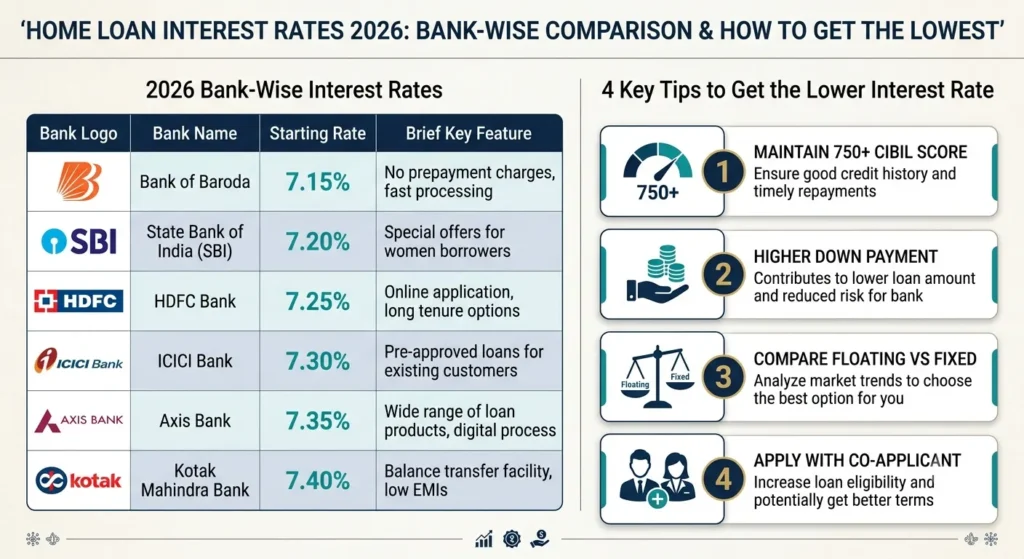
The table below shows the full range each lender quotes, not just the headline starting figure, since a rate advertised from 7.25 percent can run well into double digits for a weaker applicant.
| Lender | Starting Rate | Full Range |
|---|---|---|
| SBI | 7.50% | 7.50% – 8.70% |
| Bank of Baroda / PNB | 7.45% | 7.45% – 8.00% |
| Bajaj Housing Finance | 7.25% | 7.25% – 13.20% |
| HDFC Bank | 7.75% | 7.75% – 13.20% |
| ICICI Bank | 7.55% – 7.75% | 7.65% – 9.80% |
| Axis Bank | 8.15% | 8.15% and above |
These figures move often, so treat them as a snapshot rather than a locked-in number. Always confirm the current published rate directly with the lender before applying, since even a page updated this month can shift after the next policy review.
How a Floating Rate Is Actually Built: Repo Plus Spread
Every floating-rate home loan since October 2019 has been required to link to an external benchmark, almost always the RBI repo rate. Your actual interest rate is simply the repo rate plus a spread that the bank sets based on your credit profile, income, and loan amount.
This structure matters because the repo component is identical for every borrower at every bank. The spread is the only part that differs from one applicant to the next, and it is also the only part you have any real ability to influence. Once you understand this, the entire comparison shopping exercise changes shape: you are not really comparing banks, you are comparing spreads.(Source)
Why the Advertised Rate Is Rarely the Rate You Get
A bank advertising “starting from 7.25 percent” is quoting its best-case spread, reserved for applicants with a strong CIBIL score, stable income, and a comfortable loan-to-value ratio. Most borrowers land somewhere higher on the range, and that gap is exactly where the real comparison happens.
Do’s and don’ts when reading a rate table:
- Do treat the advertised starting rate as a floor, not a promise, and ask the lender directly where your specific profile lands on their range.
- Do request the rate in writing as part of a sanction letter, since verbal quotes during the sales process can shift once underwriting reviews your file.
- Don’t assume the lender with the lowest headline rate will actually offer you the lowest rate; a narrower-range lender with a slightly higher starting point sometimes ends up cheaper for a mid-range profile.
- Don’t skip comparing at least three lenders, since spreads for the same profile can genuinely differ between banks.
MCLR vs External Benchmark: Why Your EMI Did Not Move
This is one of the most common and least understood questions in the home loan cluster, and it deserves a direct answer. Your EMI may not have fallen despite the repo rate holding steady or being cut earlier. Usually, one of three things is happening.
First, your loan may still be linked to MCLR rather than the external benchmark. Loans taken before October 2019 are frequently still on this older system. MCLR adjusts at the bank’s own pace, not directly with the repo rate. Second, even loans on the external benchmark reset only periodically, typically once every three months. A rate change only reaches your EMI once your specific reset date arrives. Third, some banks respond to a rate cut by shortening your tenure instead of lowering your EMI. This is actually the default action at several lenders, unless you specifically request otherwise.(Source)
A fourth, rarer case is worth flagging too. Some older loans still sit on Base Rate, a system that predates even MCLR. These loans see almost no meaningful transmission of rate cuts at all, and a balance transfer or a direct request to switch benchmarks is usually the only realistic fix.
| Benchmark Type | Common For | Speed of Transmission |
|---|---|---|
| External Benchmark (EBLR/RLLR) | Loans taken after October 2019 | Resets at least every 3 months, tracks repo rate directly |
| MCLR | Loans taken before October 2019 | Adjusts gradually, at the bank’s own discretion |
| Base Rate | Older legacy loans (pre-2016) | Very slow, minimal transmission |
If you are unsure which benchmark your loan sits on, your loan statement or sanction letter will state it directly, and your bank’s customer service can confirm it in a single call.
Fixed vs Floating: Which Makes Sense Now
Floating rates are cheaper today, and this is what most borrowers choose. A fixed rate buys certainty at a premium over the floating option, which suits someone on a tight monthly budget who cannot comfortably absorb a rate increase later.
Several lenders now offer hybrid products that fix the rate for an initial period, often three to five years, before switching to floating. This can be a reasonable middle ground for a borrower who wants short-term predictability without permanently paying the fixed-rate premium over a 20-year tenure.
What Your CIBIL Score Is Worth in Rupees
Your credit score is the single biggest lever behind where you land on a lender’s rate range. A score above 750 typically earns close to the advertised starting rate. Scores in the 700 to 749 band usually attract a premium of roughly a quarter to half a percentage point above that.
Worked example: On a ₹50 lakh loan over a 20-year tenure, a 0.25 percentage-point difference in rate changes the EMI by roughly ₹780 to ₹800 a month. Over the full tenure, that gap compounds into several lakhs of rupees, purely from the difference between a 750-plus score and a mid-600s score. For a deeper look at how your score is calculated and what moves it, ASBL’s “https://asbl.in/blog/cibil-score-and-its-significance-in-home-loan-approval/” guide to CIBIL score and home loan approval</a> covers this in detail.

The Costs Beyond the Rate: Fees, Insurance and Prepayment Terms
A marginally lower interest rate is regularly outweighed by the fees stacked around it, so the rate alone is an incomplete comparison. Processing fees typically run around 0.5 percent of the loan amount, though several lenders waive or discount this during festive periods or for strong-profile applicants who simply ask.
Insurance is often bundled into the sanction and can meaningfully raise your effective borrowing cost if you do not review it separately. Prepayment and foreclosure terms also vary; most floating-rate loans carry no prepayment penalty by regulation, but it is still worth confirming this explicitly before signing, particularly on any fixed or hybrid product.
How to Negotiate a Lower Spread
The spread is genuinely negotiable, and most borrowers simply never ask. Banks rarely volunteer a review of your spread once your loan is sanctioned, so the initiative almost always has to come from you.
Three things most reliably move a lender on spread: a CIBIL score above 750, an existing banking relationship such as a salary account held with the same bank, and a written sanction letter from a competing lender showing a lower quoted rate. Many lenders also offer a small concession, typically around 0.05 to 0.10 percent, when a woman is the primary applicant or co-owner. This is modest on its own, but it often stacks with lower stamp duty rates offered to women buyers in several states.
Balance Transfer: The Arithmetic of Switching
A balance transfer is worth considering when your current rate sits meaningfully above what a new lender is offering, generally a gap of half a percentage point or more, and you still have a reasonable stretch of tenure remaining, ideally five years or longer.
Run the actual numbers before switching. Fresh processing fees, legal charges, and valuation costs on the new loan all eat into the saving, so the comparison needs to account for these upfront costs, not just the headline rate difference. Late in a loan’s tenure, most of the interest has already been paid off, since amortisation is front-loaded, so the potential saving from switching shrinks sharply the closer you get to the end of your term. ASBL’s guide on “https://asbl.in/blog/home-loan-emi-calculator-common-mistakes-first-time-buyers-make/“is a useful companion read when working through this arithmetic.
Do’s
- Compare the actual rate offered for your profile, not just the starting rate.
- Check your CIBIL score before applying, especially if you want the lender’s best rate band.
- Compare at least three lenders and obtain competing offers in writing.
- Ask which external benchmark your floating-rate loan is linked to.
- Compare processing fees, insurance and prepayment terms alongside the interest rate.
- Use a competing sanction letter to negotiate a lower spread.
- Calculate the total savings before opting for a balance transfer.
Don’ts
- Treat a bank’s advertised starting rate as a guaranteed offer.
- Compare lenders solely on their headline interest rate.
- Assume a repo-rate change will immediately reduce your EMI.
- Ignore whether your existing loan is linked to MCLR or an external benchmark.
- Overlook fees and insurance when comparing the overall borrowing cost.
- Switch lenders late in the tenure without accounting for the limited remaining interest savings.
Nine Ways to Bring Your Effective Rate Down
- be dragging it down unfairly.
- Apply through your salary account bank first, since an existing relationship often earns a better starting spread.
- Get sanction letters from at least two competing lenders and use the stronger one as leverage.
- Ask directly about a women’s concession if applicable, since it is rarely offered proactively.
- Negotiate the processing fee separately from the rate; the two are often more flexible together than either is alone.
- Choose a shorter tenure where your budget allows, since this reduces total interest paid even at the same rate.
- Confirm which benchmark your loan is linked to, and consider a transfer if you are still on MCLR or Base Rate.
- Review your spread periodically, not just at the time of taking the loan, since your credit profile likely improves over time.
- Compare total cost of borrowing, including fees and insurance, rather than the interest rate figure alone.
Key Takeaways
- The repo rate has held at 5.25 percent through four straight RBI meetings, keeping most floating home loan rates broadly stable through mid-2026.
- Public sector banks currently start cheapest, near 7.2 to 7.5 percent, while private banks and HFCs open a little higher with a wider overall range.
- A floating rate is simply the repo rate plus a spread; the repo part is fixed for everyone, so the spread is what you are really comparing and negotiating.
- If your EMI has not fallen after a rate cut, check whether you are on MCLR instead of the external benchmark, whether your reset date has arrived, or whether your bank shortened your tenure instead.
- A CIBIL score above 750 typically earns close to the advertised rate; a mid-600s score can cost several lakhs more over a 20-year tenure.
- A balance transfer only makes sense with a meaningful rate gap, enough remaining tenure, and the switching costs genuinely worked out in advance.