Builder Subvention Scheme Explained: How It Works, Benefits, and Risks
Quick Answer
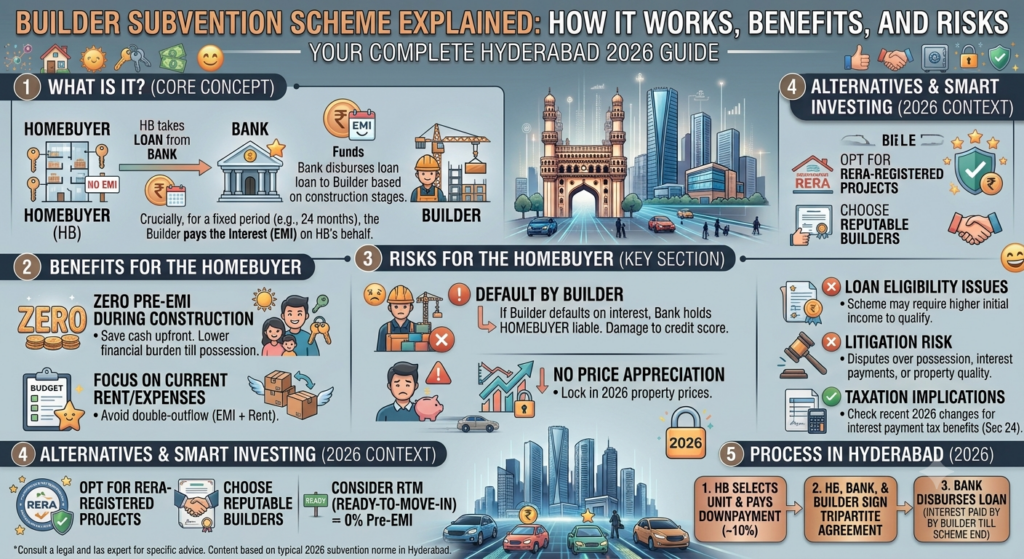
A builder subvention scheme lets you buy an under-construction property by paying a small upfront amount, while the builder pays the loan’s pre-EMI interest until possession or a specified period. It can ease your cash flow during construction, but the loan remains in your name, meaning you are still legally responsible if the builder defaults on those payments
“No EMI till possession” is one of the most persuasive lines in Indian real estate marketing, and also one of the most misunderstood. For a buyer weighing the cost of renting a home while also paying an EMI on a new one, an offer that removes that overlap sounds like an obvious win. The underlying arrangement, known as a subvention scheme, genuinely can ease that burden. It can also, if a project runs into trouble, leave the buyer holding a bank liability they never expected to carry alone. Both things are true, and a buyer evaluating this offer deserves to understand both before signing anything.
What Is a Builder Subvention Scheme?
A subvention scheme is a three-party financial arrangement between the homebuyer, the developer, and the bank or housing finance company funding the purchase. The buyer pays a relatively small percentage of the property’s value upfront, typically somewhere between 5% and 20%, while the bank sanctions and disburses the remaining loan amount to the developer as construction progresses. During an agreed period, usually until possession or a fixed number of months, the developer takes on the responsibility of paying the interest on that loan, commonly referred to as the pre-EMI, directly to the bank on the buyer’s behalf.
For the buyer, the practical effect is that no EMI outflow begins until possession, or until the subvention period specified in the agreement ends, whichever comes first. This is the appeal in a single sentence: a buyer can secure a property and let construction proceed without simultaneously paying rent on a current home and interest on a loan for one that isn’t ready yet.
Be Among the First to Own a Legacy
What is easy to overlook in the marketing pitch is the word “on the buyer’s behalf.” The loan itself is still sanctioned in the buyer’s name. The developer’s commitment to pay interest is a contractual promise between the developer and the bank, or sometimes between the developer and the buyer, but it does not change who the bank considers legally responsible for repayment. That single detail is the hinge on which most subvention scheme risk turns, and it’s worth keeping in mind through everything that follows.
How Subvention Payment Plans Work: 20:80, 10:90, and Other Common Models
Subvention schemes in India are usually named after their payment split, with the first number representing the percentage the buyer pays at booking and the second representing the percentage the bank disburses to the developer over the construction period.
20:80 is the most commonly advertised structure. The buyer pays 20% at booking, the bank funds the remaining 80% progressively as construction milestones are met, and the developer covers the interest on that 80% until possession or the agreed cutoff.
10:90 follows the same logic with a smaller upfront commitment from the buyer, useful for buyers with limited liquidity at booking but comfortable taking on a larger loan exposure sooner.
5:95 pushes this further still, with the buyer contributing only a token amount at booking. This variant is less common today, partly because regulators have grown more cautious about schemes that shift almost the entire financial exposure onto the bank and, by extension, the buyer, very early in a project’s life.
10:80:10 is a slightly different structure, where the buyer pays 10% at booking, 80% is disbursed progressively during construction as in the other models, and a final 10% becomes due at possession, layered on top of the usual EMI transition rather than the full balance shifting to EMI at once.
Regardless of the specific split, the underlying mechanics are consistent: a smaller upfront buyer contribution, a bank loan disbursed against the balance, and a developer commitment to service the interest for a defined window. The variation lies mainly in how much of the total cost the buyer commits early, and how that affects both affordability and exposure.(Source)
Worked Example: What You Actually Pay Under a 20:80 Subvention Plan
A buyer is buying an apartment costing ₹80,00,000 through a 20:80 subvention scheme, where the loan interest rate is 9% per annum and possession will happen 24 months from the date of booking.
At the time of booking, the buyer pays 20% of the property price upfront which comes to ₹16,00,000.
During the construction period, the bank disburses the remaining amount of ₹64,00,000 to the builder in stages based on the construction progress.
On this disbursed amount, interest accrues at the agreed rate. Assuming the full ₹64,00,000 is disbursed roughly midway through construction on average, the annual interest works out to approximately ₹5,76,000, or about ₹48,000 a month at 9% per annum. Under the subvention arrangement, the developer pays this interest directly to the bank. The buyer’s monthly outflow during this period: ₹0 in EMI or pre-EMI.
At possession: Once the buyer takes possession, or once the subvention period specified in the agreement lapses, whichever happens first, the buyer’s own EMI obligation begins. On borrowing ₹64,00,000 at an interest rate of 9% p.a. for a period of 20 years, the monthly EMI that has to be paid would be approximately ₹57,600.
Here lies the difference: In a regular construction-linked scheme without subvention, the buyer pays pre-EMI (interest component only on the amount of loan already disbursed) almost immediately after the first disbursement, resulting in real monthly outflow in the buyer’s account much before the possession of the property. On the contrary, in an arrangement with subvention, this entire 24-month gap has no EMI outflow for the borrower, as long as the developer’s promise is fulfilled and the project is completed on time.
The phrase “assuming everything goes as planned” is doing a lot of work in that sentence, and it leads directly to the real risk buyers need to weigh.
The Real Risk: What Happens If the Builder Misses an EMI Payment
This is the single most important thing to understand before signing a subvention agreement: the buyer remains the borrower of record with the bank throughout the subvention period, regardless of what the developer has contractually promised to pay.
If a developer runs into cash flow trouble, a construction delay, or outright financial distress, and stops paying the interest they committed to, the bank does not pursue the developer for that missed payment. The buyer is listed on the loan, meaning that the lender will interpret the late payment as the buyer defaulting instead of the builder. The consequences will be similar to the situation when the buyer seems to have missed making any other EMI – such as penalty interest amounts, collection calls, and negative credit reports with CIBIL, despite the fact that the buyer has neither been involved with making the payment or may not know about it at all until it shows on his/her credit report.
This scenario played out at scale in a number of high-profile stalled projects over the past decade, where thousands of buyers under subvention arrangements found themselves simultaneously fighting for possession and defending their credit history for payments they never made and, under the terms they signed up for, were never supposed to make.
It’s precisely this pattern of harm that led the Reserve Bank of India to discourage upfront bulk loan disbursement tied to subvention schemes as far back as 2013, and later prompted the National Housing Bank to restrict housing finance companies from funding such arrangements altogether. Bank-funded subvention in its original, most exposed form has effectively been phased out as a result.
What continues in the market today is largely builder-funded subvention, where the developer, not a separate financing arrangement, bears the interest cost directly, alongside tighter RERA-linked disbursement rules designed to reduce exactly this kind of exposure.
The practical takeaway is simple, if uncomfortable: a subvention scheme shifts a cost, not a liability. The developer may pay the interest bill, but the buyer never stops being the one the bank can legally hold accountable if that bill goes unpaid.
RERA Safeguards for Subvention Schemes: What Protects You
RERA does not prohibit subvention schemes, but it does impose several protections that meaningfully reduce, without eliminating, the risk described above.
Mandatory project registration. A developer can only offer a subvention scheme on a project that is registered with the relevant state RERA authority, which brings the project under RERA’s broader disclosure and accountability requirements.
Disclosure of payment terms. Developers are required to clearly lay out the payment structure, including the subvention period, the exact cutoff date or milestone at which the buyer’s own EMI liability begins, and any conditions attached to the developer’s interest commitment.
A ban on misleading advertising. RERA specifically prohibits developers from advertising a scheme as “no-cost EMI” or “zero EMI till possession” unless that claim is genuinely and fully accurate, including any hidden charges. A scheme where the buyer’s EMI liability actually begins after 24 months regardless of possession status, for instance, cannot honestly be marketed as running until possession.
Escrow account requirements. RERA mandates that 70% of the funds collected from buyers for a project be deposited into a dedicated escrow account, used only for that project’s construction and land costs. This is designed to prevent developers from diverting funds collected under one project, including subvention-linked disbursements, to shore up an unrelated, struggling project elsewhere in their portfolio.
Construction-linked disbursement. Rather than releasing large sums to a developer immediately upon booking, current norms tie bank disbursement to actual construction milestones, which limits how much exposure builds up before real progress on the ground can be verified.
These protections matter, but they are not a guarantee. RERA can penalise a developer for a missed commitment and give a buyer a formal complaint route, but it cannot retroactively undo a credit score hit that has already occurred, nor can it force a financially distressed developer to suddenly produce funds it doesn’t have. Before relying on your loan and payment structure, it’s worth understanding how a tripartite agreement actually allocates responsibility between buyer, builder, and bank, since this is the document that determines exactly what recourse you have if something goes wrong.
Do’s
- Verify the project’s RERA registration before booking.
- Get the subvention period and cutoff date in writing.
- Read the tripartite agreement, not just the brochure.
- Compare the total price with a regular payment plan.
- Check the builder’s delivery and financial track record.
- Understand your liability before signing.
Don’ts
- Don’t assume “No EMI” means no loan liability.
- Avoid relying solely on marketing claims.
- Don’t ignore the tripartite agreement’s terms.
- Avoid skipping comparing costs with non-subvention plans.
- Don’t overlook your credit score risk if the builder defaults.
Subvention Scheme vs Construction-Linked Payment Plan: Which Is Better?
| Factor | Subvention Scheme | Standard Construction-Linked Plan |
| Upfront payment | Low, typically 5-20% | Similar, but full pre-EMI starts sooner |
| EMI/pre-EMI during construction | None, paid by developer | Buyer pays pre-EMI on amount disbursed |
| Buyer’s credit exposure during construction | High, buyer is still the borrower of record | Same exposure, but buyer is actively managing payments and aware of status |
| Risk if developer defaults | Missed payments can hit buyer’s credit score without warning | Buyer controls their own payments, so no surprise defaults from a third party |
| Typical property pricing | Can be priced higher to absorb the developer’s interest cost | Often priced lower, since no interest subsidy is built in |
| Best suited for | Buyers confident in the developer’s financial strength and project timeline, who value cash flow relief during construction | Buyers who prefer full visibility and control over their own payment obligations |
Neither structure is inherently superior. A subvention scheme genuinely helps a buyer who would otherwise be stretched thin paying rent and pre-EMI simultaneously, provided the developer is financially sound and the project is realistically on schedule. A standard construction-linked plan trades that short-term relief for direct control and predictability, which matters more to buyers who would rather manage a known monthly cost than depend on a developer’s continued financial health for two or three years.
The one comparison buyers consistently skip, and shouldn’t, is the final price. Because a subvention scheme requires the developer to absorb real interest costs, that cost is rarely absorbed for free. It’s common for the same unit to carry a higher base price under a subvention scheme than under a standard payment plan, effectively passing the interest cost back to the buyer through the sale price rather than through a separate EMI.
A buyer should ask for both price quotes and compare the genuine total cost, not just the payment structure, before assuming subvention is the cheaper route. Understandingthe real cost of buying an apartment in Hyderabad in 2026 is a useful reference point for putting any subvention-linked price quote into proper context.
What to Check Before Signing a Subvention Agreement
A few checks, done before signing rather than after a problem surfaces, go a long way toward protecting a buyer under a subvention arrangement.
Verify RERA registration independently. You should not depend solely on the what the builders say. You must check the relevant project on the RERA site and verify its registration status.
Get the exact subvention cutoff in writing. Confirm whether the developer’s interest commitment runs until actual possession or until a fixed date or milestone, and understand what happens if the project is delayed past that cutoff. This single clause has caused more buyer disputes than almost any other feature of these schemes.
Read the tripartite agreement, not just the sales brochure. The document that actually governs your obligation to the bank is the loan and tripartite agreement, not the marketing material or even the builder-buyer agreement. Any promise not reflected there carries little legal weight.
Assess the developer’s financial track record. A subvention scheme is only as reliable as the developer’s ability to keep paying interest for the full period. Look at the developer’s history of on-time delivery and financial stability on other projects, not just this one.
Compare the final price against a non-subvention quote. As covered above, ask what the same unit costs under a standard payment plan and treat any price difference as the real cost of the subvention benefit.
Confirm your own understanding of the risk, not just the benefit. Go in accepting that you remain legally responsible for the loan throughout, and decide whether the cash flow relief is worth that exposure given your own risk tolerance and financial cushion.
A well-run subvention scheme with a financially sound developer and a properly documented agreement can be a genuinely useful tool. A vague one, from a developer without a strong delivery record, is the kind of decision that’s very hard to undo once trouble starts. Before committing to any project, it’s worth learning how to verify a project and stay safe under TS-RERA, since the same due diligence applies whether or not the payment plan involves subvention.
Key Takeaways
- No EMI doesn’t mean no loan liability.
- The buyer remains the borrower throughout.
- Builder defaults can impact your CIBIL score.
- Always verify RERA registration and agreement terms.
- Compare the final property cost, not just the payment plan.