New RERA Rules in Telangana: How They Impact Hyderabad Real Estate
Quick Answer
Telangana RERA has introduced several genuine changes since late 2025, including mandatory online registration of Agreements to Sell, stricter possession-delay interest rules, annual agent renewal with continuing education, and a QR-code verification system launched in January 2026. Enforcement has also intensified, with penalties worth nearly ₹10 crore imposed on 11 developers in mid-2026 alone. Agent certification and the pre-launch offer ban are now established practice rather than new developments.
Hyderabad’s property market has grown fast, and regulation has tried to keep pace. Telangana RERA, active since 2017, was designed to bring accountability to developers and protection to buyers. Several older stories about this authority keep resurfacing online, particularly the agent certification rule and the pre-launch offer ban. Those changes are real, but they date back to 2023 and earlier. This article instead focuses on what has actually changed recently, backed by dated sources, so buyers and investors can separate settled practice from genuine news.
What’s Actually New in Telangana RERA Right Now
Several updates have arrived within the past twelve months, and each one changes how buyers and developers interact with the system.
From October 2025, every Agreement to Sell for a RERA-registered project must be filed online through the TSRERA e-filing portal within 30 days of execution, according to Westside Realty’s regulatory tracker. Paper-only agreements no longer hold up in RERA disputes. This closes a gap that previously let some transactions sit outside formal record-keeping.
In December 2025, TSRERA made possession-delay penalties mandatory instead of discretionary. Developers who miss the RERA-declared possession date must now pay simple interest at SBI’s MCLR plus 2 percent per annum on amounts already collected from the buyer. Earlier, this compensation depended more heavily on case-by-case rulings.
From January 2026, project hoardings, brochures, and advertisements must display a QR code linking directly to that project’s TSRERA registration page. Buyers can scan the code on-site and instantly see registration status, approvals, and declared timelines. This single change has made spot verification far easier than searching the portal manually.
Be Among the First to Own a Legacy
Agent oversight tightened as well. Since September 2025, agents must renew their TSRERA registration every year and complete 10 hours of continuing education on RERA law. Agents operating without valid registration face a fine of ₹10,000 per day, a penalty structure confirmed across multiple industry trackers.
| Change | Effective From | What It Means |
|---|---|---|
| Mandatory online ATS registration | October 2025 | Paper-only agreements are not valid in RERA disputes |
| Mandatory possession-delay interest | December 2025 | Interest at SBI MCLR + 2% applies automatically on delay |
| QR-code project verification | January 2026 | Buyers can verify registration instantly on-site |
| Annual agent renewal and training | September 2025 | Agents need yearly renewal plus 10 hours of continuing education |
These four changes represent the genuinely new part of the Telangana RERA story in 2026, and each has a specific, verifiable start date.
Agent Certification and the Pre-Launch Offer Ban: Now Standard Practice
Two rules often described online as recent are, by 2026, well-established parts of how Telangana RERA functions. Agent certification, which requires passing a competency assessment before operating, was introduced years ago and has simply become routine. It is no longer a changing rule; it is baseline compliance.
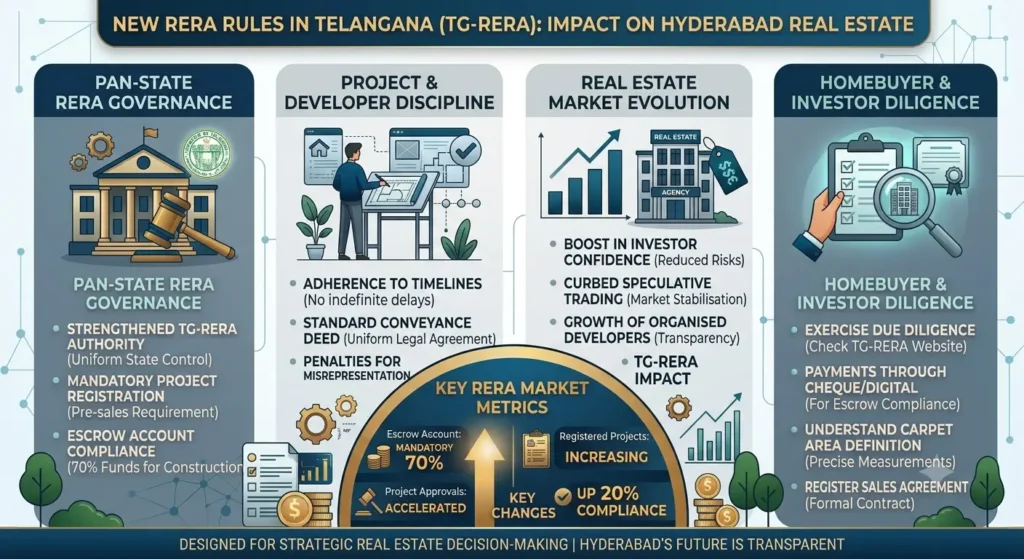
The same applies to the prohibition on pre-launch offers for unregistered projects. Telangana RERA does not allow developers or agents to market or accept bookings for a project before it receives registration. This rule has existed for some time, and its main relevance today lies in how actively it gets enforced, not in its novelty. Recent penalty cases discussed below show this ban is applied with real consequences, even though the rule itself is not new.
What These Rules Mean for Buyers and Investors
Buyers gain concrete, usable protection from these updates. The QR-code system removes the need to search the portal separately while standing at a sales office or site visit. A quick scan confirms whether a project is genuinely registered.
Mandatory possession-delay interest also changes buyer leverage. Previously, compensation for delay required a discretionary ruling. Now, the interest calculation applies automatically once a project misses its declared date, which gives buyers a clearer basis for compensation claims.
Investors evaluating pre-launch discounts should treat any unregistered project as carrying real regulatory risk rather than simple opportunity. Recent penalty cases confirm that discount pricing on unregistered projects has not disappeared, even though the practice remains prohibited. A 10 to 25 percent headline saving rarely compensates for the risk that a project never completes registration or delivery.

What Stricter Compliance Means for Developers
Developers now face tighter documentation requirements at every transaction stage. Online ATS filing within 30 days removes flexibility that some developers previously relied on for delayed paperwork. Compliance teams need workflows built around this deadline rather than periodic batch filing.
Mandatory delay interest also changes cost planning. Developers can no longer treat possession delays as a matter for negotiation on a case-by-case basis. Project financing and construction schedules should account for automatic interest liability if timelines slip.
The scale of 2026 penalties, including the roughly ₹10 crore joint action and several individual fines exceeding ₹1 crore, indicates that enforcement resources have expanded. Developers marketing projects before registration face a materially higher chance of detection and financial consequence than in earlier years.(Source)
How to Search and Verify a Project on the Telangana RERA Portal
The current, official Telangana RERA portal is rera.telangana.gov.in. Older references to a separate tsrera.telangana.gov.in domain should be treated as outdated; buyers should rely on the current official link only.
To verify a project, visit the portal and use the project search feature. Enter the project name, the RERA registration number, or the developer’s name. The result shows registration status, approved layout details, promised timelines, and any recorded compliance history. Since January 2026, the same information is also accessible by scanning the QR code displayed at the project site or in official marketing material, which is often faster during an actual site visit.
For a full step-by-step walkthrough of registration, document checks, and portal navigation, see ASBL’s TS-RERA Guide for Beginners. This article focuses on what has changed recently, while the beginner’s guide covers the ongoing process in full detail.
Do’s
- Verify the project’s RERA registration before making any payment.
- Scan the project’s QR code or verify its details on the official Telangana RERA portal.
- Ensure the Agreement to Sell is filed online within the prescribed timeline.
- Keep copies of all agreements, payment receipts, and communication with the developer.
- Review the developer’s compliance history before booking a property.
To Avoid
- Investing in projects that are not registered with Telangana RERA.
- Relying solely on brochures, advertisements, or verbal assurances.
- Assuming possession dates outside the registered RERA timeline are enforceable.
- Using outdated or unofficial RERA websites for project verification.
- Prioritising pre-launch discounts over regulatory compliance and due diligence.
Filing a Complaint: What the Process Actually Looks Like
Buyers with a grievance against a developer or agent can file a complaint directly through the Telangana RERA portal’s dedicated complaint section. The process requires the project’s registration details, a description of the issue, and supporting documents such as the agreement copy and payment receipts.
Once filed, the case moves to the authority’s bench for review, as seen in several 2026 penalty orders where three-member benches examined complaints and issued rulings with specific compliance deadlines. Complainants should keep records of every communication with the developer, since these often form the evidentiary basis for the final order. For guidance on what happens after a project is delivered, including handover disputes, ASBL’s article on RERA and society handover covers that stage separately.
Key Takeaways
- Telangana RERA introduced mandatory online Agreement to Sell registration, QR-code project verification, and automatic possession-delay interest to strengthen buyer protection.
- Annual registration renewal and continuing education have increased accountability for real estate agents.
- Recent enforcement actions and substantial penalties demonstrate stricter regulatory oversight of non-compliant developers.
- Buyers can instantly verify project registration by scanning the QR code or searching the official Telangana RERA portal.
- Verifying a project’s RERA status before booking remains one of the most important steps in reducing legal and financial risk.