GHMC Property Tax in Hyderabad: How to Pay, Calculate, and Avoid Penalties (2026 Guide)
Most people’s relationship with GHMC property tax goes something like this: they pay it without really understanding the bill, or they forget about it entirely until a penalty notice shows up. Neither is great. It’s genuinely one of the simpler obligations of owning a flat in Hyderabad — fifteen minutes online, twice a year — but it trips people up in a handful of predictable ways. You don’t know your PTIN. Your bill looks off, and you have no idea why. Or you just bought a brand-new apartment, and the thing doesn’t even exist in GHMC’s system yet.
This guide covers the whole picture: what the tax actually is; how GHMC arrives at the number on your bill; the exact steps to pay online; what happens if you’re late; and the trickier situations — new flats, wrong assessments, and properties that technically sit outside GHMC’s jurisdiction — that most guides gloss over.
1.What Is Property Tax and Who Pays It in Hyderabad?
Property tax is a tax local governments levy on owning real estate — your flat, in this case — and, in Hyderabad’s case, the Greater Hyderabad Municipal Corporation is the body that collects it, at least for properties that fall within its limits. The money goes toward the basics: roads, drainage, garbage collection, streetlights, and upkeep of public spaces.
If you own a flat anywhere within GHMC’s jurisdiction, you owe the tax. It doesn’t matter if you live in it, rent it out, or it’s sitting vacant — the liability is tied to ownership, full stop. And it’s yours, not your society’s and not your tenant’s, even if landlords often build the cost into rent agreements informally.
Be Among the First to Own a Legacy
It’s worth separating this clearly from your RWA maintenance charges, which are a completely different thing — a payment to your society for upkeep, not a statutory tax to the government. Skip your property tax and you’re dealing with the government, not a strongly worded notice from your residents’ WhatsApp group.
If you’re still in the process of buying and want the full picture of what property ownership in Hyderabad actually costs — not just this tax but everything that comes before it — ASBL’s breakdown of the real cost of buying an apartment in Hyderabad in 2026 is worth reading alongside this one.
2.How GHMC Calculates Property Tax: The ARV Method Explained
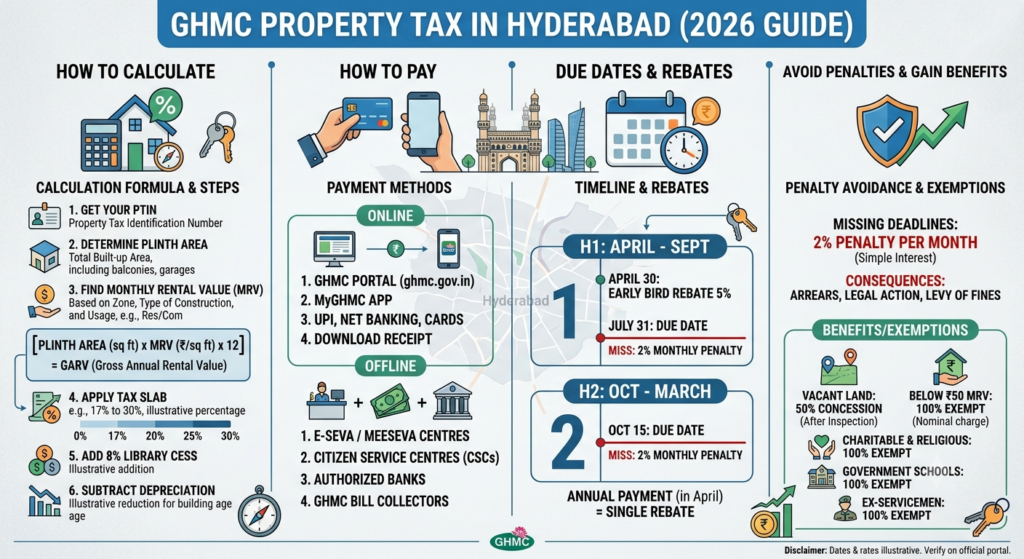
GHMC works off something called the Annual Rental Value method, or ARV. It sounds technical, but once you see how it’s built, you can roughly work out your own bill before it arrives — which is more than most owners ever bother to do.
Step 1: Locality rate
GHMC assigns a monthly rental value per square foot to each area, based on surveys it runs periodically. Central, more sought-after parts of the city carry higher rates than the outskirts. For a fairly typical residential flat in a mid-zone locality in 2026, that figure tends to land somewhere between ₹1.00 and ₹3.50 per sq ft per month.
Step 2: Annualise it
ARV = Plinth Area × Monthly Rate × 12
Say you’ve got a 1,200 sq ft flat and GHMC has put your locality’s rate at ₹2.00 per sq ft. That’s 1,200 × 2.00 × 12 = ₹28,800 as your ARV.
Step 3: Depreciation, if it applies
Buildings over 25 years old get a 10% knock off the ARV before tax is calculated. It doesn’t help most apartment owners reading this, since newer flats don’t qualify, but it’s worth knowing if you’re dealing with an older property.
Step 4: Apply the tax rate
GHMC taxes the ARV at somewhere between 17% and 30%, depending on which value band you fall into. Most residential flats in decent localities sit in the 17-25% range. On top of that comes water and drainage surcharges, calculated separately on the same ARV.
Going back to our example: 17% of ₹28,800 works out to ₹4,896 — that’s your base annual tax before surcharges get added.
So for most apartment owners in Hyderabad, we’re talking a few thousand rupees a year, not a number that should ever blow your budget. It scales up for bigger units or premium localities where GHMC’s assigned rate is higher, but it’s rarely the line item people expect it to be once they actually do the math.(Source)
If you want to sanity-check what GHMC has billed you, the two numbers worth verifying are your plinth area and the rate assigned to your locality – both should be sitting in your assessment order.
3.Step-by-Step: How to Pay GHMC Property Tax Online in 2026
GHMC’s online portal is by far the easiest way to pay this now — no queues, no bill collection counters, it works any time of day, and you get an instant receipt.
Here’s how it actually goes:
Go to ghmc.gov.in. Look for ‘Online Payments’ or ‘Property Tax’ on the homepage — GHMC tweaks its layout periodically so the exact spot might shift, but the option is always reasonably easy to find.
Punch in your PTIN. Your Property Tax Identification Number lives on your old receipt, your assessment order, or your demand notice. Enter it and the system pulls up your property’s record and what’s due.
Check the details before you pay. Owner name, address, area, property type — make sure all of it matches what it should be. If something’s off, that’s a separate problem to sort out (see the section on fixing assessment errors below) before you go ahead and pay against a wrong record.
Pick your instalment. First half, second half, or pay the whole year at once. Paying in full during the first window gets you the 5% rebate, which is worth taking if your cash flow allows it.
Pay and download the receipt. Net banking, debit or credit card, UPI — all work. Receipt generates immediately. Save it. You’ll want it for loan paperwork, resale, or just your own records.
If your property doesn’t show up at all when you search by PTIN, double-check you’ve entered it exactly as printed. If it genuinely isn’t there, it’s likely not assessed yet — which brings us to the next section.
4.Due Dates, Early Payment Rebate, and Late Payment Penalties
When it’s due
Two instalments, every year:
First half: by 31 July Second half: by 31 January
Same dates every year, no surprises. Worth putting a reminder on your calendar at the start of the financial year so it doesn’t sneak up on you.
The early rebate
Pay the full year’s tax upfront, before 31 July, and GHMC gives you a 5% rebate on the half-year amount. On an annual tax of ₹8,000, that’s ₹400 saved — not life-changing money, but it’s a guaranteed return for paying a couple of months early, which is more than you’ll get from most savings accounts. Take it if you can.
What happens if you’re late
Miss a due date and you’re looking at a 2% per month simple interest penalty on whatever’s outstanding. That adds up faster than people expect — a ₹4,000 instalment left unpaid for six months racks up ₹480 in penalty, and by a year it’s nearly ₹960, which is close to a quarter of the original instalment just in penalty.
Beyond the money, ignoring it long enough gets you escalating notices, visits from GHMC officials, and in the worst cases, attachment proceedings against the property. All entirely avoidable by just paying on time.
If money’s genuinely tight, talk to your local GHMC circle office before the due date passes, not after. Instalment arrangements can sometimes be worked out, and that’s a far better conversation to have than dealing with mounting penalties later.
5.What to Do if Your New Apartment Is Not Yet Assessed by GHMC
This one catches a lot of first-time buyers off guard, and most existing guides barely touch it.
New projects get their Occupancy Certificate, buyers take possession, everyone moves in — and yet individual flats don’t automatically land in GHMC’s tax system. Assessment isn’t instant. There’s a gap, sometimes a fairly long one, where your flat physically exists but GHMC’s records haven’t caught up.
That doesn’t mean you’re off the hook. It means you need to push the process yourself, through what GHMC calls self-assessment.
Here’s the actual process: head to the GHMC portal and find the self-assessment option under property tax services. You’ll need to submit your details — carpet or plinth area, floor, building name, residential usage, possession date — along with your sale deed, possession letter, and OC copy.
GHMC reviews it and, eventually, issues an assessment order and your PTIN. “Eventually” can mean a few weeks or a few months depending on how backed up your circle office is. Hold onto your possession documents until the PTIN actually comes through — they’re your proof you own the place and you’re actively trying to get assessed, not just sitting on an unregistered property.
Don’t assume GHMC will catch up to you on its own. An unassessed flat causes real headaches later — at resale, when you’re trying to get a loan top-up, anywhere an NOC from GHMC is needed.
6.How to Correct a Wrong Property Tax Assessment
Assessment mistakes happen more often than people assume. The usual suspects: plinth area on record is bigger than your actual unit, the flat’s been classified as commercial when it’s clearly residential, the wrong locality rate has been applied, or the owner name still shows whoever sold you the flat.
Any one of these inflates your bill, sometimes by quite a bit.
Fixing it
Start by pulling together your documents — sale deed (showing correct area and ownership), building plan approval, your OC, and if you’ve got it, RERA registration paperwork or your society’s occupancy records confirming the flat’s actual size.
Then take it to your GHMC circle office — Hyderabad’s split into several circles, and your assessment order tells you which one covers you. File a written application asking for the assessment to be revised, attach everything, and be specific about what’s wrong and what it should actually be.
A field inspector typically comes out to verify your claim against the physical property. If it checks out, GHMC issues a revised order, and any excess you’ve already paid gets adjusted against future bills or refunded outright.
It’s not a same-day fix, but it’s a fairly manageable process if your paperwork is in order. Don’t let an error sit for years before flagging it — the longer it goes, the more you’ve overpaid.
7.Property Tax for Apartments Outside GHMC Limits
Not everything in greater Hyderabad falls under GHMC. The metro region includes plenty of areas under HMDA’s planning umbrella but actually run by separate municipalities, townships, or gram panchayats — mostly on the outskirts and in newer growth corridors.
If your flat sits in a locality run by a municipality — places like Shamshabad or Patancheru — you pay that municipality directly, not GHMC, and the portal, the calculation, even the due dates can differ. The ARV approach is broadly used across Telangana’s urban local bodies, but each authority sets its own rates and schedules independently.
If it’s a Gram Panchayat area, typically further out, the tax tends to be lighter and the panchayat collects it directly, but the obligation is exactly the same — owning property means owing the tax, regardless of which authority collects it.
How do you know which one applies to you? Check your sale deed, check an old property tax receipt if you have one, or just ask the developer’s documentation team — they’ll know. Your RERA registration documents also typically show which local authority approved the project.
For properties in DTCP layouts, or areas recently absorbed into GHMC from a neighbouring municipality, there can be genuine short-term confusion about who to pay. If you’re in that grey zone, write to both authorities asking for clarity, and keep that correspondence — it’s good to have proof you asked rather than just guessed.
This ties into the bigger picture of how property changes hands in Telangana. If you went through stamp duty and registration in Hyderabad at the time of purchase, the authority that handled your registration is usually also your property tax jurisdiction. And if your purchase happened around the 2026 changes to Hyderabad’s registration process, it’s worth double-checking your jurisdiction hasn’t shifted as a result.
8.FAQs
1.How is GHMC property tax calculated for an apartment in Hyderabad?
GHMC uses the Annual Rental Value (ARV) method. The ARV is estimated based on the monthly rental value per sq ft for your locality and property type, multiplied by 12. Tax is then levied at 17–30% of the ARV depending on the value band, with additional surcharges for water and drainage. A 10% depreciation is allowed for buildings over 25 years old.
2.What is the due date for GHMC property tax payment?
GHMC property tax is payable in two half-yearly instalments. The first instalment is due by 31 July and the second by 31 January each year. Paying the full annual tax in the first instalment qualifies for a 5% rebate on the half-year amount payable, making early payment financially worthwhile.
3.What is the penalty for paying GHMC property tax late?
Late payment attracts a simple interest penalty of 2% per month on the outstanding amount from the due date. Sustained non-payment can result in notices and, in extreme cases, attachment of the property by GHMC. Paying on time or requesting an instalment arrangement is always the better option.
4.How do I pay GHMC property tax online?
Visit the GHMC website at ghmc.gov.in and navigate to ‘Property Tax’. Enter your PTIN to retrieve your tax dues. Pay using net banking, debit card, credit card, or UPI. A payment receipt is generated immediately and serves as official proof of payment.
5.My new apartment is not in the GHMC system yet. What do I do?
New apartments that have received OC and CC but are not yet assessed by GHMC need to be self-assessed and registered on the GHMC portal. File a self-assessment form with your apartment’s details including carpet area, floor, usage type, and possession date. GHMC will then issue a PTIN and assessment order. Retain your OC as proof of possession until you receive the PTIN.
6.How do I correct a wrong property tax assessment in Hyderabad?
Submit a written application for assessment revision at your GHMC circle office, supported by your sale deed, OC, and building plan approval showing the correct details. A GHMC inspector will verify the property. If the discrepancy is confirmed, a revised assessment order is issued and excess tax already paid is adjusted against future dues.
7.What if my property is in an area outside GHMC limits?
Properties in municipalities, gram panchayats, or DTCP areas outside GHMC’s jurisdiction pay property tax to the relevant local authority — not GHMC. The portal and due dates may differ. Check your sale deed or registration documents to confirm which authority has jurisdiction, and contact them directly for payment procedures.
8.Is there a rebate for paying GHMC property tax early?
Yes — 5% off when you pay the full year’s tax in one go before 31 July. It’s automatically applied on the portal at the time of payment; there’s no separate form or application involved. Just pay in full during the first instalment window and the system handles the rest.