Why is Registration of Flat Compulsory before Possession?
Quick Answer
Flat registration before possession is compulsory. Under RERA, the Agreement for Sale must be registered before a builder accepts more than 10% of the property’s price, while the Sale Deed, which legally transfers ownership, is usually registered at or after possession. Understanding the difference helps buyers protect their legal rights throughout the purchase process.
Your builder wants fifteen percent upfront and says registration can wait until handover. That sentence alone is why registration of flat before possession confuses so many Hyderabad buyers. RERA does not treat registration as a single event. Instead, two documents get registered at two different points in the purchase.
This guide aids in determining whether flat registration is mandatory, the function of each related documentation, and the operation of Telangana’s IGRS process.
The Short Answer: What Must Be Registered, and When
The direct answer is no, but only if you are thinking about the sale deed. Yes, if you are thinking about whether anything must be registered before you pay serious money.
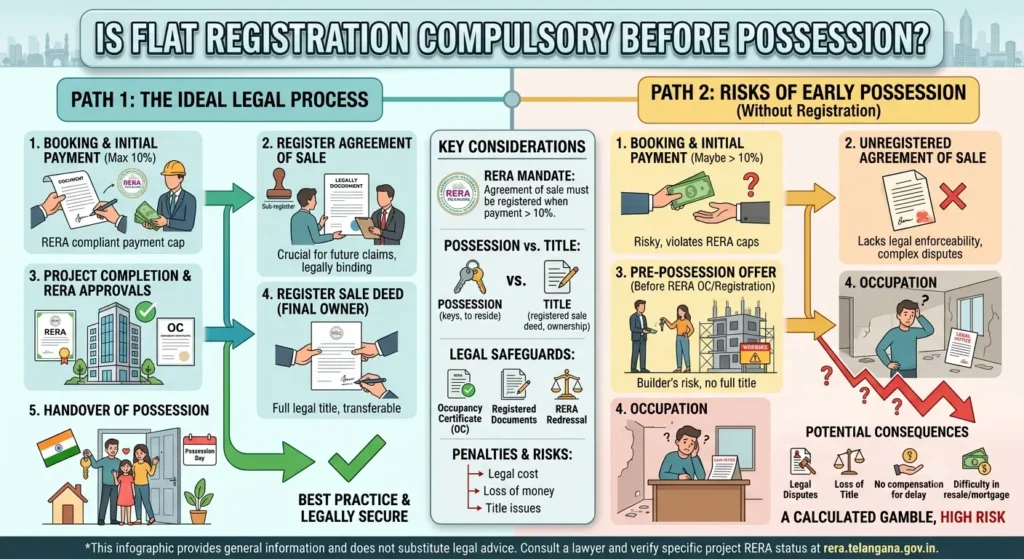
Under RERA, once a promoter collects more than ten percent of the apartment cost, a written agreement for sale must be registered. That step happens while the tower is still rising. The sale deed, which actually conveys title, is prepared when the unit is ready and possession is offered. So possession and sale deed registration usually arrive together. Early payment and early agreement registration arrive much sooner.
Be Among the First to Own a Legacy
Many online articles get this wrong. They claim a flat cannot be registered before possession. That statement mixes up the two documents. Under-construction agreements are registered every day in Hyderabad, and lenders often insist on them before releasing tranches.
Agreement for Sale vs. Sale Deed: Two Different Registrations
Buyers say “registration” once. The law sees two acts.
| Document | What it does | When it is registered |
|---|---|---|
| Agreement for sale | Locks price, carpet area, possession date, and delay penalties | After payment crosses 10%; before heavy instalments |
| Sale deed | Transfers ownership from builder to buyer | At or after possession, subject to OC and approvals |
Section 13 of the Real Estate (Regulation and Development) Act, 2016 was written for this split. A promoter is barred from keeping large advances without a registered agreement of sale registration RERA requires. Meanwhile, the flat itself may not physically exist in final form when that agreement is signed.
The sale deed is different. Until it is registered, your name does not appear as owner in sub-registrar records. You may be paying EMIs and visiting the site, but the legal title still sits with the builder. For how allotment letters fit into this chain, see the property allotment letter, agreement to sell, and sale deed guide (https://asbl.in/blog/property-allotment-letter-agreement-to-sell-sale-deed-importance-for-flat-buyers/).
Why Registration Protects You as a Buyer
A registered agreement is your contract on public record. If possession slips by years, that document is what TGRERA forums expect when refunds or compensation are claimed. Without it, you are arguing from emails and brochures.
The sale deed protects the back end of the journey. Once it is registered, ownership can be shown to a bank, a resale buyer, or a court through an encumbrance certificate. Loans are sanctioned against clear titles. Resale due diligence moves faster.
Therefore, registration is not symbolic. It is how rights are enforced. Still, a registered agreement in a non-RERA project gives weaker protection than one in a registered project. Before you sign, the project itself should be verified on TGRERA, and the TS-RERA guide for beginners (https://asbl.in/blog/ts-rera-guide-for-beginners-how-to-verify-projects-stay-safe/) explains what to check.
What Happens If You Take Possession Without Registering
Physical handover can occur while paperwork lags. That does not make the lag safe.
If you move in with no registered agreement and no sale deed, the builder remains legal owner in government records. Banks may withhold the final loan disbursement. A future buyer’s lawyer will see a title gap. In insolvency or litigation, you are better positioned with registered papers than with possession alone.(Source)
Yet sale deed registration after possession is standard. The danger is not timing the deed after handover. The danger is skipping the agreement before large payments, or living in the flat for years while the deed stays pending.
In Gachibowli, a family occupied a 3 BHK while the sale deed sat unsigned. Two years later, project accounts were entangled in litigation. They held keys but not registered title. Resale interest dried up until the deed was completed, and stamp duty was scrutinised because of the delay.
Step-by-Step: Registering a Flat in Telangana
Telangana uses a hybrid process. Preparation happens online. Execution happens in person.
First, confirm TGRERA registration and approved plans for the phase you are buying. Next, review the agreement for sale before any payment above ten percent. Stamp duty and fees are calculated and paid through IGRS Telangana (registration.telangana.gov.in). A slot is then booked at the sub-registrar office with jurisdiction over the property.
On appointment day, the buyer, authorised builder signatory, and two witnesses present originals. Biometrics are captured. The document is registered and numbered. A certified copy is collected after processing.
At possession, the same flow repeats for the sale deed. Because each stage has different duty calculations, do not assume one payment covers both. Also review the builder’s RERA track record in Hyderabad (https://asbl.in/blog/how-to-verify-a-builders-rera-track-record-in-hyderabad/) before money leaves your account, not after registration day.

Documents Required for Flat Registration
Documents required for flat registration differ slightly by stage, though overlap exists.
For the agreement for sale, the sub-registrar typically expects the TGRERA certificate, allotment letter, buyer KYC, stamp payment proof, the draft agreement, and witnesses with ID. For the sale deed, a registered agreement, payment receipts, occupancy certificate, lender NOC if a loan is active, encumbrance certificate, and executed sale deed draft are added to the file.
Photographs of the property may be required in certain cases. GPA papers are accepted only when signing authority is genuinely delegated; those documents should be checked carefully.
When a home loan is involved, disbursement is usually tied to these registrations. The first home loan guide (https://asbl.in/blog/the-essential-guide-to-your-first-home-loan/) maps how banks align tranches with agreement and deed milestones.

Do’s
- Register the Agreement for Sale before paying over 10%.
- Verify the project’s TGRERA registration first.
- Keep all registration and payment documents safely.
- Check stamp duty and fees on IGRS before payment.
- Ensure all documents are complete before visiting the SRO.
Don’ts
- Paying large advances without a registered agreement
- Relying only on brochures or verbal promises.
- Delaying the Sale Deed after possession.
- Assuming possession alone proves ownership.
- Ignoring missing approvals or occupancy documents.
Registration Charges and Timelines in Telangana
Flat registration charges Telangana buyers pay on the sale deed combine stamp duty, transfer duty, and registration fee. Together they commonly reach six to seven and a half percent of market value, depending on whether the property is treated as urban or rural. Rates are revised from time to time, so the IGRS portal should be checked on the day of payment.
On a seventy-five lakh rupee urban flat, stamp duty near four percent lands around three lakh rupees. Transfer duty near one and a half percent adds roughly one lakh twelve thousand. Registration fee follows the current slab. Total government cost often falls in the four and a half to five and a half lakh range before advocate charges.
Timelines are usually predictable when files are complete.
| Stage | Practical timeline |
|---|---|
| IGRS slot booking | Same day to one week |
| SRO appointment | One working day |
| Registered copy | Two to five working days after visit |
Delays carry consequences. If a builder accepts more than ten percent without a registered agreement, RERA is breached. If a buyer delays the sale deed after possession, title stays with the builder on paper. Insufficient stamp duty can get registration refused or penal duty demanded under the Registration Act. A long gap between possession and deed also exposes you if the builder’s finances change.
Booking and duty payment are handled online. Biometric registration is completed offline at the SRO. Plan a full working day for that visit.
Key Takeaways
- According to theRERA provision number13, pre-registration is linked to the sale agreement, but not the sale deed itself.
- The sale deed is normally registered at or after possession when ownership transfers.
- Possession without any registered paper leaves the builder as legal owner on record.
- Telangana charges on the sale deed typically total around 6% to 7.5% of market value.
- IGRS handles booking and duty payment online; biometrics are completed at the sub-registrar office.