What Is Stamp Duty on Property? A Simple Guide for Savvy Indian Homebuyers
The flat is priced at ₹80 lakh. Your bank approves the loan. Then the registration office quotes another ₹4.8 lakh in government charges you never budgeted for. That gap is usually stamp duty on property India buyers discover too late.
Stamp duty is not a negotiable add-on. It is the tax that makes your sale deed legally valid. This guide explains what it is, who pays it, which rate applies to your document type, and how to calculate the real total before you sign.
What Is Stamp Duty, and Why It Exists
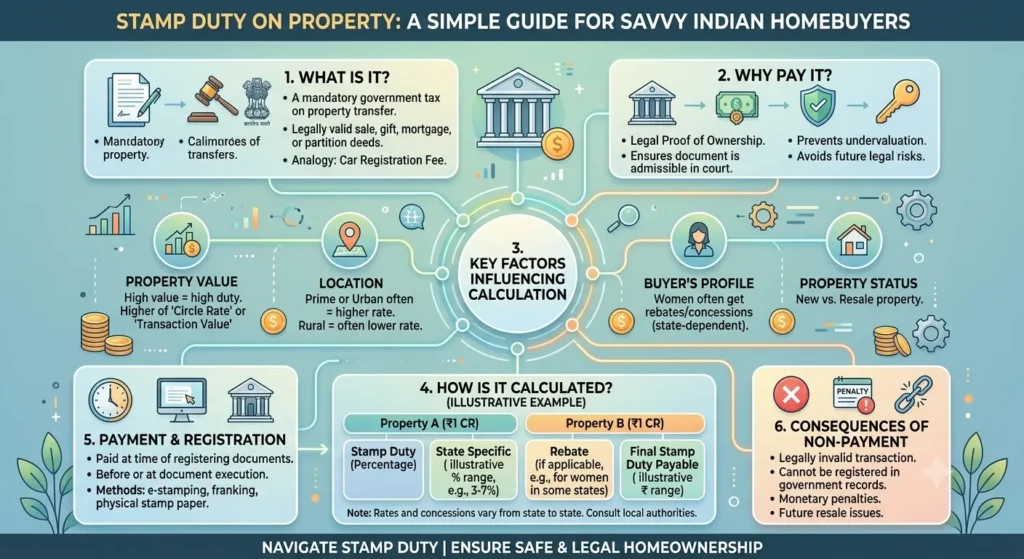
Stamp duty is a government tax levied on instruments that transfer property rights:sale deeds, gift deeds, lease deeds, and certain agreements. Pay the correct duty, register the document at the sub-registrar office, and the transfer enters public record. Skip or underpay it, and the paper may not be admissible as proof of ownership in court or before a bank.
India’s states set their own rates. Telangana publishes schedules on the IGRS Telangana portal (registration.telangana.gov.in). Hyderabad buyers therefore work with Telangana percentages, not a single national slab.
Stamp duty exists for two practical reasons. First, it formalises transfers so ownership disputes can be traced through registered records. Second, it generates revenue for the state. For you, the relevant point is simpler: no valid stamp, no clean title chain.
Be Among the First to Own a Legacy
The legal backbone is the Indian Stamps Act and state amendments, enforced alongside the Registration Act. For how registration turns a stamped document into a protected title, see the Indian Stamps and Registration Act guide (https://asbl.in/blog/how-the-indian-stamps-and-registration-act-protects-your-real-estate-investment/).
Who Actually Pays: Buyer, Seller, or Both
In practice, the buyer almost always pays stamp duty, transfer duty, and registration fees in Telangana residential sales. Sellers may bear society transfer charges or capital gains tax, but government registration costs sit on the buyer’s side of the ledger.
That default can be negotiated. Some resale deeds state that the seller will gross up the price or share a portion of duty. Whatever you agree, put it in the sale agreement before token money moves. Verbal splits create disputes at the sub-registrar counter when only one party arrives with a challan.
If you are buying from a developer, the sale deed is typically executed in the buyer’s name with the buyer funding duty. The builder’s role is to provide title documents and witnesses, not to silently absorb six percent of market value unless the contract says so.
Stamp Duty, Transfer Duty, and Registration Charges in Hyderabad: The Standard Rate
Most Hyderabad flat buyers registering a straightforward sale deed in a GHMC or municipal area fall under one reconciled structure. Do not mix this with GPA-linked or village rates until you confirm your document type.
| Component | Rate (urban corporation / municipality) | What it covers |
|---|---|---|
| Stamp duty | 4% | State tax on the instrument |
| Transfer duty | 1.5% | Additional duty on immovable property transfer |
| Registration fee | 0.5% | Sub-registrar registration charge |
| Combined total | 6% | Applied to chargeable value |
Which rate is mine?
If you are purchasing a ready or resale apartment and executing a sale deed that transfers ownership in one step, this 6% combined rate is your budgeting baseline. That covers the majority of ASBL readers comparing stamp duty registration charges Hyderabad line items on a typical flat.
Duty is calculated on market value or stated consideration, whichever is higher. IGRS publishes guideline values by locality and construction type. Agreeing a lower sale price in the deed does not reduce duty if the government market value exceeds it. For recent revisions to those guideline values and what changed in 2026, see the Telangana property registration updates guide (https://asbl.in/blog/understanding-property-registration-bihar-key-changes-in-telangana-2026/),that article owns regulatory changes; this one owns the conceptual rate map.
Payment flows through e-stamp challans on the IGRS portal before your sub-registrar appointment. Keep challan receipts with your sale deed file.
Why Some Documents Cost More: Agreement of Sale, GPA, and Possession Status
Not every property transaction uses a sale deed on day one. Under-construction purchases, informal transfers, and legacy layouts sometimes involve agreement of sale, possession letters, or General Power of Attorney (GPA) combinations. Each carries its own stamp schedule on IGRS Telangana’s ready reckoner.
| Document type | Typical stamp duty | Transfer duty | Registration | Notes |
|---|---|---|---|---|
| Sale deed(urban) | 4% | 1.5% | 0.5% | Standard flat purchase at registration |
| Agreement of sale without possession | 0.5% (not adjustable) | — | 0.5% (capped) | Early RERA agreement stage |
| Agreement of sale with possession | 5.5% (adjustable) | — | 0.5% (capped) | Higher because possession shifts |
| Agreement of sale cum GPA | 6.5%(portion adjustable) | — | 0.5% (min/max slab) | Sale deed vs GPA stamp duty difference |
Why GPA-linked agreements cost more
A plain sale deed transfers title immediately through registration. An agreement of sale cum GPA bundles the promise to sell with broad authority to deal with the property. Telangana treats that as a near-conveyance because possession and control often move together. Hence stamp duty on agreement of sale Telangana with GPA sits at 6.5% stamp duty,not the 4% sale deed rate,before registration.
RERA agreement path
When a builder collects more than ten percent, a registered agreement for sale is mandatory. That stage usually attracts the lower 0.5% agreement rate without possession, not the full sale deed stack. The sale deed—and the 6% urban total—typically arrives at possession when title transfers. The allotment letter, agreement to sell, and sale deed guide (https://asbl.in/blog/property-allotment-letter-agreement-to-sell-sale-deed-importance-for-flat-buyers/) maps how those documents sequence in a Hyderabad flat purchase.
If a broker proposes “GPA only, save stamp duty,” treat that as a red flag. You may save upfront tax and lose bankability, resale liquidity, and legal clarity.

Gram Panchayat vs. Corporation and Municipality Rates
Location classification changes the math. Properties under Gram Panchayat jurisdiction use a different row on the ready reckoner than GHMC or municipal parcels.
| Location class | Stamp duty | Transfer duty | Registration | Combined |
|---|---|---|---|---|
| Corporation / municipality (urban) | 4% | 1.5% | 0.5% | 6% |
| Gram Panchayat (rural) | 5.5% | — | 2% | 7.5% |
A villa plot marketed as “Hyderabad outskirts” may sit in a panchayat belt where the 7.5% total applies on sale deed registration. Always confirm whether the survey number falls under GHMC, a municipality, HMDA, or gram panchayat before you quote stamp duty calculator Hyderabad results from an urban-only template.
Gift transfers between close relatives sometimes attract concessional rates under specific state notifications. Those are edge cases with documentary proof requirements, not the default for an arm’s-length flat purchase.(Source)
A Worked Example: What You’ll Actually Pay on a Typical Flat
Theory ends here. Numbers begin.
First Scenario:
Ready 2 BHK apartment in a GHMC municipality area. Government market value and agreed price both align at ₹80 lakh.
Document: standard sale deed.
| Charge | Rate | Amount |
|---|---|---|
| Stamp duty | 4% of ₹80,00,000 | ₹3,20,000 |
| Transfer duty | 1.5% of ₹80,00,000 | ₹1,20,000 |
| Registration fee | 0.5% of ₹80,00,000 | ₹40,000 |
| Total government charges | 6% | ₹4,80,000 |
Budget ₹4.8 lakh on top of the ₹80 lakh price,or negotiate who bears it in the agreement. Add advocate fees, document scanning, and society transfer charges separately.
Second scenario — ₹1 crore urban sale deed
| Charge | Amount |
|---|---|
| Stamp duty (4%) | ₹4,00,000 |
| Transfer duty (1.5%) | ₹1,50,000 |
| Registration (0.5%) | ₹50,000 |
| Total | ₹6,00,000 |
Third scenario — same ₹80 lakh in Gram Panchayat
| Charge | Amount |
|---|---|
| Stamp duty (5.5%) | ₹4,40,000 |
| Registration (2%) | ₹1,60,000 |
| Total | ₹6,00,000(7.5%) |
Use the IGRS market value search for your exact survey before relying on these rounded examples. A post-2025 guideline revision in your micro-market can push chargeable value above your agreed price.
Under-construction buyers pay the lower agreement rate earlier and the sale deed stack later. Model both stages in your cash-flow plan, not just possession day.
What Happens If You Delay or Underpay
Underpaid stamp duty triggers penalties and can block registration at the sub-registrar office. An improperly stamped or unregistered document may not be accepted as evidence of ownership,creating problems when you sell, mortgage, or defend title.
Common failure modes:
·Paying urban 6% on a deed that should have used GPA or panchayat rates — short payment detected at SRO.
·Using agreement rates on a transaction that functionally transfers possession — reassessment with differential duty plus penalty.
·Delaying sale deed registration after possession while the builder remains legal owner on record—separate from stamp duty but compounds risk.
Telangana enforcement relies on document examination at registration time. Fix duty before the appointment, not after a rejection. Once registered at the wrong value, correction involves additional challans and time.
Stamp duty is also separate from GST on under-construction units and from post-registration costs like mutation. Budget the full stack. When you reach physical inspection before paying, the construction quality guide for luxury apartments in Hyderabad (https://asbl.in/blog/avoid-construction-quality-issues-luxury-apartment-hyderabad/) pairs technical checks with your financial close.
Key Takeaways
- Stamp duty is a state tax on property documents; without it, registration—and legal title—does not hold.
- In most deals, the buyer pays stamp duty; the split can be negotiated but must be written in the agreement.
- A standard Hyderabad flat sale deed in a corporation or municipality area totals 6% to 4% stamp duty, 1.5% transfer duty, 0.5% registration.
- Agreement of sale with GPA and Gram Panchayat sales follow different schedules; do not use the 6% figure blindly.
- Duty is calculated on whichever is higher: your sale price or the government market value.