IGBC, GRIHA, LEED: What They Mean for Your Home
Quick Answer
When a site visit mentions “IGBC Gold” or “pre-certified Platinum,” a buyer needs to know whether that label describes a verified, finished home or only a design on paper. A home buyer who learns the difference between registered, pre-certified, and finally certified, and then asks for the final certificate with its date and public listing, can avoid paying a green premium for a promise that may never be fully delivered.
When a hoarding outside a residential project says “IGBC Gold,” does that mean the finished home has passed a green inspection, or simply that the developer hopes it will?
Most buyers assume the first. In reality, the answer depends on a detail that brochures rarely explain. Green building ratings move through different stages, and a project can display a rating level long before anyone has checked what the builder actually built.
This question carries real weight for buyers in their 30s to 50s. A green home promises lower water use, better indoor air, and more efficient energy systems, all of which matter to a family that plans to live in the home for many years. Naturally, buyers want to know whether those benefits exist on site or only in a design file.
This guide explains what IGBC, GRIHA, and LEED actually measure, how the three stages of certification differ, how to read the level on a brochure, and which questions to ask before treating a home as green.
Live Where You Work | Spacious 3 BHKs in the Heart of the Financial District| Ready to move-in | From ₹1.99 Cr .
What IGBC, GRIHA and LEED Actually Cover
Each green building rating system scores a project against its own set of criteria. All three are voluntary, which means a developer chooses to apply for them. Importantly, none of them works as an occupancy certificate, which remains a separate legal permission to live in the building. The guide on occupancy certificate explains it document in detail.(Source)
IGBC Green Homes
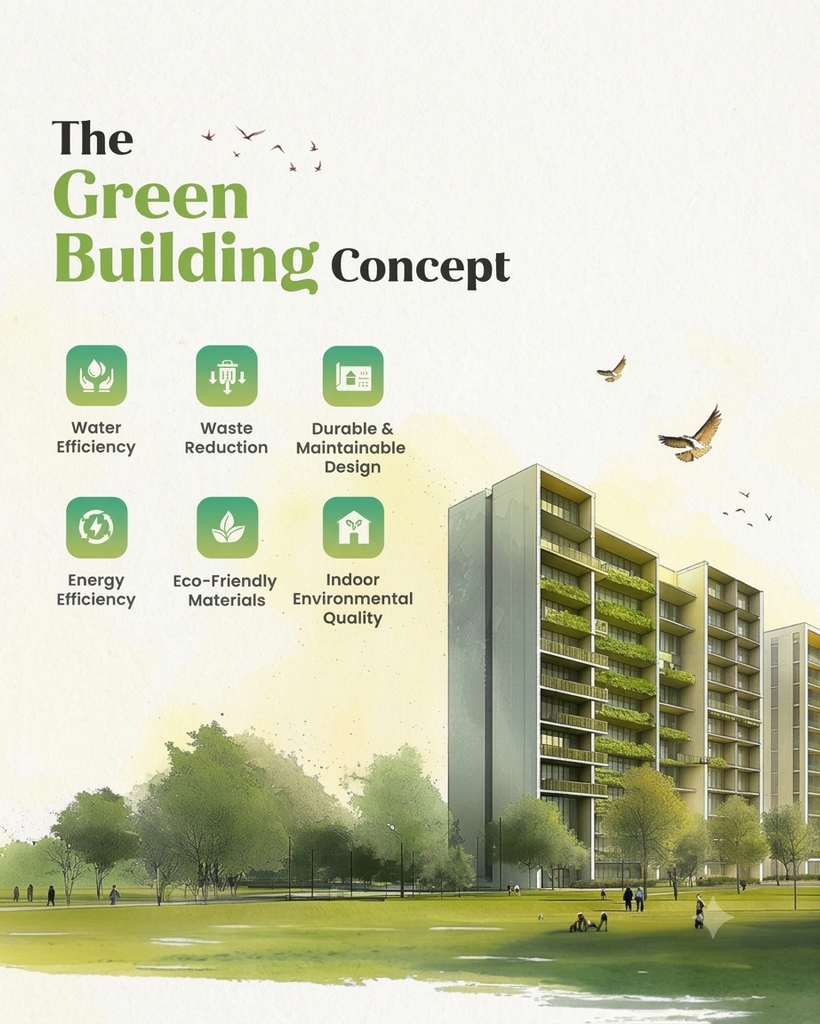
IGBC runs several rating programmes, and for residential projects, the relevant one is IGBC Green Homes rather than its programmes for commercial buildings or factories. IGBC built this programme for Indian homes, and according to its official page, it scores projects across six categories:
| IGBC Green Homes category | What it looks at |
|---|---|
| Site Selection and Planning | How the project uses and connects to its site |
| Water Conservation | How the project reduces and manages water use |
| Energy Efficiency | How the building limits energy demand |
| Materials and Resources | The choice and handling of building materials |
| Indoor Environmental Quality | Air, light, and comfort inside the homes |
| Innovation and Design Process | Additional measures beyond the standard credits |
IGBC describes the programme as able to deliver energy savings of 20% to 30% and water savings of 30% to 50%. These figures represent IGBC’s programme claim, so actual savings in any individual home depend on its design and on how residents use it.
GRIHA
GRIHA is India’s national green building rating, developed with roots in TERI and the Ministry of New and Renewable Energy. It assesses a project across design, construction, and operation, and it awards a star rating. Its process generally runs from registration, through workshops and site visits, to a final evaluation and award.
The right GRIHA product depends on the size of the project:
| GRIHA product | Typical residential fit |
|---|---|
| GRIHA | Projects generally above 5,000 sq m, with at least 80% residential use |
| SVAGRIHA | Smaller projects between 100 and 5,000 sq m |
LEED
LEED comes from the US Green Building Council (USGBC), and GBCI handles its certification review. For residential projects, LEED certification follows a clear path. First, the project registers its intent. Next, a LEED Green Rater verifies the measures on site. Finally, GBCI reviews the project and awards certification.
In a multifamily building, LEED certifies the whole building at one level, so every flat in that building shares the same rating. A single flat cannot earn certification on its own.
Features such as rooftop solar panels can help a project earn credits in these systems. However, a solar installation on its own does not equal a green rating. ASBL’s guide to solar panels for apartments covers solar separately, while the article on green building trends in Hyderabad explores other green features.
Registered, Pre-Certified, Finally Certified
This section matters most for any buyer. A project can sit at one of three stages, and each stage tells the buyer something very different.
| Stage | What it means | What the buyer should know |
|---|---|---|
| Registered | The project has joined the rating programme | No rating level exists yet. IGBC states that registered projects without a rating level must not use IGBC logos or rating levels in marketing |
| Pre-certified | The design has received a score based on documented features the developer plans to include | IGBC states that the pre-certified level need not match the final rating, and that IGBC is not responsible for promises developers make to buyers |
| Finally certified | The council has verified the implemented measures on site | IGBC issues a plaque and letter. The certification stays valid for three years, after which the project recertifies |
According to IGBC, a pre-certification also remains valid for three years, and the developer must file status updates every six months during that period. IGBC may also visit the site.
The other two systems follow a similar logic, with some differences:
| System | Design-stage step | Final step |
|---|---|---|
| IGBC Green Homes | Pre-certification | Final certification after site verification |
| GRIHA | Pre-certification at design stage | Final evaluation after construction |
| LEED (residential) | Registration shows intent only; optional precertification exists only for LEED v4.1 Multifamily and Multifamily Core and Shell | Certification after Green Rater verification and GBCI review |
In other words, “pre-certified” describes a design letter, while “finally certified” describes a site check. Similarly, a LEED registration only signals intent. Since optional LEED pre-certification applies only to specific multifamily products, a buyer should not assume that every “LEED pre-certified” claim follows the same path.
For a buyer, the most useful habit is simple: ask which of the three stages the project has actually reached.
How to Read the Level on the Brochure
Each system uses its own scale, so the same word or number can mean different things across them. The tables below keep each system separate, as the councils themselves do.
IGBC Green Homes: Multi-dwelling levels (from IGBC’s official page)
| Points | Level | Recognition |
|---|---|---|
| 50–59 | Certified | Best Practices |
| 60–69 | Silver | Outstanding Performance |
| 70–79 | Gold | National Excellence |
| 80–100 | Platinum | Global Leadership |
At every IGBC level, a project must also meet the mandatory requirements, regardless of its total points. These bands apply to multi-dwelling projects, so individual homes may follow different terms.
GRIHA: Star ratings (from GRIHA’s official page)
| Score | Rating |
|---|---|
| 25–40 | 1 star |
| 41–55 | 2 stars |
| 56–70 | 3 stars |
| 71–85 | 4 stars |
| 86 and above | 5 stars |
LEED: Certification levels (from USGBC)
| Points | Level |
|---|---|
| 40–49 | Certified |
| 50–59 | Silver |
| 60–79 | Gold |
| 80 and above | Platinum |
A simple illustration: Imagine a project that earns 55 points. Under IGBC’s multi-dwelling table, 55 points falls in the Certified band. Under LEED’s scale, however, the same 55 points would sit in the Silver band. A GRIHA score of 55, meanwhile, would mean 2 stars. For this reason, a buyer cannot compare an “IGBC Gold” with a “LEED Gold” or a “GRIHA 4-star” as if they meant the same thing.
What to Ask Before You Treat the Home as Green
A green label becomes useful only when the buyer can verify it. Before booking, a buyer can work through six questions:
- Which system and which product? IGBC Green Homes or another IGBC programme? GRIHA or SVAGRIHA? LEED for residential or for commercial buildings?
- Which stage? Is the project registered, pre-certified, or finally certified?
- Can the developer share the certificate PDF? It should show the date, the level, and a project name that matches the TGRERA registration.
- Does the project appear on the council’s public list? IGBC, GRIHA, and USGBC each publish details of rated projects.
- If only pre-certified, when is the final rating due? And has the developer filed the six-monthly updates?
- Does a separate occupancy certificate exist? A green rating never replaces it.
The third question deserves extra care. A certificate that names a different project, phase, or tower from the one the buyer is booking does not apply to that home. ASBL’s TS-RERA guide for beginners explains how to match a project name with its registration.
Construction methods also differ from green ratings. For example, a building can use Mivan construction, which is a form-work technique, with or without any green rating at all.
Once these questions check out, buyers with further questions can reach out to ASBL.
Do’s
- Ask which stage the project has reached
- Request the certificate PDF with its date and level
- Check the council’s public project list
- Compare levels only within the same system
- Match the certificate’s project name with TGRERA
- Keep the occupancy certificate in the same file
Don’ts
- Assume a level on a hoarding means final certification
- Accept a verbal claim or a logo on a brochure
- Rely on a third-party website alone
- Treat IGBC Gold, LEED Gold, and GRIHA stars as equal
- Accept a certificate for a different phase or tower
- Treat a green rating as permission to occupy
Key Takeaways
- IGBC, GRIHA, and LEED are voluntary green building rating systems, not occupancy certificates.
- IGBC Green Homes scores projects across six categories, from site planning to innovation.
- Registered means the project has joined a programme, pre-certified covers the design, and finally certified covers verified construction.
- IGBC states that pre-certified levels need not match final ratings and that it is not responsible for developer promises.
- Each system uses its own scale, so the same number of points can mean different levels.
- A buyer can ask for the final certificate, check its date and level, and confirm the public listing.